An Interview With Angel of My So-Called Secret Identity

Did you know that comic books can have internships? I can imagine that many of us can only dream of having a job that revolves around helping others create comics. Today we at GEEKPR0N have with us Angel, an intern for Will Brooker’s My So-Called Secret identity series, contributor, cosplayer, and geek to ask more about the comic, her role in its process, and just what it entails to be a comics intern. 

GEEKPR0N: So Angel, can you tell us more about your background and interests? 

Angel: I’ll start with the obvious: I am a comic book junkie.

That’s probably my mum’s fault; she brought me up on a slightly unconventional diet of Star Wars, superheroes, and Scalextric cars (while also imbuing me with an appreciation for fluffy toys and musicals), all still interests.

At the moment I’m studying International Relations at university, with the hope that I will eventually work for an international NGO. The plan (a very loose plan) is to emulate the superheroes about whom I read, and help to eradicate injustice throughout the world. Baby steps though…

GP: How did you become an intern for MSCSI?

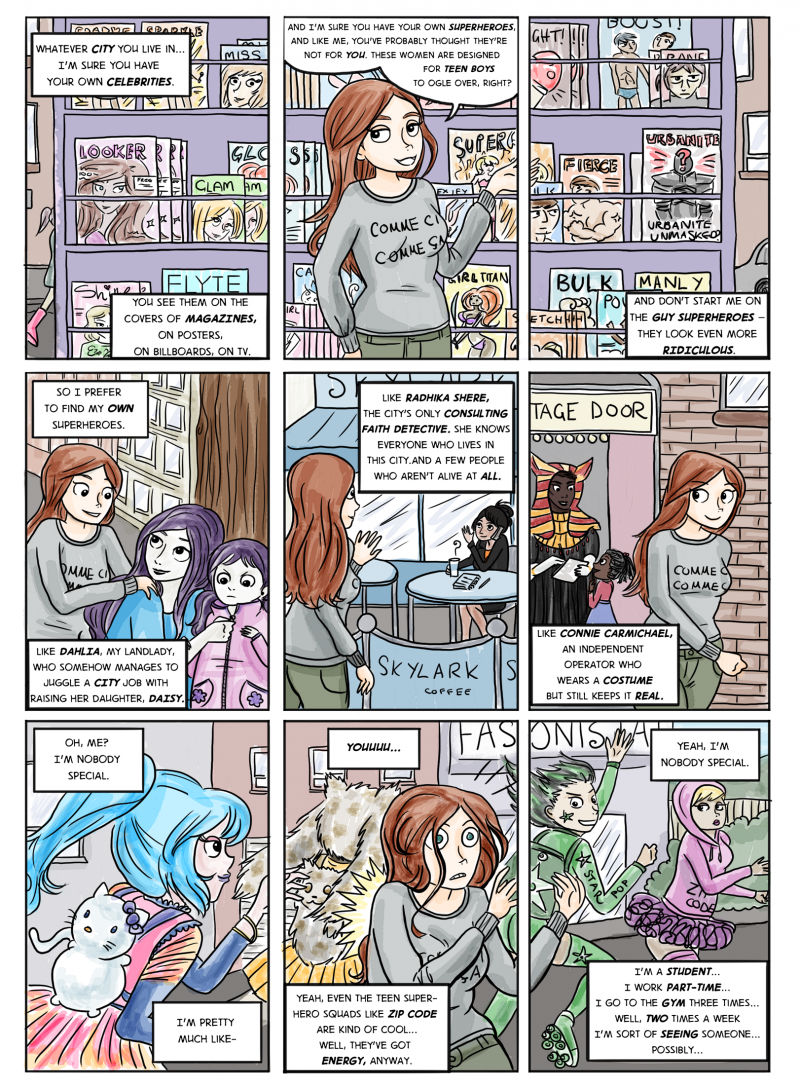
A: You might learn a bit about me when MSCSI Volume 2 comes out, via Radhika Shere. When I found My So-Called Secret Identity I was immediately attracted to the setting and the characters. However, the issue that I have with pretty much every form of media, whether it be books, films, TV, etc, is that I am either able to relate to a character’s background and personality, or to their physical appearance, never both. Obviously I don’t want to look at a comic book and see a world populated entirely by me, because as my sister would tell you, that would be horrific. Despite this, It would be great to see just one female character of Indian descent whose life and traits aren’t stereotypical. I’m very lucky to have been raised to believe that I can be whoever I want to be, regardless of what other people automatically assume. That said, there are other young, brown-skinned, female comic book fans out there who don’t see themselves reflected in their favourite shows or books.
Additional Text: Kat Poole and Tracey Ramsden

Positive representation is hugely important, everyone needs someone to relate to and for inspiration. Anyway (rant over!), I badgered the MSCSI team to design a non-stereotypical Indian woman. To my immense surprise, Dr. Will Brooker replied and gave me the unbelievably cool opportunity of creating such a character. I took the whole thing really seriously, wrote out pages of backstory, and worked with Dr. Brooker to perfect her appearance. And so Radhika Shere was born.

After that, I guess Dr. Brooker thought I was sufficiently invested so as to want to be more involved in MSCSI, and he offered me a role interning as Kickstarter manager.

GP: Can you tell us about what it is like to be an intern for a comics project? And what have been some of your most notable experiences in that role?

A: My role includes helping to run the Kickstarter and social media pages, sending out all the digital rewards, and making lots of lists – of backers, of the rewards, of sponsors and their messages. AND IT IS AWESOME. Even the email chains discussing funding and page counts were enjoyable because the MSCSI team is so inclusive and encouraging, despite the fact that they’re all professionals and I was initially just a super eager fan… The best part has to be that I get to glimpse sneak peeks of the story and art before other fans. Reading Radhika Shere’s first scene made me giddy with excitement.

GP: What are some aspects of MSCSI that stand out for you the most? 

My So-Called Secret Identity Cat's Life

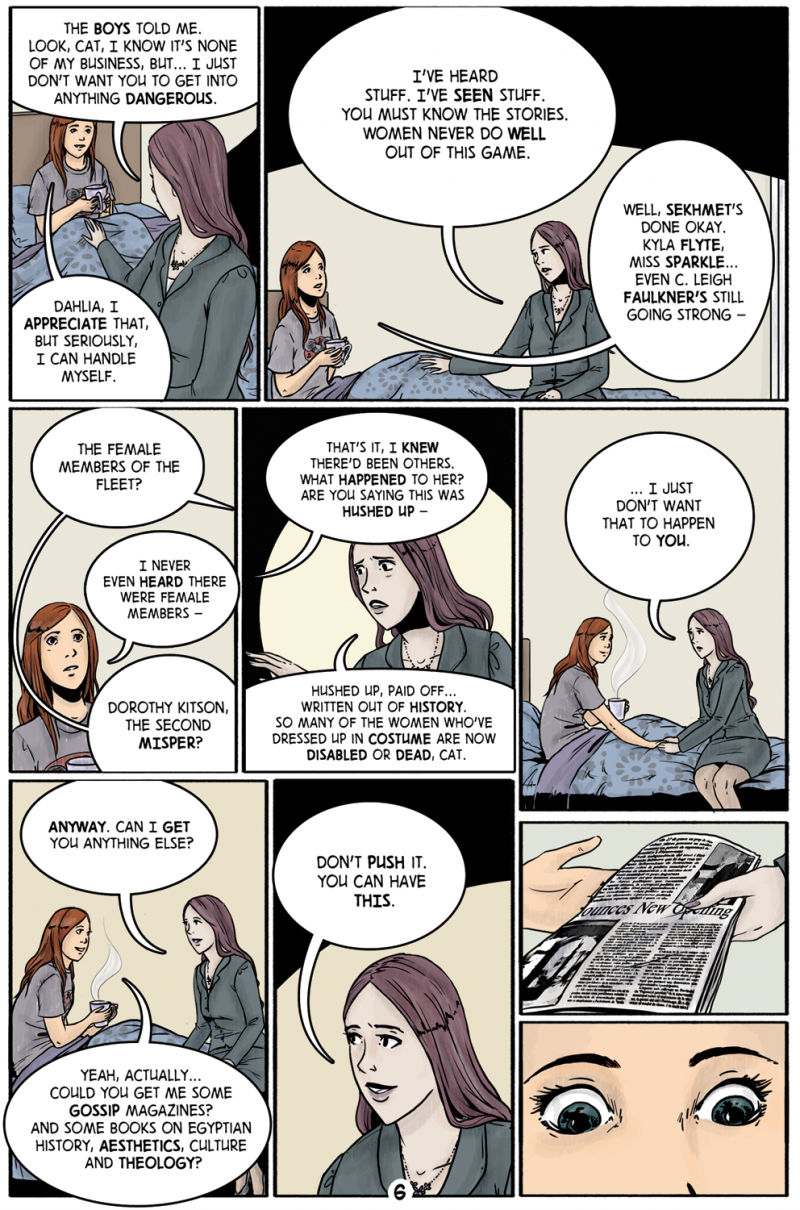
A: My So-Called Secret Identity is such a powerful comic book because it’s so relatable. Cat stands for every woman who has ever been looked down on in a professional situation because of her sex, every child accused of cheating because their work is unexpectedly above average, every individual who has ever personally wanted to improve a society that they see as inherently corrupt. The beauty of it is that there isn’t just one feminist icon in MSCSI. Cat may be the protagonist but Dahlia, Connie, Kyla and Miss Sparkle are all strong and flawed in their different ways. No tired tropes here!

GP: What would you — as a reader — like to see in future issues of MSCSI?

A: I would like to see more backstory, more about the Major and the Illinois Serum, and more about Doll’s Eyes. The antagonists’ actions drive so much of the happenings in Gloria, and it would be interesting to know the bigger stories behind the glimpses we got in Volume 1. Like all MSCSI fans, I would also like to know what’s going to happen. I’m rooting for Good to triumph, but with villains like Carnival chaos is a pretty appealing prospect too…

GP: At one point you cosplayed MSCSI’s Miss Sparkle in her tiger aesthetic. Do you cosplay regularly, and was there a reason you chose to make yourself up as this particular character?  

A: I’d never used face paint before, but my friends had some left over after our Halloween party, and it was Body Confidence week at my home university (I’m on an exchange in Paris at the moment). So I decided to try to paint my whole body to show how I feel when I’m at my most confident – fierce! In the end I looked like Miss Sparkle, so I sent a photo to Dr. Brooker as Cat’s the only character that we know to have been cosplayed so far.

My So-Called Secret Identity Sekhmet and Miss Sparkle

Although I love dressing up, and I’m planning to go to a Comic Con next year with some friends, where I’ll definitely cosplay, I haven’t actually done it before. Unless fancy dress parties, school plays and World Book Days count, in which case I have been many different characters, most notably Esmeralda from the Hunchback of Notre Dame and Zazu from the Lion King.

Comics intern Angel cosplays as Miss Sparkle: a hero that we will hopefully learn more about in the next volume of My So-Called Secret Identity.

GP: Who are your favourite MSCSI characters and why?

A: Radhika Shere! Cat’s brilliant, I can even relate to the little things she does, feeling proud of her not just for joining the superhero game, but also for things like telling Enrique that she didn’t agree with his homophobic comment. In addition, the way she’s portrayed, not as a super-slim, busty crime fighter, but as a normal, intelligent student, makes me über-happy. She’s someone who eats doughnuts, finds it difficult to walk up 44 flights of stairs even in an emergency, and mixes up her words at important moments. What’s not to love?!

Moreover, it would be so easy for her character to lapse into a pity party about not living with her family and having to do things alone, but she doesn’t throw tantrums or give up.

She also doesn’t aggressively assert her independence at the cost of all her relationships. Don’t get me wrong, Cat’s flawed – for one thing she repeatedly ignores Dahlia’s advice. However, she does, admirably, accept help from her friends. For me, that’s what the last page of Issue 5 is about, how even though Cat, Enrique, Dahlia, Kit and Kay are strong separately, in a team they’re unstoppable.

MSCSI Team Cat

And too so seems to be the creative team behind My So-Called Secret Identity: with Volume One launching sometime in Spring of 2015. And we too, at GEEKPR0N, also look forward to the beginnings of Volume Two.

Their Voices Are This Film – Review: She Makes Comics

She Makes Comics is a documentary directed by Marisa Stotter, and produced by Patrick Meaney and Jordan Rennert of Respect! Films. It is also executive produced by Sequart’s Julian Darius and Mike Phillips and comics librarian Karen Green of Columbia University.

It’s hard to review a documentary. I think it’s even more difficult review a documentary that you like. In the interests of full disclosure, I backed the She Makes Comics Kickstarter. I even wrote about it twice here on GEEKPR0N and promoted it before I knew what film I was going to see. I was utterly fascinated with the concept of a documentary that focuses on not only the past, but the present history of women in comics: as creators, publishers, and fans.

Unlike other documentaries I’ve seen, the interviewers aren’t present. There is no presence of a single interlocutor or a primary voice. In fact, there are several voices that create the narrative of She Makes Comics: both in terms of the film’s structure and the history of women in comics. What I found fascinating was how each figure interviewed not only seemed to bring a particular topic or issue, but they interlapped with each other, and sometimes talked about one another in each cut, and even attempted to give a voice to the women in the comics industry who had long since passed. While the first and middle part of the film focused particularly on creators and historians and women who are, and were, in the industry, this gradually gives way to a multitude of newer and more contemporary presences in comics.

Also She Makes Comics was edited extremely well. Sequences with interviewed figured were accompanied by cuts of these creators interacting with their fans, of cosplayers at conventions, of segments of historical filming and popular cultural scenes, and even dramatic re-enactments. I do feel that the section about a woman feeling uncomfortable in a comics store, while definitely a valid experience, was overwrought and could have been portrayed much more realistically: though the discussion about it made up for that somewhat jarring, almost kitsch portrayal.

There were different section in this documentary, though the segues to each were so smooth and organic that it takes more than one viewing to identify where the topic begins to shift. Roughly speaking, She Makes Comics starts with the history of women on comics, the formation of Comic Cons and women trying to find a place in them, a powerful section on X-Men and its inspiration on female creators and fans, women in comics publishing positions, difficulties dealing with the insular chauvinism and misogynist mentality of “all-boys clubs” shops, the advent of groups supporting women in comics, some insights into the creative processes of the female artists that make comics, the treatment of female characters in comics in relation to their male counterparts, the importance of discussion of sexism and an emphasis on diversity in the comics medium, the importance of Internet communities, the acceptance of the graphic novel in mainstream culture but women still not being taken seriously in that field, the cultural difficulties of women pitching comics ideas in the industry, the creation of female comics spaces, a section focusing on harassment, and a final segment ending off with a focus on female-led or created comics and geekdom.

As you can see, this covers a lot of territory though by no means is it exhaustive: and these places definitely interlap. There were many things of note, but here are some of the few that stood out for me. The earlier history portion of the film particularly focuses on Jackie Ormes: the first female African-American cartoonist who will actually be getting her own mini-documentary by the creators of She Makes Comics due to them meeting their Kickstarter goals.

Jackie Ormes: creator of the Torchy Brown strip and the single-panel cartoon Patty-Jo 'n' Ginger.
Jackie Ormes: creator of the Torchy Brown strip and the single-panel cartoon Patty-Jo ‘n’ Ginger.

There was mention of the fact that there were more women creating comics when men went off to war and how female readership began to decrease after the Comics Code was enforced and superhero comics were supported over other genres. It was interesting to learn about the Marvel and EC comics artist Marie Severin in addition to Ormes, though I would have liked a little more information on Miss Fury creator Tarpe Mills.

The discussion of Comic Cons and cosplay is really timely, however, based on the recent flak the latter has been getting from some industry artist. Wendy Pini hits home the fact that, as a cosplaying pioneer — specifically of Red Sonja — she managed to create the persona for herself necessary to make her art, get into the industry, and essentially become completely independent with Elfquest.

Wendy Pini and so many others after her identify so much with their cosplay and fandom that they create works and spaces for others.

She is an interesting parallel to Gail Simone who got into comics through her critical work in Women in Refrigerators: analysing how dead or traumatized female characters were used to advance male plots and eventually making nuanced female heroes herself. Both creators got into the industry in different ways through geek culture and their insights and I just thought it was truly awesome to have that reminder that fandom and criticism can lead to creation.

Some male figures in comics were also interviewed such as Chris Claremont, Paul Levitz, and Richard Pini: but the focus was on them in relation to their female influences, employees, and creative partners. Certainly, Ann Nocenti and Louise Simonson, both editors of Claremont’s X-Men run, influenced his work considerably: a series many of us have related to as marginalized geeks and nerds in our time. And Nocenti’s anecdote about initially thinking she was tapped to help write porn was rather hilarious. Karen Berger was also interviewed and her comment about liking “psychological stories and weird shit” as inspiration for what she helped to promote and publish in her Vertigo imprint made me smile as well.

Even though queer creators in comics were mentioned in the same place as online spaces, I feel there wasn’t as much focus on them. In addition, there were a few creators I was hoping to see such as Alison Bechdel and Aline Kominsky-Crumb that didn’t make it into the film: though the former was mentioned. Carla Speed-McNeil and Hope Larson made brief appearances, which was nice to see.

According to Kelly Sue DeConnick, there is even a rocket scientist in the ranks of those who idolize Carol Danvers and what she represents to them.
According to Kelly Sue DeConnick in She Makes Comics, there is even a rocket scientist in the ranks of those who idolize Carol Danvers and what she represents to them.

But there were two things She Makes Comics truly did for me. The first is that it introduced me to all-female fan groups like the Carol Corps, organizations that support women reading and making comics such as the Friends of Lulu, and even spaces like the Brave New World Comics Geek Boutique that challenge the very form of what a comics store is. And I want to read Marjorie Liu, G. Willow Wilson, Gail Simone, and Kelly Sue DeConnick. They are not talked enough nearly enough in mainstream comics geekdom, even now, and while I was curious about them before, I’m definitely inspired to look at Birds of Prey, Captain Marvel, Ms. MarvelPretty Deadly, and others now.

I feel as though, even and especially if, you are a comics aficionado you will learn a lot from She Makes Comics. And if you are completely new, this is even better for you: for while it doesn’t give you everything, it is an excellent starting point into some works with different perspectives and interesting stories.  I would definitely like to think that She Makes Comics hits home the fact that not only have women contributed to comics and geekdom, but they still do and they will.

Wendy Pini at one point shared an anecdote about a young woman who, despite her skill, didn’t have the confidence to acknowledge her art work as good: and even had difficulty presenting it to her without urging. Janelle Asselin, former editor at DC, mentions that she had very few women give her pitches. I hope that this documentary — and other works and groups and people of similar spirit — help to change this climate and culture, and make something as multifaceted as the film I had the privilege to finally see.

She Makes Comics is now available in both digital and DVD form.

A Female Doctor: A Sex + Gender, Timey Wimey Talk

There were hints of it when The Doctor regenerated at “The End of Time.” Neil Gaiman’s episode “The Doctor’s Wife” pretty much stated that Time Lords can change sex from regeneration. And then, of course, we have our friend Missy — or The Mistress — to consider from this past year’s Doctor Who. And according to Steven Moffat, the man who also wrote the two-episode comedy special Doctor Who and The Curse of Fatal Death — the role of The Doctor will eventually be played by a woman. According to Moffat, they have been laying down the groundwork to do this for some time, but it is a question of finding the right personality before they can make this an eventuality.

Doctor Who, particularly in the era of Russell T. Davies, has been pushing the envelope of just what future, and present, life can be: and how far it can be accepted as a given. There is, and there will be, resistance on the part of some fans. I mean, The Doctor has been consistently male for at least thirteen incarnations now — from 1963 all the way to the present — and even for those who are not outright dismissive or hateful towards the idea, it would take some getting used to.

But, at the same time, would it really?

Could it be time for a female Doctor? Steven Moffat says, "Possibly."
Could it be time for a female Doctor? Steven Moffat says, “Possibly.”

The Doctor has changed a lot throughout the years. He is the Lego-equivalent of a protagonist: even though you can rearrange him into different shapes, sizes, and patterns the building blocks of him as a character — his core — will always be the same. This allows the people working with him to tell new stories about his character while always making it clear that he is The Doctor. And myths change over time: they adapt according to the times and even the culture of the audience.

There are some interesting implications, of course. There is the matter of LGBTQIA representation to consider with regards to sexuality and gender. For the most part, The Doctor has been portrayed as asexual and while it’s tempting to mention that in latter years he has become a lot more romantic and has displayed feelings and more physical expressions of love towards his Companions and other characters, these are not necessarily mutually exclusive ideas. Certainly asexuality does not exclude the possibility of platonic love — which seems to be a default setting of The Doctor’s character — and it also doesn’t outright dismiss the notion of romantic or even physical love.

So what if The Doctor has relationships with male or female Companions, or other characters? Does it really matter what body The Doctor has at the time? Certainly this wouldn’t affect The Doctor’s brilliance or core personality. In fact, this would make some good stories in and of themselves. I mean think about it: The Doctor changes into a woman for the first time in her life. Does it take some getting used to? Do her relationships change? Does this create discomfort in her Companions, or another level of relatability?

And this isn’t even going into gender. While Missy prefers to be called The Mistress or a Time Lady, would The Doctor want to be considered female? Would she insist on male pronouns: as gender does not necessarily equal sex? I’m thinking that she would adopt female pronouns as Steven Moffat and others probably wouldn’t delve too much into this nuanced issue for mainstream television. Personally, I could have seen Missy insisting on being called The Master and it would have definitely fit her core character to do so.

I think the idea I’ve been thinking about the most since the possibility of sex-changing in regeneration actually came about is whether or not The Doctor would be a good representation of a transgender — or gender-fluid — character. On one hand, I can see some transgender and queer fans completely supporting this idea and perhaps relating to this character more: expanding on the idea of a complex LGBTQIA universe that Davies himself brought to television.

But then there is the opposite side of the coin. Some fans have accused the creation of characters such as the female Thor, and the Black Captain America of being gimmickry: as something of a fascinating “What If?” oddity that will be retconned out or marginalized again once the status quo of those franchises are restored. Certainly, there is something to be said about making a story about an entirely original female character instead of temporarily gender-bending an established one. One concern I have in seeing a female Doctor is that she will, inevitably, regenerate again and that this last regeneration will either have less time on screen, or become something of a one-off.

I think that this can be done under a fine hand and certain degree of sensitivity, but whether or not Steven Moffat and his writers are up to the task is a whole other story entirely: though the fact that Doctor Who has hired Catherine Tregenna, its first female writer in about six years, might hopefully be a step in the right direction.

Personally, I want to see a female Doctor. I want to see what she would be like and to watch her dance toe-to-toe with the messed up intrinsically Lovecraftian madness of the Whoniverse. I want to see her laugh and cry, be silly,  fierce, and terrifying, a fiery angel and a goofy clown, and loving hard, while pulling her sonic screwdriver on some Daleks. It could be another adventure for The Doctor: a new aspect of the character’s life that we can see unlocked in both external and self-exploration.

In the end, I want to see The Doctor give her Companions The Talk. You know the one. Whereas humans get the Birds and the Bees talk, Time Lords get The Timey wimey, wibbly wobbly Talk. I’d like to see her explain that just as she understands, or doesn’t understand, or intuits time so too does she understand, not understand, or intuit her own sense of sex and gender. So too does she understand, not understand, and intuit herself.

But really, I just want to see The Doctor’s happiness as she gets her ultimate wish: when, at long last, she finally gets to be ginger.

From The Book Circus: Amanda Palmer’s Art Of Asking Book Tour

A few days ago, a friend of mine let me know that Amanda Palmer was coming to Toronto on the last leg of her Book Tour. Unfortunately, by the time I got the message she followed up on it: informing me that the Lee’s Palace venue tickets were sold out. I’m not exactly sure why I did it. I had a suspicion and I applied for a ticket on Ticketfly: just to see if I could. It was this same hunch that had me standing in a line outside of Lee’s Palace for over an hour with the rest of Amanda Palmer’s fans: again, just to see if they would accept this ticket and let me in.

We all stood out there for a while: waiting for the doors to open past their 8 pm deadline. A fellow fan was nice enough to pass around free doughnuts: which was pretty good indicator of just what kind of crowd was gathered there. In all honesty, when the line started moving I was a little bit stunned that the establishment let me straight through.

Once we came in, we took the seats that we could while Amanda Palmer’s assistant Whitney Moses, dressed in her Erika Moen’s Anal Safety Snails shirt, came on stage to do some maintenance while leaving a glass of wine for Amanda. The event had a great turn out: made all the more evident by the teasing that began.

At one point Amanda herself appeared in the window above the stage and everyone cheered. During more preparations, as more people kept coming in, the music playing at Lee’s Palace would pause just long enough to get everyone to think that their night had begun: to revving them up further.

But it wasn’t long until Amanda herself finally came on stage, tossing flowers to the audience, strumming her ukulele and as she talked it got more difficult to describe the night in linear detail as I got caught up in the palpable joy of the crowd. She came onto the stage with another Amanda: a sign-language interpreter whose translations of Amanda’s words and songs were just as beautiful and interesting to watch as Amanda herself. In fact, sometimes it was good sort of challenge for me to split my attention in focusing on either one or the other.

After a request from a fan, we got to learn that out of the one hundred and ninety songs Amanda has created, she has apparently only memorized ten of them. She read from parts of her book The Art of Asking, while letting a fan perform an act of bibliomancy and selecting a passage for Amanda to read: even as another came on stage and choose a few sentences that Amanda decided to put into vocal music. In her book, she referred to a bit of history from Richard Zack’s An Underground Education with regards to Henry David Thoreau and how, while he made his hermitage at Walden Pond, he visited his rich friend that owned the property and accepted baked goods from his family.

The moral of the story is the core of The Art Asking: namely, don’t feel bad about taking the doughnuts. This is the second time I’ve mentioned doughnuts at the Book Tour. Very soon, I will talk about it for the last time.

There were a few particular parts of the Toronto Tour that particularly stuck out for me. Amanda began the event by playing her version of “Fuck The Police” — a day after the Ferguson verdict — and informed us that she was Toronto’s peace protest before this part of her tour that day. I have to admit, it did make me pause and it brought up some very uncomfortable issues for me: of the violence, of expression, and of cultural appropriation.

She also played a vocal duet of Dresden Doll’s “Delilah” with Whitney — who is a talented musician in her own right — while on her keyboard. This led to another difficult subject. It was after this song about an abusive relationship that she invited Sasha Manes of the Toronto YWCA branch on stage to talk about the importance of women’s and children’s shelters as well as her own organization’s charity initiative. Amanda’s Book Tour shared the same day as the International Day for the Elimination of Violence Against Women.

And both on her own initiative and when asked by her guest Eric Alper the Director of Media Relations for eOne Music Canada, Amanda also didn’t shy away from talking about Jian Ghomeshi. She talked about how many of her fans didn’t want him to be there and how, in the end, she didn’t want her Book Tour in Toronto to be overshadowed by, or all about  him. At least, that was my understanding of the matter.

Eric Alper himself covered a fair bit of ground in more ways than one. Remember how I mentioned doughnuts twice? Well, Alper decided to distribute seven hundred Timbits to the entire audience while he and Amanda kept talking. They talked about a range of topics: from the dangers of all music being placed under digital rights management again and no longer available to share freely online, to Amanda’s hopes on what crowdfunding might do to free more artists and their audiences from the influence of an unchanging music industry.

I was particularly intrigued when Alper asked Amanda just what she cut out from the final draft of her book. She mentioned two anecdotes: one about the fact that her programmer mother’s team worked with and accepted the identity of a transgender member as a given in the 1960s, and another about a woman thanking her for her work as a living statue in representing “white power.” Certainly, these are stories in and of themselves.

At one point, Amanda’s friend Anthony was brought up. Anthony Martignetti is a psychotherapist, but to Amanda he is her life mentor and friend. He has been suffering from cancer and, as of this post, has gotten a bone marrow match. He has written two memoirs about his family life and his own: and as someone who has reviewed both of his books, I can’t help but think to myself that when Amanda at one point began to sing Dresden Dolls’ “It’s All In The Family” that she was referring to Anthony as much as to herself. Indeed, at one point when she was reading an excerpt from her Art of Asking, I realized that it was actually the preface that she wrote to Anthony’s Lunatic Heroes.

After Amanda took some questions from the audience, she proceeded to wrap up the night with two songs. The first was “Bigger On The Inside,” which aside from the coincidental geek reference is also a song she played for the first time at Anthony’s Beloved Demons book launch. It is a raw, poignant and very real song written from a dark place in an attempt to grasp at meaning.

Of course this prepared the way for “The Ukulele Anthem” finale: a triumphant and passionate song about expression and hope.

Finally came the book signing part of the night. The line became something of a spiral and given the fact that I’d rented Uzumaki a few hours before, I almost wondered if everyone was going to become enmeshed into a great pattern and be stuck with each other, in a more positive way, forever.

I hung back for the crowd to die down a little more but I still managed to make some friends at the end of the night. I’m told that this is not an uncommon occurrence during one because there is just something about a fanbase or community of geeks and survivors that Amanda Palmer’s music and sheer presence brings together. Even looking back at the people who hummed and song along to her songs, it made me realize that many of them had memorized them by heart. For a while in time, it almost felt like the Fraggle Rock world promised to me as a child that never panned out into adulthood.

By the time I came to Amanda Palmer with my copy of The Art of Asking, my legs hurt from a combination of the hard raised benches of Lee’s Palace and standing when the discomfort grew too much: a minor version of the story Amanda recited from Anthony about a dog that won’t move off of a nail because it doesn’t hurt enough yet. Amanda herself looked utterly exhausted. From the blurry pictures taken faithfully by her awesome assistant Cat, you can glean that she was barely awake and I was not particularly that coherent.

All I said to her was that my friends said hello and that, if she remembers, to tell Anthony I said hello as well. And that was pretty much it. I wrote this whole account by hand initially: one on the back of my Porter Square Books receipt from Amanda’s local book store Porter Square Books, when I couldn’t get it from Amazon due to its issues with the book’s publisher Hatchette, and the ticket that I wasn’t sure would even let me into the building.

I wrote this from my new friends’ house where I stayed for the night after we all left together, frazzled from meeting a celebrity, for drinks. They are in the process of moving out of the country. It’s funny how things can work out that way. Just as this was Amanda Palmer’s first Book Tour, this was my first ever somewhat musical concert or event I actually enjoyed. It was my first Amanda Palmer event. Actually, Amanda had another term for her Tour. She actually called it a Book Circus.

So this was my first Book Circus. And a good circus delivers excellent food and entertainment, but this one also makes you see the uncomfortable things, the difficult questions, and the fragile strength of tired, blurry figures in the night.

This is the clearest picture I have. And yes, my hair is down too.

Either way, it is already an unforgettable experience.


A Review Of My So-Called Secret Identity Volume One

It’s been a few months since My So-Called Secret Identity‘s Kickstarter got funded and while the shipping of the physical Volume One has been delayed, backers have already received their digital copy. Now having my own copy and finally getting to read Issue #5 that resolves the story arc’s cliffhanger, I am going to review My So-Called Secret Identity.

My So-Called Secret Identity, a comic written by Will Brooker and drawn by Sarah Zaidan and Susan Shore,  is a story that requires some attention to detail. It utilizes the aesthetics and tropes of the superhero genre and even possesses some characters that, on the surface, appear to be DC comics analogues.

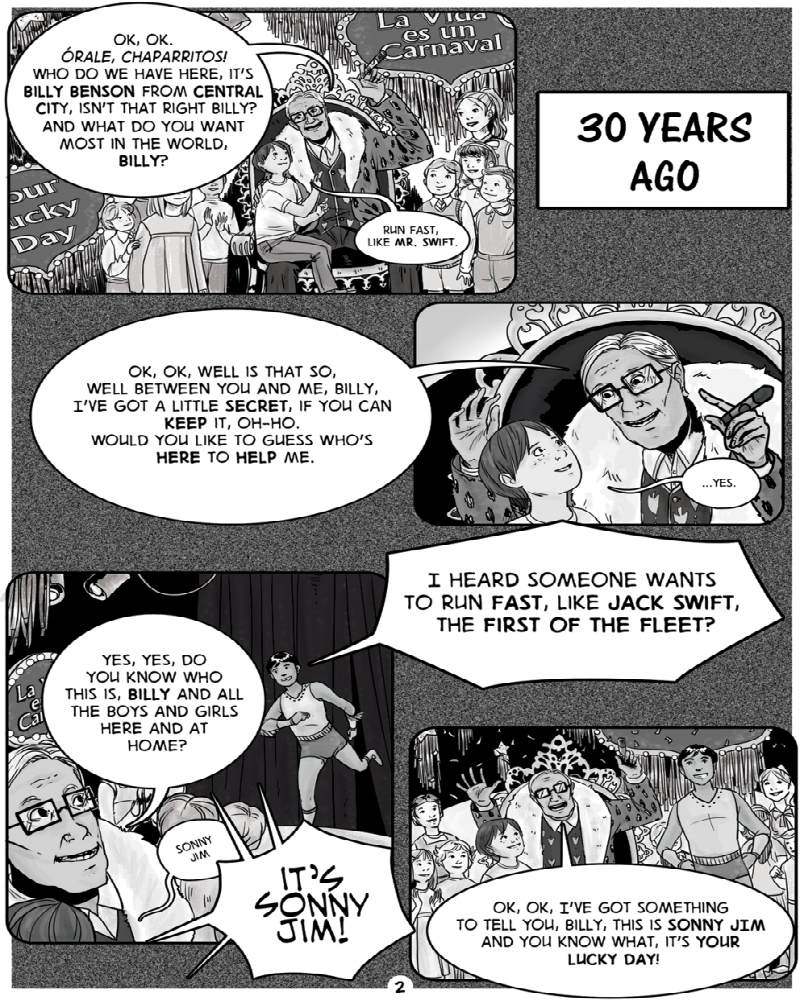
The comic’s storyline takes place in Gloria City, perhaps an alternate version of New York City, where the Major and the seemingly super-powered Fleet fight to maintain order and security, while the black-garbed Urbanite and his side-kick Misper combat the twisted designs of Carnival. Meanwhile the feline Sekhmet steals items and Doll’s Eyes preys upon the hapless citizens of Gloria: leaving her signature flora calling cards.

But, as the protagonist Cat Abigail Daniels observes, it is all a front: all part of “the theater.”

Cat's Trauma MSCSI

The Major, who is also the Mayor of Gloria City — seemingly a combination of Superman and Captain America — maintains his power by fighting against the chaos of villainy with empty political slogans and promises. Urbanite is more extreme in some ways. As a parody of Batman’s vigilante justice, he terrorizes both citizens and criminals alike with contradictory rhetoric and ham-fisted violence: never understanding or never wanting to understand that he is just a tool in maintaining the political status quo set in Gloria between the Major and Carnival: the latter of whom seeming to be a wannabe worn-down Joker game show host. Kyla Flyte is a stereotypical blonde, beautiful, and sparkling superhero who seems to spend more time preening, conducting family business, and signing photographs than doing anything to help anyone.

And what’s truly awful is that in the midst of all the combat these heroes, villains, and anti-heroes it’s innocent civilians and properties that truly get caught in the crossfire. In the world that Will Brooker sets up for us, it seems as though both super-heroism and villainy are past times that belong to the rich and popular while very few ever care about the lives of those who they ruin in their play.

Of course, even this layer of “the theater” is not what it seems. Certainly it would be all too easy for Brooker to follow the examples of Alan Moore’s Watchmen and Garth Ennis’ The Boys: in showing us how superheroes would realistically not work.

Enter Cat.

My So-Called Secret Identity Cat

Through Cat, a young literature and philosophy student who is tired of watching her city suffer, we see the fulfilment and promise of a different perspective. This is a woman who values her friendships, who calls people on their bullshit but who is perfectly capable of seeing the good and forgiving the bad. She isn’t particularly athletic, or rich, or possess any superhuman capabilities. But as Brooker and his team like to state:

Smart is a superpower.

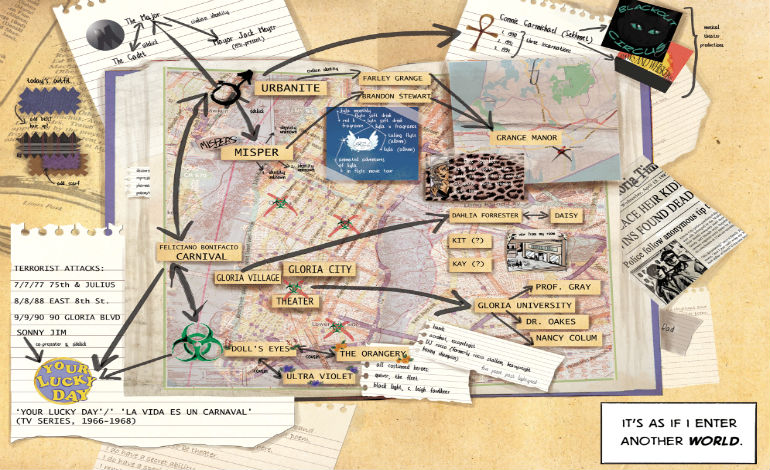
It isn’t so much that Cat even has an eidetic memory. She actually does have to use memory aids to help her piece together names, events, backgrounds, and places in order to attempt to solve a crime. Even though it’s derived from the profiling that her policeman father might have passed on, along with the art of scrap-booking, Cat creates mnemonic devices known as MindMaps: collages that help her process information and reflect how her mind makes connections. Did I also mention that Cat is an excellent multitasker and can solve some problems as she is processing others?

My So-Called Secret Identity Mind Map

Cat has also faced discrimination because she is a young woman and she is, in her own words, “Goddamned smart.” She has been mistaken for being a secretary, an academic cheater, and “just a young girl.” Just a girl. It’s at this point that she decides to enter “the theater” and definitely shake some things up.

Book One of My So-Called Secret Identity is divided into five parts. The first part, or issue, sets the scene of present-day Gloria City and Cat attempting to navigate through it. We get introduced to her friends and some of the main heroes. In Issue #2 “Love Lives!” Cat examines the “open secrets” of secret identities, gets a costume made for her by her friends Kit and Kat, encounters the brutality and cluelessness of Urbanite and infiltrates the latter’s mansion while in Issue #3 “Nine Lives!” Cat tries to talk to Sekhmet and by Issue #4 she, unfortunately, encounters the “Big Bad” Carnival. Finally, in Issue #5 “Second Life!” Cat deals with the aftermath of her decisions and sees a multitude of possibilities.

There were so many ways that Brooker could have taken this story: so many tropes into which it might have accidentally fallen. The setting keeps you on your toes. It makes you read and observe closely. If you are good enough, you can actually find “Easter eggs” and predict some revelations in the story. Also, if you are a veteran comics reader you might recognize not only the obvious heroes and villains, but also some of the influences behind Cat and her friends. The fact is, like Alan Moore and what he did with his Charlton Comics analogues in Watchmen, Brooker has some DC analogues as well: and like Moore’s, his become their own people while — unlike Moore — they deal with issues in an entirely different way.

For instance, just as Cat was a Barbara Gordon analogue she confronts her own casual mistreatment as a woman in a patriarchal society over-focusing on class by entering into “the theater” on her terms: to actually create change as opposed to feeding into the system. Her entrance into “the theater” is a dangerous one: and not just because of the very real threat of physical harm. Certainly, the hearkening back to Gail Simone’s Women In Refrigerators trope — of the death and crippling of female characters as targeted loved ones triggering the plot in general — is all too present: and it is more of a danger that Brooker himself, as the writer of this series, luckily manages to avoid on at least two counts. He does mention it being a very real possibility in the comics universe of Gloria City.

Also, it’s usually unfortunate to be a side-kick in this world as well.

Dahlia Talks to Cat MSCSI

But there are two other factors to consider as well. First, the trope of gaslighting. On at least one occasion Urbanite threatens to “silence” Cat and Enrique even warns her that Urbanite would put her in Bedlam, that world’s Arkham Asylum, just to be rid of her. Not only does Brooker deal with the concept of women’s freedom being curtailed by the symbol of an authoritarian regime, but in putting Cat in a mental institution he is labelling her behaviour — her need as a woman and as  human being to help others — as “crazy” and it has the potential to make her question herself. Certainly, much to my disappointment with regards to good villainy and relief on Cat’s behalf, it is a good thing that Carnival didn’t see the uses of gaslighting: as that may be Cat’s few potential weaknesses.

Hopefully we will not see a villain named Gaslight in the near-future: though hopefully Cat should have a good support base at this point to deal with that and keep her from going at this alone.

Of course, there is the other problem: of perpetuating the system. Cat is attempting to play in the same “theater” as all those other heroes. Certainly her falling into the Refrigerator could be part of maintaining this flawed system of control and death, but celebrity status — the bane of all the heroes and villains involved — could be the subversive force that might undermine Cat’s own resolve in a different way. Just look at Kyla Flyte for instance, or even Connie Carmichael — Sekhmet — to a somewhat lesser extent. In a way this is also Brooker’s challenge as well as Cat’s: to make sure she doesn’t become merely a symbol, a rebellious force co-opted into another old guard, or a seemingly “exoticized” element that only props up the system.

Additional Text: Kat Poole and Tracey Ramsden

However, at the moment Cat seems to bring something else into all of this: namely the Do It Yourself indie attitudes, with some influence of geek cosplaying love, of creating your own costumes and trading favours — interacting through a gift economy associated by some scholars with female fandom — with friends to support herself. Perhaps this will catch on in later Books and, certainly, even Issue #5 mentions that there are already lower income heroes. Maybe this will be an impetus for change.

This same subversive mentality is used to examine other issues in My So-Called Secret Identity as well. For instance, we see that even Cat cannot speak for all experiences: and she is honest about this. Her look at the racism that Connie Carmichael has to deal with as a person of colour in addition to being a woman potentially in contention with other women — that motivated her in a large to become Sekhmet — is very intersectional and it shows that even though she might be aware of it, she even knows it is outside of her personal experience.

Cat Meets Sekhmet MSCSI

There is also the fact that The Major and Urbanite, as well as Carnival are two sides of the same coin. The Major and Urbanite police the citizens of Gloria City into accepting their patriarchal rule, even if they do have good intentions. Urbanite himself violates Cat’s personal space, rough-handles her and threatens her even while downplaying her concerns and actions:  making her vulnerable to the violent misogyny of Carnival. And somehow, it’s even worse that someone like Urbanite believes — or wants to believe — that he is doing the right thing. You have here an authoritative system that punishes but also perpetuates with violence. When what happens to Cat seems to become public, this might force the citizens of Gloria to truly look at this issue and I wonder if this will indeed play a role in the next Book.

My So-Called Secret Identity attempts to place homosexuality as part of a norm in this world — through perhaps Kit and Kay’s relationship — and even seems to have an alternate version of Cat who is transgender. Dahlia Forrester, who is actually a superhero in hiding named Ultra Violet and an analogue of Black Orchid, even tells Cat that she tried to “pass” and it only perpetuated the system. I like that there is a Black Orchid analogue: as Neil Gaiman’s iteration of her deconstructed superhero expectations of violence in a very clever and meaningful way.

And Will Brooker manages to combine all of these elements with the premise of a world that had superheroes since 1945: not unlike the superhero comics history timeline of our world. I do wonder, though, if it might not have happened as early as 1938.

My So-Called Secret Identity Issue 4 Part Four

Quips aside, I do think that some sequences were fast-forwarded a little too quickly. I would have liked to see the evolution of Cat’s relationship with her friends and perhaps more about the world. Certainly, I would have liked to see an actual conversation between Connie and Cat take place during Issue # 5: because obviously they came to some kind of agreement after Cat’s horrific experience. But this one criticism is minor considering how all five issues of Book One fit incredibly well together.

I especially like how Will Brooker presented the alternate timelines in Issue #5, how he so casually introduces real superpower into the world without being as blatant as making a Superman or a Doctor Manhattan (the Deleted Scene included in the Book, however, would have revealed this aspect earlier on through more than just talk and it’s just as well it got excised), and how, despite the fact that I strongly suspect Carnival did more to Cat than leave that scar on her face, he didn’t give into the spectacle of violence or turn her into another Oracle while, at the same time, Brooker narrowly escapes making Cat a Mary Sue for which little bad can occur: exposing her to the realities of her world and its physical and emotional consequences. He lets her play out the role she sought and, upon risk of making light of went through which is not my intention, Cat wears her scar and her newer costume well.

There are some questions I’m left with however. Is Cat’s father still alive at the end or was it just part of a mess of truths and hallucinations? What happened between them seven years ago? How did Enrique initially join Urbanite? And is there importance to the Wallace Twins newspaper clipping in this entire story?

I really want to find out what happens next and, perhaps if I further train my superpower, I might be able to get more details from the comics issues that I have. Be on the look out for My So-Called Secret Identity, my friends. It is clever, poignant, it has some subtle social commentary intermixed with a fascinating plot, and it’s like looking at old friends in an entirely new way. Some of them might be a little more uncomfortable to be around, or more pitiable, in other cases a whole lot more bad-ass.

And some, in another persona, another guise, may well finally get to be themselves.

Cat Masked MSCSI

Super Zero: It Gets Better

“You never hear about how the apocalypse smells like total ass. But it does.”

And so do some stereotypes. We all know this one: about the geek who thinks they are so prone to so many physical and emotional weaknesses that they will slow down everybody else if they are even noticed at all.

Mitchell L. Cohen’s short zombie film Super Zero starts off just like that age-old trope. You know the one: about the stereotypical geek boy whose crush and attractive female love interest doesn’t seem to notice him, who he doesn’t have the courage to even talk to, and who views himself as almost completely useless. It’s a story told so many times by our culture and literature that it is essentially a very typical narrative. But Cohen adds two more elements to this story.

Josh Hershberg doesn’t view himself as that passive-aggressive stereotype of “the nice guy.” He doesn’t think he is owed anything by Page Reynolds or even society. In the year 2017, as a sample of water is discovered and taken from a Mars expedition, he can’t even enjoy this development of science in his geeky life. Why?

Because is geeky is going to be over in a very terminal sense. In the society that exists before the apocalypse, Hershberg has brain cancer: the kind that doesn’t have a cure. Hershberg ends up quoting Theodore Roosevelt when he states “do what you can, with what you have, where you are” in a self-derisive way: because he doesn’t have that much time left. The initial tones of Hershberg’s first-person narration in Super Zero are laced with an irreverent black humour and an infusion of despair as he decides to end his story.

It’s funny, however, just how the reminder and slogan of “It gets better” becomes so prevalent as the zombie apocalypse part of the story begins.

It gets better ... at least for some.
It gets better … at least for some.

Cohen plays up Hershberg’s adaptation to a foul-smelling post-apocalyptic world with a slow and careful pace. You wonder just how a slow-moving cancer victim with seemingly no fighting or survival experience would even last a minute after an outbreak of fast moving zombies: yes, that kind of zombie. Certainly the stock survivalist jock Nate Bishop and the wise-cracking obnoxious Gary Amante characters see him as more of a liability even though Page, who has survived this far, seems to be a popular girl with a “heart of gold” or at least common human decency. In fact, from the very beginning you see that she does indeed notice that he exists and has an inkling of what he’s capable of even before he reveals it.

Because when you realize that Josh Hershberg is a hard-core engineering geek genius and you see just what he can do with a brain disease that makes him unpalatable, a walking stick and something that looks like a flux-capacitor, you will not be disappointed. All in all, I think that while Super Zero does use some age-old high school zombie survival group stereotypes — complete with the compassionate woman, the stoic jock, the annoying and loud meat-shield, and the nerd — it has the potential to utterly subvert them. In our day and age, we’ve seen a lot of bad-ass geeks and nerds of all genders, so to some degree we are rather spoiled.

And wow is that musical score ever bad-ass.

After watching this film I want to see what happens next as Cohen wants to grow Super Zero into a series. Does Josh Hershberg’s biological advantage overcome him in the end? Would that affect any relationships that he may make? What happens if the group loses him? Will he leave a legacy or will this all get changed somehow? And would we see more development for the other characters?

And as a geek, how do you think you would survive a zombie apocalypse? Personally, my fantasies have wavered between learning necromancy and controlling the zombies, dying first because I slowed people down, or finding my way to a group of my friends where I can tell stories for morale. But while I don’t know about myself or the rest of you, I do think that if Josh Hershberg could give this film a subtitle it would be the following:

Who's Useless Now?
Who’s Useless Now?

An Early Christmas Present: A Preview of A Doctor Who Christmas

What is a preview to a seasoned time traveller, or Whovian, but an eye-blink in the future before a Weeping Angel temporarily sends you on your way? In this case, Christmas came early yesterday as BBC One made good on its promise and delivered a preview of the upcoming Doctor Who Christmas Special.

For someone who once knew Father Christmas to the point of calling him Jeff (whether or not this was a Time Lord joke or not is another matter entirely), The Doctor does not seem pleased to meet Santa Claus this time around.  In fact, Clara herself doesn’t really look like a regular old bouncing ball of wonder when Santa and his elves are meeting her on a rooftop: for some reason.

I like how the story gets turned around: how parents giving their gifts to their children in lieu of Santa is the real story while Santa — whoever or whatever he is — seems to be the reality. It’s a pretty clever twist: especially when you consider how eerie it must feel for Clara when the elves are detailing elements of her childhood that only she would know, and Santa in particular asks an uncomfortable question.

I have to say that right now in this preview they look anything but friendly: sort of like a mask of innocence worn by a hint of menace. And there is one more thing to remember: Santa may generally be considered a benevolent figure, but does keep a list — which he checks twice — of who is naughty, and who is nice.

And, of course, there is the Krampus part of the Santa story that generally gets left out nowadays: much in the way that most fairytales — most ancient folktales — have become sanitized.

I’ll just leave you with that thought. Think of it as an early Christmas present.

Jovanka Vuckovic Looks Inside The Box

I met Jovanka Vuckovic this weekend. It was the second and last day of the Suspect Video and Fangoria-sponsored Torontonian convention Horror-Rama and I stepped behind the curtain to sit in on Jovanka Vuckovic’s Hangout session: to listen to her answer questions about her career and her future plans. I didn’t go into the Hangout with plans to write an article this time. I have written about Jovanka Vuckovic before: specifically about her creating the film adaptation of Clive Barker’s short story The Last Will and Testament of Jacqueline Ess.

But in the midst of hearing about her time at Clive Barker’s house, an anecdote or two about Guillermo del Toro, her plans for and a few more details about Jacqueline Ess, her views on diversifying the roles of women in film as characters and creators, and advice about not necessarily requiring film school to direct a film Jovanka Vuckovic revealed something for the first time that day.

She told us that she would be writing and directing a short film based on Jack Ketchum’s story “The Box.”

I’ll admit that up until that moment I’d never read anything of Jack Ketchum’s, though I watched and loved The Woman that was adapted from his novel a few years ago at the Toronto After Dark. And I definitely heard of him in the horror community: as he is generally highly regarded there. So after being among those who got to hear the news publicly for the first time I just had to find this short story and piece together, in my mind and based on Jovanka’s works and thoughts, just how this might go down.

05039b22be9a6af5142899ef57a6ed77_400x400

There was one thing that Jovanka Vuckovic mentioned in her Hangout that really stands out for me: her need to bring her voice to the work in question. As someone who looks at a creator’s own personal bent or slant, and as a creator myself, I can tell you that this is really important and also challenging when you are working in another’s world.

Or someone’s sandbox. A box is created to contain something. It can be put together, and it can be taken apart. It can have beautiful red wrapping paper on the outside and look like a pretty present. It can be a heavy burden or something incredibly light. The thing to remember about a box is that it’s hollow on the inside: perhaps, dare I say, even bigger on the inside. A box has nothing inside of itself except for what you put into it, or how you make it …

Or what you might see in it.

After being introduced to Junji Ito’s bizarre and Impressionistic horror manga Uzumaki this past weekend, it’s tempting for me to say that just as spiral patterns are prevalent in nature and culture, so too are boxes prominent in human society: if only as metaphors. Boxes can be homes and coffins. They can also be check lists and labels. They can carry tools that build, repair, and take things apart.

Children play in boxes and imagine them to be something else.

The way I see it, these considerations are important in speculating just what kind of creative sensibility and voice Jovanka Vuckovic might bring into “The Box” of Jack Ketchum. And in order to ponder further on that, there will be some story spoilers.

Jack Ketchum The Box

“The Box” is a story about a man who watches his family slowly and peacefully starve to death after his son gets a peek at a stranger’s box on a bus ride. This box is like a twisted version of Pulp Fiction‘s MacGuffin. However, unlike that film’s briefcase we only get to see the box once: and even then we never know what’s inside of it. It’s gone: slipped back into the night. But, at the same time, this isn’t true.

The true horror of the story is the fact that the protagonist watches everyone he loves understand something he can’t, seen from that box, while slowly and gradually fading away: leaving him alone and desperate to find that man and his box again so he can finally feel what his family feels, and join them.

Jovanka Vuckovic is no stranger to families, death, and particularly children in horror. She isn’t even unfamiliar with Impressionist or the abstract: the Kafkasque in storytelling sensibility. All you need to do is view her short films The Captured Bird and The Guest to see that much. But here is where Jovanka’s voice comes into play with something like “The Box.”

It’s only in retrospect that I realize that she is making this film for Magnolia Pictures and XYZ Films’ all-female anthology XX and it makes so much sense. At the Hangout, Jovanka told us that she is going to make the film version of “The Box” from the perspective of the mother as opposed to the father. You might think that this doesn’t make a difference, but it does. It really does.

I already have my own speculation as to what was in that box. The story narrator’s son, who looked inside, told his father that he saw “nothing” in the box. At the same time, the man who carried it claimed it was a present. What if the box contained the truth: that life is meaningless in itself and the acceptance of such is positively liberating?

Then you also have to take into account that the father character makes a point of stating that he has always carried a deep sense of detachment and separation from the rest of the world: from all other people including his own family. At the same time, the father believes in routines and order. He believes in protecting and helping his family. He just can’t let go of needing to live so that he can continue that role: and it’s only at the end that he realizes that this role no longer exists. He has no emotional shelter — no box — around him any more. He needs to find a new one.

Now think about this. It’s very clear that society has different roles and classifications for the female gender. There are various expectations for women, some spoken and others not, that they have to struggle with every single day. And motherhood is loaded with even more cultural assumptions and scrutiny. A mother tends to be seen as always related to her family unit, particularly to her children. But a mother is also a woman and a human being first: someone who can’t always relate to people, even her loved ones, all the time. Sometimes she just doesn’t understand her family: and feels distance from them and the guilt that comes with it. Sometimes she needs her own time away from societal and familial obligation and deep down in a place she doesn’t always want to look feels the burden and wants to be rid of it all. In this way, a mother is a person who has to reconcile her own individuality with her family-identity: or a lack thereof.

What happens if her family finds that box and realizes that all of these roles are pointless? There is her love for her family and her sense of obligation. Would she hold onto it with a death-grip towards the very end? Would she be afraid of dropping that heavy burden off of her shoulders? Would she fight to save their lives? Or, at the end of the film, would there be a shift from the personal into the frighteningly transcendent? Would she finally accept the inevitable and realize that she — and they — are and can actually be free?

It would be quite a challenge: to create something that could become a feminist existential horror genre film: a very poignant and human story. But this is all speculation on my part. There is just so much potential here and we will only know if Jovanka Vuckovic turns this “Jack in the Box” inside out after the film is shot this December.

Doctor Who: Mischief, Misrepresentation, Misrule, And Missy

Wow.

Just … wow.

After doing my coverage for the Toronto After Dark Film Festival last week I didn’t really have time to go into the previous Doctor Who episodes “Flatline” and “In The Forest of The Night.” Between an episode dealing with denizens from a gritty revisionist and twisted graffiti version of Flatland and practically a children’s special about the specialness of children and the Earth saving itself respectively I found I didn’t have very much to say about the characters that wasn’t a continuation of previous insights.

Now, Missy — the erstwhile main antagonist of this story arc — did have some appearances in both of these previous episodes. In “Flatline” Missy looks at Clara through her tablet and calls her “Her Clara,” and that she chose her well. This already brought some questions as to who Missy actually is: especially given that she was calling herself The Doctor’s girlfriend. Her appearance “In The Forest of The Night,” expresses pleasant surprise over the world essentially saving itself. There is no lead up, no particular indication as to what is going to happen in “Dark Water.”

Between creepy beings from another dimension attempting to engineer lifeforms in ours and invade our space and a sunny fairytale hearkening back to the ancient tales of the Black Forest, what was about to be revealed in “Dark Water” is blacker than the blackest soul, and appropriate when you think about it in retrospect.

We are going into Spoilers now. Turn back if you have not watched “Dark Water.” Turn back while you still can and see it as soon as possible.

In “Dark Water,” Danny dies.

Even in the Whoniverse, cellphones can be a hazard.

That’s it. In the beginning of the episode he is talking to Clara, freaking out on the phone about telling him she loves him, and he gets hit by a car.

The End.

Now, Clara has already been exhibiting some rather questionable and immature behaviour. In “Flatline” she gets called on her dishonesty to Danny and The Doctor by The Doctor himself — through the backhanded compliment of saying she made a “good Doctor” — and we all know that The Doctor always lies. In “The Forest” Danny pretty well figures out that she had been lying to him about no longer adventuring with The Doctor as well, but he takes it in stride all things considered: as The Doctor is helping them deal with the situation, he is dealing with his duty in chaperoning his young students and, ultimately, tells her he is happy where he is. Personally, I think that Danny is a better man than most people would be in his situation: both then, and now.

And in “Dark Water,” so is The Doctor.

I know you can say that Clara is desperate to save her boyfriend’s life and is willing to destroy all space and time to do so. Very few people would be less than willing to do almost anything to save someone they love if they have the hope and the chance to do so.

But Clara’s character, as she has been written this entire time, seems to have come to a head. Tell me: how would you feel if your best friend, who hadn’t been returning your calls, who then shows up, who had been lying to you for some time, took all the spare keys to your ancient home, seemed to knock you unconscious, takes you to a dangerous place and threatens to destroy all your keys and leave you two there if you don’t break all the rules and potentially cause more pain and suffering than has already happened?

Remember: this is your friend who you searched for ages to find again, who had been with you in all your changes and all your life, and who you never thought would betray you. Ever. How would you feel?

I wonder if either of them remember that The Doctor can open the TARDIS with the click of his fingers.
I wonder if either of them remember that The Doctor can open the TARDIS with a snap of his fingers.

I won’t lie: in that time before the commercial break, I really hated Clara. I actually despised her: or at least the way that Moffat has been writing her and wrote her in this one part. And I also won’t lie: when The Doctor revealed that he had simulated all of it through a telepathic connection — after she thought she destroyed all the keys and ruined any chance of her finding Danny or getting anywhere again — and she had to face the fact that she had betrayed her friend, I felt a bit of satisfaction in seeing her crumble.

In fact, I almost wish that when The Doctor told her to, “Go to Hell” that he sincerely meant that …

Beyond, you know, actually being literal and helping her and attempting to take them into the afterlife to save Danny’s existence. To bring him back. Perhaps the afterlife is simply another dimension to the TARDIS, or maybe there is a reason why all TARDISes would, presumably, have safeties in place: even with a Time Lord pilot.

I guess it’s not that accurate to say that The Doctor is a better man than most people in that situation, when someone you love hurts you, but then again he isn’t human: and he did see how far she was willing to go.

So here we are.  We follow The Doctor and Clara into a place called The Nethersphere which seems to be the afterlife. Now, we’ve seen this place before. We’ve seen Missy here in what she called The Promised Land dealing with seemingly dead people that encountered or had tangential contact with The Doctor.

But it’s here where we begin to understand how this place works: through Danny. Yes, Danny is now the one sitting at a desk being told that he is dead and the creepy seemingly metaphysical rules for how this afterlife works is just … creepy. It is here, however, that we seem to uncover Danny’s secret.

You know all the times that Danny reacts to his military past being brought up? Well, we get a glimpse as to why it is so devastating for him. And when you consider his previous occupation and what he had done compared to his current one working with children … I feel bad for him. As a viewer, I feel bad for Danny Pink and what he tries to atone for and how he tries to be strong for everyone: even after he is supposedly dead.

By the time you see The Doctor and Clara around the skeletons in their tubes, and if you’ve seen the trailers for this episode and how “the dead out number the living” and how they are told that the liquid in the tubes is dark water that makes all inorganic matter invisible: you can figure out just what those things are.

But then we have Missy.

Oh Missy. You know, I thought that the twelfth incarnation of The Doctor was the ultimate troll — the master of stirring up trouble — but watching Missy do that to The Doctor was nothing short of brilliant.

So yeah ... that happened.
So yeah … that happened.

Imagine a warped version of Mary Poppins pretending to be a tactile AI simulation, providing hints that she isn’t and, well, manoeuvring The Doctor towards the punchline.

And the punchline is this.

All this time some people have thought that Missy meant “Miss C:” perhaps a corrupted version of Clara. Others thought that Missy was The Rani or Romana. We see all this evidence: the mind-machine interface Matrix-like technology of The Promised Land, the cruel meeting that Danny is introduced to, the most probable lie that he is actually dead and the option to erase his own feelings, even the mechanized sound that the Cybermen — who we knew were there — make when they march.

What do footsteps sound like when they march? Who has a derisive view on a human heaven, or utopia? Who likes to find the weaknesses of humankind and use them against them: changing humans into their own worst enemy?

Missy is not Miss C. Missy is short for Mistress. And Mistress, for all its other connotations, is the female noun for …

Master.

Quite a few people guessed that Missy is a female regeneration of The Master, but Steven Moffat said The Master and the Time Lords wouldn’t be playing a role for a while. Of course it has been said that Moffat lies. And so he did.

The sound of drums isn't the only thing coming it seems.
The sound of drums isn’t the only thing coming it seems.

So how did Missy survive attacking Rassilon in her previously unstable incarnation while, presumably, being sent to Gallifrey to get sealed into a pocket dimension? How long has she been working unseen and in the shadows? And does Gallifrey play a role in all of this? Missy claims that The Doctor abandoned her but why hasn’t she killed him yet? What are her plans in presumably controlling this army of Cybermen? Will Danny erase his feelings and join the Cybermen after bravely getting Clara to shut off communications between them? And how will Clara deal with facing down the Cyberman that is right behind her?

Where is this all going?

Well, whatever happens next it all seems to be leading into a “Death In Heaven.”

Building On Speculation: Eric Heisserer and The Door That Isn’t There

There are many kinds of doors. Some close, some remain open, some never exist, and some … remain unseen. Until it is too late.

It is the season for horror. But, for online horror, the season started early. Just three months ago My dead girlfriend keeps messaging me on Facebook was a story spread like a trail of goosebumps from the subreddit r/nosleep to creep out and outright terrify readers on the Internet.

I am very interested in these kinds of stories. They are often called creepypastas: essentially online urban myths and, for lack of a better word, folktales with elements of the uncanny copy-and-pasted across many forums and message boards. Some of these stories have no authors, or none have disclosed themselves while other writers proclaim themselves and their stories as works of fiction and horror after they have become viral. Jeff the Killer is a haphazard example of a creepypasta without named authors that’s circulated for some time, while Candle Cove is the creation of Kris Straub which got circulated and promoted as true on other sites.

But then there are the others: the ones that write their narratives as though they are true and they leave it open as to whether or not you, as the reader, should believe them. They create a door out of the corner of your perception to let your imagination inform you of what you will see if you dare to step through.

Enter Eric Heisserer and his … door.

Eric Heisserer himself is a horror writer and director but, before that, he created an online epistolary horror story called The Dionaea House: a narrative made up of a series of correspondence outlining the investigation and disappearance of friends in a particular house.  You see, I thought I knew Heisserer from his directing work but I actually remembered coming across this story in my research for creepypastas. Eric Heisserer created this work in 2004 — a piece that actually gave him the opportunity to get into screenwriting and directing — and, as such, is no stranger to the kind of writing and mentality in creating a creepypasta. So that might “solve” some questions with regards to the truth behind his current story.

Cautionary message: do not read past this point if you don’t want spoilers. You have been warned or if you’d like, I’d turn back if I were you.

His account begins as Information I’m dumping here for safe keeping on reddit. You might want to view Dread Central‘s version of the story in their article Eric Heisserer Details a Truly Horrific Account as well: not only does it seamlessly incorporate the hyperlinked images directly into the text,  it is also easier to follow.

With regards to this story, there is already some suspension of disbelief needed by that title alone, but r/nosleep has a policy for interacting with any story in its jurisdiction as true. Basically a friend of a friend named Kevin is searching for his sister who went missing in her house some time ago. You then find out that Kevin’s sister Gwen and her estranged husband Robert lost their child Dash: who simply vanished from his room in that same house.

Dash's Room Heisserer

Robert moves back into the house after Gwen’s disappearance and starts to impede any investigation on Heisserer or Kevin’s part. So we already have a few horror tropes and devices happening here: the series of derivative horror stories sent to Heisserer and the one exception, the “friend of a friend,”  a suspicious husband, and of course people going missing in a house. You can also see the similarities between this situation and the disappearances within Heisserer’s The Dionaea House along with some of the epistolary format — what with the first-person perspective and the addition of journal entries — but there are some differences.

For instance, Eric Heisserer is the primary narrator of this story as opposed to his persona and the other fictional narratives that made up The Dionaea House. And there is the nature of the epistolary format. While it’s true that in The Dionaea House Heisserer creates constant additions and updates to Mark’s investigation with links to other characters’ blogs, chat logs, text messages and the like, his subreddit account has something else.

This is in the form of Gwen’s hobby, created to deal with the obsessive compulsive disorder she apparently developed after Dash went missing, and it’s the element that expands the scope of the story and makes it both truly creepy and utterly fascinating.

Essentially, Gwen began researching and practising an obscure form of photography: branching from her fascination with its infra-red variant. This leads to the inclusion of some interesting graphic evidence and the addition of a journal written in the Philippines from 1954 by a photographer’s assistant named Salazar.

Salazar Journal Heisserer

In the initial thread of the story, we see that the scans of the journal entries are all in a dialect of Filipino which Eric Heisserer and Kevin can’t read. Instead there are some disturbing images there to entertain us in the meantime.

And then we get updates and some translations. It also gets better due to the fact that while The Dionaea House adds to its narrative through hyperlinks and blog comments, commentaries in the subreddit actually expand on what could be going on in the latter narrative. The story seems to be participatory: like an improvised collaboration around a camp fire of digital information and helpful hyperlinks. People seem to be helping Eric Heisserer build a nightmare. They are building a nightmare together. This is how viral creepypastas happen

I honestly hope that this story will continue or lead into another project despite “Robert” filing a “cease and desist order” against Eric Heisserer. But in any case, there is a very intriguing comment with which I’d like to end this article.

Salazar Ink Heisserer

In the special form of photography that Salazar creates and Gwen adopts from his journal, one of the chemical developing agents is derived from the leaves of balete or banyan trees. According to an excerpt from a Wikipedia article the commenter StudiousIdiot, among other spiritual connotations “A number of these [balate trees] are known as strangler figs wherein they start upon other trees, later entrapping them entirely and finally killing the host tree,” to which the commenter adds “That other photo we haven’t seen yet – the one with the unseen house? It chills me to read that while thinking of what might be growing there.”

The Jungian image of a new home connected to an old and decrepit old larger house that you can only see when something else points it out to you is precisely just what a creepypasta can become: a story that is linked to an ordinary reality that can turn into a viral meme, an ever-evolving horror mythos, and even a dionaea — a venus flytrap — that can capture your fascination, your fear, and swing shut behind your soul forever. And I hope I and others will get to see the process of its expansion and entrapment over the imaginations of many more.

Pleasant dreams everyone.

eric heisserer door