Games I Never Played: Mage and Castle Falkenstein

My last post was about the role-playing game that my friends and I have played on and off for some years now. But what began to change my attitudes about table-top role-playing–and what it is actually about–was something else.

For years, I’d played Dungeons and Dragons. I was typically a mage character that backed up the warriors and clerics in my group of friends. We fought generic monsters and all that lovely stuff. Basically, I was used to the Nordic medieval model of what a table-top role-playing fantasy world usually is: often taken from the influential J.R.R. Tolkien model of Middle-Earth. This was often augmented with my own readings of Margaret Weiss and Tracy Hickman’s Dragonlance series as well as those strange and multifarious wonders found in Forgotten Realms.

White Wolf’s Mage series also changed my attitudes about what I thought a game should be. Mage–as part of White Wolf’s Old World of Darkness line–introduced me to a lot of metaphysical concepts as well as new ways of looking at what a mage should be.

In the Old World of Darkness, a mage was much more than a person in robes, with a spell book and a staff: they could be wuxia-adept martial artists (wuxia being a fictionally depicted form of martial art that lets its practitioners unleash supernatural feats), mad scientists, Matrix-like computer-hackers, secret adept societies, shamans, pagan witches and all the different interpretations you could get away with. They even had these people called The Hollow Ones: essentially magic-wielding Goths that delved into countless different sources of knowledge from the Romantic period to the present time while taking their joy as the world burned.

I was in a very pessimistic and cynical mind-set in those days and the idea of a World of Darkness: where everything was degrading and there were secret fonts of knowledge intrigued me a lot. The esoteric and abstract rule-system also fascinated me: by having dots in various skills and attributes and Spheres of Magic. You also had something called Arete–the Greek word for honours or excellence–which was a dot-metre that determined how much of reality you understood and how much enlightenment you had. The more dots you had, the more Sphere dots you could get. That said, it also relied a lot on actual role-playing: on acting out your character.

I did have issues with the fact that there was this thing called Paradox. Essentially, a Mage affects Reality with their power, but Reality is made from consent: Consensual Reality being created from what a majority of people unconsciously believe in. So if you used a blatant display of magic in a reality that did not accept that such a thing could happen (like throwing a fireball from your hand), you would suffer Paradox and if you gained enough of it bad stuff would happen. Of course, this was not counting the fact that some of your spells might not even happen at all because reality doesn’t except it.

So I had issues with that. In retrospect though, the impetus on making subtle magics: on combining minor spells with major overt actions and creating some plausible deniability towards reality is really cool.

But it wasn’t always a very positive world-view and after a while I started to think back on another strange role-playing world I was introduced to. A friend introduced me to a world called Castle Falkenstein. I found it … really bizarre at the time, but in a weird way that was very compelling. Bear in mind that I had up until that moment never even heard of steampunk or understood what it was.

In Castle Falkenstein, I found an alternate Victorian world where fictional and historical characters existed side by side along with magickal lodges, secret societies, spies, mad scientists, Dwarven engineers, Faerie Lords and Dragons. The core book introduces you to the world through a character from our own–Tom Olam–who was a computer game designer and was essentially kidnapped by a wizard and a Faerie Lord to save their version of Earth. Tom Olam actually makes it his duty to make sure that the alternate Earth in Falkenstein does not enter into two World Wars and become like ours. He attempts to save magick, the Faeries and even the Victorian societies and utopian ideals that he sees there.

The plot and structure of Castle Falkenstein is heavily influenced by Anthony Hope’s The Prisoner of Zenda: a story about a man who poses as a king to save a kingdom and a whole lot of other goodies. It does take a very unrealistic view of what our Victorian Age was like–with emphasis on “the good old days where science was always considered good and there was a strong honour-system in place” and ignoring things like the vast divide between social classes and other such lovely things–but it is also an alternate world where these noble things may have actually happened. I like the continent of New Europa and the nation-state issues between Bayern (or Bavaria) and Prussia. Also, America is divided into different nations as well: which is a really cool thing to see.

Castle Falkenstein also had its own unique playing system where you used playing cards instead of dice. Apparently among the upper elite, a die was considered a vulgar form of entertainment while playing cards were perfectly acceptable. I even tried learning and adapting their system to some games I tried to make: with varying degrees of results.You could also be a great many things: various forms of Faerie (including the Daoine Sidhe that looked very elven), a Dragon Lord, a Dwarf inventor, an adventurer, a scientist, a mad scientist, a mage (whose magick actually seemed to involve something like String Theory with its subetheric knots and what-not), a journalist, a diplomat, and all that fun stuff.

But I think the real reason I loved this game so much–one I never actually had the opportunity to play–was because of its emphasis on hope and the alternative ways history could have turned out with fantastic elements. It also showed me that fantasy games could occur in other eras besides a medieval one and also alongside some elements of history.

Where Mage was delightfully dystopian, Castle Falkenstein was unashamedly utopian, swashbuckling and romantic in all the connotations you can take. And there was greater emphasis on role-play and creating a three-dimensional character. You were encouraged to keep journal entries of your exploits so that other people could see them. It was just an awesome idea and I actually all the books long after the series went out of print. I felt a lot like Don Quixote: like a person who wanted to be part of something that no longer existed, that was lost over time, but felt like it should. There is your romanticism again for you. Maybe I also liked having these game books because I needed something good and positive in my life at the time.

I think it says something that I went back to collect the Falkenstein books instead of the Mage ones: though those are awesome as well. I think that in some ways my change from thinking about fantasy as D&D to looking at it from the perspective of these books began my change in how I looked at writing in general. I also think I need to play more games to talk more about them. But I will say that each of these had both their time and their dream.

Full Beings and Perfect Forms: Aristophanes and Plato in Miracleman

Before I begin, I would really like to point out that I’m aware of the fact that I’m talking about a comics series that few people have had the opportunity to read: though perhaps there are more readers of Miracleman out there than I assume. In addition, there will be some spoilers in this article, so for those still interested in reading the comics and can get access to them, read them first before reading this article. And for those who have no idea what I’m talking about, I talk enough about superheroes here and the philosophy of them to probably be followed. It’s up to you whether you want to read the comics.

Like I say every time I make this disclaimers, you have been warned.

Well before Alan Moore revised or deconstructed the figure of the superhero, people always assumed that even though superheroes have their official crime-fighting identities and their civilian alter-egos they are still ultimately the same person. The same was the said for Marvelman (later named Miracleman and possibly Marvelman again depending on whether or not Marvel Comics releases Alan Moore and Neil Gaiman’s runs) and his Family: that even though they spoke a magic word to change from human to superhero and back again, they always had the same personality.

Alan Moore challenges that assumption with his revisionism. We see a vast difference between Kid Miracleman and Johnny Bates: the child that he came from. Of course, that has a lot to do with the fact that Johnny switched into his Kid Miracleman persona as a child and let it grow up separately from his human child form. This, along with the event that forced him to hide and the circumstances of how he got his powers, might have warped his mind into two distinct personalities: though both have access to the same memories which is something to consider.

Moore even makes you begin to question if Miracleman and his alter-ego Mike Moran (though they both share the same initials) are in fact the same person. While both begin with a similar morality and are genuinely good people–and they share memories–key differences begin to occur to differentiate them. It’s probably even further complicated by the fact that Miracleman had been dormant for years after a traumatic event, while Mike Moran himself continued to age and live his own life until another traumatic event forced him to remember the key-word to bring his superhero persona back.

Then there is Young Miracleman–or Dick Dauntless–who died and was brought back to life. From Neil Gaiman’s run, or from what exists of it so far, there is no difference between Young Miracleman and his alter-ego at all. Finally, Miraclewoman seems to be the most balanced of the entire Miracle (or Marvel) Family in that as the doctor Avril Lear and Miraclewoman she also seems to be the same person and has learned a lot about her dual nature by exploring both.

As I read the entire series as it was, I began to notice certain elements that Alan Moore and to some extent Neil Gaiman incorporated into their work. In a lot of ways and I have Alan Moore in particular in mind, they brought the idea of the superhero back to its roots: to the mythologies that created it as they took it apart. The secret British government program that was created to make these super-beings is called Project Zarathustra: based off of Nietzsche’s idea of the ubermensch or the superman. The superman is supposed to be a being that has transcended all conventional morality and chooses to create their own code to live by: possessing the power to do so through sheer will. I talked about this a little bit with my Whoever Hates the Man of Tomorrow? article, but this is a theme that definitely plays out with Miracleman.

There are other mythological references in Miracleman: such as the heroes’ home base being called Olympus, the body-switching Qys as the supposedly unwitting genetic prototypes of the Miracle Family being referred to as the Titans or the Primordials that existed before the “superhero pantheon of gods,” and even the battle with the twisted Kid Miracleman supposedly mirroring Ragnarok or the “twilight of the gods.” Moore even creates a nice mythological analogy between superheroes and supervillains: the former being Heroes and the latter being known as Dragons or monsters to be vanquished. We see a lot of Nordic and Greek mythology being drawn on to create this version of Miracleman. But there is more.

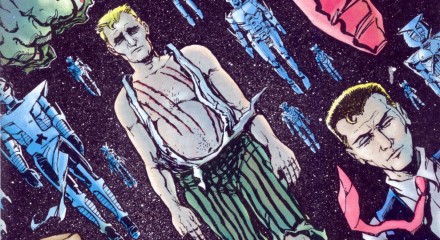
As I continued reading Miracleman, I saw another parallel developing. It began when I saw the twisted fused twin skeletons inside of the British government’s secret Spookshow warehouse: where Miracleman and his kind were created. Originally, I was led to believe that these fused skeletons were the remains of Young Miracleman from his own death, but in reality they were the dual remnants of Young Nastyman: another experiment that went insane and died through mid-transformation within a volcano … or so Miraclewoman says.

That grotesque fusion of two skeletons reminded me of Aristophanes’ myth of love. I know how disturbing that may sound, but I didn’t actually start thinking of it that way until Miracleman himself began to explore his own identity and the line between himself and Mike Moran. According to Plato in his Symposium, Aristophanes explained why love existed by telling a story in which once upon a time mortals were larger beings with two-heads, two sets of genitals, and two sets of limbs. They were powerful and they defied the gods so much that Zeus split them into two. This myth was supposed to explain that love is that need for each person to look for the other person split from them or, as we hear it in our own popular culture, each person looks for “their other half.”

That was the resonance I got when Alan Moore really came to the finer details of how the switch between mortal and divine works with the Miracle Family. It’s almost as though Project Zarathustra, in analyzing the bodies and the technology of the Qys–of fluidly intersexual Titan progenitors–tapped into a place of mythical proportions to recreate that “lost existence” that Aristophanes goes on about. One very interesting thing to note about Aristophanes’ myth is that when human beings were once unified, greater beings it was implied that they could defy and potentially challenge the gods themselves: which was one reason why Zeus and Apollo divided and changed them. Therefore, it can also be implied that Project Zarathustra allowed mere mortals to tap into the divine, to a place beyond the divine, to become a lot more than what they already were and challenge the established order around them.

Aristophanes’ myth that was meant to examine the origins of love and humanity’s potential to divine power is argued by scholars to be a comedic or lampoonish idea to reflect its comedian creator. Yet I find nothing particularly hilarious about this, though it is interesting that it was considered a “comic” idea: one that has translated itself so well throughout the ages. There is also another saying in popular cultural with regards to love as reunion: that just as people are looking for their “other half,” there is also in a relationship reference to one’s “better half.”

This is where I begin to wonder, like a few scholars before me, if the myth of Aristophanes wasn’t created by Plato himself to add a nice neat argument to his Symposium. We can argue whether or not Socrates created his own philosophy too until the cows come home, but that’s not the point here. Plato himself had his own theories about reality and the subjects that exist in reality. He believed that there are two worlds: the World of Forms or Being and the World of Becoming. The World of Being is a plane of perfection. You can find the originals or the perfect forms of anything that has ever existed. You can find the ideal object–such as a chair–or subject–such as a man or a woman as well as thoughts, feelings and knowledge–here.

Then you have the World of Becoming, a gradation of said perfect forms into more worn and degraded shapes. They deviate or change from the ideal and ethereal prototypes that they come from. The idea is that we live in the World of Becoming and that we seek the World of Being. You can see here, and I’m sure my high school philosophy teacher would be proud of me at this moment, how this Platonic thought influenced the Western idea of Heaven and Earth, or Heaven and Hell.

When I read Miracleman, I saw an interesting parallel with this Platonic conception. Miracleman and his kind are the perfect forms. When they are not used, the forms are kept in a place of pure energy known as Under-Space: a nice analog to the World of Forms itself. They rarely ever age, they cannot be destroyed through conventional means, they have extraordinary clarity of thought, devastating power, and even their costumes are engineered from an alien material that cannot be destroyed and reflects the moods of their wearers. Their powers and natures are explained as being the result of a psychic field or harmonic around them that they can control. In other words, the Miracle Family practices mind over matter.

My reading of this is that human scientists–degraded imperfect people like the rest of us from the World of Becoming or matter–used a link to the World of Being or the spirit to reverse engineer near perfect forms that mortals can have access to. Even Miracleman explains that he has the same thoughts that Mike Moran does, but he can see them and perceive his world with far more clarity and insight. We can get even more Platonic or Gnostic and say that through science, the Miracle Family gained a greater link to their spiritual, real, celestial selves. It is also no coincidence that Alan Moore, their revisionist, began to embrace further mythological and spiritual elements in his later works and even in his own life.

So it seems clear cut that Miracleman and his Family are their own essential selves having been unified. Of course, it is not nearly so simple as that. Mike Moran, Johnny Bates, Dick Dauntless, Avril Lear and Young Nastyman (or Terrence Rebbeck) did not seek this enlightenment. They were kidnapped, kept in medically induced comas, experimented on, had essentialized clone bodies made for them, had said bodies transferred into Under-Space where their minds would be trained to switch back and forth to by a word command, and were brainwashed to believe they were superheroes in a comic book-like virtual world before being abandoned as too powerful and too dangerous and marked for a termination order which, inevitably, failed.

It all sounds so banal when I summarize their origins like that. In a lot of ways, the Miracle Family are more like the uncanny Freudian doubles or doppelgangers of the mortals which they are linked to. They have great powers and insight, but they do not always relate well to the World of Becoming around them. Some of them are malicious because of this and even the best-intentioned among them have the potential to cause immense and traumatic change to the world.

I personally think that they are all of these things and more. I think that Moore portrayed them as humanity’s need to reach for and become the divine: or to remember its divinity. What happens after the creation of said beings, their own realizations of what they are,  and how the affect and what to share their perspective with the world around and the people who made them is–in mythological retrospect–an inevitable conclusion.

ETA: After writing this article, I’ve realized that you can examine the Miracle Family with a particular focus on identity. Much in the way that Neil Gaiman’s A Game of You really plays with identity, gender and the fluidity and change of self-identity, his and Alan Moore’s Miracleman can also be examined in a similar light. Maybe one day someone will do that … when the damned thing is republished.

Abraxas, legal issues, Abraxas …

Just Write It: The Perils of World-Building

When I was in Grad School, I studied the concept of mythic world-building as the focus of my Master’s Thesis. To study and work with archetypes to build a whole other kind of world–reflective of the one we live in–can be a very rewarding and even more time-consuming quest.

I was talking with an acquaintance of mine about world-building: about doing research, getting the details just right, figuring out how the laws that govern your world actually work, what events have happened before the main story, the various back-stories that have occurred before and essentially the entire works. It is a necessary process: whether you are trying to make a narrative copy of the world that exists around you or a whole new one that–let’s face it–has some basis in history or imaginings that have happened before.

However, too much world-building can cause problems. I know: that sounds really weird, doesn’t it? How can world-building cause a writer or a story problems? How can there be such a thing as too much?

Well, the answer is that there is. Earlier on, I said it was very time-consuming and it is. You can spend months and years creating a whole world and know the ins and outs of every rule and power that exists there. You can spend that time modifying it too and rewriting it: which is all very well and good until you ask yourself where the story is. You know: the spark or idea that made you so enthusiastic to make all of this to begin with.

Like I said, it can be fun to create your setting, but it isn’t fun when you get so bogged down with the details that you can’t write the story that you set out to make. I imagine that this happens a lot with novelists, but I know from experience that it can definitely happen to short story writers.

So now that I’ve stated the situations, what is my advice on the matter? Well, I’d say–just like I said to my friend–if you have a story you need to write, write it. Just write it. You can deal with details and and corrections later. You can expand on what you have. But if you  don’t have anything and only notes, you do not have a story. If you have a crude story, it is still a story and you can build from there: like taking a cutting from a plant and putting it in water … or cloning a whole human being from a limb.

So really, before you get bogged down in too many notes, just write the damned thing: or a damned thing. Damned stories being interesting aside, you will thank yourself for doing this later.

Now, to follow my own advice.

Whoever Hates the Man of Tomorrow?

Alan Moore attempts to answer a question originally of his own making when he created Whatever Happened to the Man of Tomorrow? years ago. This question has been asked a variety of times since the end of the superhero’s Silver Age and has garnered a variety of creative answers.

But why Superman? Why is Superman still so important? I admit: I have friends who simply don’t see the point to the Man of Steel’s continued existence or, indeed, his creation to begin with. One main criticism that people have with regards to Superman is how unrelatable he is to the reader. I mean, come on now, none of us can generate heat rays out of our eyes, fly, possess X-Ray vision, make freeze-breath, or be invulnerable. Certainly, no one has Superman’s “boy scout” morality without any other very human flaws and failings to match it: if that.

I can understand why Batman is more relatable. He is a human being who has used material resources and pushed all of his human skills to their limits by sheer obsession and utter will. If anyone should be the Man of Tomorrow, gender connotations notwithstanding, you’d think it would be Batman. Certainly, many people have a great love of the vigilante: of the person that goes beyond the law, becoming extra-constitutional, going beyond the polis–the city-state–to become a god or a monster to see that proper justice or vengeance is done. And there are heroes being venerated today–perhaps throwbacks to the ancient literary heroes–who are far more brutal and even more morally ambiguous than Batman.

And Superman? He is a “goody-goody.” He is so much a goody-goody he is too good to be true. Whereas Batman operates beyond the law or within its blind-eye, Superman obeys the law in as much as he can save innocents and capture criminals. Perhaps there is little difference, save that the law seems to like Superman a lot more or accept that he is beyond them: that he is using his powers to uphold the law and safety to a fault. Indeed, you could say that Superman has more a lovable personality: or is more personable and wins all popularity contests through his sheer good nature while Batman fights with fear as his weapon. Fear does not make you popular or loved: but it gets the job done.

But is that the only thing Superman has over Batman and others? That he is more lovable and makes a show of following rules? That he is superhuman and chooses not to obliterate the world? That he ignores or reshapes the reality of the world? Or worse: does he continue to patronize his friends, his allies, his enemies, and the human race by presuming to always save and stop them? Is his alter-ego of Clark Kent, according to Bill in Kill Bill Vol. II, simply a grotesque critique of what he thinks a human being really is?

The truth is, when you look at Superman, you see an incredibly powerful being that could rule and destroy the world. He could rip us apart like insects. Yes, Kryptonite can hurt and kill him but he has enough knowledge to protect himself against it. In fact, the knowledge and intelligence he possesses from the Fortress of Solitude that is his Kryptonian birthright and from his own experiments is enough to dominate and destroy all human kind. There are many people who–if they had his knowledge and power–would do exactly that and have very little qualms about doing so. Some people in the DC Universe already have.

It is already clear that Jerry Siegel and Joe Shuster based him off of Friedrich Nietzsche’s idea of the ubermensch: a being that has grown beyond the constraints of morality and limitation to choose their own path, yet they injected “good old morality” into this alien superman and made all of his achievements naturally-born and inherited from the dead.

So why is Superman special? Why do I think he is special? I might have written some of my answers already but–if I had to sum it up–I would have you consider the following.

Imagine finding out that you have the power to crush steel with a punch or even just the touch of a hand. If you wanted, nothing could ever touch you. You can move as fast as or beyond the speed of light. If you jump, you will jump extremely high and eventually be able to fly: but you need to somehow know how to control where to go or how to move given that you still have a humanoid form and it is not built with the instincts for flight.

Now take all of that–never mind the fact that you have to learn how to control your temper, your passions and hold your parents or your lovers carefully so that you don’t crush or hurt them–and then add an alien birthright whose most modest lore could detonate the world many times over and again: possibly taking you and everyone you love with it.

Your merest touch could kill a person and your slightest knowledge could destroy them. It makes for a lonely existence doesn’t it? And yet, somehow deep inside of you, you not only find the will to master all of these powers but you actually want to use what you have to help other people. At the same time, you just want to be like other people: even though deep down you know you never truly will ever be. You don’t want to be thanked, you just want to help and out of all those things you could do, you choose to do so.

In Mark Waid and Alex Ross’ Kingdom Come, a horrible calamity happens and Superman gives up on being Clark Kent. We see a person who lived among humans, who loved them, who had friends among them and wasn’t alone become an out of touch and distant Superman who only responds to the dead name of Kal-El from an equally dead and distant world. It is a Superman who still wants to do good and still feels bad over the loss of life, but he can no longer relate to anyone that he wants to save and people cannot relate to a person who looks upon them as so … lesser than he is.

He becomes the genius that cannot relate to anyone and garners misunderstanding and even contempt: because if a superhero, like a genius, cannot relate to those they save or even us readers then they have failed in a very fundamental way.

Unlike Bruce Wayne whose civilian identity is a mask for Batman, Superman is Clark Kent. He was born as Clark Kent and even though he isn’t human, being Clark Kent has taught him control and about life. As Grant Morrison demonstrates with a bright and essential freshness in his Superman All-Star, the power has not mastered Superman as it has so many others.

Superman has mastered the power and like the ubermensch he chooses his morality: which is to help people. At the same time, he is like Thomas Mann’s Tonio Kroger: who can see the dance of humanity around him and even replicate it artistically but is never really a part of it. It is his strength and his sadness and yet he finds the joy in helping others find joy. Very few others in fiction or the real world could ever be like that.

I write a lot of dark and conflicted characters yet once–long ago–Superman was one of my earliest childhood heroes. And in some ways, he still is. I’m glad the idea of him exists. I’m glad he exists.

Thus concludes another episode of Matthew Kirshenblatt writing about superheroes. Up, up and away my friends.

Legend of Zelda: Link’s Enlightenment

I’d like to say that this is another video game review, but that isn’t exactly true.

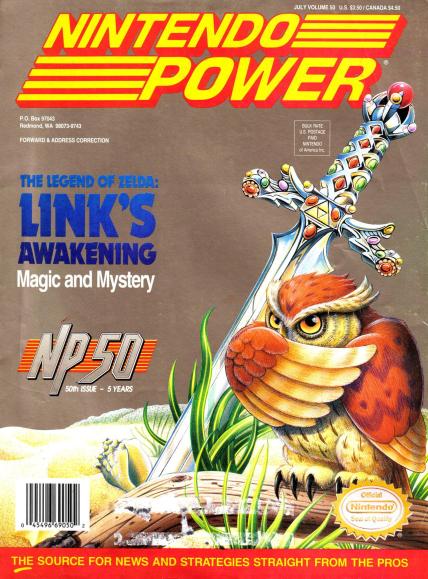
I first heard about Legend of Zelda: Link’s Awakening back when I used to get Nintendo Power Magazine. I remember that day. It was the summer time and the bus dropped me off from camp in front of my old elementary school. My Mom was there with Issue 50 of Nintendo Power that I’d been waiting impatiently for. This is what I saw:

http://countzeroor.files.wordpress.com/2010/10/magazine-nintendo-power-v6-7-of-12-legend-of-zelda_-links-awakening-1993_7-page-1.jpg

This mysterious owl sat near the sword. Originally I was annoyed that my copy of this issue got tattered, but it and the faded tan-bronze cover only added to the mystique that Nintendo no doubt wanted to build around this issue and the game they were featuring in particular. Well, for me, it worked.

It didn’t work in getting me to get the game however. Not initially. And when I did get it I didn’t really have as good a head for puzzles and video game combat strategy back then. By that point, my friend who’d gotten the game before me proudly spoiled the ending: or maybe I asked him. I don’t actually remember. So I don’t know why I picked up the game again years later, but I did. By that point I had a little more common sense and I’d played a few more games. Also, I’d read some philosophy: a lot more philosophy.

You are Link. You are on a ship in a storm that leaves you marooned on a strange Island. You figure out that the only way to get off of the Island is to awaken the Wind Fish in its egg on the top of the highest mountain.

There are puzzles and mysteries and secrets. You have many moments: most of them fun, a lot of them dangerous and you get to know the mysteries of Koholint Island. There are strange people, weird creatures, a talking owl that periodically advises you in riddles, a man who eats things he shouldn’t … and a girl who likes to sing and just spend some time on the beach with you.

I’m going to go into Spoiler Territory right now. Unlike Super Mario Brothers 2 where the “it is all just a dream surprise ending” just seems like a cop-out, in Link’s Awakening it is a gradual realization that comes with some sadness at the end of the game. In fact, the spirit of this game is perhaps even more emblematic of mono no aware–of understanding and having empathy towards the impermanent beauty in life–than even Terrangima.

Then you take the chronology that Nintendo claims the Zelda games all have into account. Personally, I liked the idea that each game in the series was a “legend”: a story with some elements of history but each being an account that has ultimately been changed over time as memory fades. However, in this case, I like that Link’s Awakening apparently happened after A Link to the Past as I’ve understood it.

Let me explain my take on Link’s Awakening and what I feel is really significant about it. From my North American understanding, there were three games before this one–the two Nintendo and the Super Nintendo ones–and all of them involved Link rescuing Zelda and dealing with the Triforce.

Here is how I see Link in this game. He has done all of these heroic things, but after he has completed them, he’s tired. In Hyrule, he is known as the rescuer of Zelda and the hero of the Triforce. If he had a normal life before this, it is gone. Maybe he just wants to get away. Maybe he lost much of what matters to him. Maybe he just doesn’t know who he is anymore.

The fact is, before this point Link didn’t seem to have an identity outside of being Zelda’s hero and the gatherer of the Triforce. Link’s Awakening, despite the franchise title, is Link’s story. It is not only a hero’s story, but the story of a man who journeys into his own subconscious. The owl that he finds on the Island is that part of him–the wise being or animal archetype–guiding him through this inner journey. Every creature and obstacle is his unconscious mind trying to keep him in a state of ignorance. Every time Link reclaims or gains a new item, he starts to remember more of who he is: or begin that process of knowing who he is.

You can  get even more Jungian and say that Marin–the girl he meets–is his anima: the feminine aspect of his mind that reveals things through subtle intuition and actually has him pay attention to the things he has taken for granted in the other games. He plays around, he laughs and he learns to enjoy the sunset and the sentiment that can feel when watching it. He also has to face Eight Nightmares that could represent emotions or attachments: seals of power that keep the Wind Fish–or Link–from waking up, while the ultimate Shadow Nightmare at the very end of the game symbolize the essence of his greatest personal fears and then ultimate universal horror.

He has to gather eight instruments to create music from a tune that Marin sings him to get into the egg that the Wind Fish sleeps in. And when the Wind Fish wakes up … it can fly. And it does.

It is a symbol of awakening: of enlightenment. It is a symbol you would find in some Eastern thought or even in a very mythological way. I know you can easily say that the Wind Fish dreamed Marin, the Owl, the Nightmares and the entire Island: that they were all aspects of its dreaming mind.  Link might even be a part of its mind and it has awakened to another reality. It is a valid interpretation given how Link physically wakes up on a floating rafter in the ocean. Does a man dream of being a pebble or does a pebble dream about being a man? Does Link dream about the sleeping Wind Fish and its Island, or does the Wind Fish dream about a sleeping Link?

The thing is, when I talk about all this, I believe I’m actually talking about Link as a symbol and not necessarily with regards to the ambiguous continuity that Nintendo is trying to make between games. I think, that at that moment above when Link destroys the last Nightmare and wakes up the Wind Fish, he is really awakening himself. At that moment, in that moment, Link is more than just a silent hero that goes around fulfilling tasks and doing what Zelda cannot or will not.

When Link wakes up the Wind Fish, when the illusion of maya that is the Island disappears, when Link regains consciousness: he actually gains consciousness. He expresses emotion through his interactions with everyone on the Island: each one of them aspects of himself. He realizes he has a whole world in himself that is a part of a reality outside of him as well. He experiences mono no aware: that sorrow and acceptance with regards to the passing of beauty in life. In one tiny hand-held 8-bit console with grey graphics or crayon-colours, Link is depicted as having achieved enlightenment and self-knowledge. For the first time, the hero of Hyrule knows who he is. He someone who dreams and is dreamed of. He is an archetype.

For the resources of the time that made this game, isn’t that just … beautiful? I’d really like to think so. I know many of you might think that I am reading too much into this and that it is just a game. Certainly I would not say that Link’s Awakening is a tool for personal enlightenment, though it is tempting to say in a creative sense, but it does depict some cultural depictions of it well. It is a beautiful artifact and I’m glad I knew it. Obviously, if this were an official review it would be getting five out of five.

I would like to leave you with just one more thought. When Link wakes up, it’s as though it was all a dream. When we finish playing a video game, the game is over. We put down the console or turn off the computer and go do something else. Our interactive electronic dream is over. Yet do all of those challenges and experiences: and those touching moments all fade away and mean nothing because they were not physically real? Did they not happen? Somehow, I don’t think so because, even when we finish sleeping, our dreams never really go away.

They continue stay with us. Because dreams are memories too.

https://i0.wp.com/www.projectcoe.com/wp-content/uploads/2012/04/tumblr_legu6rTqGz1qaaf7po1_500-300x269.png

Creativity and Academia: The Glass-Bead Game That Never Ends

It’s amazing–to me–that I forgot to talk about this at all in my review of Hermann Hesse’s The Glass-Bead Game. I was originally going to write this as an addendum to the piece, but then I realized that the issue I want to address actually covers some much broader ground.

One that that is always stressed in Hesse’s novel by the Castalian Order that developed the Game is that it is not their role to create new things. Castalians are not supposed to be artists, but scholars of a spiritual bent and–according to them–anything that comes from the Game is simply to be contemplated and there is great discouragement against changing the rules that create and make up the Game proper. Basically, the Game itself seems to have been developed from pre-existing knowledge and there is usually great resistance from the Order itself in altering any of the rules or guidelines that were made to create it.

However, it is not only this. As I said before, creativity apparently is discouraged in Castalians in general: but that is simply not true. At one point in his studies, Joseph Knecht is encouraged–like other developing students in his Order–to write creative pieces about what they could have been in their lives. Also, he makes many changes to the rules of the Game even before he is Magister Ludi and they are accepted. Knecht could–of course–be the exception due to his gifted nature and not the rule–but it goes further than that.

To combine different disciplines together to create different patterns of expression is creation. There is analysis and study involved, but there is a synthesis of the parts into something new. Therefore, even during Knecht’s time before his reforms and his demise, the Glass-Bead Game–a contemplation exercise of intellectuals and academics–is a creative venture.

It reminds me of why I chose to pursue the Humanities at my University and why I pursued them in the way that I did. I learned about a great many things to do with literature, philosophy, history, social theory, and even to an extent art and expression. My program was by its nature very interdisciplinary and it looked not only at how certain philosophies and conventions work, but what forces make them and why.

Humanities also encourages scholars or humanists (as they are apparently called) to apply a plurality of “lenses” or “frames of reference” to a particular subject. For instance, when looking at a book we would look at the history of the culture that it was written in, the philosophical movements that existed then, the potential other sources that might have influenced its creation, the writer’s life, and how that book influenced other books and other cultures even and what the implications of what that book says might mean and how it might have meant different things to different people. So instead of looking at it from one view or lens, the theory was that we were to look at a thing with different mental tools or perspectives. We are even encouraged to look at how those tools and “lenses” were created: and why they exist the way they currently are.

All of that can be really difficult to articulate and sum up into a few sentences. Indeed, when people asked me what my Major was and I told them it was Humanities, more often than not they didn’t know what I was talking about: or they had a very different understanding as to what the Humanities actually is. For instance, the University of Toronto’s Humanities is different from York University’s: in that the former has certain divisions of Humanities, while the latter has an entire program that combines all those elements together: or tries to.

The fact is, for me, it often seemed like my Program–and maybe even Humanities as I know it–seeks to justify its existence by trying to be a discipline like Science or English. Sometimes even I feel it is just a “jack-of-all-trades while mastering none” perspective or that I personally just possess a whole lot of “party-cocktail trivia” and nothing more compared to the specialists of different fields. Personally, to make a gaming digression, I think of it as multi-classing and spreading certain dots or numbers of Experience Points out that–while it may take a while–will eventually pay off a very well-rounded character.

My role-playing game analogy and tangent aside, sometimes I felt like–just with the Glass-Bead Game of Castalia, the Humanities is very stringent on its guidelines of scholarship and what scholarship is because it is a “relatively young” discipline as we understand it and it wants legitimacy. The thing is I think both are already legitimate and allowing for flexibility in what scholarship and academia can be–by allowing for change–they distinguish themselves. I know sometimes I really wanted to say that I shouldn’t have felt like I had to apologize for my choice of Program and–more specifically–the Humanities shouldn’t have to apologize for what it is.

As an interesting side-note, apology originally was derived from the concept of defense: defending your perspective through logical debate known as argument. I also think there are many other ways to make your point instead of being defensive or not testing what your discipline–or your medium–can do. Film and comics were very similar to that regard in that both wanted to “fit in” and be accepted but they are different. I know I’m making a lot of very potentially bad analogies here in equating disciplines with media, but in my mind they are very similar if not one and the same.

What I love about the Humanities is that it let me put so many things together–it let me be analytic and synthetic–and I think I had more opportunity to do so in that discipline than anywhere else. I got to look at my favourite authors and writings. I got to analyze some of my own stories in a final paper. I even wrote a comic book script as a final assignment in another course: using my knowledge of the course material and comics media. I know York has an Interdisciplinary Studies Program as well where students are encouraged to do independent work and even create art as their final project.

As you can see, I feel very passionately about this. I think that gathering and critiquing knowledge is important, but that once you try to look at the why of something–to contemplate it and its application to yourself … to look at the human in it–creating something can be just as important. I like that my Program allowed me that freedom, for the most part, and it’s just amazing how The Glass-Bead Game applies to so many of these issues that I’d been thinking about for a very long time now.

I firmly believe that when you make a work of any kind, you create knowledge: and that viewpoint challenges not only what scholarship is, but what art is as well. There was a time in history when apparently there was no division between what was art and what was science. They were all apparently unified under Philosophy along with a whole other lot of disciplines we separate and specialize now. I’m obviously not saying that other disciplines are not as important or that their distinctions should be eliminated: specializations can be very important because they focus on a particular subject or task quite efficiently and with necessary detail.

But I like the differences in the discipline I chose and that potential for growth that I always felt there. It certainly feels like it fit my mindset: at least at the time. The best part is that even when school is out, you still keep learning about the Humanities. You can still keep making things. The Game doesn’t end after you graduate college or university. It doesn’t end when you leave Castalia for the unknown. You keep playing and, you know, I think that is a very good thing.

Comics Review: Miracleman: The Making of and the Human in a Superhero Utopia

There have been a lot of articles and discussion on this matter. J.C. Maçek III gives a very in-depth background into the history of the creative and legal controversies behind Marvel/Miracleman and his comics, while Julian Darius talks about why Miracleman Matters and how it is a prime example of the Comics Revisionism happening in the 80s. I kid neither myself nor you in that there is a lot more out there: more than the actual comic itself.

I find it amazing how much one superhero and his comic can complicate things. I personally think it is ridiculous and a crime against humanity that the Miracleman series has not been published in ages. In fact, it is patently ridiculous that it still isn’t out yet and it’s been this way for decades. The only way you can even get hard-copies nowadays is to find the single issues at certain comic book stories, or ebay, and be prepared to spend a lot of your hard-earned money: anywhere from hundreds to thousands of dollars. I really wish I was making this up. It is a bloody crime and I hope that any legal bullshit that still exists is rectified at least in my lifetime.

But I’m not here to rant about creative legalities. Rather, I want to talk about this series because I read it and I have a few thoughts on the matter that I really want to get out there. They will probably not be as detailed as those in the above links, but I will do my best as always.

Essentially, without giving much away, Miracleman is about a superhero that finds out–after years of forgetfulness caused by trauma–that he is a lot more than he appears to be: and I don’t mean that he realizes he is a superhero. That last is the least of it. Alan Moore revised this character from the hero’s comics Golden Age days when he was Marvelman and part of the Marvel Family: the latter of which he also revised too.

What can I really say without spoiling it on the off-chance that you might read it one day: or at least not spoiling it too much? Alan Moore takes the archetypal building blocks of this super-hero and to say he revises him and his world is an understatement. It is more like Moore rips into the spine and gives us a “behind the scenes” look at a two-dimensional plane to reveal a gritty, grandiose third-dimensional reality that blows your mind. The comics of Marvelman become a mask for a much larger world.

It is a story about a man who finds himself and does not realize what he has found. It is about a relationship that changes. It is about how a human being would really deal with super-heroism and what that is. It is about a former ally becoming your worst enemy, and showing the world just how horrifying a madman with super-powers truly is. It is about finding out that your old arch-nemesis is your creator and needing to surpass that. It is about Project Zarathustra, the Spookshow, comic books as mythology, and saving people’s lives for “their own good,” and the potential consequences thereof.

To say that Miracleman is a critique of the superhero is another awful understatement. All I can say is imagine Watchmen and what it does to the masked hero and his or her superhero successor, and then imagine a series that is somewhat “broken” (in the sense of it sometimes having gaps but also being insanely powerful) and goes an entirely different route from apocalypse and dystopia.

I was first re-introduced to Miracleman through an article I found in my own Master’s researches into mythic world-building called “What if the Apocalypse Never Happens: Evolutionary Narratives in Contemporary Comics” by Abraham Kawa in a volume entitled Comics and Culture: Analytical and Theoretical Approaches to Comics. Aside from it also talking about Alan Moore’s proposed “Twilight of the Heroes” which is a very fascinating concept in itself, it deals with how humanity would handle the world being saved after becoming so reconciled to its ending.

That is the challenge that Alan Moore leaves Neil Gaiman as he finished his run of the Miracleman series. Some people apparently this was really cruel of Moore. I mean: where do you go from such a seemingly close-ended conclusion? Where do you go from up? How does humanity deal with a utopia on Earth crafted with the best of intentions? Just how does humanity survive perceived perfection?

And that was Neil’s creative challenge to answer. Darius, along with a few others, says that Neil Gaiman’s writing and concepts in his Miracleman run were not on par with Alan Moore’s. However, I disagree. I think that Neil was given an incredible challenge, but one that his mind worked with. Think about it: Alan Moore created a background and a world. He crafted and borrowed and mythologically re-adapted the main players. He set certain events in motion.

But what I think Neil did was that then he looked at the other half of the equation as it were. In his Miracleman: Golden Age run, Neil looks at how ordinary people like you or I would interact with this utopia that Moore left in his wake. They are still human beings and still have their strengths, their weaknesses, and their differences. It is still a physical world. Yet Neil also taps into that great mythological well and he plays with the form of the comic to an awesome degree. Miracleman # 20 was by far one of my favourite stories: reminiscent of Stardust and yet so different. It crafted to look like a children’s story, but it is a children’s story about a very different kind of child and a very different reality where the stars are dangerous but also wonderful. He tells a grown-up and a child’s story. I think it was one of his best works and it is a damned shame that it is not accessible. As far as I am considered, that comic alone demonstrated what great mastery truly is.

Also, Issue 22–with the Carnival celebrating life and death, and the balloons in the sky– actually made me cry because it was that fucking beautiful, and I use my profanity here for tremendous emphasis. Some of the earlier issues were a little awkward, but they definitely hit their stride and there is a lot of innovation but always that human element. Even Darius mentions in the above article that there is some considerable nuance in Neil’s Miracleman stories. Alan Moore can obviously utilize the human element, but he tends to be more grandiose and ideological I find: while Neil always finds the mystery and the human and he shows you that the story never ends where you think it will.

And he could have ended Miracleman after The Golden Age, but he went on to a Silver Age that … never ended because it was unfortunately never continued. Miracleman is almost a lost, and incomplete masterpiece made by two mythopoeic genii. It makes me sad to think about it, but I’m glad I did manage to read this and I feel so much better as a reader and writer for it.

I would give Miracleman five out of five. It may be broken. It may have its issues and some plot gaps, and some copyright issues by having visual references to both Marvel and DC in it, but it was well worth reading and its worth as a story far outweighs its legend as the unfinished, ligated product that people still talk about and wait for. As for me, I earnestly look forward to the day when I can link to it here, and when I can buy copies for myself to hold in my own two hands.

Kimota, ladies and gentlemen.

The Source and Its Creative Feelings

A little while ago–most likely in my article “The Onus of Creativity,” I made reference to the age-old question of where writers get their inspiration from. Or what specifically is the nature of the energy that powers a creator to make a work of any kind, and can you actually sense that energy?

I believe you can sense that energy behind someone’s act of creation. As to where I get my inspiration from and what the nature of that energy is for me, the answer is really one and the same. In X-Men: First Class, Professor Xavier is attempting to guide Magneto into–not only to using but–mastering his powers. He tells Magneto to envision moments of greatest joy and the most horrendous pain. By combining these feelings, by drawing from the well of passion and clarity that they both come from, Magneto is able–for the first time in his life–to consciously and concisely access the full range of his powers.

The point is: the place that Magneto draws from is love and hate; joy and sadness; serenity and power. One of my Creative Writing teachers once said to us that when we write, we should always write from a place of calm and detachment but–while I agree with a lot of that in principle–that is just not how humanity nature, or its art works: at least not in their entirety.

One way you can look at it if you’d like is that emotion and sentiment–even interest–begins the impetus for, and the creation of structure and clarity. Viewing emotions in a calmer retrospect has its advantages. Yet art is also about expressing yourself: even with violent splashes of paint across a canvass. I believe that there is that “knife’s edge,” that X-Men: First Class, among other creative places makes reference to: that tenuous ground between elements and emotions that is a whole other mindset in itself.

It is also not a precise science. Sometimes you feel more than you think, or you are more sad than angry, or more angry than happy. There are different mixtures of all emotions, impulses and thoughts: known more kindly, again, as human nature. People always tell you when you feel conflicted to “express it” or to even “write it down.” Sometimes the process is calming, other times cathartic, removed, continuous and nagging, and whole other kinds of varieties thereof. And that knife’s edge can slip from one direction to another: or even become a sundial whose shadow is determined by the outer world and the place you choose to find yourself situated on.

But whatever it is, it is unique and not the ultimate thing. Those energies will always be there by virtue of what you are as a person, but it is the vessel that matters more. It is the thing to maintain and focus so that you can use those energies to make whatever you want or need. That vessel, of course, is you and it is a task that is easier said than done.

It is easier said, but it is necessary.

Dreams of Lost Pixels, Hand Eye, and More Video Game Ramblings

I know I’ve said this before, but I am not a video game expert. Like I’ve said, I’ve played some video games in recent times but I have been very eclectic about what I will play, or even watch being played. It doesn’t mean I hate them and I do keep track of some that really catch my eye. I’m very partial to role-playing games and the only reason I hadn’t played as many as I would have liked is because I have had issues with time and money: in that I don’t always have a lot of either.

But I am interested in video games: specifically their game-play, their story lines or premises, and their choice of aesthetics. I like the idea of an interactive story that can translate itself or spread itself across multimedia.

I don’t say this often, but at one time I wanted to be a graphic designer in order to make video games and animation. Unfortunately, I didn’t really have the programming skills and the teachers that I had couldn’t teach me in a way that I could engage or absorb. It’s funny because, once, I really used to love technology. Some of you might laugh at this: those of you who know me personally. I used to think that video game technology, for instance, along with the Internet and computers would only get better with time and it could only go up from there.

I’m not sure what happened. I think I was into PC games a lot and I never had a good enough computer. I also didn’t want to get sucked into online games and I saw the quality of some console games change and not for the better. Also, in my How to Turn a Medium into a Genre I mention how I felt a misguided amount of shame for playing “old and obsolete childish games.” I’m also glad I really got over that nonsense. I do think the real reason I don’t like to play many video games is because I know I will get invested into them if they are really good and I get worried about losing time and also getting too … attached to something: to the point of being sad when it is over, or upset when my skills fail me past a certain point. Sometimes, as weird as this sounds, I get concerned about caring too much about a game.

Now, let me say this: I was really happy to be at the Comics Vs. Games element of TCAF this year. I really loved just playing some of the games with some person I just met there. It felt different and new. To make this story, if you want to call it that, even more interesting as a person who has not played a lot of contemporary video games and likes to watch a lot and remember old games, I have been interested in writing plots for and–really–just writing video games.

I know: now I am just a paradox. Now before anyone starts to tell me how foolish these thoughts are, I am aware of that. I have read and heard enough from some people in the industry–or who are getting into it–to have a little bit of an idea as to how hard it is to get into the industry and to do the amount of work and research to create a game. It isn’t something to do on a whim.

So, like I said, I came across Comics Vs. Games and saw this situation where artists were being paired off with video game creators to make games together. And … I don’t really know what to say: something in me just felt really happy to see that. Another part of me also felt immensely jealous because–once–it was a dream of mine. I am a writer. I have not really published anything for monetary gain as of yet and I am not exactly at a stage where my writing is popular. I know I am not there yet.

So I went back on to the above website and saw that Miguel Sternberg–the indie game designer and pixel artist who organized Comics Vs. Games–has been working on a new project. You should definitely check out his page Spooky Squid Games because there are a lot of very innovative and intriguing goodies on there that you probably all know about because you’ve kept with the times: including the game Guerilla Gardening: Seeds of Revolution where the object of the game is to play as protagonist Molly Greenthumb who gardens to subvert a totalitarian regime. Essentially, you grow plants to not only improve your city, to make it “green” again, but to also allow provide morale to other citizens to peacefully overthrow the State. It sounds like a cheerfully subversive game that creates a social commentary about our own culture and also refers to a few similar instances of this phenomena that have actually happened in our world. In fact, it has resonance with Roger Doiron’s TED Lecture My Subversive (Garden) Plot.

But the game that has really gotten my attention–just today–is one called They Bleed Pixels. God, I can’t begin to tell you just how beautiful I find that title. Imagine a pixelated Goth girl character who can change her hands into claws as she goes and kills creatures with pixelated stylized violence and blood. You literally see tiny squares of red gush in fountains as she creates combo attacks–with numbers appearing above them–in midair sometimes. I really like the deceptively simplistic aesthetic and the music suits the background.

It makes me genuinely happy to see something like this. There is also another interesting gameplay element in that “save points” have to be made by you and you have to expend your own points gained in battle to make them. In other words, it costs you to make save points and makes the game more challenging and forces you to be more versatile. It makes you interact with that world much more: giving you the power to manipulate your reality but also having to play by the ad-hoc rule you make for yourself. The controls are apparently very easy and precise to make without having to resort to ridiculously complicated button-mashing to fight, though I am just repeating what I have more or less read. Also, I read that they are making a silent comic to tell this character’s story about her interaction with a Necronomicon-like book and beyond.

I would definitely play this game: if only to relieve some blood-lust, which is always a plus for a game in my opinion. It might not be an RPG, but it looks fun and I like fun.

You know, sometimes I feel like I’m a fake for writing about video games and other things of which I do not have expertise. But do you know why I am writing about this? It’s because it interests me. It is partially the world-building and interactive parts, but it also appeals to a part of me I don’t always get to express. I’ll let you in on a secret too: I actually wrote a very rough script for a RPG video game: one that would definitely need a Restricted Sign if I ever posted it serially here or anywhere else: if only because of its sometimes tasteful, though definitely (if somewhat questionably) mature content. It was a 16-bit game with some ideas for interactive game-play. I actually think of it as a parody of an RPG video game script with a lot of meta-narrative fourth-wall breaking.

I’ll also say this: if I ever get to the point where I am considered a professional or well-known “artist of words” and someone ever offers to do a video game collaboration with me, I will probably not turn them down. In the meantime, I have been looking at the Hand Eye Society which is a non-profit organization that deals with organizing video game projects and supporting Toronto’s video game community. I’m not sure if they are still having socials, but they have mentioned volunteer opportunities on there and I am contemplating finding out more about this.

I may well be an amateur writer and general enthusiast, but when I look at these links I realize that these people do things with the medium of a video game that I never thought possible or really thought about and I think that is just bad-ass. I also really love creative things and it would definitely be something new. In any case, it is something to think about. I hope that this has been an interesting, if somewhat long post.

The End?

Steampunk, Cyberpunk, Dieselpunk, Mediums, Genres, and Making Choices

Going to the Steam on Queen Fair on Saturday made me think about some things. And despite the adage that if there aren’t photos it didn’t happen, I was there. There were booths with various things: including a squid-headed cane (which I still insist was Cthulhu without his batwings), a decoration of a spider made out of metal parts, some vintage-looking ray guns, and so on.

What really got me–though–were the costumes. Some people really got into the spirit of the thing in an insane way: with women in elaborate bodice-dresses, hats and coiffed hair, men in suits, and people even wearing turn of the twentieth century summer dresses, bowler hats and suits that looked more at home in the Prince Edward Island of Anne of Green Gables and Road to Avonlea than twenty-first century Toronto. Add some clock-work props and Steampunk aesthetics and you pretty much see what you get. It was like going into a time-warp.

The event took place at the Campbell House off Osgoode Station and it was like being in a shady verdant bubble of alternate Steam Age reality while being surrounded by a busy and summery contemporary world. The inside of the house had various Steampunk exhibits: one drawing room looking like a makeshift Victorian workshop and laboratory while outside were singers and even a bawdy dance or two. But one group of people that really caught my interest were two women sitting on a blanket in the grass dressed as though they came from Avonlea: The Lost Ladies of Zion Schoolhouse.

These lovely and adorable ladies–having found themselves lost from 1910–are on a quest to find their way back to it again. They also represent the Gibson House Museum and Zion Schoolhouse which hosts birthdays, historic dinners and special theatre events using said “costumed” interpreters to immerse people into a Victorian-Edwardian frame of mind.

But after going to this Fair, I started thinking about Steampunk: as well as more pesky considerations of how to view a medium’s growing complexity. Steampunk is a science-fictional genre–with consequent costume aesthetics–that generally operates from an alternate nineteenth to early twentieth century that utilizes the power of Steam in its day-to-day technology. Yet I have always felt it was more than that. I always believed that Steampunk hearkens back to that old Victorian utopian mindset of Science being a power of benevolence and constant progress. You can see it in a lot of Victorian literature and media of that time. Yes, in the genre there are people who use Science and Steam Age technology for evil, but they are always countered by “the good guys.” There is swashbuckling, an ideal of honour, and a lot of anachronistic versions of modern technology powered by steam and sometimes–if it is very special–there is still magic and the supernatural coexisting alongside all of this as well.

It seems a sunnier world, doesn’t it, or at least the conception I’m talking about. I have a friend who thinks Steampunk is all about the costumes now and a certain kind of elitism: which I think is hilarious seeing where it derives itself from historically and culturally. But on Saturday, all I saw was people having fun and one can never get tired of seeing that. I also think that Steampunk is our time’s way of creating a genre–a sort of retroactive genre–of an alternate form of progress where Science and Adventure are still seen as these great forces with good intentions.

Because of course you have Steampunk’s alternate: Cyberpunk. If Steampunk is an attempt at utopian fiction, Cyberpunk is dystopian. It is a world where generally technology and science have invaded the lives of its people to an insane degree. These worlds are generally polluted and corruption is everywhere and no one of authority can be trusted. There generally aren’t “good guys” in the traditional sense, but there are definitely survivors. I think that for a time we leaned more towards Cyberpunk because it was exemplifying just what our world was turning into. I also think Steampunk was a reaction to that dark mindset: because while Cyberpunk seems to talk about where we are heading, Steampunk seems to be a deceptively nostalgic genre that talks about what could have been … and yet by doing so, it encourages what could be too.

These are both obviously generalizations. It is tempting to get caught up in them. For instance, there are some historians that say that the Western world’s general optimism about Science and progress was ultimately destroyed at the advent of World War I: when that same knowledge that should have helped people was used to destroy and degrade them instead. It is tempting–at least for me–to wonder if there would have been a World War in an alternate Steam Age. Of course, there could have been: just with different tools because human beings do not change that much with different technology.

But I sometimes wonder what our world would have been like without World War I. What would have happened if those generations of young soldiers hadn’t died? Or what would have happened if the Holocaust had never occurred? Who would they have become? What would our world have been like?

You see how tempting those lines of thought are. I guess you could say: “Okay Matthew, maybe you should write a book or story about that or something instead making these suppositions,” and I’d say sure: when I am more qualified or there is an angle that catches my mind and I can build on with the knowledge that I have.

I’m also tempted to talk about Dieselpunk: about a genre (some say a sub-genre of Cyberpunk) that has 1950s technology and a 1920s or 30s culture. You can definitely find influences from Steampunk and Cyberpunk: save that it is a genre that centres around the internal combustion engine, diesel fuel, and the discovery of nuclear power while computers and the Internet are not quite there yet. I believe it is still a contested or developing genre and subgenre and I find it amazing just what can actually be classified under it. It is a genre I am really interested in and I think I can relate to a lot more because it is closer to our world and time-line in a less nostalgic way. Of course, there are a lot of Buck Rogers and Flash Gordon moments in this genre as well: as exemplified by Sky Captain and the World of Tomorrow. Hell, you can even say that Captain America and the Hulk are some examples of Dieselpunk superheroes if you’d like: with the retro-50s aesthetics, science-fiction serial feel, mentality as well.

And here I go on a tangent again. As I was thinking about all of this, I started thinking back to what I said about video games–about how mediums can turn into genres–and I began to ask myself this question: what does it mean when a medium can turn into a genre? What does that mean? And I think that if I had to give a one-word answer, it would be choice.

I think that when you can choose to go beyond the technical and ideological aspects of a medium–of what you can materially and creatively do–then you can create a genre or something that defies genre entirely. When you have the options, or make the options to do something different with a familiar convention, when can choose to do so, that is the moment when everything changes and variances can be made. It’s about there being an option and therefore being able to make a creative choice.

Because, in the end, that is what being creative is about. It’s about making choices and knowing that we can always do so: whether you want to dress like a grease-monkey, wear a soldier’s uniform with a clock-work eye, look like a hacker, draw it, or write about all of it.

I think I’m going to let the “Lost Ladies” end this entry off. Though I imagine it to be somewhat frightfully inconvenient to become lost from your own time period, there is just something encouraging to see them making do with their picnic basket and afternoon tea. If only getting lost in time were that convenient and pleasant. Say your hellos, ladies and gentlemen.