When You Wish Upon a Star, Far, Far Away …

So this is an unplanned post. For the past couple of weeks I’ve been writing these posts in advance so that I could have a block of time to deal with my creative collaboration and other writings. But this is something that I feel I have to address in some way.

Anyway, a day or so ago I was in the middle of playing Kan Gao’s To the Moon–an excellent game which I will talk about in more detail at another time–about the day after Hurricane Sandy when my Dad starts talking to me about something. He had been listening to the news and he told me that not only did Disney buy out LucasFilm, but there are going to be three more Star Wars films starting in 2015 and onward.

At the time, I thought was some kind of joke. It just didn’t make sense. Then after I finished off To the Moon, I went online to see what was going on and I find out that George Lucas has retired, apparently made some script outlines for Episodes VII, VIII, and IX, and that Disney is going to help make these happen.

So. Here’s the thing.

What do I think about this?

The answer to this question, as of right now, but it may change as I continue writing this post is that I honestly don’t know.

You know, once, a long time ago in a galaxy far, far away that was the last dregs of my childhood, this would have made me fucking ecstatic. I always wanted to see what happened after Return of the Jedi. I wanted there to be more. In fact, I was so attached to the characters to the point of them feeling like friends to me that I really wanted to see them again. When I first heard that there would be more films, I thought this might be it and, hell, they might even incorporate things from the books: of which I am mainly talking about Timothy Zahn’s Thrawn Trilogy.

Instead, after buying those Special Edition video cassettes and listening to interviews with George Lucas, I found out that the new films would be Prequels: the story of how the Star Wars universe as we knew it became what it was. I was a little startled, but I was still very enthusiastic. Mainly, I was kind of scared to wonder what happened to Luke and Leia’s mother: which was a source of great mystery in those days.

Then the Prequels happened.

Yeah. I wrote a post on here which pretty much sums up what I think happened creatively with the Prequels, but I would just like to add that I think a few fanatics like myself were spoiled by two things: that we were no longer children and things like Ewoks (though I would never compare Jar Jar Binks to an Ewok, because Ewoks are awesome) just didn’t really relate to us anymore, and that what we saw in the films didn’t match up with the spirit of the Expanded Universe. I’m talking about the books, comics, and video games. Yes, I know it’s nerdy and also anal to focus on continuity and that it says something about  person when they wince–painfully wince–at every preconceived notion of a creative work becoming no longer … consistent.

But then I look at some aspects of the EU, and realize that there were inconsistencies and painful moments of chagrin even then, but I think I–for one–was so hungry for extra Star Wars then that I just didn’t care. I wanted to see my friends again. Nowadays, I still like seeing them but, wow, I would tell them to lay off the ridiculousness.

I think a lot of my own issues with the Prequels are due to my own idea of what I thought the Expanded Universe was like, and my own sense of continuity (I will not link to ItsJustSomeRandomGuy right now with his “Continuity song,” I will not), but at the same time sometimes you just need to take something as it is: right there, and right in front of you.

So when I hear that there will be more films … I really don’t know what to say. Oh, I will be watching them. I’m not even going to delude myself. I remember my friends and I were talking and some of them thought that a Star Wars “reboot” would do wonders for that universe. But this isn’t a complete reboot: this is a continuation. At the same time though, it’s a new film narrative that can be written and depicted differently. I’m not very familiar with legal and directing processes, or how a corporation manages creative property and, really, the creative process, but Disney bought Marvel and we have The Avengers film. I may be propagating some sort of logical fallacy by writing this, but I felt like I definitely had to mention that.

The truth is, when this is all said and done, I still don’t know what to think. But I guess if I absolutely had to say something, I would say that as long as I am entertained, I am willing to see just how far this can go if only to see more John Williams’ Star Wars music get created … and just to watch the Internet go insane.

And who knows: maybe we will finally know what Yoda is … or something.

So I am going to be evil and wrap this up with these closing statements. When these movies happen, all I can say is may the Force be with you … and let your conscience be your guide. 😉

Building a Character to Make a World: Our Project Continues

About a month ago, I said that Angela O’Hara and I would working on a comics collaboration together. So here is an update on our Project thus far.

I gave Angela a whole list of comics artists to research in order to get the right aesthetic for our world. The following inspirations were Jonathan Lethem’s Omega the Unknown, Chris Ware’s “The Super-Man” stories, Saint-Exupery’s Le Petit Prince, the rugged elementalism of the anime Gurren Lagann, Sarah Howell, and Neil Gaiman’s run of Miracleman.

At the time, Angela was not completely sure how to go about this: which was fair given the fact that all I had seen of this world I’d envisioned were a few scenes and figures inside of my own head. It’s amazing how something in your mind cannot always be so easily translated into real life.

After a summer of proposing this Project, I was galvanized into action when Angela said she was going to be pursuing her drawing career full-time now: which is excellent because she is a gifted illustrator and a comics-creator. This was when I realized I needed to give her what I had and, once I did, I realized I gave her more than enough to work with at that point.

In the end, I created a fairly detailed back-story (or at least something far more detailed than what I thought it would be), some character outlines and descriptions, and even some notes on the minions that I’m keen on including in this strange new world of ours. So armed with artistic inspirations as well as character descriptions, names, a background story, and a rough idea of the main plot Angela began drawing.

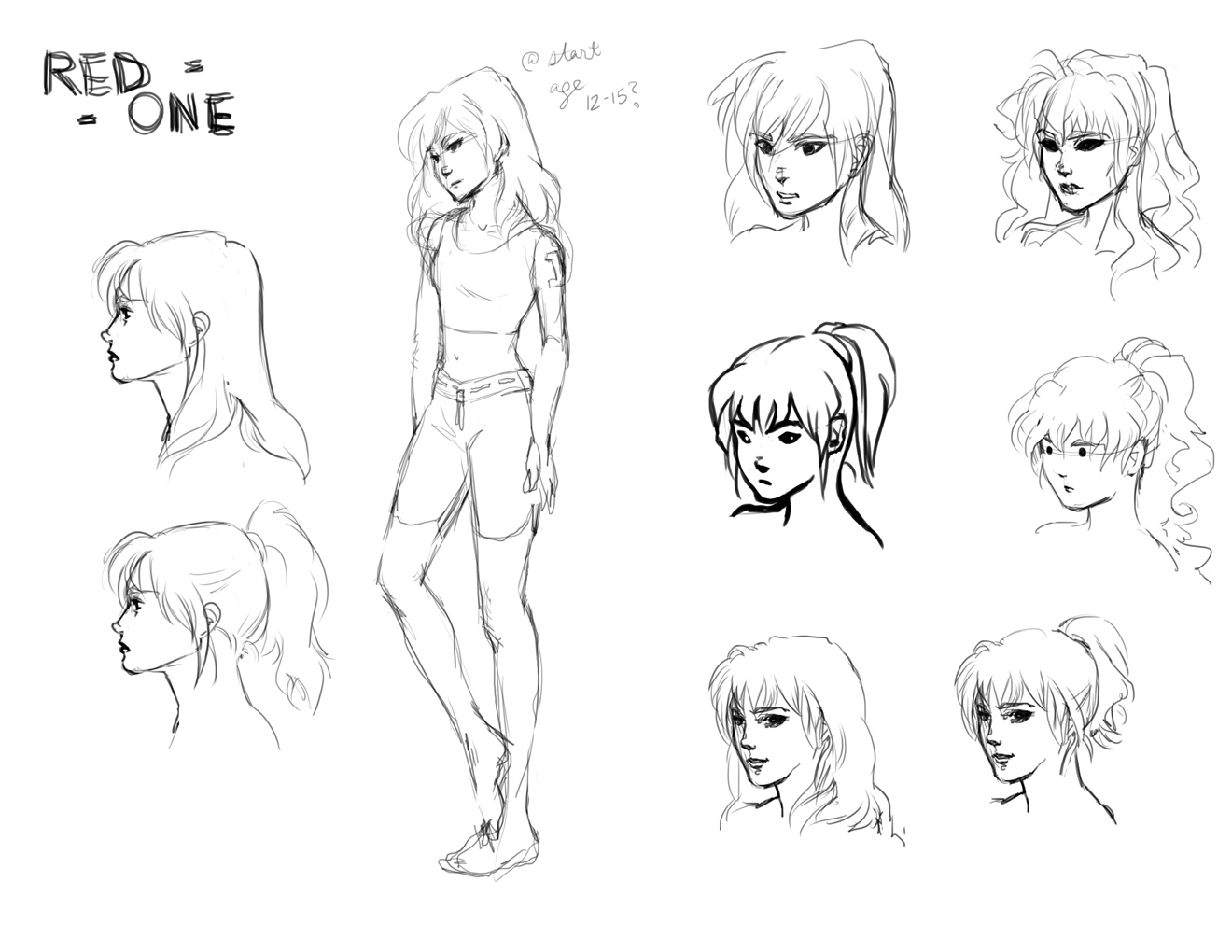
It was when she sent me these first pictures that the challenge really began. As you can see, they are all excellent illustrations of the main female protagonist. Usually, I could have just selected a few and suggested some details here and there, but her features were not as distinct in my mind as I would have liked. Then I started to think about what the world would be like: specifically what we wanted our aesthetic to be.

For two days, I thought about this and luckily Angela and I managed to talk about it. She told me that she wasn’t completely sure what aesthetic–of the inspirations I chose–that she was supposed to use so she decided to draw different pictures of our character in various styles. I felt really torn: because I wanted to see this world as an elemental place of basic shapes but some very realistic elements, but Angela drew all of these really good illustrations. It made me question the fundamental substance of what I wanted our world to look like.

But Angela has a good way of asking the right questions. Not only did I manage to answer some of her questions, but I started to add some details of my own. Another question that really got me was how old our protagonist was going to be and what she would be wearing before she got her costume. These were definitely questions that I needed to answer and in the end we decided on her being twelve or so, with rudimentary clothing that she had been forced to create herself.

Angela was also curious about what costume our character was going to have. She experimented a bit and showed me this:

This is what prompted me to tell her the idea I had with regards to the main character’s costume: and how that was going to fit into the plot. Let’s just say: it’s less than she chooses the costume, but rather that it chooses her … and in unexpected way.

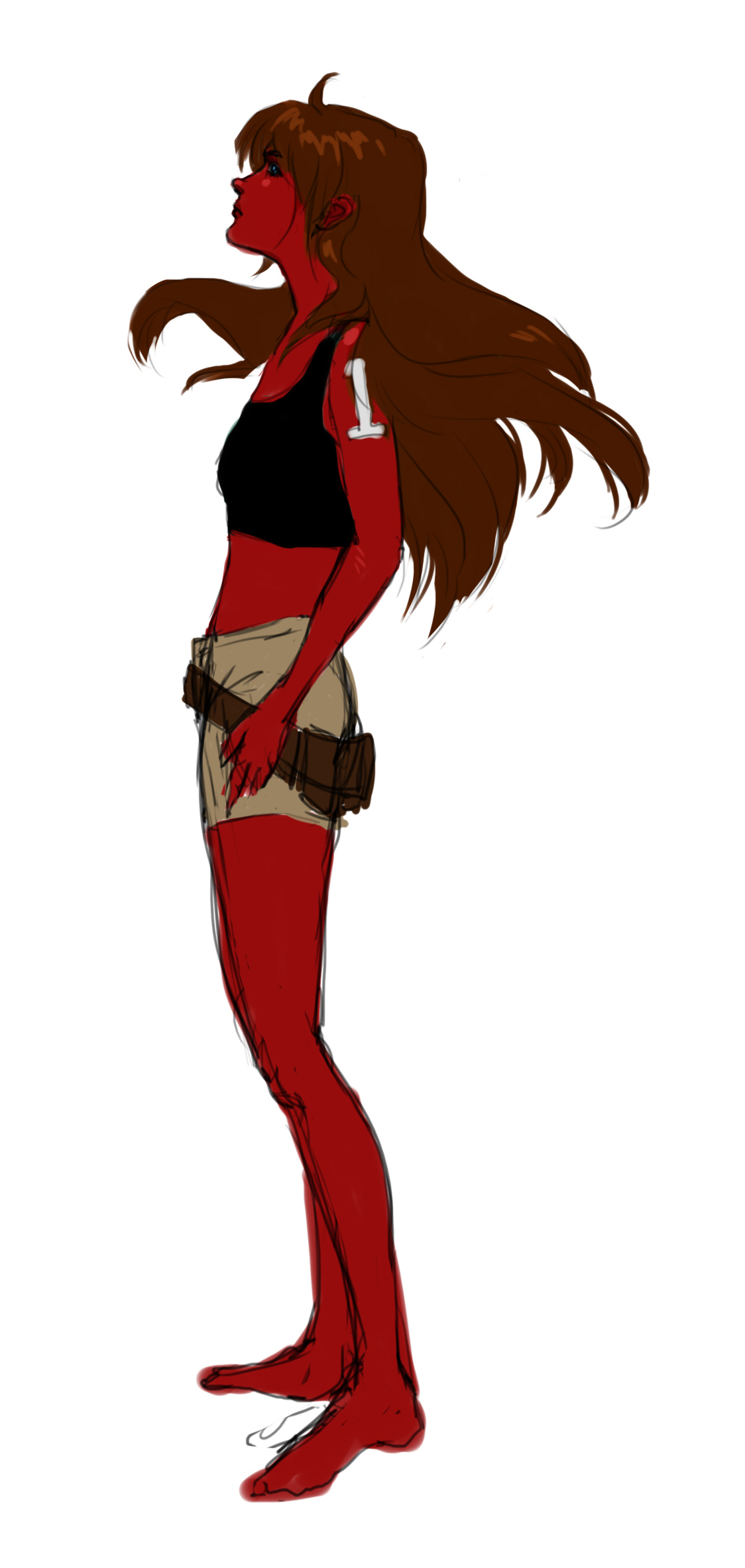
Finally, Angela had an “Aha!” moment and after I chose a few of the profiles that she created and made some suggestions, she managed to mix together something of Saint-Exupery, and something very reminiscent of Mark Buckingham’s drawing style in the illustrated story section of Miracleman #20: Winter’s Tale. As you can see, our protagonist looks like she is painted and has very bright colours. And yes, you’ve seen it right: she is red. 🙂 As of right now, this is the closest working illustration and aesthetic that we have and Angela is still working on it: along with drawing out a few more of our characters. It is just so beautiful, lush, and artful.

Another excellent advantage to having this working model of our whole aesthetic is that I have inspiration. There is nothing more buoying than seeing something you envisioned becoming as close to a tangible image as can be made possible to really encourage you to keep creating. The added bonus of this feeling is that with our last Project, Thebes was supposed to be based off of our re-interpretation of mythology: of stories and characters that already existed. With this Project, we are making something relatively new: something that didn’t exist before quite the way we see it.

I mean, I know: I understand that all superheroes are archetypes and variations of Superman or older mythical figures, but the characters in this story have their personalities and I try to look at the basics of what they can do as much as possible … of which I am now figuring out. It is also very helpful that, right now, Angela and I are on a very similar wavelength in figuring these details out.

In fact, all of this is a process of figuring things out: as though Angela and I are spying on another world and trying to translate it into ours as much as possible. When we’ve done more work on this–and I create at least a rough outline of the booklet–I will start calling the characters and our Project by name. Until then, both will be as silent and as wordless as our comics work itself.

The Power of the Original, the Creativity of Change

In The Source and Its Creative Feelings, I wrote about the emotions and energy that can power inspiration and ideas. In this article, I’m talking about the material and the quality of it that can fuel that kind of inspiration.

So I was watching the classic 1963 film Jason and the Argonauts last night, and it occurred to me just how much it was tangentially in there in the culture of my childhood. It wasn’t so much the movie itself as it was the aesthetics and the attitude of it. In fact, the only film that really comes to my mind with that same spirit is Cecil B. DeMille’s The Ten Commandments.

Whenever I thought of the ancient past or mythology as a child, I used the imagery of these movies and others like them to inform myself of how both should have looked like. Then I fast-forward this concept of mine by a few years. I used to think that the fantasy genre were all stories like The Hobbit and Lord of the Rings, followed by Dragonlance and Forgotten Realms, and I tried to write exactly like them: especially the latter two series.

I thought that some of my more weirder story ideas–including an alternate storyline with The Ten Commandments–were silly and a waste of time, or at the very least beyond my means and personal faculties to create at the time.

This was before I realized that there was original source material.

Every story ever made is an echo of another story that exists before it, or coexists alongside of it in another form. But every story as a source: a prototype or “Ur-Text” (Ur being a term for the mythical first of something, such as the first ever human city-state) or place that is tapped into.

I believe that every creator taps into that source. However, I also think that the strength of a creator’s link to that source all depends on where and how they tap into it. Originally, I was going to say that a creation inspired by an original source–or the closest known or accessible thing–depends on one thing, but after thinking about it a bit more I realize there are two elements involved.

The first element is, like I said, finding the earliest myths or art-forms that you can read, understand, or learn to understand and take inspiration from them. They are the closest things to the source, or what the famous mythologist Joseph Campbell called “the mono-myth”: the supposed first story that all sentient human stories come from. I feel that once you learn to understand the spirit of the earliest story or source that you can find with regards to your work–and specifically use it to gain your own personal creative slant on it–then you have gained something powerful and you are more than on your way to augmenting or discovering your own creative voice.

But then there is the second element that I thought of very recently: which is that once you gain an idea of the original source material that created the story or story-type you are working on, you must make it timeless in a way that everyone can relate to, and therefore make it relevant. Take what you have learned or understood and apply it to your time and the issues and themes that are important to you as a creator, a person, or even both.

Think about it: before DeMille’s Ten Commandments, or Jason and the Argonauts, all there was to determine how the ancient world was, and how their myths functioned were books, broken sculptures and fragments of art. The creators of both films had to go through all of that material and decide what they were going to use or change. I won’t even go into Ten Commandments, because there have been many other films and stories created from that Biblical tale at different points in time, and even the ancient Greek myth of the Argonauts has changed throughout time and culture as well.

But what I am saying is that the creators of both looked at the original sources as much as they could and made something, and added character and motivations that audiences could relate to. Even J.R.R. Tolkien looked at ancient Nordic tales and history in the creation of his Middle-Earth: which in turn informed how a lot of the fantasy genre derived from it would be for a time.

Like I said, I do think that knowing the original source of something gives you a special insight into that thing and in making something that is either a homage to it, or a unique derivation. This is what I have adopted for a lot of my writing and creation process. It gives you more to work with and more to change should you choose to do. And that is the key here: knowing the closest source gives you more choices … especially with what you want to reveal what is important to you about them and other people.

When I was growing up, I took films like Jason and the Argonauts with its stop-motion clay animation less seriously than I did the developing CGI graphics coming around then. But now, looking back I realize just how much of that influenced the creation of CGI and what film-making could be: as well as storytelling. Maybe it’s because as a culture now almost everything that is “retro” or considered old is popular and new again. Of course, as some other popular cultural articles suggest this could be all be just part of a cycle that happens with every decade or era.

My era of the 80s and onward, as well as the things that inspired them in earlier years, has become a lot of my source material and now I am starting to realize that I can express it. This is a good thing. The possibility that some of the quirky weirdness in some of my stories may have been inspired by Joss Whedon’s irreverent flippant dialogue in Buffy and other shows is an added bonus: from my perspective anyway.

Really, I just like creatively messing around and reading and watching old, good things and good new things for universal and innovative storytelling ideas. I probably could have summarized this whole post into that one sentence, but there you go. 😉

Seriously, Story? Get Out of My Head! And Then Writing With That

So this was me a few days ago.

I already know that I need to work on my collaboration, but I have this story idea. It was supposed to be a minor one: one of my old usual one-off post stories I’ve made in another forum but something happened.

It’s not an unfamiliar feeling. I found myself staring at a blank screen. The story was there–mostly clear in my head–and I was looking at this screen and became very aware of the fact that I needed to move my hands to write the thing into existence. If I didn’t move my hands, or find the energy, this story would not exist at all.

So I switched away from my writing screen because I got tired of looking at it and vowed to go back and do something with it later. I was in the mindset of that I needed to get this story done so I could do my other work. So I sat at the screen again and condensed what I knew of the events into a post. I had a lot of details that I also needed to keep track of and I didn’t write them down because this was supposed to be a one-off story and it was also supposed to be one bloody post.

This occurred on and off for three days or so: with fits of procrastination and writing some posts for this Blog. The story sat in my head: sagging under this heavy weight that was beginning to put me into a very autistic or at least one-track mentality. I guess some would consider it borderline obsession, but the fact was I couldn’t ignore it and it was too big to warrant one post.

All right, fine. You win story. I’ll give you more room. So finally I started writing it and once I had that first line, I thought, “Okay, now I know you will get on the page.” I even changed one of the main character’s names as I wrote it and it worked. I had everything figured out more or less. So you think that it was smooth sailing from there, right? Right?

The answer is no. Hell no.

Then I found myself making more names. The next thing I know I am calling up back-stories and keeping them in front of my eyes like translucent membranes while writing character dialogue and interaction. After I made my first post, each one came slowly and methodically with many pauses in-between as I had to keep my concentration and self-discipline in line.

Before I know it, my one-off story has a whole ton of world-building behind it for something that was supposed to be a somewhat intelligent parody of a genre. I mean, I was prepared for the fact that I was layering my story and the nuances of my characters, but this was getting ridiculous: fucking ridiculous. I used to be able to write several pages of interactions in a day and I was getting bogged down because I wanted it done and out of the way so I could move onto other things.

I had to fight with some depression: with the possibility that no one was going to read it, with asking myself if I was just trying to impress people, with the fact that it wasn’t going to be any good, and the fact that I was spending way too much time and effort on something that should have been a one-off and very few people are going to see anyway. But I was also asking myself why I wanted to make this story. What was so important about making it and placing it where I did? And that was when I realized something: that sometimes when I create, it’s not a river rushing through the structure of me, but it’s me fighting against myself.

Basically, I was fighting against myself: trying to overcome myself to finish this story because I knew that once the damned thing was done, I would feel a lot better. I don’t think it’s any coincidence that sculptors sometimes beat the shit out of their clay to make what they want. It is just as much frustration as it is a need to create.

And I’m using profanity for a reason here. Creating can be tedious but also an ugly, messy business that tears into the blackest, dirtiest, filthiest parts of your psyche to express something from inside your mind into words. Sometimes, as I wrote this thing, I thought maybe I’m old. Like I said, I used to write several pages a day of things but my brain also likes to keep making things intricate and build-up a conflict to the boiling point.

Now, once that build-up was finished and I got to the action, I actually moved pretty fast and was caught up in the moment. It was so strange. Before this, it was like I was boring holes into a blank screen with my eyes–willing something into existence–and actually feeling my head get congested and feeling heat radiate off of my body as I sweated. It was like that energy kept ebbing and waxing–like I was visualizing something inside me consuming itself–until, finally, I found that rhythm and I just felt that creativity blaze inside of me again.

At one point, I had to eat voraciously because I had burnt that much heat moving and squirming around. But by that point, I was almost done the entire story. And when I did, I felt this tremendous sense of relief. I overcame myself. I’ll tell you, I don’t always succeed in overcoming myself but it is always feels like a success when I do.

Of course, I still feel like writing more things. I also have to remember to pace myself and not rush matters. There are other things going on with my life that also contributed to my sense of needing to do my primary work, but I know that I can’t put all creative and personal facets of me on hold to work on one thing, and I shouldn’t. I put pressure on myself. But at least, even though it may have been an engineered battle in my head, it was–this time–a battle that I didn’t lose.

Fate, Fortune, and Freewill: The Challenges of Table-Top Role-Playing

https://i0.wp.com/us.123rf.com/400wm/400/400/excessmind/excessmind1201/excessmind120100004/12044191-big-orange-marble-twenty-sided-die.jpg

So during my last game session with my friends, one of my characters seems to have died. This would actually be the first time I had a character that died in a table-top role-playing game. Sir Vaeric Aedrin of the Order of the Imperial Knights was last seen drowning in a sandstorm in a desert on Mandalore. Why did this happen? Well, very simply enough: he failed his Survival and Endurance rolls on the D20 system and the last I saw of him was him being buried in sand.

I’ll admit. I wasn’t very happy. But for the most part I really liked how I role-played him. Sometimes you have to understand that, in at least a D20 role-playing game like Dungeons & Dragons or one that uses the former’s rules, a lot of your actions and their consequences are determined by the role of the dice.

It can be frustrating. You come up with these ideas and you plan out what you want to do–though some cases you have enough additional modifiers to add to the dice number to exceed the difficulty number–and then you have to basically trust in the die or dice not to fuck you over. And sometimes that D20, that twenty-sided die, is not always your friend.

That’s not the only challenge in role-playing this kind of game however. There is also the challenge in creating a personality for your character and to keep role-playing that personality consistently. I like to create back stories for my characters and then attempt to have the character act according the nature I made for them. The thing is, even barring the fact that you could make a roll that changes the outcome of a situation, you have to also take into account that your character will change. It’s impossible for them not to. You have to figure that stress and particular situations will greatly influence them. Your Dungeon Master or perhaps more accurately your Game Master–if they are any Game Master at all–will present challenging situations for you to role-play through. I don’t just mean creating physical obstacles or enemies to kill, but moral quandaries and interactive role-play situations as well.

For instance, Sir Vaeric as well as his commander Sir Kentari and the recent addition Sir Hett go into a Mandalorian base to investigate it: as one of their other team-mates had a calling from the Force that there was something important about this place. They end up getting caught in a fire-fight between two Mandalorian factions. Choosing a side becomes easy in that their new companion Sir Hett is on one side. But it’s what happened afterwards that I’m thinking about. Sir Vaeric is a bladesmaster and a man of honour, yet his allegiance is ultimately to the Empress, or as was his battle cry, “For Empress and Empire.” There are these refugees and the surviving Mandalorians that are protecting them. They are all headed to the same place to, presumably, the Resistance of a Death Watch ruled Mandalore.

Sir Vaeric tactically believes that having more Mandos on their side could bolster their chances of survival. He also thinks it’s the right time to do to allow the refugees–victims of Death Watch’s allies–to have some protection and be able to fight in the Resistance: maybe even as a gesture of good will so that the Resistance will be more inclined to give he and his fellow Knights their Prince back. Sir Kentari, on the other hand, along with Sir Hett remember their oaths as Imperial Knights and see their mission to get their Prince back as paramount. They also greatly esteem their abilities over everyone else’s and have a certain degree of arrogance that is something of a trademark among Imperial Knights. They rebuke Sir Vaeric–thinking he is delirious from a neck wound–and in the end even he sees that refugees would slow them down and attract more notice to them.

In the end, the refugees and their Mando Clan are free to leave and both parties go their separate ways: which is just as well because we also encountered a sandstorm that would have killed all of them had they come with us. But you see with this example of how Sir Vaeric’s personality and his oaths conflict. What complicates this even further is that I was also playing Dravas C’Tor: my humanitarian Force-sensitive archaeologist and he would have definitely wanted those refugees saved. In retrospect, separating the two personalities–as well as what I want to as a player–was definitely a challenge and it can be easy to confuse the two.

Another notable example was when we were all in the desert, Sir Kentari had to make a choice between rescuing his Knight Brethren that fell in the winds and C’Tor. Dravas C’Tor in another game accidentally killed his Master and failed to save the life of his Knight Brother in a previous quest. Sir Kentari would have loved to save Sir Vaeric and Sir Hett and left C’Tor to rot. But his mission was to save the Prince and C’Tor was selected by the Empress to be the negotiator between the Empire and the Resistance: since he had ties with the latter. In the end, Sir Kentari had to save a man he despises, “For Empress and Empire.”

I think another confusing matter that does tend to come up is remembering that there is what you as a player wants or knows, and what you as a character would do. You might think that after a long time of role-playing, it would get easier to differentiate the two, but doesn’t. You will always be challenged: especially when you play characters with different experiences and knowledge. I can’t tell you of the times I wanted to access computers just to remember that I’m not my NX droid, or examine the lore of a civilization and I’m not my scholar character, or even sometimes get aggressive and realize that is how my Sith character would be. Now it is wanting to go into direct combat and remembering that I’m not my Imperial Knight anymore.

The thing is that when I make a character, there are commonalities from my own personality. They tend to be knowledge-based or artistic in some way: even if it is being artistic with a lightsaber blade. But what I know as a player or, as someone who has lived a thousand lives as a player to adapt George R.R. Martin’s phrase, is not necessarily something I know or can do in-character.

So really, I can sum it up like this: I have an idea of where my character has been and where they want to go. There are rules in place to see if what they do actually works or how their actions actually happen. At the same time, I have to make decisions that are separate from the dice rolls. Sometimes, I really don’t like dice rolls and numbers: partially because I have difficulty with numbers, but also I tend to role-play or act out my characters more than rely or depend on my statistics. However, I also try to remember my statistics because there do need to be rules in place–to create a structure–and it is a pretty cool thing when you roll your die and you get a 20 or, in my die’s case, an “EQ.”

I would have been very angry if, say, Sir Vaeric died in the desert automatically and there was nothing I could about it. A lot of players would have been pissed that they hadn’t died in battle. But the way our GM did it made a lot of sense. We had to roll to pass Endurance and Survival checks. We had the chance to succeed or fail. We didn’t just immediately die in an arbitrary way. Also, it’s realistic. When you find yourself in unfamiliar terrain and you’re not prepared to be there or deal with harsh environmental conditions, you are at risk. Weather brings armies down. You can be the greatest swordsman in the galaxy, but when a sandstorm and static electric currents assault you, you’re probably going to be screwed.

I’ll admit that numbers and statistics and feats do play a role in something like a D20 game and I am not always the best at figuring our the rules. But I also know it is a lot more than just numbers or the equipment you get or the back-story you make. In my other article, Role-Playing as Interactive World-Building, I talk about how a role-playing is a creative collaboration and it’s no less true here. Your character will evolve. You will roll twos on your D20 and fail a medical procedure that could have saved a companion’s life. Out of character, you know that’s not your fault, but in character there is the reactions of everyone to consider. You incorporate the results of rolls and actual decisions you make into how you and your characters interact with and change the world you make.

In the end, I’d say that when you table-top role-play, your first collaborators along with the GM are fate, fortune, and freewill. There is a plan and the dice can randomize that plan, and your game might have a particular spirit of its own, but your decisions are still very much important.

Dreams and Dragons, Wolves, Wargs and Wights: Shamanism and Magic in A Song of Ice and Fire

So in my last post on this matter, I promised to talk about shamanism in George R.R. Martin’s A Song of Ice and Fire: especially with regards to some particular characters. If you have not read the books yet or you have not finished reading the books in the series that exist so far, please stop reading this post now because there be spoilers here.

All right. So now that I’ve gotten that out of the way, I’m going to unpack some interesting characteristics that I’ve noticed in some of the Targaryens and the Starks. These two Houses are descended from the Valyrians and the First Men respectively: making them the potential heirs to various kinds of magic that manifest subtly at first and then become more overt later.

First, let’s deal with the blood of the dragon. We know from the novels and the novellas in particular that the Targaryens–a family descended from the mystically advanced and dragon-riding Valyrian Freehold–have members with Dragon dreams. These dreams are highly figurative and metaphorical but they can essentially tell the future or even I would imagine say something about the past. Aside from these dreams, however, and inbred family members that are either genii or insane with predilections towards greatness and fire, the current Targaryens do not seem to possess anything else in the way of magic.
Even with dragon eggs and some knowledge of the maegi–with that mystical group’s knowledge of blood magic–other Targaryens could not bring their dragons back from extinction.

With one very notable exception.

daenerys and dragon

While her brother Viserys seems to have inherited the insanity and pettiness of the family, and Maester Aemon has only the dreams and the genius, Daenerys Targaryen has “dragon dreams” and awoke her dragon eggs. But how? How did she, out of all her family,  properly “awaken the dragon” within her? How did she become immune to fire for just enough time to stay with her dragons on Khal Drogo’s and Mirri Maz Duur’s funeral pyre?

The thing to understand is that is how it all happened. The reader already knows that Daenerys has the dreams. But the dreams aren’t enough. They are the first step it seems. When the dragons died in Westeros, a lot of Valyrian lore and ritual about them was lost over the generations: with details such as how to hatch dragons, breed them, and tame them disappearing into the mists of time.

Now the easy answer to how Daenerys awoke her dragons is to say that she used blood sacrifice to awaken them in the flames and access the latent power inside of her. Then you also have to take into account Melisandre of Asshai’s assertion that dragons can only be awakened by royal blood and then consider that Daenerys’ unborn son Rhaego Targaryen died in Mirri Maz Duur’s ritual so that Khal Drogo could “live” again. This–combined with the maegi’s own death–could have awakened the dragons.

However, there is something else to consider. When Ser Jorah carried Daenerys into the tent where Mirri Maz Durr was performing a ritual to “save” Khal Drogo, she either almost died or something far worse threatened to swallow her spirit. She had a dream of running away from a great blackness and, as she did so, she passed several generations of Targaryens urging her onward to save herself: from the earliest to the last. If I recall properly, even her son was there. It is at that point, that I believe, after this experience that something wakes up in Daenerys: namely the power of the blood of the dragon.

I’m not sure if her immunity to fire was temporary, but it probably was as she has burned her hands after these events. But it seems, to me anyway, that Daenerys accessed the blood of her ancestors and maybe even their spirits to become whatever it is she is on the road to being in addition to the Mother of Dragons.

One important rite of the shaman is to die and be reborn. The flames from which Daenerys Targaryen came from seems to cover that in a very symbolic way. But as I said before, there are others aside from the Targaryens who follow something of a shamanic path.

The Starks are the others that I am thinking about: particularly Bran Stark.

We know now that the First Men and their descendants have the capacity to be wargs: to be able to send their spirits into animals and either control them or influence them through symbiosis. We also know that the “simple minded” can be influenced in this way as well by a warg. An interesting real-world parallel is when you look at people accused of being werewolves, it had sometimes been said that they were sorcerers that shed a wolf skin or put in on. It is metaphorically similar to how a warg works and it definitely has shamanic undertones.

Off-tangent, the mere fact that the Westerosi Houses adopt animals for their sigils and familial-identity is pretty totemic. I’d imagine their ancestors also adopted these traits as protective measures: having the belief that by linking these animals to them they would gain their abilities in some spiritual way. They may have even had shamans or wisemen among them. But some of the First Men’s descendants go further than that in taking “animal skins.” In addition, some tend to have “wolf-dreams”: not merely living through their adopted animals, but sometimes having visions as well.

Bran and most of the Stark children, including Jon Snow, have been having these to greater and lesser extents: though not Sansa because of the death of her direwolf Lady. But Bran and Jon are the most striking of the Starks to this regard. We know that wargs are born, but I strongly suspect that if what Bran’s teacher, the Three-Eyed Crow, says is true about a rarer few among the wargs being greenseers, then something must set off this trait.

Bran Stark’s powers as a warg and dreamer only truly manifest when he’s pushed out of the tower and left to die. He is physically crippled: as though he paid the price for this death which he came back from. The young Stark even has an older teacher to guide him. In some shamanic traditions, a shaman loses a physical part of them before gaining power. Usually, it is their eyes or sense of physical sight but not always. They also tend to have mentors or teachers.

While I do think Bran had the potential for being a greenseer in him, there needed to be a traumatic event or powerful catalyst to bring it out: as with some shamanic awakenings. I also imagine that if anyone else had gone through that fall, warg or no, they probably would not have woken up.

But then we have Jon Snow.

Jon has his direwolf Ghost and has been seen to go into the latter’s mind sometimes. He can’t go into multiple animals yet and he probably isn’t a greenseer. But he does have “wolf-dreams,” and one prominent dream he had at one time was being in the crypts of Winterfell where the dead of the Stark family were viewing him from oldest to the most immediate (if only in perceived disapproval because of his bastardy). Does this sound familiar at all to another person having another dream about their ancestors?

As for Jon’s future, I am just as much in the dark about it as everyone else, but I suspect that if he is as close to death as he is now and he somehow comes back he will not be the same … or maybe he will be even more of what he is supposed to be.

These speculations aside, I know there are problematic elements to consider. I mean, Theon Greyjoy has nightmares of the Winterfell crypt and he isn’t even a Stark: not remotely. And others have dreams too besides some of the Starks and the Targaryens. But there are a lot of really eerie parallels going on here that I just wanted to draw attention to and put in some kind of framework.

I guess in the end it comes down to a discussion of what magic in Westeros and Essos actually is. What is fascinating is that the children of the forest had greenseers before the First Men and we know the children taught the First Men about the land and their magic. It’s stated that children and perhaps even humans that are greenseers change eye-colour or have strange eye hue to begin with. Bran’s eyes seem normal, but there is also a rite in which he has to ingest weirwood seed paste to fully awaken his greenseeing abilities: specifically in sending his spirit in the weirwood trees all over the known world. As such, he has to be physically integrated into a tree to do so.

What is striking is Bran’s master. I suspect that the Three-Eyed Crow is the Targaryen bastard Bloodraven and if he is, and I’m sure he is, he is not only an older man than Maester Aemon was–if you can still venture to call him a man at this point–but he is of Targaryen blood and is a greenseer. We know that Bloodraven was an albino and had red eyes. Targaryens have always had different coloured eyes from everyone else. I wonder how a Targaryen can be a greenseer: if only perhaps through his mother’s First Men-descended Blackwood line?

But the Targaryens themselves, like I said, have different coloured eyes and hair from everyone else and they sometimes have strange abilities. I wonder if there is any relation somehow: at least in how some magic works.

It also makes me ponder another matter. The red priests of Rh’llor in Essos use fire to heal, look into the future and even in some cases resurrect the dead by breathing their fire into a body’s mouth. It makes me wonder if there is some relation to them and ancient Valyria: aside from the fact that the Westerosi Prince that Was Promised or the Essoi world saviour Azor Ahai reborn is supposed to come from the Targaryen line if all things are to be believed or be consistent. I also wonder if Rh’llor was one of the gods that the Valyrians worshipped as well before their Doom: though it is also likely that worship of him came from Asshai-by-the-Shadow. Then you also have to consider that Rh’llor’s great nemesis is supposed to be the Great Other and, according to Melisandre, the god or ruler of the Others beyond the Wall. Certainly, like the Others, the priests can reanimate a person yet they lose their short-term memories, they do not heal properly, and they become essentialized versions of their previous selves … or the animated echoes of their last task.

And this brings me to something else. Aside from the fact that I wonder if the order of the green men on the Isle of Faces have any relation to the greenseers, there is also the nature of a greenseer to consider. They link with the weirwood trees and they know how to presumably influence animals and simple-minded beings: even take control of them. They are apparently so potent that it is suggested that the gods of the First Men are actually greenseers: either still conscious or comatose and dreaming in their trees.

The Others apparently use necromancy to animate their wights. The wights seem to have no personality but they do have remnants of memory that allow them to serve their masters. Their eyes also change colour into an ice-blue: a hue matching that of their masters: the whitewalkers. It is also notable that when the warg Varamyr Sixskins abandons his body for his wolf after he unsuccessfully tries to transfer his spirit into a woman, that he only sees the woman later animated as a wight and not his original body with it. Perhaps the presence of warg blood keeps someone from being possessed or being reanimated in the same way: the character of Coldhands being a potential example for instance.

https://i0.wp.com/images4.wikia.nocookie.net/__cb20110411014304/gameofthrones/images/c/cb/White_Walker.jpg

We also don’t know what the Others–specifically the whitewalkers–actually are. They could be a people or maybe they are constructs? What disturbs me is that no one really knows about the lands they come from or like I said what they even are. There are hints of babies being sacrificed or being shaped into them. Certainly, the fact that they dissolve when exposed to dragonglass is a very strange phenomenon and may be indicative of the possibility that they are constructed, but a lot of that is just rumour and conjecture like a lot of this post.

But I wonder what lies beyond the Wall and the known wildling territories. I wonder if something else is lying in wait and also sleeping: but dreaming lucidly. I wonder if the whitewalkers really are the Others … or if the Others are something far more terrifying.

It’s fun to actually go through all of this. I know I don’t have thorough textual evidence or quotes to back up what I say, but I do see there being something of a pattern here. I just don’t know what it is. Ygritte once said, “You know nothing, Jon Snow,” and that makes at least two of us. I do look forward, however, as an avowed fanboy to learning more as the story continues to present itself.

What’s That Sound? It is the Sound of A Song of Ice and Fire … Singing

File:A Game of Thrones Novel Covers.png

I admit that last week I was not meeting my quota of a post on Monday and Thursday. But in my defense, I had a very good excuse: namely, finishing off reading George R.R. Martin’s A Song of Ice and Fire.

I’ll tell you now: I didn’t originally anticipate writing an article on this series. In fact, it’s ironic because I never planned on reading the series in the first place. I know: that’s blasphemy and all that. So here I was at the turning point of finishing my Master’s Program, typing up and haphazardly organizing my notes on mythic world-building when my friend Noah messages me and asks me essentially where I’ve been for about a year now. I tell him I’ve been writing my paper for that time and more and as well going a little bit crazy.

So he tells me about A Song of Ice and Fire. Now, I only knew about it peripherally. I had friends who were–and are–still complaining that Martin is taking too long writing the books and they spend that time speculating about what happens next. You have to understand, I went through my epic fantasy reading phase where each book is a tome and a half long a while ago at this point. Not too long ago, I was reading and rereading books and articles for my Master’s Thesis. I’d also attempted to slog through all of Robert Jordan’s Wheel of Time series and failed from lack of attention. In addition and I know this is really going to sound snobby, I sometimes have this inherent distrust for something that is that popular: though I’ve ignored that distrust multiple times in the past and this was no except.

But it was also more than that. I didn’t want to start reading something and investing myself into it. Because those kinds of books–if they are good ones which A Song of Ice and Fire is–they will do it to you and I was already becoming a master of procrastination. Moreover, I was afraid of letting more imaginary characters into my head space and investing in them if that makes any sense at all.

It turns out, though, it was exactly what I needed.

It was also very fitting. The irony that I had originally avoided reading a series of mythic world-building because of my mythic world-building project did not escape me and it was a problem that was rectified after letting myself table-top role-play again and hearing in tangent things about Westeros and that world in snippets. You know what I mean: your friends telling you little things about green men and fire priests and politics but not wanting to spoil anything for you because they believe that it is a crime that you of all people aren’t reading this story? Yeah, those kinds of snippets and previews that you read online as well.

So I will try not to go into any spoilers and just make a few writing observations about Martin’s ongoing masterpiece. The best way to start this is to talk about something that seemingly doesn’t relate to anything here but ultimately will.

I’m going to talk about Achilles’ shield.

When I was in Undergrad, I took a course called Interpretations of Homeric Epic where our professor told us about the shield of the Myrmidon hero Achilles in Homer’s Iliad. What is so special about this shield? Well, it is a shield that encapsulates the sun and moon, the world, the people farming it, warring in it, and serves as a microcosm of an entire world: the same world that Homer depicts in his narrative that he applies to our world when he writes or tells it. One possible literary term for the metaphor of the Shield, if you’d like to see it, is ekphrasis: which is essentially a method of describing and bring an experience to a reader or listener through the use of immense and multi-layered detail.

I will freely admit that I took some dilettante-like and potentially inaccurate liberties in defining ekphrasis as a literary device–which Achilles’ Shield represents–but I also think it really describes the intricate details inherent in A Song of Ice and Fire‘s narrative. The books themselves are a source of ekphrasis: along with the weirwood trees and other beings that find themselves becoming more immanent and saturated into their world.

Through a few perspectives, you will find yourself awash in a sea of beauty, sex, cruelty, filth, banality, mystery, hints, poetry, laughter, politicking, battle, subtle magic and death: lots and lots of death. And not just figurative character deaths, but brutal and literal character deaths. Through each chapter from a different person’s perspective, you will watch them interact with this finely woven world-tapestry of things right in front of them and inches away and either watch them change in the process … or wink out entirely. That is what A Song of Ice and Fire is: at least from my own understanding.

What amazes me, however, is not only how Martin can turn a phrase but also how he is able to keep so many details straight–large and small–and make his narrative more intricate, interlocking, and flexible than a Maester’s chain. I sometimes feel like I have to go to a Citadel of my own to get everything straight but his world stretches out so beautifully even with all the horror: and this is not counting the terrifying supernatural menace here either. It does make me despair of the humans in Westeros and that whole world sometimes: just as it sometimes intimidates me as a reader and especially as a writer. I wonder just how Martin is going to resolve all of this.

I could go on somewhat off-tangent to talk about the shamanic element in Daenerys Targaryen and Bran Stark’s journeys, but I might save that for another post. I will however say one thing. The real reason it took me so long to create another post on here was because I was reading George R.R. Martin’s Dunk and Egg novellas: stories that take place approximately a hundred years before his main saga.

I didn’t know if I would like them, but I did. A Song of Ice and Fire is full of intrigue, manipulation, treachery, and politicking–known fondly as “the game of thrones”–but the Dunk and Egg stories look at a hedge knight and his strange squire wandering Martin’s multi-layered world and bringing almost a … purity or simple wonderment to another otherwise dark yet beautiful place.

Now I think I will end this long post with a quote from one of the books. It encompasses everything I feel when I read good literature: especially from a genius like George R.R. Martin.

Martin states, “A reader lives a thousand lives before he dies … The man who never reads lives only once.” If you want to know the context of this quote or indeed of a lot of the things I just said, read the series. You will not be disappointed. I’ve already lived quite a few lives in various forms in the saga of Ice and Fire. I expect there will be more before this is all said and done.

My Best Friend Was a Sith Lord: Tony Pacitti’s My Best Friend Is a Wookiee

I found out on Facebook today that Tony Pacitti’s book My Best Friend Is a Wookiee: One Boy’s Journey to Find His Place in the Galaxy is going out of print. Now, I wrote a review of it on Amazon, but now I feel like I have to say something more about it.

Tony Pacitti himself has said that the Star Wars galaxy and culture has changed so much that his role is smaller in it now. Some of the Amazon commentators themselves have written that Pacitti talks about his own life more than Star Wars and that at the very worst, his reminisces are very self-indulgent and have no value.

I think it’s safe to say that I disagree with all of the above. Pacitti talks about a period of history: from the 1980s to the 2000s where the cultural impact of Star Wars and geekery is seen on people growing up. He uses himself as a prime example obviously, since his work is a memoir, yet what I find really striking is just how much his childhood and experiences have in common with my own. Pacitti talks about television shows and games that existed during the same period I grew up in: from Saved by the Bell to Magic Cards. But more than that, he captures that feeling many people had after the Original Star Wars Trilogy ended: that need to see more. It was the need to see and experience more of that universe.

So I too delved into the Star Wars Expanded Universe. I too bought as many books that described that universe in more detail. I role-played in that universe and so did my friends: so do we still in fact. My friends and I watched the Old Trilogy long after the 70s where we hadn’t been born yet and we had similar reactions to the Prequel Trilogy: reactions that have great sympathy with Pacitti’s own.

I’ve written about Star Wars on here before with regards to what my actual issues with were and what I think George Lucas had been trying to do in an ideological way. I won’t rehash them except to say that Lucas too had been influenced by his own childhood and young adulthood to create what he did. Pacitti was definitely informed by what Star Wars represents. Star Wars is a space opera: an epic fantasy with a backdrop of space, a setting with technology, droids, and aliens alongside human beings. It begins “Long, long ago in a galaxy far, far away,” but it is closer than you think.

Star Wars contains archetypes that we can all relate to: facets of different kinds of sentient existence. These characters are accompanied by powerful leitmotifs–by thematic music created by John Williams–to bring out the terror and wonder in us. Is it that inconceivable that a film series like Star Wars, having ingrained itself into the popular consciousness and playing our collective unconsciousness, could have informed our time period after the 70s? I know there are many other films that have done something similar, that this element is what people look for when they want to call a creative work a classic or something seminal: a seed of an idea that leads to something else.

Shouldn’t a classic also be judged by how it influences not just a large amount of lives, but one life? Tony Pacitti manages through a caustic wit to identify himself, and himself in relation to a culture that has not changed at all: in that it is only still growing. So I agree that the culture around Star Wars is changing, but it is still Star Wars and I think that Pacitti’s role in Star Wars–at least with regards to what he wrote in this book–is still relevant and important. I for one am really glad that he wrote it and that I bought the thing when I did two years ago.

We all want to identify ourselves with the things we love because we adopt them or feel sympathy with them as a part of us. So once again Tony, thank you for writing this book and thank you for reminding me who my best friend is.

An Interactive Music-Making Epic: TweakerRay’s Collector Chapter 02

Many posts ago, I set myself the challenge of writing something about Sarah Howell’s silent comic. Today I’m doing the exact opposite. I have been given the challenge of writing an article on a music CD: namely TweakerRay’s Collector Chapter 02.

This might be a little unusual for me, but I have always loved epic music and TweakerRay’s Collector definitely falls under that designation. But how do you write about music? For me, I’ve learned to do that in my own writing: describing the harmonics of certain songs that I like and trying to find words to approximate the sounds that I hear. Certainly I’m not completely familiar with music or music-mixing terminology enough to write about it under those terms. My friend who gave me the request to write this, however, requested that I write about what the music makes me feel and what story is revealed to me by listening to it. In some ways, looking at the soundtracks with that frame in mind makes it easier for me to talk about.

First, let me give you an outline of what you should expect to find on the CD itself.

There are thirteen tracks in Collector Chapter 02. In addition, there is a Demos and Instrumentals section where TweakerRay gives you different mixed versions of his songs, a PDF version of the booklet included with the CD which I will go into more detail about later, and an actual Commentaries section dedicated to many of Collector‘s tracks by TweakerRay himself. So if you want to know more about these soundtracks in a technical way or by music terminology, TweakerRay explores his tracks in that fashion far better than I could.

There actually is a narrative that TweakerRay himself creates in his CD. TweakerRay’s Extended Play Collector Chapter 01 (the second half of which was called “Digital Ghost” and can be found on this Youtube link here) sets up a very strange scenario. Essentially, you hear messages on what appears to be TweakerRay’s voice-mail: a few praising him, one woman asking him what he wants and a man threatening him. The voices all mix together until you hear a man come in, who meets a woman waiting for him there. Not long after, she shoots him and the man calls out TweakerRay’s name before he presumably dies. I always interpret this haunting but active rhythm of hard beats to be TweakerRay himself on the run.

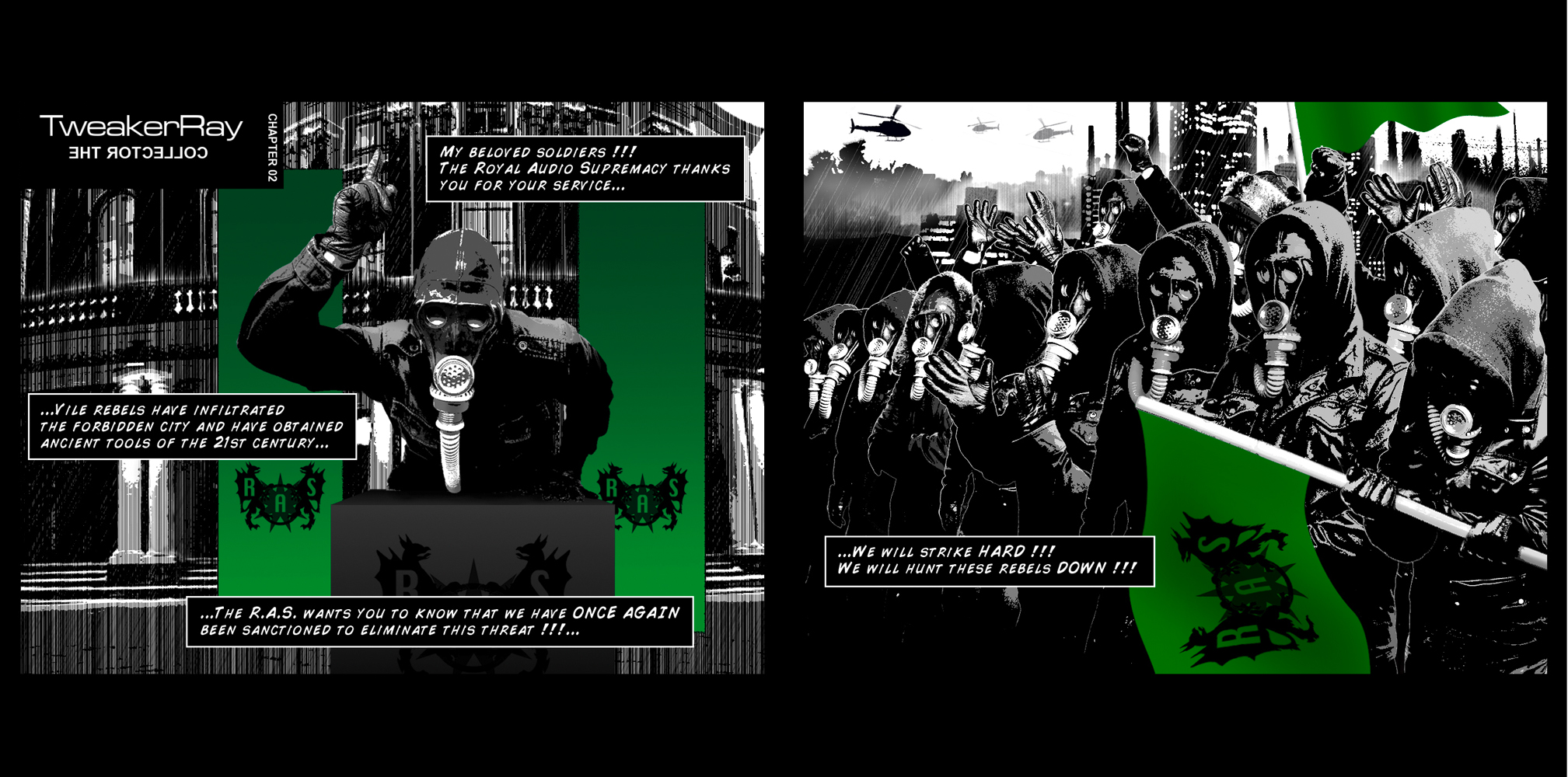
My job, however, is to talk about the songs in Collector 02 … and the booklet. The “Introduction” starts off strong: with a grandiosity and booming power. Years after the events of Chapter o1 and TweakerRay’s disappearance, it heralds and complements the voice of a futuristic dictatorial power: the leader or representative of the R.A.S. (the Royal Audio Supremacy) that talks about how it has banned the dissonance of “old and corrupted” music–declaring it dangerous to people’s minds that is reminiscent of the way that Plato considered art and poetry deadly if not controlled by the morality of the city-state– and how rebels threaten to bring it back. This fascist transmission of censorship also sets the stage of just what kind of world this music exists in. It is a fun, but in other ways a very serious creative premise about freedom of expression and what it faces against a need for perceived safety over that liberty.

Thus begins the instrumentals of Collector Chapter 02: its hard raking beats and piano keys–playing soft like rain–becoming a stride through a fortress city of inhuman glass and metal ruled by this tyranny and one person’s journey in defying this status quo.” Toxic Wasteland’s” rough and wavering rhythms and rising harsh crescendo brings to my mind a panoramic shot of the rest of the world in a stagnant ruin away from the R.A.S. capitol and the passing of forbidden instruments and music between the peoples within it in order to spread this rebellious musical dissonance.

It is “Status Report Sgt. Q” that brings back–with an ominous bell-toll–the vocal to the music. The rhythm is still severe, but there is a realization of horror in it as the rebel Sergeant Q makes us aware of what the R.A.S. has truly done: using censorship and force to pretend to bring peace, but in reality subjugate all people, keep them from questioning and maintain the corruption of their corporations and minions on the Earth. He states that music–the last refuge of creative freedom on and offline–has been censored by the government and its allies. The hard percussive metal beats of the music set the stage for the rebellion that is about to come.

And this is where, as the track title states, some of the citizens of this world “Fight Back.” It starts off smooth and then rises with a reverberating power–with intermittent 8-Bit sounds reminiscent of the Nintendo Entertainment System’s synthesized tones–and the addition of TweakerRay’s voice singing: abjuring that “it’s time to fight back.” But then … something bad happens. In the song “The Shot,” there is one crack of a gunshot that echoes throughout the distance followed by the deep current of a sound almost in denial accompanied by the sad chiming and gradual un-damming of an even more sorrowful crescendo as if the gun-shot itself has become the tragedy. We never know who got shot–if it was a who and not a what … like the idea of expressive freedom itself–but as “The Shot” fades off like a dactyl or a sad lullaby, the listener knows that the stakes have changed.

Sometimes I’m inclined to think it is the death of Sergeant Q that brings on this music or maybe the figure of TweakerRay–the symbol of this rebellion–but those are just my interpretations. TweakerRay himself explains in his Commentary what event motivated him to create this track. As it is, the sound of it just tends to remind me of all the things I’ve lost and it is a powerful song that sings of loss itself.

The tone changes after this. “They Don’t Know” heralds a newer form of rhythmic aggression in a journey or a quest for battle as TweakerRay’s vocal makes its rising fiery resurgence decrying how no one under that government or censorship–that condoned that shot–know exactly what it is that they have done. Aside from the “Introduction” that I love due to its all too seductive fascist overtones and promises of ancient and imminent destruction, as well as the powerful reverberating sadness of “The Shot,” I feel that “They Don’t Know” is one of the most powerful songs of the track and one of my personal favourites. It is empowering in a different way than the trappings of power or deep human sorrow. It is justice and vengeance both synthesized into song.

By “The Hunting,” with its fast–very fast–rhythmic beats and clanking, I can almost see the R.A.S. stepping up its efforts to stamp out the rebels: now realizing that they have only created martyrs by their repressive actions. It’s almost like the conflicting noises symbolize fighting on the streets, in the buildings and in all arenas across the regime. It is the fight for a society’s heart: for a free humanity’s soul.

After this there is an “Interlude,” with even more evidence of winding 8-bit tracks. At this point, it sounds as though there is more subterfuge going on: as though the rebels are passing around more forbidden instruments and sound equipment to the citizens: as though encouraging them to fight for freedom as overt physical fighting happens overhead. Perhaps by “Electronic Beast,” TweakerRay himself, back in vocal form, is abjuring the citizens–who have so far been serving the R.A.S. regime with approved music and mainly silence to “come to him,” to create their own music. While this something of a social perspective, I feel it is a compelling interpretation: where Sgt. Q tells the listener that the Internet has been censored, TweakerRay tells you of “the electronic beast”: of the passion in the communal machine that must yet be released.

Then we go into the steady hard rhythms and rough guitar-string instrumental rhythms of “Collector I” (Collector II and I seem to be reversed order for some reason) which also seems to be something of an interlude as well: perhaps symbolizing the secret actions of citizens deciding what to do with the new furtive powers they’ve been given. Certainly, the synthesized hard-rock crescendos of the song are beautiful to hear in any case.

By “Broken Dreams,” I … seem to run out of words. There is something hard and elegant about this song. It is sad, as though someone–perhaps the figure of TweakerRay–is moving on from his task. It is as though he has done what he has had to. It is less a tragedy, and something more transitory and resolute with its echoing vocals and touching piano keys. He is not that person anymore: he is “broken dreams”: a refracted mirror of many other people now. Maybe at this point in the narrative, he decides to fade into legend, into myth and become not just one person but all people in the musical narrative that want freedom. Thus he sheds his persona to let everyone else free themselves without violence but through acceptance of “what is.” This is also a favourite track of mine, as it seems to symbolize a “moving on” to another life but leaving something important–a legacy–behind.

Finally, there is “Transmission.” The CD could have ended by “Broken Dreams,” but some things transcend that. You see, from what I understand, the message or the medium–the music–has spread. Others are now adding their voices and interpretations and only then–at an ominous screeching echo–does the entire Collector 02 end: on a note feels like it is “to be continued.”

Most–though not all of this–was a creative interpretation brought on by listening to the music and if you expected this to be more of a traditional review of a musical score, I’m sorry to have disappointed you. But not really.

I think that I have said more than enough about how excellent I think this CD is, but before I wrap this up I want to talk about its one other feature.

That’s right: the booklet. The comic booklet.

The booklet was created by the artist and photographer Fotonixe. In fact, each included image in this article is actually the result of her work on this CD. Aside from some very professional stark illustrated green, black and grey backgrounds behind comics-style white font lyrics, Fotonixe actually creates sequential panels of figures to go along with some of the vocals within the CD track. For the most part, she seems to have a very fumetti-style of comics creation: using modified photographs and photo shopped images to illustrate a story. The style is also very reminiscent of the 1980s Slovenian FV Disco: a gritty collage-like yet dark and vibrant artistic style derived from the FV 112/15 Theater that used stills of digital footage, photographs and other images to make–among other things–visual art.

What’s also striking about this reminiscence is that FV Disco was described as crazed mixture of communist and capitalist punk made after the fall of communism in the former Yugoslavia. Even though this may not have been Fotonixe’s intent, it has a great resonance with the themes that TweakerRay has made inherent in his piece and as such is an excellent aesthetic complement to it.

There are two more things I would like to mention: both with regards to TweakerRay’s Chapter 01 and 02. The first is that the excellent audio dialogue of Chapter 02′s “Introduction” was written by the artist B.S. of D., while the artist Freshoil read the audio of Sgt. Q in his “Status Report.”

The other thing I’d like to talk about is that both Chapters 01 and 02 have a very interactive element in them. At some point, TweakerRay asked for vocals and audio from some of his listeners. These elements made their way into 01‘s “Introduction” and 02‘s “Transmission.” In addition to the fact that he wrote his artist persona into his musical narrative as a main protagonist, I’m impressed with how he encourages his fans to essentially collaborate with him in his works and even make remixes of their own. As someone fascinated with interactive storytelling processes I find to be an excellent idea and a good way to cultivate an audience of listeners.

If you are interested in buying Collector Chapter 02, you can get the Limited Deluxe CD here or an MP3 album here. Also, if you are interested in TweakerRay’s work and/or Fotonixe’s art, you can click on both of those links as well.

If you buy the CD or the MP3 album, the following are samples or previews of the tracks that you should expect.

I definitely give this musical work a five out of five. It reminds me of the days when I used to go downtown and dance to hard alternative rock and synthesized electric body music and how epic it all was: and how awesome it can be.

Showing and Telling, Ambiguity and Obscurity: Or Author What the Hell is Going On?

So I’ve joined a Creative Writing group and I’ve so far gone to my second session of it. It’s actually been a long while since I’ve gone to a Writing group and it’s about time.  It also  seems we are all learning as we’re going along.

One thing I’m finding, which is both really weird and really interesting, is how Creative Writing advice can be applied “wrong.” I’m talking about something I find in my own stories and writing in particular. For instance, anyone who has ever written anything has probably one time or another clenched their teeth against that age-old cliche and absolute “Show us, don’t tell us.” It’s easy to say, but it is not always something that you can do. One time, I wrote a story as if I were “telling” it just out of pure creative spite. I could even tell you stories about how many times “Show us, don’t tell us” has been told to me, but that would just be boring.

Instead, I’ll tell you how–over the years–this advice helped me and how I haven’t always applied it well. It forced me to stop info-dumping. You know, explaining every single little thing to the point of ridiculousness. I learned to have all that information in the back of my head or–better yet–written down on various sheets of paper for consultations depending on what kind of story I was making.

So I would write things and slowly reveal the information. I even toyed with vague descriptive sentences that played with the seeming of things: especially in paranormal settings. Unfortunately, that is where I went wrong a lot of the time. You see, I was so focused on making a surface of a complex thing that a lot of that complexity was either lost or obscured. My problem was that the line between the ambiguous and the obscure blurred for me. Being ambiguous means that you leave something open, but it’s clear that it’s open whereas being obscure is purposefully with-holding information and thinking that your readers will guess it through reading your work.

There is something to be said about writing clearly and concretely enough so that people know what is going on. I just take it for granted that my readers know what I’m talking about. I mean, granted again, I do write for a particular audience and I never thought I would be a bestseller–which I’m not–but everyone reads differently. There are always different interpretations of things and that is perfectly natural, but it makes it all the more important to write something clearly and concisely.

I tend to go into detail about some things and then skimp on detail in others that some readers might actually be interested in. I guess I show some things and do not show others, or I “tell” the things I should show. I don’t really know. I do know that there is a nice alchemical medium somewhere and that perceptual environment–the mind of the reader–can make all the difference.

Often though, it feels just like this:

And that is my workshop comment for today. I hope it was helpful. As for me, I have plenty of work I still need to do.