Building a Character to Make a World: Our Project Continues

About a month ago, I said that Angela O’Hara and I would working on a comics collaboration together. So here is an update on our Project thus far.

I gave Angela a whole list of comics artists to research in order to get the right aesthetic for our world. The following inspirations were Jonathan Lethem’s Omega the Unknown, Chris Ware’s “The Super-Man” stories, Saint-Exupery’s Le Petit Prince, the rugged elementalism of the anime Gurren Lagann, Sarah Howell, and Neil Gaiman’s run of Miracleman.

At the time, Angela was not completely sure how to go about this: which was fair given the fact that all I had seen of this world I’d envisioned were a few scenes and figures inside of my own head. It’s amazing how something in your mind cannot always be so easily translated into real life.

After a summer of proposing this Project, I was galvanized into action when Angela said she was going to be pursuing her drawing career full-time now: which is excellent because she is a gifted illustrator and a comics-creator. This was when I realized I needed to give her what I had and, once I did, I realized I gave her more than enough to work with at that point.

In the end, I created a fairly detailed back-story (or at least something far more detailed than what I thought it would be), some character outlines and descriptions, and even some notes on the minions that I’m keen on including in this strange new world of ours. So armed with artistic inspirations as well as character descriptions, names, a background story, and a rough idea of the main plot Angela began drawing.
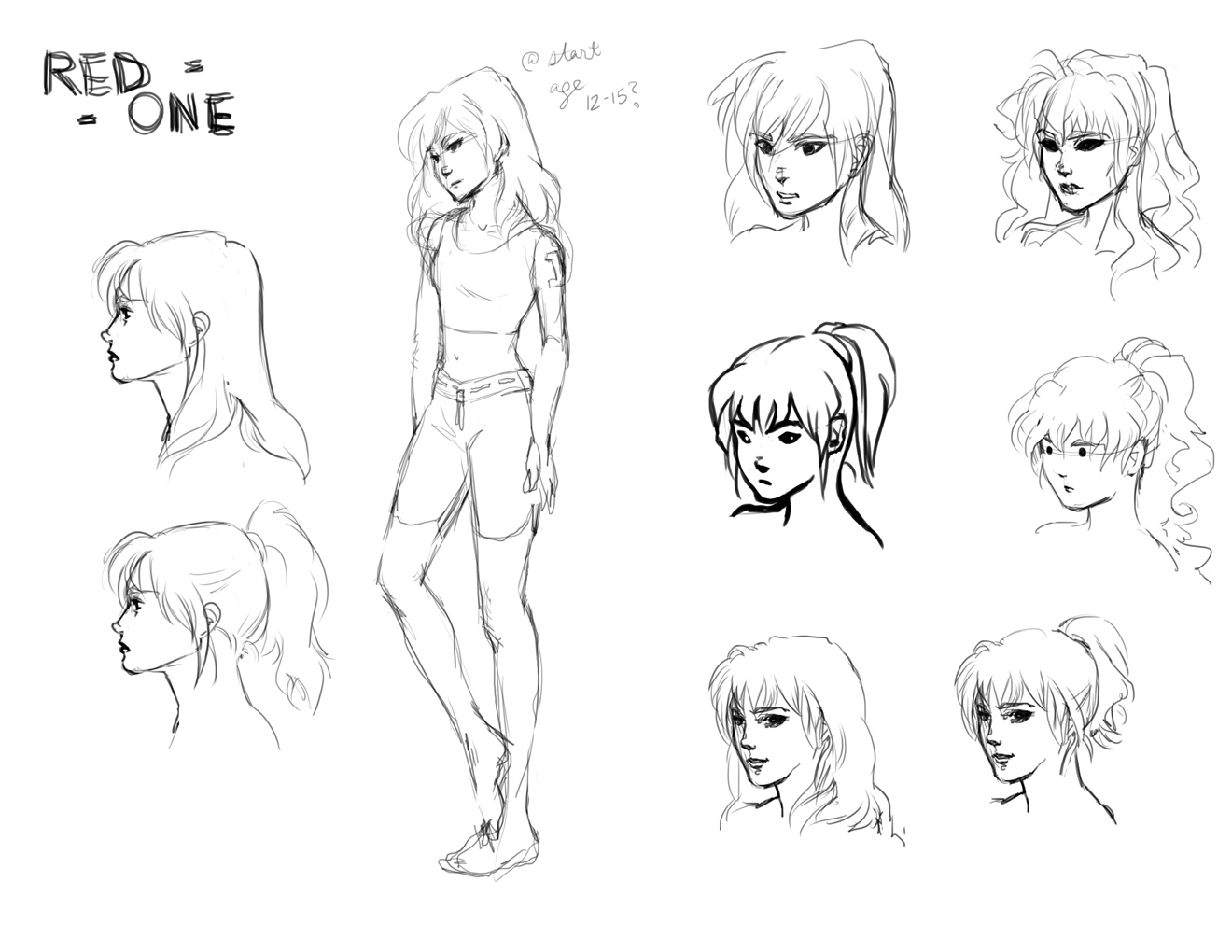
It was when she sent me these first pictures that the challenge really began. As you can see, they are all excellent illustrations of the main female protagonist. Usually, I could have just selected a few and suggested some details here and there, but her features were not as distinct in my mind as I would have liked. Then I started to think about what the world would be like: specifically what we wanted our aesthetic to be.

For two days, I thought about this and luckily Angela and I managed to talk about it. She told me that she wasn’t completely sure what aesthetic–of the inspirations I chose–that she was supposed to use so she decided to draw different pictures of our character in various styles. I felt really torn: because I wanted to see this world as an elemental place of basic shapes but some very realistic elements, but Angela drew all of these really good illustrations. It made me question the fundamental substance of what I wanted our world to look like.

But Angela has a good way of asking the right questions. Not only did I manage to answer some of her questions, but I started to add some details of my own. Another question that really got me was how old our protagonist was going to be and what she would be wearing before she got her costume. These were definitely questions that I needed to answer and in the end we decided on her being twelve or so, with rudimentary clothing that she had been forced to create herself.

Angela was also curious about what costume our character was going to have. She experimented a bit and showed me this:

This is what prompted me to tell her the idea I had with regards to the main character’s costume: and how that was going to fit into the plot. Let’s just say: it’s less than she chooses the costume, but rather that it chooses her … and in unexpected way.

Finally, Angela had an “Aha!” moment and after I chose a few of the profiles that she created and made some suggestions, she managed to mix together something of Saint-Exupery, and something very reminiscent of Mark Buckingham’s drawing style in the illustrated story section of Miracleman #20: Winter’s Tale. As you can see, our protagonist looks like she is painted and has very bright colours. And yes, you’ve seen it right: she is red. 🙂 As of right now, this is the closest working illustration and aesthetic that we have and Angela is still working on it: along with drawing out a few more of our characters. It is just so beautiful, lush, and artful.
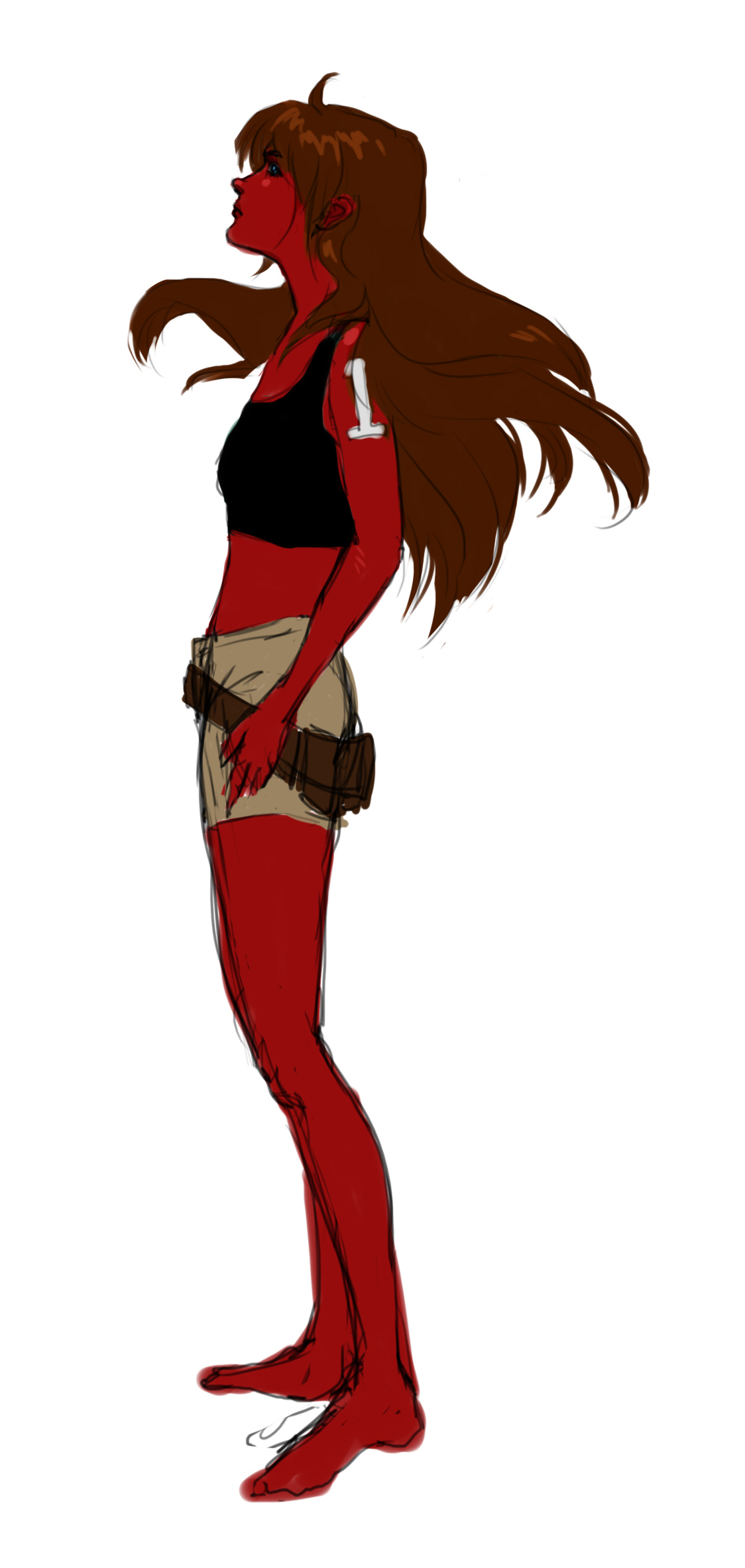
Another excellent advantage to having this working model of our whole aesthetic is that I have inspiration. There is nothing more buoying than seeing something you envisioned becoming as close to a tangible image as can be made possible to really encourage you to keep creating. The added bonus of this feeling is that with our last Project, Thebes was supposed to be based off of our re-interpretation of mythology: of stories and characters that already existed. With this Project, we are making something relatively new: something that didn’t exist before quite the way we see it.

I mean, I know: I understand that all superheroes are archetypes and variations of Superman or older mythical figures, but the characters in this story have their personalities and I try to look at the basics of what they can do as much as possible … of which I am now figuring out. It is also very helpful that, right now, Angela and I are on a very similar wavelength in figuring these details out.

In fact, all of this is a process of figuring things out: as though Angela and I are spying on another world and trying to translate it into ours as much as possible. When we’ve done more work on this–and I create at least a rough outline of the booklet–I will start calling the characters and our Project by name. Until then, both will be as silent and as wordless as our comics work itself.

Horror as Collaboration: A Multimedia Nightmare

Just as the creature from Edison’s 1910 film version of Frankenstein formed, as seen in the picture above, I have been thinking about the best way to go about doing a viral creepypasta.

Then I came across this link from a friend of mine to the story of The Dionea House. It has a very epistolary format: in which a story is narrative constructed through what seems to be correspondence or journal entries. In the case of the above story, they even use online journal links and phone texts.

I was so impressed with Candle Cove, that I wanted to do something like that. In fact, it is the model which I want to create a viral creepypasta: a horror story or account that will be posted throughout the Internet. But now I realize how some of the challenges I proposed in my other posts on Horror as a Universal Power: The Function of a Creepypasta and especially Making a Receipe For a Creepypasta With Uncanny Filling can finally be addressed.

Essentially, I need collaborators. I need to engineer a situation where we can go to a board and have a correspondence discussion: an exchange of posts talking about an event that we create. It is kind of like role-playing and also collaborating on a story together. By writing it like this, we can have all the natural typos, grammatical errors, and some natural energies and improvisation come through. We can begin it through talking about fact, and then slowly getting to the emotional creepy parts.

Of course, we would have some challenges. For instance, what Message Board could we take? Should we make our own? And if so, how do we deal with others posting? Or, rather, would be excellent to get them in on it too? At the very least it can add to the legitimacy of it and make it look like a spontaneous thing if other people who don’t know about this potential Project got in on it. If we can make this a great participatory writing project turned creepy meme, that would be excellent: but it has to be unified and coherent while at the same time have an element of the unexplained and horrific in there as well.

All I need is an idea for a story and I have a few. My list might have something or perhaps even one of my dreams from my dream journal beside my bed. If I can get some people to create photographs, graphics, and artwork as well that would just be an added bonus.

Tis the season of Halloween. This might just be interesting.

The Power of the Original, the Creativity of Change

In The Source and Its Creative Feelings, I wrote about the emotions and energy that can power inspiration and ideas. In this article, I’m talking about the material and the quality of it that can fuel that kind of inspiration.

So I was watching the classic 1963 film Jason and the Argonauts last night, and it occurred to me just how much it was tangentially in there in the culture of my childhood. It wasn’t so much the movie itself as it was the aesthetics and the attitude of it. In fact, the only film that really comes to my mind with that same spirit is Cecil B. DeMille’s The Ten Commandments.

Whenever I thought of the ancient past or mythology as a child, I used the imagery of these movies and others like them to inform myself of how both should have looked like. Then I fast-forward this concept of mine by a few years. I used to think that the fantasy genre were all stories like The Hobbit and Lord of the Rings, followed by Dragonlance and Forgotten Realms, and I tried to write exactly like them: especially the latter two series.

I thought that some of my more weirder story ideas–including an alternate storyline with The Ten Commandments–were silly and a waste of time, or at the very least beyond my means and personal faculties to create at the time.

This was before I realized that there was original source material.

Every story ever made is an echo of another story that exists before it, or coexists alongside of it in another form. But every story as a source: a prototype or “Ur-Text” (Ur being a term for the mythical first of something, such as the first ever human city-state) or place that is tapped into.

I believe that every creator taps into that source. However, I also think that the strength of a creator’s link to that source all depends on where and how they tap into it. Originally, I was going to say that a creation inspired by an original source–or the closest known or accessible thing–depends on one thing, but after thinking about it a bit more I realize there are two elements involved.

The first element is, like I said, finding the earliest myths or art-forms that you can read, understand, or learn to understand and take inspiration from them. They are the closest things to the source, or what the famous mythologist Joseph Campbell called “the mono-myth”: the supposed first story that all sentient human stories come from. I feel that once you learn to understand the spirit of the earliest story or source that you can find with regards to your work–and specifically use it to gain your own personal creative slant on it–then you have gained something powerful and you are more than on your way to augmenting or discovering your own creative voice.

But then there is the second element that I thought of very recently: which is that once you gain an idea of the original source material that created the story or story-type you are working on, you must make it timeless in a way that everyone can relate to, and therefore make it relevant. Take what you have learned or understood and apply it to your time and the issues and themes that are important to you as a creator, a person, or even both.

Think about it: before DeMille’s Ten Commandments, or Jason and the Argonauts, all there was to determine how the ancient world was, and how their myths functioned were books, broken sculptures and fragments of art. The creators of both films had to go through all of that material and decide what they were going to use or change. I won’t even go into Ten Commandments, because there have been many other films and stories created from that Biblical tale at different points in time, and even the ancient Greek myth of the Argonauts has changed throughout time and culture as well.

But what I am saying is that the creators of both looked at the original sources as much as they could and made something, and added character and motivations that audiences could relate to. Even J.R.R. Tolkien looked at ancient Nordic tales and history in the creation of his Middle-Earth: which in turn informed how a lot of the fantasy genre derived from it would be for a time.

Like I said, I do think that knowing the original source of something gives you a special insight into that thing and in making something that is either a homage to it, or a unique derivation. This is what I have adopted for a lot of my writing and creation process. It gives you more to work with and more to change should you choose to do. And that is the key here: knowing the closest source gives you more choices … especially with what you want to reveal what is important to you about them and other people.

When I was growing up, I took films like Jason and the Argonauts with its stop-motion clay animation less seriously than I did the developing CGI graphics coming around then. But now, looking back I realize just how much of that influenced the creation of CGI and what film-making could be: as well as storytelling. Maybe it’s because as a culture now almost everything that is “retro” or considered old is popular and new again. Of course, as some other popular cultural articles suggest this could be all be just part of a cycle that happens with every decade or era.

My era of the 80s and onward, as well as the things that inspired them in earlier years, has become a lot of my source material and now I am starting to realize that I can express it. This is a good thing. The possibility that some of the quirky weirdness in some of my stories may have been inspired by Joss Whedon’s irreverent flippant dialogue in Buffy and other shows is an added bonus: from my perspective anyway.

Really, I just like creatively messing around and reading and watching old, good things and good new things for universal and innovative storytelling ideas. I probably could have summarized this whole post into that one sentence, but there you go. 😉

Book Review: Brian Selznick’s The Invention of Hugo Cabret

One evening, when I was living downtown, I came across a book in a church-run thrift store. It was this big thick-paged book with a very luminously colourful ornate cover. I’d never ever heard of The Invention of Hugo Cabret before this point, but I saw that Scholastics had published it, and it was about five dollars or so. So I bought it and it sat in a cupboard for a while until I finished my initial draft of my Master’s Thesis. Then a day or so before leaving on a trip, I began and finished reading it.

Hugo Cabret is the story of an orphaned boy of the same name who finds himself operating and maintaining the clocks of a Paris train station while attempting to fix an old and broken clockwork automaton. It is when he attempts to steal some parts from an old man’s toy booth at the station that he reveals a far greater story and his life changes forever.

I really don’t want to spoil this book. I will tell you now, though, that it is excellent. Brian Selznick is not only an excellent writer that knows how to pace and flesh-out his characters, but he is a brilliant illustrator. Hugo Cabret is essentially an illustrated novel: with pages of text inter-dispersed with sequential pages of softly shaded drawings and stylistically-faded copies of sketches and photographs. It basically looks like a notebook or a journal: especially with the image of a lock on its cover. Given that there is a notebook that features somewhat heavily in the plot–once belonging to Hugo’s inventor father–the aesthetic follows the form well.

What I also like about Selznick’s aesthetic form is that it is on that border between an illustrated novel and a comic: in that while there are pages of words, and pages with pictures and words, there are also entirely silent panels that display interrelated sequences. It’s a nice borderline form and it adds to the content nicely.

In terms of content, this book is apparently labeled a work of historical fiction. This is an interesting designation because while there is definitely one central character that is real and historical, Selznick has taken some creative liberties. I also wonder in light of this if the other characters may be conceptions of this particular character’s work made into real personalities in a meta-narrative sort of manner. I love that kind of thing, in case you didn’t already get that, but even if it’s not true there are definitely moments where the concepts of the characters could very well fit into … other conceptual places.

But what really intrigues me about this book, aside from its liberties and ambiguities as “historical fiction,” is how it eventually focuses on the medium of film. In contemporary times, we often take moving film for granted. It had to develop from somewhere after all: both technologically and artistically. Even Hollywood itself was a small independent pioneering workshop studio at one time before it gained more resources and popularity.

While this story seems to take place in the 1920s, it refers after a while to the turn of the century when film was being developed: as well looking at the kinds of people who helped to create it. And who were these people? Some of them were magicians. I am not being figurative here. Some of them, including one of the characters in this book, were artificers, artists, and stage magicians before they became directors and creators. And it makes sense. After all, aside from the fact that vaudeville and its acts, along with theatre, and opera preceded a night at the movies in terms of prestige and guaranteed entertainment, film is kind of like watching a magician’s shadow-play on a thin skein of reality. It is a concept that reminds of Clive Barker’s short story “Celluloid”: where the silver screen is a more permeable layer of existence with our world than we would be comfortable to believe.

I love the image of the magician as film-maker and inventor, and if you read this book I assure you, you will understand what I mean. A friend of mine once said to me that if I embodied any kind of film, it would be the black and white 1902 A Trip to the Moon: something that is extremely symbolic, experimental, even comic, but also parodies and is self-reflexive and aware enough to know that by consciously parodying things, it reveals its opinions on what these things are. I mention this film for a reason that has to do specifically with one aspect of the book. What’s also interesting is that not long after I read this strange and awesome artifact, a film was released based off of it: one I’ve still have yet to see.

That digression aside, I give Brian Selznick’s The Invention of Hugo Cabret an unambiguous five out of five. Until next time, au revoir. I seem have something in my eye.