Fire Emblem Blazing Sword, Games as Silent Dramas, and the Tragedy of Kishuna

During the last years of my Undergrad, I bought two used games (and no, this is not the beginnings of a creepypasta): Final Fantasy I and II and Fire Emblem. I got through the first part of Final Fantasy pretty easily and then the until part held no more interest for me. It was too simplified and hadn’t yet reached that point of complex plots, captivating character development, and entertaining gameplay. So then I started playing Fire Emblem Blazing Sword.

I have to say: I was astounded. Up until that point I’d never found a strategy RPG more captivating, more fun, more incredibly frustrating to the point of me throwing it across the room than Fire Emblem. Up until this point I’d thought that there were no other games aside from Final Fantasy that had that combination of complex characters and fun gameplay. But it was the characters and the extra content that intrigued me the most.

And so today, I am going to talk about a character that doesn’t get mentioned a lot in the game or anywhere outside of the Fire Emblem Wiki site. I am going to talk about Kishuna.

Who is Kishuna? And this where we get into a bit of spoiler territory. When you first run into Kishuna in Fire Emblem, he comes unannounced and unexpected. He is a red-robed being whose very thin and pale face is covered by a hood. Kishuna is accompanied by a group of very immensely powerful Morphs–mystically artificial beings that you encounter more and more as the game progresses–and they are hard to kill. Another thing you need to know about Kishuna himself is that he doesn’t attack you. No. But his mere presence–his aura–is powerful enough to neutralize all of your offensive and healing magic. So as long as you are in the blocks affected by his red aura, you can’t use your magic at all. He is called a “Magic Seal” for that reason.

So Kishuna–who is an enemy–arrives to mess up another enemy’s plans: the enemy you have to defeat. I can only conjecture that he is there out of pure spite: because he pretty much hates everyone for what happened to him. So, you can kill him with conventional weapons: however, he is very hard to hit and your speed and accuracy has to be exceptional to do so. If you do manage to kill him after some considerable effort in the protagonist Eliwood’s Chapter, he dies and that is the end of him. But if you are playing Hector’s Chapter, that is a whole other story: a whole other story indeed.

I won’t go into any more particulars about game-play requirements to do all of this. You can find all of this stuff pretty much here. As you come to the Nabata Desert, you see Kishuna again in an underground complex. The screen transitions into a flashback of a blurred naked spindly pale being in a magic circle standing in front of Nergal: the main antagonist of this game. Nergal created Kishuna as an experiment to see if he could make an alchemical being with emotions. The screen transitions back to Kishuna–surrounded by an army of his elite Morphs–and his only dialogue just as it was in the previous time you met him is, “…”

When you come to him here, you sense a lot of hostility and anger. But then if you beat him he seems to die again. If you are doing things properly, towards the end of the game you will encounter Kishuna one more time. He is in another set of underground ruins and he is having a flashback of Nergal coldly and callously rejecting him: telling him he was a mistake and that he should go and rot somewhere for all he cares. All Kishuna ever says as the flashback transitions away is, “…”

As you go towards him, you have a character in your group–the same one who sensed him earlier–who detects him again but also feels from him loneliness and intense sadness. After you kill his Morphs–and I always wondered where he got those Morphs from since he was a reject: I assume he either made them himself or they were more rejected Morphs from Nergal that he just gathered together in silent, resentful company beneath the bowels of the world–you have to kill him.

Your characters never learn Kishuna’s name or even know what he is. He never speaks. And at the end, when you finally kill him, it’s almost like he has just given up. It’s as though the failed Morph wants to die.

I don’t think I ever felt so … sorry for a fictional non-player character until this point. Imagine a being who was made as an experiment–with feelings–who is abandoned and then meditates on his creator’s abandonment of him for what seems to be centuries. Each flashback and transition shows this sprite meditating on the futility and loneliness of his existence. But that is only one aspect of the tragedy of Kishuna.

You see, assuming you did everything right game mechanics-wise, by encountering Kishuna in these ways you also unlock Nergal’s back story. You find out more about the Dark Druid: that he really had been a good man once and the road to hell for him had been paved with good intentions. In that first flashback with him and Kishuna, Nergal seems less hostile towards his creation–having just made him then–and seems more intrigued by his existence. He says something to the effect of, “It is said that man was sculpted by the hands of the gods. If so, then you, who was sculpted by these, my hands …And I, whose labours gave you breath and life… What are we then? What does that make us? In your fabricated heart, which I gave unto you, what is it you believe Kishuna?”

It is almost as though Nergal made him to appeal and examine feelings he cannot–or will not–examine in himself anymore. But I think what is even more telling than his creation of Kishuna is his violent renunciation of him. When he calls Kishuna–one of his earliest experiments–weak, a pale imitation, and worthless he isn’t so much calling Kishuna that as he is referring to the last of his lost humanity. And I think that is the saddest thing of all: that the tragedy of Kishuna isn’t just his existence, but how he represents Nergal’s double: as the dregs of humanity that the Dark Druid ultimately rejects. When Nergal talks to Kishuna–like any artist or creator–he is really talking to himself.

Some people might say to me that I’m reading too much into this: that this is just a video game and has no more value beyond simple entertainment. But a video game is a medium for storytelling. In many ways, video games–such as role-playing games–are a lot like interactive silent movies with dialogue and mimed movements of characters. The fact that with these sprites and words the creators of this game managed to convey such nuance and depth of emotion and character is a tremendous feat of creativity.

I’ll also tell you something a little more personal. I started playing–and continued to play–Fire Emblem in my last years of Undergrad because I’d had a really difficult breakup: my first one. So I engrossed myself into this game. I immersed myself into that world that wasn’t my own. I got attached to characters and situations there. In some ways I felt like I was doing more in that world than in mine. I know how that sounds, but that is also how–to some extent–it was.

What I really liked about this game is that it makes you into a character. You are a tactician and you can name yourself. Your characters refer to you and ask you for advice. When I first met Lyn, the Sacae plains-woman and master swordswoman, she–to an extent–began to feel like the friends I felt I didn’t have in reality anymore. But when I ran into Nergal, he reminded me of all the mistakes I made and just how far from my goal I became. And with Kishuna, I emphasized with what it felt like to feel abandoned and left filled with rage and sorrow.

If a game can do that, it is a good game and–as far as I am concerned–an excellent art-form. So here is my tribute to Fire Emblem and Kishuna: perhaps an under-appreciated but an ultimately very important and human character.

Do Video Games Devalue the Concept of Money?

This is something else I made a fairly long time ago, but it is still timely I feel. Also, I appreciate the irony in that while I state what’s in the above title I am still applying it to a money-making capitalist industry. But irony is what makes for interesting stories throughout history and–in particular–our current time period. It is a really short article or, really, a meditation. I’m sure–and I know–that there are others that are far better researched, more detailed,  and passionate out there. But that said, like always I hope you will find it interesting. And it’s something that has to be said.

In most video games, money is meaningless except for what you can buy with it.

I mean think about it for a few moments. In Super Mario Brothers, you can hit a floating block and get as many gold coins as you’d like. In Legend of Zelda, you can cut bushes and enemies down for rupees. In various role-playing games, you can kill as many enemies as you’d like or open a random treasure chest and you will get a whole ton of gil or money to spend it on weapons, armor, other items and anything you’d like.

What is interesting to note about this video game logic is that currency can be found relatively anywhere–whether on the ground, earned through battle or trade, or even stranger places–and that is its only significance: that it is something you can find almost randomly or make easily to facilitate your journey through that reality. There is almost a very understated Communist or at least Socialist aspect to how the “economic” state inside quite a few video games work and if I got this idea from someone or something else–which is more than possible–then that person is more clever and perceptive than I am.

It is … immensely hard sometimes to see someone get an easy 99 coins, or 999 maxed out or over billions in gil and know that–in real life–you have to struggle just to get a twenty dollar bill. And you don’t get to fight and defeat bosses to get this money. You have to work for them and not in the good evil henchman way.

What it comes down to is that the object of the game of reality is to survive and, unlike a video game, you cannot easily replenish your bank account after a splurge … and you rarely get any game Restarts–or start overs– if you screw up.

And While I’m At It …

I figured that this would be an appropriate place to put this. It is a little creative monologue sketch or vignette I made a year ago that reflects a lot on the nature of creativity. It is, fittingly enough, entitled “Creativity.” I hope you’ll enjoy it. I have one more old work to post on here–where more people can see it–before I move on. See you soon.

Creativity

“Sometimes I have to wonder about what people say about human genius,” he says, before leaning more heavily against the wall.

“Take Mozart for instance. Many claim that the composer wrote compositions completely free of error, blot and correction. He created his music ready-made and fully formed like Athene plunging right out of the temple of Zeus. If so, what a Metis he and others must have swallowed beforehand, if you will pardon the mythological digression.”

He chuckles, and then sighs, “It would sound wonderful to have this ability, wouldn’t it? If it existed, I mean. To be able to create perfection out of your own two hands, out of your very mind itself …” he pauses, “Or would it be so wonderful?

“For instance, imagine everything they said about Mozart was true. Think about making something everyday without making any mistakes in it whatsoever. Consider that you will have done this not just every day, but every year that you’ve been alive and first conscious of your gift. Then put the drive into consideration. Imagine feeling outside pressure and your own inner drive wanting you to make something better than the last time you created something. You always have to be better no matter what.

“But let’s just say you can tolerate — or perhaps even thrive — under these circumstances. You accomplish everything you set out to do and you finally approach the end of your life. Imagine slightly before this happens, you think about everything you’ve done up until this point. You have your old works and manuscripts in front of you and look through them to try and catch just a hint of the glimpse of that place you were in when you first made them so long ago. I don’t know about you, but as good as I would be, I wouldn’t be able to find it again.

“Instead I think that if Mozart really made all his works straight and unblemished from his mind, all he would see in front of him are the mistakes he never made or learned from, the absence of the rough drafts that could have made him wince with chagrin and sentiment, the non-existence of any chronicle of his progress and growth, and the lack of any seed that germinated his very ideas. If any of this is true, what he would have realized at that moment was that the only thing that ever made him worth anything was something outside and despite himself: something crystalline perfect and utterly sterile. And if this were the case, wouldn’t he have realized this much earlier than just at the end of his life?

“What would that have meant? Would there have been any meaning in it for him at all?”

He stares at the wall for a little while before considering his next words, “I would like to believe that this isn’t true at all. I’d like to think that not only is human genius potential in varying degrees, but that it is something that always has room to learn and change. Therefore, I do think Mozart had one or two corrections on his note sheets from time to time, or changed nuances to his music as he performed them for each audience he came in contact with.

“Of course, it’s also very possible that I’m wrong. Maybe he did make perfection and still learned anyway. Maybe there are people who are capable of this and better themselves only in making different and more complex works. But then where does that perfection ultimately come from?

“Maybe, in the end, it was no accident that I mentioned Athene in the head of Zeus. Daimons. Muses. After all, genius was once considered a spirit that made a human its vessel for a time. And if that’s true, just how much — if any  — creative responsibility belongs to its creator? Perhaps nothing Mozart ever made was ever original or his own. Maybe nothing we make belongs to us in any capacity. But would that provide a sobering blow to the human ego? Or tremendous sense of relief?

“I don’t know,” he finally shrugs, “As for me, I’ll take my good moments, my mistakes, a drink of whiskey and a listening to of Mozart’s Requiem any day.”

Ice-Nine Mornings and Vonnegut Nights

I’d only heard his name in passing as I read other works of fiction and science-fiction. I’m not even sure how my girlfriend got me to start reading Kurt Vonnegut: what the precise details of that moment were like but I remember other details.

It was summer of last year. I was still in the process of (procrastinating) writing my Master’s Thesis and driving myself crazy. I’d finished reading Hermann Hesse’s Glass Bead Game–or Magister Ludi if you’d like–and I found that once I did I wasn’t really interested in reading anything else of his. But I was starving for reading material: so much so I didn’t even know that I was.

I don’t exactly remember when my girlfriend and I started talking about Cat’s Cradle, but we did and I really wanted to read it. But as I write this I remember that it had to do with her introducing me to Vonnegut’s made-up religion of Bokononism–of the concept of a karass as a strange unification of people under God or divine influence, and especially a granfalloon: the creation of a forced or “false” group of people who really have nothing in common whatsoever but–again–something forced or artificial. I’d had some personal experiences with both–and it is hilarious and fitting just how fictional concepts make human nature and interaction easier to understand–and I wanted to know more about the book from where it all came from.

Unfortunately, despite our best efforts, we couldn’t find her copy. So I gave in and borrowed it from York’s library. As I was reading it and making commentary on the way as I usually do, all my girlfriend really told me at the time was that she found it “cute” that I thought I could predict how a Kurt Vonnegut novel would end or even continue.

She was right.

What can I tell you? That summer, Kurt Vonnegut–or “Grandpa” as my girlfriend likes to call him–exposed me to a world of black, black humour and rendered spectacularly the banal frailty and stupidity of the human race in such a way that was immensely entertaining. His “what-the-fuck” moments were plenty and awfully true to the strangeness of life. I started Cat’s Cradle slow. It was a deceptive little bugger: with each chapter little more than a few pages for the most part. Then as I got towards the middle I consumed each page with voraciousness and a notable lack of mercy or pity.

After that there was an old, tattered, and well-loved copy of Mother Night for my consideration: where what we consider war crimes and human atrocity, stupidity, and uniqueness essentially and cunningly “fuck you the fuck up” and your preconceptions too. The best lesson I got out of the thing that I read as I took the bus to school, lay in our bed, and even rode with my friends to a table-top role-playing game session with Lego is to be careful of what you pretend to be, because you might become it.

I remember mornings where my girlfriend forced me to go meet my friends for gaming weekends and those books accompanied me with lunch. I didn’t think about my looming school project, but I learned from Grandpa Vonnegut instead–my cynical, grumpy, literary grandfather–about life. I don’t remember the last Vonnegut book I read. It was about a man who was a former soldier and he taught at a college close to a prison. I never got farther than the chapter with him and his class looking at old and failed perpetual motion machines found in an attic.

I remember that part well. I was riding by myself back down two buses from York Region back downtown from said gaming session and the serious work around it  :). It was the bus I took on Bloor in the late warm summer night: under the amber artificial lighting of the bus, the ambiance of the passing streetlights outside, the fading blue darkness in the sky. and a metal framed red-purple seat. I put that book on hold to read A Song of Ice and Fire–based on my friends’ constant pestering that I needed to–and I never picked it up again. I wish I had.

My Vonnegut education is not complete. I didn’t finish that book and my girlfriend doesn’t have Slaughterhouse Five. I hear Vonnegut likes to break the fourth wall so much after a while that he just gets fed up and it is less a spectacle and more a matter of a “I don’t give a damn” course. I can sympathize with that. I think I will be a grumpy old man like that when I’m old. I’m already half-way there with the grumpy part. Or maybe that’s crazy I’m thinking about.

I do think that you need to have time between readings of Vonnegut: just like you don’t want to eat bitter-sweet chocolate all the time: just occasionally and when the summer times come, and when you have a long bus ride far past two in the morning and you need some black therapeutic entertainment on the TTC … all the way home.

The Onus of Creativity

First, let me again thank all of my new readers for reading as well as “Liking” my posts and “Following” my Blog. I very much appreciate it and it encourages me to keep writing on here: influencing me to believe I have things that are worth saying about what I do.

A question that writers almost always get asked at some point or another–so I’m told–is where do you get your inspiration from?

It’s a similar question to the infamous where do you get your ideas from, and I might get into that as this Blog entry unfolds a bit more. I can be a real smart-ass and say that I get my inspiration and my ideas from inside of the strange, convoluted thing that is my mind. I can even be literal and say that I get them from reading, from watching movies and television, from my time at school, from long walks talking to myself, and from basically experiencing life. I even say as much in this Blog: which was founded on those very principles.

There was a TED Lecture created by the writer Elizabeth Gilbert called On Genius in which she discusses the Western view of what an artist and a creator is. Specifically, Gilbert looks at the symbol of the tormented artist: of the person or “genius” who is the sole producer of all the art and knowledge and expression that comes to them. She contests the view that it is somehow “natural” for a creator to suffer from depression, alcoholism, to be genuinely unhappy a good portion of their lives.

Even though she tries to debunk this, there is something very … seductive about the idea. I mean, look at the very nature of a piece of literature for instance. There is no novel, or short story that doesn’t have a conflict of some kind inherent in the plot or the theme of the thing. Without conflict, there is no story. Not really. Utopias get very boring to talk about after a while, but we love to hear about how they go wrong. Just like nightmares can seem more compelling to write and read about than dreams. So if these traits existence in the makeup of fiction, why shouldn’t they be in the nature of its creators?

Sometimes unhappiness, or tremendous passions fuels a writer. And in some of my darker moments, I believe that true joy is finite, while unhappiness is limitless. Sometimes, I don’t even believe I’m wrong and it is no secret I tend to write about some dark, violent, and sad things. Imagine writing about a world around you that was perfect and always full of joy. Imagine just how hard that would be to hold anyone’s interest for longer than a few minutes. Neil Gaiman managed to do something like this in his run of Marvelman/Miracleman, but even then he had to bring human nature and its inherently conflictive nature towards a paradise that was imposed on it.

When I’m feeling really negative, I feel like my negativity is what makes my writing immensely powerful: hence my above statement. I also know it is not always the case. Passion and conflict are not necessarily inherently unhappy, but necessary things. If anything I’d venture to say that stasis is also a tremendous unhappiness because nothing grows in it. That can be a form of struggle itself for a writer: the struggle against stasis.

In her TED lecture, Gilbert attempts to look at how earlier cultures dealt with the concept of human genius. She talks about how the Greeks believed that each person occasionally meets a daimon–a spirit or muse–that gives them ideas outside of themselves. The Romans also adopted this notion and called this spirit a genius. It’s all a conceptual framework. If anything, I understand that one advantage to this paradigm is that it takes the personal onus or burden of creativity from inside the individual and places on something “outside” of them. Alan Moore, in his Voice of the Fire, even states that he placed the building of said novel on the town of Northampton which he was writing about in a mythological way.

I think that it is a question of cultural and personal attitude towards the creative process and your own life too. I know that I also have a responsibility to write and express myself, but my experiences and knowledge also informs that. Sometimes I do feel a strange energy in me when I write something. Even when I write something with personal emotion, it overlays a kind of calm as well as I feel myself “getting the job done.”

I will tell you now: I almost didn’t post this here because I thought it would potentially be too personal and I want to just make this about writing. At the same time, my writing is powered by my emotions and experiences. It is a dichotomy I have to navigate a lot.

I’d like to finish off this post by quoting from the last eight lines of Gwendolyn MacEwen’s “Dark Pines Under Water,” in which she states:

Explorer, you tell yourself, this is not what you came for
Although it is good here, and green;
You had meant to move with a kind of largeness,
You had planned a heavy grace, an anguished dream.

But the dark pines of your mind dip deeper
And you are sinking, sinking, sleeper
In an elementary world;
There is something down there and you want it told.

Despite what happened to Gwendolyn in her own life, and towards the end of her life these wise words are a gentle admonition to remember and I have to remember them everyday. If you haven’t, you should definitely check out Gilbert’s TED Lecture and the other TED Creativity Lectures as well. I hope that you can all find what suits and works for you as well.

Star Wars: Back to the Basics

So this is not a new argument. I have been thinking about–and talking about–the Star Wars films and their effectiveness for years. I’ve been talking about George Lucas’ universe to the point of being obnoxious. I have readers on here who have heard me say many of these things before in some way or form: mainly in the form of ranting. I might have even written something like this in another forum, but after a few more years and really not talking about Star Wars for a while I think I can better articulate some of my views.

Let me begin by saying that you would be right if you guessed that I like the Old Trilogy far better then the New one. I will also tell you why, and I will tell you why by delving into something I’d spent some years studying in my Grad Program: mainly mythic world-building.

In the Old Trilogy, you have a universe that is already established. It looks worn and the aliens and droids are its indigenous cast. In other words, they look like they belong there. You have very archetypal environments that these beings can play in and there seem to be stories behind everything. What’s more is that the universe–or Galaxy–presented to us is filled with mysteries. These mysteries are what make the Old Trilogy: the mysticism of the Force, the background of certain characters, the unspoken history behind particular groups such as the Jedi Knights and just how old some places and people really are. There are a lot unspoken stories or rumours in this galaxy as well and when you first enter it amid the swashbuckling and space-fights you really get immersed in it.

It like you just came to this place in the middle of the story–which you have–and there is so much you want to know even when the three films are over. The Old Trilogy is filled with darkness and old history, but also with the hints of glory and just a mythical greatness that pulls you in with the scenery, the hinted upon lore, and John Williams’ musical score.

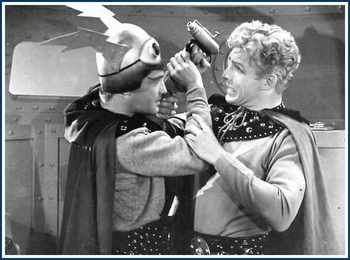
George Lucas has explained that his inspiration for Star Wars–in considerable part–came from the Flash Gordon and Buck Rogers science-fiction shows he watched as a child. These “space-opera serials” helped to inform and create his own. You can see it in the devil-may-care blaster-toting Han Solo, all of the space battles, and even in Luke’s wannabe adventurer character: at least in the beginning. Basically, these old science-fiction elements are integral to Star Wars’ existence.

I just thought this scene from The Star Wars alternate reality comic–the one adapted from an original draft of Star Wars itself–would be appropriate on some many levels considering the subject matter and the character resemblances. But what is definitely from my perspective is the following.

Then you have the Prequels, or the New Trilogy. One thing that most creators of worlds tend to do when they make a world for the first time, or try to re-imagine a pre-established world is to “go back to the basics.” You see a lot of this in comics nowadays: using Golden or Silver Age characters and expanding on them or taking a different slant on how they might be. What I think happened was George Lucas looked at the Star Wars universe he created and decided to “go back to basics”: to tell the story of what caused a lot of the events that happened in the Old Trilogy and at the same time re-imagine Star Wars. Of course there are two kinds of re-imaginings: which are reboots (which the Prequels were not) and matters of continuity.

From my perspective the Jedi are evil … no, George Lucas brought Star Wars closer to the spirit of the source material that informed his own childhood enjoyment: that of Buck Rogers and Flash Gordon. In fact, I believe he said as much in an interview or two in the past.

Flash Gordon aesthetics …

Meet Revenge of the Sith.

I believe that with the Old Trilogy, Lucas started out with those inspirations and expanded from them into something that looked older and actually resembled that strangely wonderful and mysterious phrase, “Long, long ago in a galaxy far, far away” that never gets explained but is still beautiful. With the Prequel Trilogy, I feel like that Lucas “went backward” and started to make something closer to the old shows he was inspired from. It wasn’t old and established anymore. The lines and creases weren’t there: the organic elements were stripped away to reveal this prototypical place.

Not all of the ideas in the New Trilogy were bad. Some were very intriguing and even did expand on certain elements in that galaxy. But unfortunately, they were elements that were poorly executed: if only because they seemed rushed. There was only so much lore you can throw into even three films to hold someone’s interest and sometimes things can get lost when you try to be succinct and “to the point.” Also, and I think you might know all too well the example I’m thinking about, it is a lot like humour: sometimes you can hit that place and sometimes you get far off the mark and actually offend people. Jar Jar, I am looking at you.

But some wooden dialogue and unfortunate caricatures aside, I think there were a lot of concepts that just couldn’t be fit seamlessly into the Prequels. I don’t like all of them and I would have liked to see some different things happen than what did, but I can sympathize with those limitations. That is probably what The Clone Wars CGI cartoons are for: to fill in the gaps between Episodes II and III. Again, they seem to hearken back more to Flash and Rogers and there are some intriguing concepts in them but they can be clumsy and awkward to watch: never mind how they can mess with continuity. And then, of course, there is the humour too.

Some people might even find the closeness to those old science-fiction serials outdated for our time, but I can see how it can be pulled off. I will tell you though that the galaxy of the Prequels does feel like a different galaxy from the Old Trilogy and sometimes it s a jarring thing to realize there supposed to be the same. I miss the mystical elements and mysteries of the Star Wars I grew up with.

And then there is Stars Wars: The Old Republic. I haven’t played this online multi-player game but my friends do and they have been trying to get me on this habit for a while now. But from what I have seen, this galaxy has gone back longer ago, but unlike the Prequels it does not seem farther away. Here you have the grittiness of the Old Trilogy mixed with a massive amount of Jedi and Sith lore. Both Jedi and Sith do not feel as watered-down as those in the Prequels: in fact from what I have seen they are what I always expected them to be. You have your bounty hunters, dynamic smugglers, and all of that stuff with plenty of story and mystery to explore.

I feel that for this game, the creators went back to the basics of Star Wars: but instead of merely just the science-fictional basics, they went back to the archetypal mythological building-blocks that I love so much. And I feel that is a place where the New Trilogy should have gone: that if we had gone to the mythical gravitas of the Jedi at their peak, Anakin Skywalker as a hero, Obi-Wan as a wise mentor even then, with Yoda still in the place of sage, and seeing Anakin go from something of a combination of Luke and Han into a tragic monster instead of the flash of ship and droid battles, and an actual romance between him and Padme in the films it would have made all the difference. Also, seeing Darth Vader slaughter Jedi in his suit, and even seeing the populace turn on and allow soldiers to take away and commit genocide against the Jedi–who’d otherwise been a natural part of their galactic population–would have really been far more striking and effective: from my point of view anyway.

Still, I am glad the New Trilogy exists and has inspired me and others. I like it in that it seems like a prototype or an outline of a movie or another world. But I would go with the timelessness of the Old Trilogy any day.

I would like to mention one more thing though. There are some people that wished Star Wars would be as dark and gritty as the Old Trilogy and remain so. Some people do not like the “cutesy” elements of it. You know the ones: the talking battle droids, the Gungans and the Ewoks.

Let me tell you something about Ewoks. I know that many consider them to be a blemish on Return of the Jedi. I don’t. Long before I watched the movies, I used to watch Saturday afternoon cartoons like Ewoks and Droids. They were the things that made me aware of the Old Trilogy. I really liked the Ewoks and the droids and seeing them in live-adventure with other bad-ass characters made Star Wars seem so much more real to me and that made my childhood self so happy: as though they–my friends–could exist somewhere out there past all we know in our world.

Sometimes when I get annoyed at the droids or Gungans, I ask myself what would it have been like if I hadn’t seen the Ewoks in Episode VI: if Star Wars had remained completely gritty all the time to the very end? People decry marketing the films solely to children, but children have made this universe. I was a child when I saw the films and they changed my life. Do I think that children can handle grittiness, violence, and the concept of the struggle of good verses evil? Of course. I definitely don’t think that things need to be “dumbed down” or completely censored out for children to like them. I also don’t believe good quality films for children should be three-hour long commercials.

At the same time, I also believe that a little light and levity and the comical–when done well–are also good for children and adults too. I wouldn’t have liked Episode VI if Han Solo had died the way it was originally planned or if there had been no Ewoks. They are also a necessary “basic” in the Star Wars universe: almost like a living cartoon–a neoteny–that is different from us but definitely something we can relate to. I always find it funny how we can relate to something that is more simplified than we are more than something that is supposed to be as complex and “serious” as us.

That too is something to keep in mind with regards to Star Wars, or Indiana Jones, or many similar adventure films: that while archetypal dangers and challenges are key, it is only when they are set with humanity and warmth that they feel like you are taking your first step into a much larger world.

Addendum: I DO like Lucas’ film work paralleling scenes between the Old and New Trilogy: especially with regards to what Luke does and what Anakin does. Also, Anakin Skywalker is a very good subversion and critique of the vintage reckless, daring hero archetype.

Film Review: Inglourious Basterds

I’ve been making a lot of reviews lately, I know, but this film has made itself a special place in my heart. I also made a reference to it in one of my earlier entries–with regards to Marvel’s Nick Fury–and I guess compelled to actually say something about the film now that I actually watched the thing.

If I could sum up Quentin Tarantino’s Inglourious Basterds into two words, it would be these:

Fuck History.

If I could get a mug or zippo lighter in the spirit of Garth Ennis’ Preacher with those words, I would definitely consider it. I think what I really liked about Tarantino’s film is the fact that it plays on your expectations–usually well ingrained film or plot-expectations–and then says “Nope,” and does something else entirely. There is something really exaggerated and almost lampoonish about Inglourious Basterds: from the portrayal of its characters, to the garishness of its iconography and all the way to the messed up situations that occur within it.

But while there are moments of hilarity–yes hilarity in a movie about a group of Jewish-American soldiers sent to kill, torture, and destroy Nazi soldiers in 1944–it is not a comedy or a parody. It is quite serious. It is a film that shows what happens to the best laid plans: especially in a war or an enemy infiltration situation and how quickly some interesting characters can die. It illustrates how evil wins when good men have their families threatened. In addition, it also shows how the “good guys” can be immensely but necessarily cruel in war, and how even an evil, remorseless antagonist can be one of the most captivating characters in the entire film.

There is something very … comic book action hero-like about this film and how it is put together. Tarantino himself stated that he wanted to create a World War II movie over the backdrop and ambiance of a spaghetti Western. There is definitely a resonance of Kill Bill in some of the seemingly ad hoc situations that arise in this film: complete with contemporary music set around a period piece and lots of gore and dead Nazis.

But I definitely think about super-hero comics when I think about this film now in retrospect. Hitler seems to have something of a cape, the American soldiers have a very brash gung-ho Americanism thing going on, the Nazi antagonist is very Machiavellian and over the top, and there is a very clear revenge scenario going on here. It feeds into your sense of blood-lust and satisfaction in watching something “evil” die. At the same time though, Tarantino subverts this. For all the protagonists portray the Nazis in the film as evil, and often most of the people in here are relatively two-dimensional–there are still moments of humanity from the “bad guys” that almost make you feel sorry for them being scalped, or having swastikas carved into their heads, or, you know, killed.

As for those people who think that this, well, obviously not historically inaccurate, consider my reference to action hero comics. Was it accurate for Superman to beat the crap out of Hitler? Was it also accurate for Captain America to have a few swings at him? Probably not, but I’m sure there was definite satisfaction in reading that and these comics–the result of war propaganda and good art–translated into Tarantino’s film very nicely.

But all that is either surface or merely part of the film. There is another aspect as well: more of the details. The multi-lingual segments of the film carried me through and gave me some more of the ambiance of that time. It left it no less charged. And then there is a meta-thematic element: that of film itself.

It is no coincidence that the build-up and the climax of Inglourious Basterds takes place in a film theatre, is centred around the viewing of a propaganda film, is subverted by a “revenge film” and whose antagonists are ultimately destroyed by film–by a moving sequential account of history ignited by the flames of war–itself. Because while many of the events in this movie did not happen, and many of the characters didn’t even exist, I feel like that the enemy’s “death by film” symbolizes a much greater artistic achievement over fascism: that when you seek to destroy something with art, art can ultimately change and destroy you as well.

On the television, Inglourious Basterds didn’t get any stars–which is a shame–but that only suits its personality. It’s not here for the glory, and it is not ornate or nice, but definitely has a lot of very kick-ass–literal and otherwise–moments. I think that I will give this film a five out of five.

Comics Review: Chester Brown’s Paying For It

One weakness I have as a writer, that I always have to work on, is that once I start talking about really abstract concepts–like my last post on Craig Thompson’s Habibi–it can become very unrelatable. And if something cannot be related to, a reader will be less inclined to want to unless they are part of a specialized reader-audience: and even then readability is important. It is key. There are very few things more asinine than talking about how elitist some knowledge-bases are while at same time bandying about its jargon like it is a matter of course and not even bothering to explain what it means in context.

For me, a dialectic is a structure where two or more concepts are pitted against each other: or at the very least a structure of, or narrative argument. I also think it can be more complicated than the above and can say more than one thing at the same time. So, really, mentioning all of that in this review is appropriate given that the book I want to look at is called Paying For It.

Chester Brown is a fascinating cartoonist. He and Craig Thompson have a few things in common: in that they came from some relatively religious backgrounds and have delved into some esoteric subject matter from time to time. Brown himself really likes to make “weird stories” in addition to the esoteric stuff and examines human relationships in a very analytic, detached, but thoroughly detailed way. If you want to look at a wide variety of Brown’s work, I would suggest reading his collection The Little Man.

As for Paying For It, I came across it a year ago when I went to the previous session of the Toronto Comic Arts Festival. I bought the book and had Brown sign it whereupon I was exposed to another very fascinating dialectic with some interesting implications. First of all, it is an autobiographical work. This is no new thing given that Brown has drawn autobiographical comics before, but this time he gets honest: sometimes brutally honest. You know, that kind of honesty where you show yourself in wide natural human spectrums of intelligence, decency, and ugliness.

Chester Brown essentially creates a comic about his experiences with prostitution: with sex-workers. However, he doesn’t stop there. No, Brown doesn’t really defend his actions–or his depicted thoughts–so much as advocate prostitution as a natural form of human monetary, social, and personal interaction. He depicts this through interactions with his friends as well as the women that he makes sessions with and a very long Appendices of actual information and figures at the back of the book.

Like I always like to say as a catch-phrase, this is no new idea. Prostitution has been called the oldest profession in the world for a reason. The aesthetics of Brown’s graphic narrative definitely affects how his argument: and story because the argument is merely one facet of the thing. It is flat background with simple small square panels on which the characters are small. The sexual acts are quick and to the point and almost clinical. The sex-workers’ faces are never seen at all–which Brown explains is to protect even the hint of their identities–and he even admits that has changed their names. Some other reviewers have commented on this and I can see different interpretations of how this can be perceived by the reader.

One might say that he is objectifying these women by what he does with them, and by depicting them in his story, yet you can also make the argument that by reducing everyone–including himself–into these small caricatures he shows that the issue is either bigger than all of them or it is something that in the grand scheme of things the universe doesn’t really care about. I myself really feel a little unsettled about sex and the body being treated as a very clear commodity: which is even reflected in Brown’s internal monologues. At the same time, there are also depictions of humanity: of affection, and warmth, and questions. He shows, despite their lack of faces and names that these women are human beings who notice if someone hasn’t been around, who are curious about a person, who sometimes forget to take money, who at times will let it known that they are uncomfortable, have their own loves and insecurities, and, understand that fear can go both ways between client and employee.

Brown makes it clear that for all money is involved, as long as human beings are involved feelings of some kind–even something ideal like basic common courtesy–can always be there. Those little touches are what make this book and what add to the strong themes inherent within it. Paying For It also makes you ask some questions about what relationships actually are.

I think the crux of it for me is when Brown talks about how he hates romantic relationships and how romantic love is a faulty concept that we have built our society around. He goes on to state that romantic relationships breed jealousy and a fear of loneliness that is the price to have emotional and sexual needs gratified. When Brown talked about these romantic relationships, as a few people in society will say, he tends to refer to exclusively monogamous ones: as if the romantic somehow automatically equals monogamy.

The concept of what is “the romantic” is a very fascinating subject that scholars and people have always debated amongst themselves. Brown himself depicts himself as reading a book by Denis de Rougemont called Love in the Western World: an account of how the early “courtly-love” ballads–arguably integral to a conception of romantic love–may have been secret Cathar messages created to symbolize “a particular love for the divine” instead of for a particular individual. Notice how Brown–like Thompson in Habibi–brings in an esoteric element with regards to this dialectic of what love is: something that I’d only realized they both had in common today. Brown himself posits the idea that people did not grasp the hidden message and went with the overt love message of “love with one person in an established relationship” instead.

Like I have been saying a lot throughout this post, it is a fascinating idea but I think one that is not unchallengeable. First of all, Western culture is not a monolith. There are–and there have been–different cultures in its structure. The fact that something like the Cathar movement, though problematic because they were exterminated as heretics–is proof of that. Also, you have to look at how the word “romantic” has evolved: from the sublime and terrifying in Nature, to love between two people, and really love itself. I myself  don’t believe that romantic love is “evil” and that it can be interpreted in many different ways by our era: just as it has changed over the centuries.

It is true that love in a marriage and an established relationship is a relatively new (by some centuries) ideal. Also think about like this: in ancient times, only marriage was seen as a legitimate and lawful sexual relationship where property and political alliances were the key. It is only later that relationships outside of marriage, even those with the proviso of potentially leading to one–became more accepted and mainstream. I won’t even go into the different conceptions of what love is because that is a whole other subject matter.

Brown even admits later that perhaps romantic love isn’t so bad and can be adapted. I do find it very intriguing–however–that Brown and Thompson in talking about two only somewhat-related subjects ultimately go into a dialectic or meditation of what love actually is. One might think that talking about prostitution would exclude any mention of the word “love,” yet Brown manages not only to dissect himself and his own motivations in Paying For It, but he also critiques societal norms with regards to love and sex. Brown seems to ask the question what a society would be like if prostitution was commonplace and fully accepted. I think that such a society would have to have a very radically different idea and attitude towards sex, the body, and love. I don’t think our society is at that stage–and I’m not sure if it ever will be–but it is definitely something to think about.

I also wonder what another account of prostitution would be like from a sex-worker’s perspective: even as a comic. I think that, whatever people may say about Chester Brown and this work, that this was definitely a work of art and meditation. It is probably not for everyone and I can imagine some people having an adverse reaction to it, but to anyone else it is definitely worth pondering over. I myself am still not sure what to think of it, but I would definitely give it a five out of five: for making me think.

Addendum: Someone should definitely do a paper on Plato’s Symposium, Chester Brown’s Paying For It and Craig Thompson’s Blankets and Habibi with regards to love, but that person probably won’t be me.

Habibi and Thompson: A Dialectic of Love

I know, it’s a little irregular for me to add more to a previous review, but after reading another book I realized I’d be greatly remiss in explaining another reservation that I had about the narrative

One thing that I really forgot to mention about Habibi was its emphasis–at least with regards to its characters and their experiences growing up–on the negativity of sex. Physical intimacy, passion, and sex are depicted as tools of degradation against which the purer esoteric love that is breath, unity, and wholeness must struggle against. It is your basic Zoroastrian or binary opposition of the physical as something base–being in the realm of Ahriman or the God of the Earth–and the spiritual love of Ahura Mazda and the God of the Heavens being pure and the real thing to strive for.

It is a theme that is identified with Zoroastrianism that is credited with influencing the Essenes, the Manichean Heresy and Kabbalism as well as Judeo-Christian theology. It is also something I don’t really agree with: though there is an immaculate order to the logic being employed.

I also realized something else. This is not the first time I have seen this. I know, I just made a whole bunch of religious and cultural references earlier that say that I did, but I’m talking about Craig Thompson in particular. Because now I remember a little more of Thompson’s other graphic novel Blankets. Thompson depicts himself with his first love in a more spiritual and emotional way. Even though there are moments of very clear physical and auto-erotic interaction, I recall the illustration around them seemed more airy, as though those moments were less to do with Earth than with the idea of clouds and the Heavens. I also remembered Blankets was just as much in some ways Thompson’s meditation and debate with the fundamentalist Christianity he was forced to grow in as much as it was a first love story.

For some reason, I feel as though Thompson was more successful placing that dialectic or narrative model in Blankets than in Habibi. I mean to say, he was very successful in creating stories around this theme, but in Blankets it seemed more subtle and seamless, whereas I feel in Habibi it was … awkward somehow. Perhaps the autobiographical narrative of the first graphic novel suited the theme more because it was about Thompson, while with the second it wasn’t about him–perhaps–it felt as though it were applied to something outside of himself that he wasn’t as sure about?

The idea of two kinds of love: manifesting in physical passion and then divine adoration is not a new one, but it wasn’t until–pretty much now–that I really see just how far this goes as a narrative and how it echoes other works. I just find this–and how it functions differently from autobiography to fiction–very fascinating: especially with regards to the graphic novel that I am about to review next: Chester Brown’s Paying For It.

Comics Review: Craig Thompson’s Habibi

I read Habibi during the Toronto Comics Arts Festival over a month ago after hearing about it, and even seeing it in bookstores for even longer. It was this very thick book filled with immensely detailed black and white drawings ranging from thatch-lined to the lushly illustrated.

This does not surprise me. Thompson’s graphic novel Blankets used a very similar style: to the point where one could even see the influence or resonance of Bill Watterson’s cartooning in there as well (according to Nevin Martell in his book Looking For Calvin and Hobbes at least). However, while Blankets focused on Thompson’s autobiographical account of discovering his first love while growing up in a fundamentalist Christian family and society, Habibi is something that … covers quite a few themes.

The story itself is about two runaway child slaves–Dodola and Zam–spanning from slave markets, deserts, palaces, and harems all the way into polluted villages and industrialized cities that threaten the environment. Thompson attempts to link all of these backgrounds and elements together in the form of a love story: sometimes a very brutal, very esoteric and ecological but also spiritual love story.

I will say that Habibi–the title derived from the apparently Arabic word for the masculine “my beloved”–was a very grandiose narrative filled with Arabic and Islamic history, lore, poetry, mystical, and even Christian references: or at least from what I could glean of it given that I am not an expert in many of these subject areas. However, there are some flaws within it as well: at least to my mind. Details such as very long-winded expositions, areas and situations that didn’t seem to match other places in the world Thompson creates, one very over-long internal monologue that would have been too much even in a work of prose, and some trite moments did take away from the book a bit. In fact, I believe that it could have been culled down a lot more in some ways.

Even so, I’d say that my biggest criticism of the book is something that, in the end, is very difficult to define. Every narrative work has a pace or a rhythm to it. This is especially true in a comic or graphic narrative: whichever term you prefer. It was Scott McCloud, I believe, who said that the panel makes up the grammar of comics narrative. I think that Thompson’s piece functions well with all of the above details I mentioned, but it is very important in a comic to align your panels on the page, with each other, and with their own subject matter in such a way that you have a sense of continuity or flow. Essentially, I think that–in part–Habibi is an ornate piece whose rhythm is just a little off.

Yet there is something very special about Thompson’s narrative as well. Firstly, I like how he uses Arabic calligraphy–or at least the seeming of it–to link his words and images together. From my limited understanding in addition to my own aesthetic sense, it is truly inspiring. The calligraphy is blood, water, trash, djinn, and God all at the same time. It surrounds and binds the myths and legends and parables of Solomon, Abraham and the Middle-Eastern folktales that Dodola tells Zam at night. I really enjoyed looking at the calligraphy that represented the concept of God and just how complex and intermeshed it was. It looked like a greater, more powerful, inhuman, beautiful being that interlinks with more than one symbol in a figurative and literal sense.

And I think one reason I loved what Thompson did with this calligraphy–whether with cultural knowledge or no–is how he shows as a special intermediary between words and images. The Arabic calligraphy resembles words as the symbols we understand–whose own numbers influenced and informed our own numbering and scientific systems–while at the same time they are flowing and powerful images seemingly moving from a divine origin. It is no coincidence that many cultures throughout time have considered certain kinds of writing sacred. Comics too, in a sense, are an intermediary between the written and the illustrated and–like this form of calligraphy–it takes a different perception or frame of mind to immerse yourself in its depths.

This leads to the other reason why I liked Thompson’s use of calligraphy because of how he gets it and his subject matter–including the depictions of parallel Biblical and Koran accounts of Abraham and Isaac and Abraham and Ishmael (and how the represent two different but similar cultures)–unified under the overarching narrative of love that he creates: that of a need for unity. If love is a unity of disparate, parallel, and even oppositional stories, views, and people–or even the intense yearning for physical, spiritual, and environmental wholeness–then Habibi is an apt title for this piece.

I confess, I still have mixed feelings about it long after reading it. It is almost like Craig Thompson attempted to create a mystical illuminated text that is a unity of Judeo-Christian and Islamic elements–along with Middle-Eastern esoterica–to say something about our relationship to a world made of divine Words through the interactions of the two protagonists. If so, I can suspend some disbelief. However, even with the proviso that the overly exotic Eastern or Orientalist world he makes is “not quite our world,” I feel like it is something of a cop-out in saying what he wants to … or seems to want to … about our world as it is. I also think that the interaction between the two protagonists is somewhat cliche and I couldn’t always relate to them.

Nevertheless, I’d still give Habibi a three bordering on four out of five. Thompson does some brilliant work and innovation in a graphic and medium sense in the construction of the piece and I always enjoy his art-work. It is certainly something to be looked at more than once and by varying experts. I don’t know how helpful this review was to anyone completely unfamiliar with any of this, but I hope–like the rest–that this one was interesting.