Processing REBEL JAM.exe

A little while ago, there was a game design document called GAME_JAM, an interactive process and living document that was hijacked by marketing directors and, ultimately, abandoned by its own collaborators when the proposed program threatened great and unacceptable corruption of personal space and creator integrity. GAME_JAM was ultimately Ctrl + Alt + Deleted and its game design document, as much as kind of commercial and social contract analogue can be, returned to the drawing board.

At the end of the day, GAME_JAM was considered to be a worthy concept but its execution was flawed: a special glimpse into the process of creation inside a game jam with YouTube Let’s Players marred by an industrial bigotry and lack of understanding as to what a game jam actually is, and changed into a failed attempt at a generic reality show. I myself honestly thought that after everything that happened, the original idea would sit on that drawing board and gather dust.

Zoe Quinn decided otherwise. She decided to create REBEL JAM.

At first, this really surprised me. Zoe Quinn was one of the participants, or collaborators inside of, the failed GAME_JAM. Not only did she sign a contract in which she can’t talk about her experiences, but according to those who hadn’t signed the contract she was one of the female developers who felt the most offended by the bigotry that found its way into the tense and unpleasant situation: so much so that despite the contract she was one of those instrumental in having the participants walk away from the project altogether.

But I should have known better. Even in her article detailing what she learned from her experience, Zoe Quinn states:

My most tangible takeaway is probably this: I want to run a game jam. Not now, but after pax east and after I’ve recharged a bit. I’d like to find charismatic Let’s Play people, a couple of video cameras, a huge + cheap rentable house, and a group of indies. I’d love to have the LPers do what they’re so often so brilliant at and bridge the gap between the games and the audience, and do it super low-tech, low-budget, documentary style. Capture the inspiration, the hard work, the 3am delirium and the dumb jokes that come with it. Show people how we all band together and support each other through the deadline. That’s what I want to show the world about game jams. That’s the ambassador I’d rather be.

And so PAX East has passed. And, evidently, Zoe Quinn has recharged as well. In fact, she seems to have been at work on this concept for some time now. She continues the process of working on the GDD of REBEL JAM: a Return of the Indie counterpoint towards The Industry Strikes Back that inadvertently came from A New Jam.

Another bad, if somewhat geeky analogy aside, the concept behind REBEL JAM’s funding is the idea that this game jam will be “sponsored” by crowdfunding as opposed to corporations or industries.   Zoe Quinn and those like her seem to be in the process of making some excellent additions to this living document that we will be allowed to see: and perhaps participate in.

In my GAME_JAM Ctrl + Alt + Delete article, I mentioned that–if nothing else–GAME_JAM was a game and a design that taught its collaborators how to create, and how not to create game jams.

This GDD is back on the drawing board.

REBEL JAM. exe is now processing.

My Depression is a Ginosaji

It was Winston Churchill that called depression his black dog. I never thought of actually personifying or embodying my depression into its own form before. I suppose I’m really talking about the subject of depression due to my absence away from Mythic Bios and having thought about the matter at some length.

But there are different kinds and variations of depression depending on the situation or the person. So, after really thinking about it and with Gaming Pixie’s unintentional helpfulness in the matter in attempting to get me back for sending her a disturbing video, I give to you my loyal readers what my depression would look like.

Yes, my depression would be Richard Gale‘s Ginosaji.

A Ginosaji (which apparently means “silver spoon” in Japanese) seems to be this grotesque, dark, awkward, lurking, creeping thing that beats you with a spoon. Eventually. At first, it’s the little details that simply irk you. And you try to ignore it, or dismiss it. But then the spoon beatings keep increasing and they never stop. You can’t power through it. You can’t kill it. You can’t ever completely blow it up. You can’t become it.

You don’t know why it is even there. And just as a shovel can slowly erode a mountain given time, so can a spoon beating begin to bruise and wear you down. And it is so ridiculous. It offends your pride. It is laughable that something like this can challenge your sense of self-worth and peace of mind. It embodies all the little things that shouldn’t bring you down: the bureaucracies of the world, getting your passport, preparing your trips, even responding to potential incentives … All of these things are just one ridiculous, banal spoon blow at a time.

And when you apply this to sufferers of chronic illness, the symbol of the spoon gains a whole other kind of connotation: the irony being that while you run out of spoons, the depression always seems to get them all.

But, unlike the main protagonist of the above short film, I have my methods of dealing with this particular demon. I can at least laugh about it. Sometimes. I suppose that is the function of the Ginosaji: a ludicrous symbol of the humour in, and the parody of, human suffering and existence.

That, or he is just a douchey demon with one too many spoons.

What? Did you think I could honestly resist another reference?

A World of Darkness Closes Its Eyes

During the period of 1991 to 2004, the White Wolf Gaming Studio created The World of Darkness.

It was a dark urban fantasy, or cyberpunk near-future version of the modern world, in the form of a table-top role-playing game. In this world you could play as a vampire struggling with your inhumanity, a mage discovering the esoteric patterns underlying reality, a werewolf fighting to regain environmental equilibrium, a fae being navigating strange and treacherous faerie courts and urban decay, or a wraith exploring the realms of the afterlife. And these are only a few prominent examples of what to expect in the World of Darkness: a role-playing game created for mature players with disturbing and, conversely, intelligent and philosophical themes.

Now imagine all of this made into a massively multiplayer online role-playing game.

It’s not too much of a stretch to consider. Crowd Control Productions Games (or CCP Games), along with White Wolf, were planning to take Vampire: The Masquerade and use its emphasis on in-character or player politics to create an interesting dynamic with the rest of the dark world as a backdrop. Essentially, you as the player would know what it would be like to be an individual vampire attempting to interact with and understand undead existence amid the mortal world. It very much sounded like a multi-player expansion of the Vampire The Masquerade: Bloodlines game.

Unfortunately, CCP has been forced to cancel this project that had been in the making since 2006 and CCP Atlanta is currently in a process of staff layoffs and internal reassignments within the company. So the World of Darkness seems to have been foiled in its attempt to spread throughout the Internet. Perhaps that is just as well. MMORPGs tend to lose cohesive story development and meaning, becoming a repetitive item-drop and annual enemy killing cycle over time. Of course, I could definitely be wrong and I admit that perhaps there were different rule mechanics in this game project that might have been different from generic MMORPG game-play.

Who knows: they might have even expanded on it and added other denizens from the World of Darkness as well in a very cohesive and well-rounded manner.

I suppose we will never really know for sure now. Above is some of the first in-game footage. Tell us what you think.

This Little Party is Just Beginning

It’s been two weeks now since I posted anything on here.

Really, my post before this would could have had a few other alternative titles: you know, like “Fed Up,” or “Exhausted,” or something more responsible along the lines of “I Love You All, But I Need To Take a Fucking Break.”

So let me tell you what I’ve been doing since I last wrote here, and what I plan to do.

The very day I wrote that last post, I went to my friend Noah’s birthday dinner and then hung out with him and my friends at a Tim Horton’s: including my friend Andrew whom I haven’t talked with in ages. We just talked about geeky stuff and nothing more strenuous than that. That was about the last time I have seen my friends so far, but it reminded me that I needed to get more time out that I have, well, honestly been getting.

I’m can’t remember a lot of what I did after that. I kept meaning to write something here and I just … didn’t. I even started to get ideas again and have them become more coherent in my brain. I bought the second issue of The Sandman Overture, and then the book Darth Plagueis: the last of which I’ve been meaning to do for a while now.

And during this time I knew that I had a few ideas for more Sequart and Mythic Bios articles. I want to look at Gwendolyn MacEwen again, at an interesting form of comics, at a Batman fanfic comic and the second volume of the new Sandman. The material is all there. I’ve contemplated writing about women in George R.R. Martin’s A Song of Ice and Fire, but figured it had already been done before and didn’t include it here: though some of that did make its way into an article on Sansa Stark on GeekPr0n. Perhaps that will happen one day.

I also thought about eventually making that article on Anakin Skywalker and how as a classic science-fiction swashbuckler hero he is at a severe disadvantage merely existing in the extreme black and white Force-powerful Star Wars universe. I have also been meaning to write something for my friend Anthony with regards to his second novel Beloved Demons.

And, of course, after one playthrough so far I also want to look at Zoe Quinn’s Depression Quest. It’s fitting I guess, when you consider that this past while I’ve been depressed.

Me and my Head

At first it was all exhaustion, but then I started to get perfectionist and disillusioned and side-tracked with procrastinating. Also, I began to feel concerned that I would get restless and feel empty again: having no sense of accomplishment writing at least two hundred words a day.

So I didn’t do anything at all.

Well, that’s not entirely true. I’ve been maintaining my one post a week on GeekPr0n, as it is my job but also something I like to represent my skills well in doing, but it’d been a lot of white noise in the back of my head. Of course, that white noise is ultimately a lot of ideas that lack a structure or starting point that threatened to drive me crazy.

But now here we are. I’m writing something on here again. And now, we come to the next part of this post.

I took one proactive measure that I’m proud of. A few days ago I went downtown and made good on my Day Pass to Bento Miso: a collaborative workspace and community. Game makers utilize the space considerably, but there are a whole variety of different people that go there to work on their own projects, network, and attend particular events. I must have the strangest luck in the world in that the few times I’ve visited outside of the Bit Bazaar events, I’ve always come when most of Bento Miso’s members are at conventions.

The fact of the matter is that, as I have said before, I do need a space away from home to work, but not just on anything. There are some other projects I’ve been meaning to focus on and I have not had time or the concentration to do so. And I just need something new. So I decided to join Bento Miso as a cohort. 🙂

I remember that night, walking down Queen Street from Strachan, thinking to myself that the street didn’t feel nearly so old anymore or filled with ghosts. In the spring time, looking at Trinity-Bellwoods Park and walking down the street to take a streetcar to the subway, it felt like it was new again. I mean, here I was outside going downtown on some adventures and a new quest.

I think what I’m trying to say is that for the first time in a while I felt more like me again: no longer hiding and starting that process of making new opportunities and perhaps even connections. Who knows, right?

And I do have plans. I’ve thought long and hard about why my Patreon account hasn’t been followed or supported. And I realized that my work right now, on Mythic Bios, is good but scattered over a variety of different subject matters: all of them geeky, but not always specific or focused. This was always ever meant to be a supplement to the main writing that I planned to do.

Kris Straub, before he created Broodhollow, spent much time creating works to get to that place where he could make something akin to an ongoing master project or, if you’d like to get more profound about it, a magnum opus.

So here is what’s going to happen.

I am going to be writing on Mythic Bios once a week now. I simply can’t always write two posts a week like I used to. I need time to work on other projects and details in my life. I will, of course, break my own rules from time to time, but expect a post either Monday or Thursday. I will most likely alternate.

I will still be working at GeekPr0n creating my articles for them as well and with more time, hopefully, I can send some more … unique work Sequart’s way again. But, more importantly, I am going to be creating Patreon-Only content. My plan is to create a serialized work, or series of works, and make it so that those who Support me will be able to see whatever it is I will post there. Anyone can contribute whatever they’d like and we will see what happens from there.

And that is just for starters. I need to make my Patreon more presentable aesthetically and outline what my actual goals are. Right now I just have what I can offer. These are two entirely different things and with something more concrete, I might be in something akin to business.

You can find my Patreon account right here: http://www.patreon.com/mkirshenblatt

Let me know if you have any suggestions. I have a few ideas for some serialized work, mainly fiction, that I think some of you might actually enjoy. In the meantime, this is just the beginning. There are other possibilities as well. And I look forward to seeing where they might go.

Sansa Stark is a Strong Female Character

There will be book and television spoilers in this article. Reader’s discretion is advised.

A little while ago, when I first started reading George R.R. Martin’s A Song of Ice and Fire series, the books which the Game of Thrones television show is based from, I started thinking about the female characters of Westeros. I thought about what cultural practices and processes shaped them and influenced their minds into the different personalities that we as readers and as an audience get to see.

Lately my friends have been talking about Sansa Stark: particularly motivated by Julianne Ross’ article Why Sansa Stark is the Strongest Character on ‘Game of Thrones.’ Ross makes a point of stating that she is focusing on the character in the television series and not how she is portrayed in the books. She specifically goes into how even though Sansa identifies more with the traditional idea of the feminine, of the courtly lady, how she is no less a hero in doing so.

Sansa Stark is one of those characters that also receives a considerable amount of contempt: being seen as spoiled, weak, cowardly, or even treacherous but more than certainly naive.

Sansa Loves Joffrey

I will admit that when I first read A Song of Ice and Fire, I didn’t particularly like Sansa. She came off as spoiled, arrogant, and downright ignorant and selfish. But then I looked at where she came from. In fact, I looked at where she and other women came from. If you watch the television show or, more specifically, read the books you begin realize that while Westeros seems to be an awful place for anyone to live, it is particularly bad for women. You have this setting, this social structure from Westeros to Essos where rape seems to be a given act in the many wars that are constantly going on. And these are for the smallfolk women.

In Westeros, the women of the nobility or the various Houses seem to have a better existence. They are taught how to read and write. They are generally protected as they grow up and they have the guidance of various mentors and a good name to back them up. Of course, there is the patriarchy of the entire thing. When it all comes down, highborn women in Westeros marry whomever their fathers say they will marry. They are little more than dowries, breeders, and bargaining chips exchanged between the Houses in an arrangement that is otherwise part of the political bandying known as “the game of thrones.”

Now, some of these highborn women learn how to use the traditional feminine role to their advantage. They hold court and meet with their friends. They organize social settings, or they make themselves popular within these settings. Some begin to understand that power is not merely a sword or an army or even a drop of poison, but information and the right word whispered to the right or wrong ear. The point I’m trying to make here is that those women who understand how to use what is traditionally considered feminine in Westeros and are capable blending into that role, do so in order to survive and thrive in an environment that they can navigate or even subvert. This is, of course, not always the case. Arya Stark’s interests are more in line with the smallfolk, the commoners of Westeros, and martial considerations whereas Brienne of Tarth doesn’t have what many consider to be traditional “feminine traits” and prefers the straightforward and “masculine-gendered” idea of chivalry and battle prowess.

Sansa and Arya

And as Ross in her article states, audiences generally seem to consider these kinds of female characters as stronger and more heroic. However, heroism is a questionable word at best. Throughout our own history, and that of Westeros, heroism has been applied to people who have done morally questionable and even reprehensible acts. And sometimes heroism glorifies a certain kind of suffering or struggle that is, really, in the end all about survival. Someone can be in a terrible place and have to act a certain way in order to keep on living or maintain their sense of sanity because–in the end–they have no choice.

Sansa Stark, at this point in the television series, would not consider herself a hero and right now, she too and despite her adherence to a more conventional archetype of femininity, has no place in courtly intrigue. Right now, Sansa Stark is a child. Sansa is a girl who has been sheltered by her lord father in Winterfell and kept from seeing the worst of humanity. She doesn’t hate her servants and she even has a friend in the form of Jeyne Poole her father’s Steward’s daughter. But she has been raised with stories of courtly love, nobility and true knights. She is the girl that always wanted to meet her Prince Charming and ride off with him. Her instructors and her mother Catelyn in particular train her to be the “perfect young lady.” In fact, Sansa really has no idea about politics or the game of thrones and what is done to maintain power.

Sansa Holding On

She is a girl that takes her world for granted, and the illusions behind it even more so and when she gets to King’s Landing she has that veil slowly ripped off of her. Here is a girl whose childhood wolf pet Lady gets slaughtered because another wolf attacked Joffrey. Here is a girl who looks up to the beautiful Queen Cersei as something of a fairy-tale surrogate mother before she knows how dysfunctional and shallow and cruel she truly is. Here is a girl who finds her beloved prince and learns the hard way that not all princes are noble and kind.

Sansa Watches Ned Die

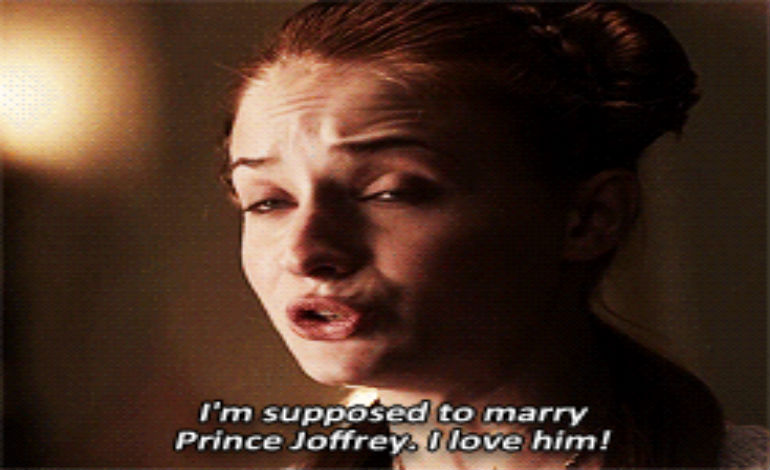
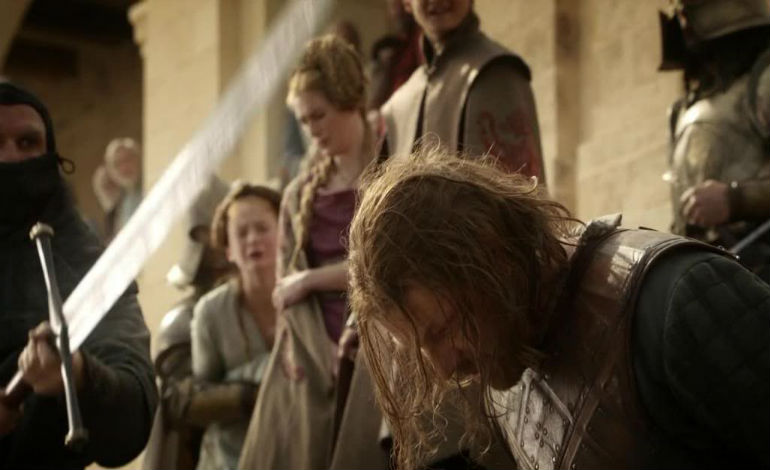
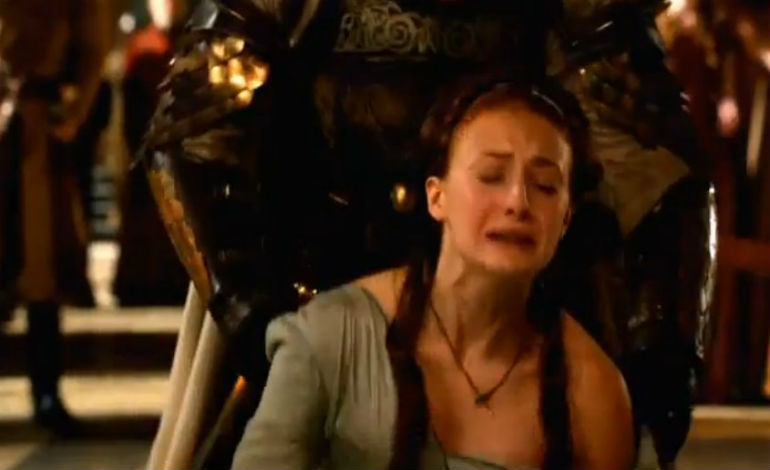
Here is a girl who is coerced into betraying her own father for political games she has no understanding of, who watches her father get executed, who has to look at his decapitated head and gets beaten by knights for the King–her former beloved’s–amusement.

Sansa Beaten

She is married into the House that ends up instigating the slaughter of most of her family and to a man she doesn’t love.

Here is a girl who likes tales of maidens and true knights and lemon cakes.

And Sansa gets used. And used again. And again. She ends up getting her first menstrual cycle, which her mother should have been there to talk her through, and has to share that with Cersei: all the while dreading that natural human function because of what it will mean for her value as a woman, as a breeder, in this situation. That one scene sticks out at me the most and if everything else wasn’t enough to make Sansa grow up in such a traumatic way, that symbolized it the best from my perspective.

Sansa and Cersei

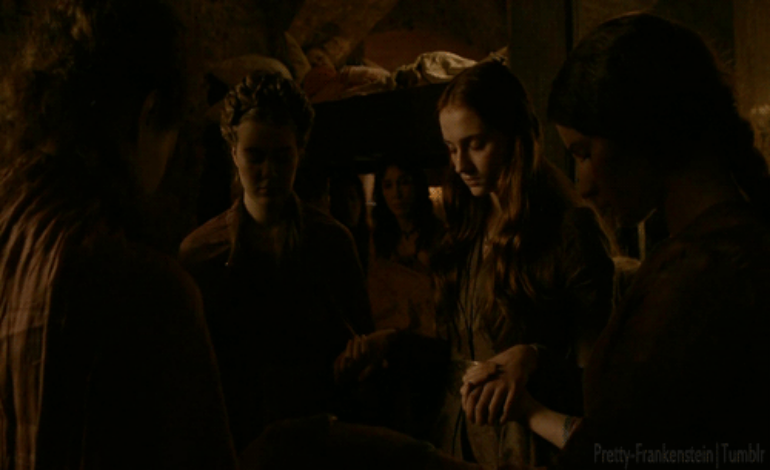
Even so, she still believes in those tales her mother and tutors used to tell her. But more than that, Sansa actually cannot stand to look at cruelty and even pleads for Ser Dontos’ life when he arrives drunk to one of Joffrey’s celebrations and when she tells Margaery Tyrell of Joffrey’s true nature. An even greater example of Sansa’s moral nobility is when, during Stannis Baratheon’s siege of King’s Landing and Cersei’s descent into despair, she actually leads the women hidden away in the castle in prayer:  keeping up morale and hope while their Queen essentially fails them and feels sorry for herself. The fact is, there is still that honour and decency that her father and House Stark instilled in her as well her own sense of compassion.

Sansa Morale

She is a girl who hasn’t been warped by bitterness and shallow displays of power like Cersei or her aunt Lysa Arryn, or blinded by the idea that political power will always benefit family first like her mother Catelyn (which was far more pronounced in the books where she wanted Lord Eddard Stark to go to King’s Landing as Hand), and she is definitely not as shrewd or as clever as Lady Olenna Tyrell but again, she found herself in this entire situation as a child. And now, for better or worse, Sansa is growing up: and she is learning. She is learning the rules of how to survive in her suddenly very cruel world.

I won’t say very much more about Sansa’s journey, but I will tell you this much. She may not be a warrior like Brienne, or a rebel like Arya, or even the fierce woman that Daenerys Targaryen forced herself to be by necessity but Sansa has many strengths that already exist inside her: great intelligence, a growing knowledge of the court and its rules, as well as compassion. I suspect she might become more ruthless in some ways, but never callow or vain or arbitrarily cruel. She won’t be as direct in her lessons of power, but she will do what she has to and, if she can, maintain her integrity and capacity for empathy in doing so. And, more than this Sansa Stark has also demonstrated, through her morality, the ability to take charge and provide a deep sense of moral support, inspiration and hope: as some might think that a good queen should.

In the end, I don’t think that Sansa Stark is a hero, or a coward, or a weakling. I think that she has her own personality and will eventually find her way through the game of thrones. I think, by necessity, she will continue to be a strong female character: perhaps not the strongest, but definitely one of them.

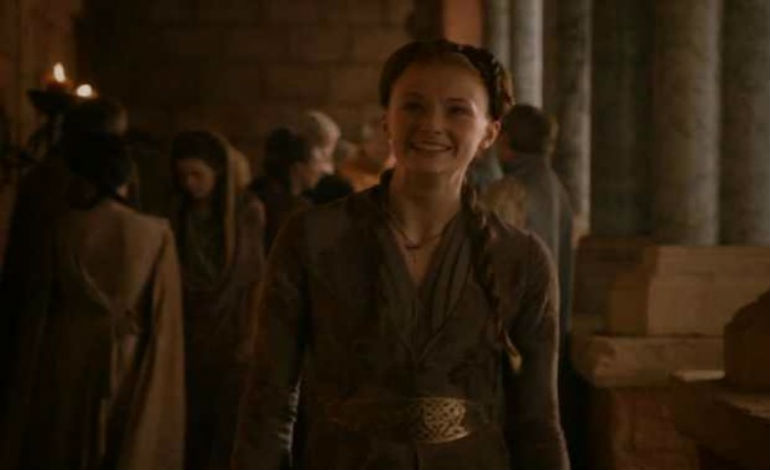
Sansa Smiles

GAME_JAM Ctrl + Alt + Delete

Imagine you are making a game. So, for the purposes of this crude analogy, think of yourself as a game developer.

Now, you have a game design document or GDD: a document made as an outline for a team in order to put a specific kind of game together. You, or a group of people supporting you, can add different additions, adjustments and clauses for the purpose of customizing your GDD and expanding it into a game that is your own.

All right, now imagine your GDD, the source that you are working from, is a Game Jam. And what is a Game Jam? A Game Jam can be seen as a space where various people–graphic artists, audio makers, programmers, and even writers–come together and with a prompt, or no prompt at all, make a game of some kind in a small amount of time. More often than not, groups of developers and creators pair themselves up before the event and have known each other for a while: creating close-knit relationships with each other ranging from working together all the way to the point of friendship. The idea of a Game Jam is to have a small window of time in which you not only get to experience spontaneous creativity in an inclusive and friendly environment but also potentially reaffirm relationships and even make new friends and contacts with a game-making community.

Now, bear in mind that every Game Jam is different. It either has a different theme, or it’s sponsored by external sources, or it is run from the houses of friends who decide to get together and make games while socializing and sharing ideas. While some Jams can theoretically have anyone of any experience level, including newbies, as participants other Jams require creators to have prior expertise before attending. One such group of the latter, with the assistance of YouTube companies such as Polaris decided to create a special Jam that could illustrate, to a larger viewing audience, exactly how some of this “spontaneous creative process” might work and, hence, demystify and even fascinate people with how ultimately a Game Jam can work.

So keep thinking of this idea of a reality-television Game Jam, called GAME_JAM, as a GDD. Imagine that some marketing directors, having never made or played a video game before, decided to add their own additions and clauses into the GDD and overrule the original creators (which, unfortunately, is a common occurrence within the industry at least). Think of these additions as analogous to the contracts with GAME_JAM participants that, if signed, would force them to–among other things–allow themselves to be “misrepresented for dramatic purposes” ala “reality-television,” not be able to promote their own independent work based on the show during this time, and always having to promote their sponsors such as Mountain Dew to the point of needing to drink it in front of the cameras that were everywhere save for bathrooms and bedrooms.

Think of what the presence of “dramatic misrepresentation” can do as well. Basically in this case, it attempts to take the spirit of cooperative gaming, and turn it into a player verses player situation with neither warning nor consent. I think, even if you aren’t a game developer, it can be safe to say that this structure is jarring and very self-contradictory: to the point where even if the clauses are tweaked, the original flaw in the messy structure that was the original conflict still remains.

But these elements in themselves didn’t necessarily mean that GAME_JAM would end. Many of the participants and group leaders such as Zoe Quinn the creator of Depression Quest, Davey Wreden of The Stanley Parable and others were and are creative enough, when motivated, to work with production: to collaborate in order to make a more unique “game” as it were.

But now think about this already inherently unstable game structure which already compromises the spirit of open space of creativity due to a certain degree of production micromanaging.

And then, something bad happens. And this something bad occurs long after the Game Design Document of GAME_JAM becomes a program in its own right.

It comes in the form of one of the more boisterous and obnoxious market directors. This Trojan virus in consultant’s clothing as it were, decides to place utilize and push for Digital rights management software or DRM that compromises the operating system that the game will be run on. It may have even seemed like productive software at the time and helped GAME_JAM and its sponsors. Even the production companies know that this particular form of DRM, in the form of one Matti Lesham of Protagonist’s attitudes, is potentially harmful but they have always tolerated it: a creative consultation program that is really a commercial program that gets clicked on and fills your computer with incessant ad ware, and intrusive spyware and worse: virulent malware.

It is this malware; composed of deceptive queries such as “Do you think you’re at an advantage because you have a pretty girl on your team?” and “Do you think the teams with women on them are at a disadvantage?” that completely corrupts the original GDD’s ideal of an open, safe, and inclusive space of creation.

And this was what ultimately caused GAME_JAM to crash.

And when it comes down to it, its participants let it crash.

Perhaps anyone else would have let the computer downstairs languish with its offensive pop-ups, its hostile injection of lag between creative processes, incessant ads and its corrupted programming except none of these other people would have been game developers or game makers. More specifically, none of these people would have been professionals.

And GAME_JAM was filled with independent developers and makers–friends and professionals of quality art–that didn’t like to deal with having their space impinged upon, or being told what to do, or dealing with someone attempting to create conflict through antiquated, misogynist hate-speech spam. Perhaps a home owner might ignore the virus on the computer they are forced to use, but a programmer would go after it and delete it mercilessly. What GAME_JAM ultimately became as a result of all the above was an unplayable mess and an extended and non-consensual trouble-shoot. The system that was GAME_JAM, even with the overt flaws removed in the form of Matti Lesham’s dismissal, was still too corrupted and buggy to prevent anything like the contradictions that allowed the infection to begin with: a whopping $400, 000 assessment.

Nevertheless, this mistake of a game taught its players and creators something. It made them go back and look at the original Game design document that was intended from the start. And they looked at it. They really looked at it, and themselves, and what they were capable of. It taught them how not to create a game and how to make a game–or a game jam–that hearkened back to its GDD: one of mutual cooperation, acceptance, friendship, and an intolerance for conformity and bigotry. GAME_JAM might have become unplayable but those involved with it will hopefully not only play other, better games but even allow themselves to make them: with everyone on-board for its conceptual phase.

Back to the drawing board Game Design Document.

For more nuanced information with regards to what happened with GAME_JAM please check out Jared Rosen’s Indie Statik article How the Most Expensive Game Jam in History Crashed and Burned in a Single Day. He was a games journalist that documented what happened at the event. The bottom of his article has links to other participants’ perspectives on the event as well. You can also look at Rami Ismail’s Polygon article A warning about contracts from the sidelines of the most expensive game jam in history and Colin Campbell’s How ‘Game Jam,’ an indie game dev reality show, collapsed on its first day of filming for good measure.

Something’s Got to Give

Hello everyone.

I’m writing this post on something of a time limit, but given how much time itself has been challenging me lately, it’s only appropriate. So let me try to tell you what I want to say.

There’s this point. I’ve been really back-logged lately. What I mean is that I have a lot of different projects and some obligations to deal with and they are beginning to mass on each other. It kind of makes it really hard to breathe at times, in all honesty. In fact, it gets to the point where it’s really hard to think and you get to that place where you begin to wonder if it is ever going to pay off.

But I think more than that is the fact that I’m starting to get tired.

Picture0039

From 2012 or so, I have had a very nice, if somewhat insular routine in place. But now that safe place from years of constantly moving around is becoming really suffocating for me. There are times when I just literally can’t stand it anymore.

I’m tired of being stuck in one place and away from resources that could help me: once I can identify and gather them. At the same time, I am terrified of reaching out for the potential of changing this situation–especially in terms of being social–because, quite frankly, I’ve been burned on that front before. There’s no other polite way to phrase it beyond that.

It’s now 2014 and I need to get a new passport. I need to not always be sitting in front of this computer screen: and when I am, one of my own customization. I need to get out of my parents’ house and meet the people I care about. Mostly, I feel this driving need to get out.

To get the fuck out.

I need to have something akin to my own space again: and not just in the material sense, but psychologically as well and when I am outside. At the same time, I need to maintain a routine and a sense of discipline but also that sense of calm and centring in carrying the rest of that out.

A while ago, I was talking about limiting my time on Mythic Bios to one post a week, as opposed to two. This was back when I was writing that other work of mine that required so much time. I am now seriously considering this. At the same time, I don’t want to become aimless or feel that every bit of writing I do has to be out of a sense of obligation. But the fact is, when it comes to it, I have not had enough time to essentially play with my writing or challenge myself: and this is not a good thing.

I need that time to play or I won’t make anything remotely original. And right now I am fighting against that whole “what is the point if I am not even getting paid because I want to pay off my dues and move out and have my own adult life again while doing something a worth a damn to me” mentality. It is really frustrating all around for me right now and, at the same time, there is this strange feeling I have that I am very close to something: to getting closer to something that I need if I can find that place. I just don’t want to stop doing my work because I’ve lost enthusiasm for it or I took much time away from it all.

I can sum this entire post up in one sentence: something has to change. And I may have some idea as to what some of those things might have to be.

Amanda Palmer: The Keening Moment

I’m not the most musically literate person there is out there. I always heard some of my friends constantly talking about musicians that they love and bandying their name all around. And I never understood it really until relatively recent times. I’m also sure that there plenty of musicians that can sing with the intensity that Amanda Palmer has displayed. But the fact of the matter is that none of the others that I’ve either heard or haven’t bring up the effect in me that she can.

Not to this extent.

I don’t even know where to start: though I do know it is going to be short. There is a moment in a few Amanda Palmer songs, particular songs, where she enters what could be called a climactic phase but what I call a keening moment. For Amanda, and from my limited experience as I am not a fully comprehensive Amanda Palmer listener, it is that point where she builds and builds her tone and pitch to the greatest of passion and it … rips through you.

For instance, take her rendition of the song “Hallelujah.”

While she didn’t create this song, and the piece in itself already has a powerful emotional resonance, Amanda increases this frequency to its nth degree. She sings it for Anthony, who at the time was fighting a particularly brutal form of cancer. Her voice is broken. Apparently, when she was singing this and as she is wont to do as she is always on the move, she was physically ill. But, as if that weren’t enough, she was also in an intense place of grief.

But when she reaches that moment of “Hallelujah” … I don’t even know what to say. It is a scream. It’s a scream that, for me, pierced me right to the quick. In that moment, it was real. It was very real because, quite simply enough, it was. It is the terror and anger of life fighting for life. It is primal and messy and only the surface of what is underneath it. It’s like that moment when you try to detach yourself from what’s going on and you don’t understand, or want to understand what your friend is going through and you hide behind something petty only for that friend to scream that this supersedes all of that bullshit and you will damn well fucking acknowledge it: because life takes precedence over the proprietary.

I’ll be honest with you. It’s makes me uncomfortable: to have that surface of pretend that makes most human interaction ripped away to expose the raw. It is a brilliant, uncomfortable feeling made even more poignant that it is from another person being shared with everyone else.

Yet as potent as this is, Amanda’s “Bed Song” is …. something else entirely.

If her voice in “Hallelujah” makes me uncomfortable in that it reminds me of mortality and my very real lack of power, “The Bed Song,” quite frankly, terrifies me.

I’m not kidding. It scares me. It scares me to the point where after having heard it a few times, I just can’t listen to it or watch the music video. It, too, is far too real. But it’s more than that. It’s worse. It is a beautiful song and an excellent series of visuals and storytelling that captures the essence of a relationship dying.

I mean: think about this. You have two people together who love each other and you watch as time and circumstance erode that connection and friendship between them into distance. Into death. I’m not even talking about the physical death that happens at the end and the retrospection, but the emotional death: the slow rot of the soul between the two people living together, but not being together in any meaningful way.

Neil Gaiman, Amanda’s husband, has created many terrifying creatures and stories in his time. He has made “Cereal Conventions” and Other Mothers and all kinds of terrors with and without flesh. But, if I were to choose, I would say that Amanda Palmer in the context of “The Bed Song” scares me more than Neil ever could. She manages to build up to and capture the essence of a living death and the helplessness of watching it happen and feeling powerless to stop it only, at the end, to confront it … after it’s far too late.

That realization, in and of itself, is enough to drive anyone insane or want the embrace of physical death, but “The Bed Song,” the idea of two people lying next to each, facing away from each other, inches away and dying alone, is all the more horrifying because it is a wrongness that becomes accepted much in the way that someone slowly succumbs to an icy death.

It is a brilliant story. It is a poignant song. It takes the spirit of that lack of communication to the point of “too late” and makes it into art.

And it utterly terrifies me: because it makes me feel something I don’t want to feel. Or it brings out something that I already have. Because that keening moment isn’t just the climax of the song or the pitch of Amanda’s voice, but rather it’s that painful and almost transcendent moment of recognizing these qualities growing inside of your own very self.

I could just leave it all at that. I could leave you here with the feeling of raw grief and a lack of catharsis. I really could be that mean and say that this is what life really is. But I would be doing Amanda a tremendous disservice. The keening moment I identify is not merely in the domain of grief but its very opposite.

“The Ukulele Anthem.”

Sometimes nonsensical, sometimes weird, but oftentimes fun and always, for me, transformative. It just expands to the horizon and becomes liminal. There is darkness but it is the song commands, “Ukulele banish evil.” I can just see a glowing, eternal figure facing the growing darkness and playing her simple ukulele: making the shadows scream and, for a time, retreat from her sheer presence, only for her to hand it to someone else cowering in the darkness, smiling and skipping away to make another one.

So while I like the ferocity and anger of the keening moment in The Killing Type and dealing with the loss of a romance as life goes on in the summery fey cabaret of Massachusetts Avenue, “The Ukulele Anthem” is, for me, a reaffirmation that eventually the darkness will be put in its place as people realize they are not alone and they can make the light grow together even sharing something as simple as how to play ukulele.

Maybe one day, when I am less self-conscious, someone will show me how to play one. In the meantime, I am just grateful that through those keening moments I have another way to relate to music. Perhaps, as Neil’s Erasmus Fry once said, all writers are liars, but I believe that at least some musicians tell the truth.

Photo Credit: Glenn Ross

What If Comics Had Been a Place Without Codes? Would We Live as Air?

I’ve been having some technical issues these past few days and time hasn’t really been my friend but what I’m going to write here past most reasonable people’s sense of sleep is another down and dirty, and therefore ad hoc, article on comics.  So if anyone out there is an expert or has done their homework, by all means, please correct me if need be.

As some of you already know Sequart created and is now in the process of editing, a Kickstarter called She Makes Comics: a documentary on women in the comics industry and the culture surrounding it. One element in particular that it has focused on is the fact that long ago there were more female readers of comics than they were male. Now, I wrote a short article on what will soon be called GeekPron in which I found some of my own assumptions to the question, well, questioned.

I believed that it was the Comics Code Authority, inspired by the fear of McCarthyism “witch-hunting,” blacklisting, the detrimental testimonials by psychological experts such as Frederic Wertham, and a loss of business that had comics publishers eliminate most of their different genres of comics and focus mainly on watered-down stories about superheroes. All the horror, revenge, gore, westerns, romances, and sexuality all went the way of the dodo at the time because of fear. Anything that challenged the rules of the Comics Code, of authority always being right and just for starters, could not exist in mainstream corporations that published for money.

But the comic book editor Janelle Asselin also mentioned that this female readership of 55% over 45% of male readers changed as the superhero genre became more mainstream. Think about that: the idea that after a time the superhero not only reduced a female readership, but also eliminated or greatly marginalized a whole body of stories and genres that made the medium different. I realize now, looking back on what I wrote earlier, that these two statements are not necessarily mutually exclusive.

I mean, if you are afraid of losing your business and your liberty in telling stories for which you want a certain pay cheque and livelihood then eliminating anything that could be construed as an overt challenge to your culture’s status quo or even subversive to it, it unfortunately makes a horrible kind of sense.

The godfather of manga Tezuka Osamu once said that “Now we are living in the age of comics as air.” And while he was most likely referring to the influence of manga in Japan as becoming more widespread, its connotations can be applied to the comics medium in general. According to Paul Gravett, in Sixty Years of Japanese Comics, Tezuka believed that comics without passion or originality can become damaging and even create pollution. It took me a long time to figure out what this meant. When I first encountered the quote and the explanation, I thought that it referred to the potential damage to the morality of the reader but now I realize that the quote can definitely apply to comics as a medium and what occurred during the heyday of the Comics Code Authority.

The age-old notion of the superhero ghetto that we are so used to hearing about with regards to the comics medium: the notion of an immature all-boys club with shallow depictions of sexuality and simplistic violence with no consequences is damaging not only society’s concept of the medium but also that of its readers and future creators.

I’m not, by any means, saying that the comics that existed before the Code and its predecessors were the fonts of enlightenment for gender or, really, humankind. But there was a lot more experimentation before the Code and it just makes you wonder: what would have happened if these vigilantes and superhuman beings in tights had just remained one of many genres and there had been no Code?

I mean, there is always the scenario that Alan Moore presented in Watchmen: that if masked heroes and one a superhero had been in existence then no one would have paid attention to Wertham and the horror comics of Bill Gaines and friends would have dominated the medium from the fifties all the way into the eighties: becoming darker and more grotesque with time while also innovating itself much like our comics have done.

But that is just one creative interpretation. Who knows? Maybe a flat period of unoriginal and recycled stories would have followed regardless. Perhaps female readership demographics would have changed or something else would have challenged the “morals of comics:” for or against the status quo. Or we could have had another Golden Age: where comics became, earlier on, a widely accepted form of beautiful art and every great artist might have tried their hand at one. Maybe comics could have become widely accepted and mainstream coffee table or instructional as manga has in Japanese society to an almost ubiquitous degree. Instructional comics even had their place in North American society and to some extent they still do.

Of course, those latter thoughts are just me playing at utopia and I’ve never been really good at that. Maybe if there had been no Code comics would have, earlier, been just another form that challenged conventional morality much like any work of great art or literature should. Of course, again, this also happened in the Western world through the advent of what we understand as Underground Comix defying the establishment during about the late 60s: about that same time frame that Asselin gave when she talked about the female comics readership majority existed from the 1950s to the 1960s. Or perhaps the comics medium would have burned itself out as a fad and amateurs such as myself would be wondering, even then, what if: what if it had been different.

As for me, if you really want my honest opinion I will say this. I think that if there had been no Comics Code or anything like it children would have still been influenced by Tales from the Crypt, and Archie, and The Lone Ranger, The Green Hornet and all of those others. And some girls and women would have had Wonder Woman and Black Fury. Many things would have continued on, but sometimes I think about that idea of all people–young, old, straight, LGBTQ, male, and female, different ethnicities, different classes–making their own comics and showing them to their friends and the world. They would realize how different they and everyone else are but also how many things they have in common.

And when you wipe away my pseudo-utopia of a whole loss of potential for a readership of intensely intelligent men, women, and sentient beings, when it comes down to it I do like the idea that without the Code and the forces behind its development, the medium of comics would have been considered more than just silly laughter and transparently hidden BDSM parodies. Those things would have been a part of the kaleidoscope. I think that many more people might have seen comics as a medium that tells all kinds of stories: a space inside and outside of us that is pictures and words. I think many more people may have been more accepting that the medium of comics as that place of sheer variety, like film, between both art and literature.

There is another way to look at Tezuka’s quote about “comics as air.” If you take the pollution of censorship and unoriginality away, what you might ideally have is a fluid art-form that anyone can learn and use. And if you consider that we all live in the continuing Age of Information and in societies that utilize wireless Internet and you include webcomics into the medium … perhaps we can all fly where only superheroes used to tread: up, up, out of the ghetto and away.

Miracleman Balloons

I Found Out I Was a Cambion on my Birthday

It was my birthday yesterday.

It’s funny. I can’t always remember what I did every March 16. I can’t really remember anything particular about 2013. I do recall watching the controversial return of Darth Maul in Clone Wars back in 2012. I also recall my girlfriend buying me a Ms. Fields’ chocolate chip cake in 2011: the same year she had offered to have me move in with her. I didn’t really celebrate my birthday in 2010: though there had been the promise of a celebration that never happened. In 2008 I brought a birth cake to a gathering and before that there was another where someone announced it was my birthday and I was all embarrassed and such.

Before that it was a blur of Undergrad and small family celebration. I do know that every time this day comes along, it feels lighter. I mean there are seasonal reasons for that. When you look at it I was born towards the end of Winter. According to my parents, I was supposed to be born in the Springtime but I was apparently eager. Sometimes I wonder about my infant self’s wisdom, but there it is.

For many years in my childhood I had a birthday party with my friends and such. And yes, I was an eighties child and my parents did rent a party room and we did watch The Neverending Story and gave out memorabilia such as Falcore on a ruler that turned into a wristband. But then I got older and my friends went their separate ways and I found that I had no friends really to celebrate anything with. Birthday parties just started to feel very childish and when many of your friends live downtown or out of province and country, it is hard. Even though it didn’t feel like it, aside from dinners that my parents insist on taking me out on now that I’m at their place and a cake, my birthday just became every other day.

C'Tor Solutions

I was lucky this weekend. My friends, some of whom I’ve known since high school and one who I knew in elementary, told me at the last minute that we had a role-playing game session. This was going to be a special session. This was the point where our characters were going to cross from the ordinary mortal realm into beings of other essences. A new rule system was based and is still being tested by us. We talked, rolled dice, ate, laughed and actually role-played. I was exposed to so much lore from this world that Noah, our DM, has taken great pains to create.

And now because of the revelations of last game, my character’s plans might have changed along with his view of the world.

We spent the first part of our time cutting out cards and writing down our new powers. Then we started playing. I felt really enthusiastic and there were twists and turns and dinner and I could just see Noah waiting to reveal all of this lore: and it is not over yet. It’s funny. I have talked about my friends here before and our games, but I don’t think I ever realized just how long we would know each other. We have evolved over the years and sometimes we are together and other times we are off by ourselves. I think that is what loners of our kind do. But loners do gather from time to time to do awesome things.

And I vowed, for that one day before I even knew we had these plans, that I wasn’t going to dwell on the more difficult elements of my life. Not my welfare, nor my conflicts, or the myriad of other things I want or need to do, or didn’t do. All that mattered was that one day where I got to roleplay with my friends.

So there you go. This is my obligatory post-birthday, well, post.

Oh and, my character found out he was a Cambion: a descendant of a human and a demon. It actually explains a lot about me. It really does.

Happy thirty-secondth birthday to me.

Looking Outward