Jenna Coleman Is Leaving Doctor Who: Goodbye Clara

I’m going to be honest: I’m glad that this is Clara Oswald’s last season on Doctor Who.

Last year, I went into a great amount of detail as to why I thought Clara Oswin Oswald Didn’t Have to be an Impossible Girl. Here we had a character who started off with a lot of spunk in “Asylum of the Daleks” as Oswin, and a clever governess between Victorian social strata in “The Snowmen.” We had the mystery of just how a human individual could appear in different time lines and planets as different incarnations of the same person.

The ingredients were all there in creating a fascinating Companion for The Doctor. Either Oswin or Victorian Clara might have made for some excellent long-term character interaction. Instead, what we got was a plot device: someone “born to save The Doctor” who later develops a tremendous sense of self-entitlement, and a propensity towards lying and outright hypocrisy.

I wonder if either of them remember that The Doctor can open the TARDIS with a snap of his fingers.
When you pull an Anakin Skywalker …

Seriously, I was kind of hoping that after her betrayal in “Dark Water” The Doctor would remember he could snap his fingers, open the TARDIS, and leave Clara behind on the lava planet. 

... expect to get burned.
… expect to get burned.

But what is worse in a lot of ways is that Moffat, and the writers he directed in his show-running capacity, seemed to do this in order to represent Clara as a reflection — and then a mirror darkly — of The Doctor even as they attempted to create for her a shambles of a personal life.

In all honesty, the character of Clara Oswald should have had her ending in “Last Christmas”: in that last denouement mirroring “The Time of The Doctor” where it is she, this time, who is old and dying and The Doctor is now young again and helping her with her party favour. Even in “Listen” and “Last Christmas,” some of Clara’s strongest episodes as a character she is still only seen as important in relation to The Doctor. But in “Last Christmas,” there was this sense of finality. We had seen Clara span space and time. But now her seeing old and tired, leaving a full life behind her in a situation that is a fixed point in time, would have been a bittersweet ending that might have made up for a lot.

Eventually even the Girl Who Fell Through Time will finally run out of it.

Indeed, “Last Christmas” was supposed to be Clara’s last episode before Jenna Coleman decided to stay on for another season.

Instead, that touching scene was rendered into another Inception-level hallucination of the dream crabs and The Doctor and Clara go off to have another tortured series of adventures. You could almost feel Steven Moffat giving detractors of Clara the finger at that point: teasing that moment and then taking it away.

It’s not fair to say that Clara is the only example of bad writing from Season Eight. Certainly, The Doctor himself suffered from this malady, but it was always in relation to the forced relationship that Moffat made between him and Clara and, up until now, didn’t seem all that inclined to change.

It was not unlike reading an otherwise excellent story with a recurrent, discordant, and obnoxious grammar mistake that the author claims is there for creative or dramatic effect: something like a narrative Jar Jar Binks.

But now Jenna Coleman is leaving sometime during the Ninth Season of Doctor Who and this leaves us with so many questions. Could the end of Clara Oswald’s time on the TARDIS have something to do with Missy calling her “Clara, my Clara,” her maneuvering to unite her and The Doctor, and the name of the second episode of the two-part opening story “The Witch’s Familiar?” Certainly, it would explain a lot: if it’s not just another contrived red herring and if her fate in “The Magician’s Apprentice” is only temporary.

Nevertheless, Jenna Coleman is moving on to her new role as Queen Victoria in the new drama series Victoria and I wish her well: just as I wish for Clara Oswin Oswald — the excellent Companion that could have been — to finally rest in peace.

Hugs are just ways to hide one's face
Goodbye, Jenna Coleman. Goodbye, Clara.

A Doctor Who Prologue

Before the return of Doctor Who, BBC One has already given us a hint of what is to come. This is a Prologue to the first episode of this season. And so: what do we have here?

Karn. The planet of Karn is the home to the Sisterhood of Karn. More recently, it was the site of the minisode “Night of the Doctor,” where we got to see the transformation of the Eighth Doctor into the War Doctor and the beginning of his entry into the Last Great Time War. However, Karn and The Doctor have an older shared history: from his time combating the renegade Time Lord Morbius as the Fourth Doctor and the introduction of the Sacred Flame and the Elixir of Life.

What is also interesting to note is that the Sisterhood of Karn are biologically Gallifreyan. In fact, not only do they possess the Elixir of Life that can at least temporarily restore life, but they create potions and processes that aid in helping a Time Lord regenerate. According to the New Adventures novel Cat’s Cradle: Time’s Crucible they are a remnant of the Pythia’s power: the original prophetic leader of an ancient matriarchal Gallifrey.

It could have been assumed, at least in how they were only portrayed in “Night of the Doctor” in the new Doctor Whos series, that Karn had perished with Gallifrey in the Time War but it also makes sense that they did not. The fact is, when The Doctor mentioned he had been the last of the Time Lords, he could have only been referring to Gallifrey and its ruling class. He never actually said he was the last of the Gallifreyans. Gallifreyans become Time Lords, but not all Gallifreyans are Time Lords and the Sisters of Karn are something else entirely: even if they are related in a biological sense.

Of course, this could be a moot point as due to the actions of The Doctor and all his past incarnations, Gallifrey was seemingly saved. Perhaps this could be applied to its erstwhile allies such as the Sisterhood of Karn as well. In any case, here in this Prologue we have an interesting situation.

Who is this person who has a history with The Doctor, and is attempting to use his servants to find him? Who is this “creature” that The Doctor owes nothing to? Well, it most likely isn’t Missy as Missy identifies with the female gender pronoun and the only minions she has are those she subverts or creates for twisted and zany purposes.

However, there might be another clue.

Who is The Doctor’s other arch-nemesis? Who has had, and still yet may retain, servants to seek him out? Who had a very long and storied association with him? Who could, at this point in his existence, be classified as “a creature?” And who is this person that he can identify with: someone who creates agents through circumstance almost as much as he has?

There had been leaks and rumours that Davros will be returning to Doctor Who. I mean, many believed that he had died before, so what is stopping him from coming back now. But there is more. One particular rumour states that The Doctor will be meeting Davros before his injuries, perhaps as a younger man … or a child. It always seems to return to that idea from “Genesis of The Daleks”: to that quandary of destroying an evil before it at least overtly becomes evil. And, as The Doctor proclaims in “The Prologue” sometimes “an enemy is a friend that you don’t know yet.”

I mean, if it is Davros he is pretty well beyond any form of redemption and some things are very much fixed points in time. Davros will create the Daleks. He will be one of The Doctor’s greatest and most ingenious enemies. But, then again, this might not be about Davros at all. This could be someone else entirely: someone we know or someone that we are about to meet.

As for the object The Doctor gave the Sister Ohila … who knows? Your guess is as good as mine. Doctor Who and its protagonist Mr. Cantankerous returns this September 19.

Who Wants To Be Luigi

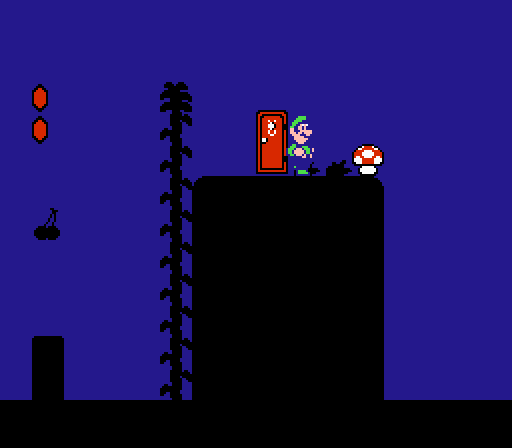
There is always someone who can relate to Luigi.

Let me be clear on the matter. It’s not because they were necessarily the younger sibling stuck with being Player Two on their Famicom or Nintendo Entertainment System. It’s not because they’ve felt second best throughout most of the entirety of their lives, or feel like they are only talked about in relation to a “better person:” to the point of their last name being the first name of said before.

I’m not talking about Luigi in the original games or even the newer adventures that have been released in recent years: particularly in The Year of Luigi.

No, I think that most of the people who can relate to Luigi have played Super Mario Brothers 2.

Yes, I know. Super Mario Brothers 2 is problematic. I mean, in addition to it only being a single-player game for the multiple choice of characters at your disposal, it is also goes in and out of being Doki Doki Panic: the intended Mario sequel, made into its own game, and whose bones made the game we all know and love from the late 1980s.

And in this game we have another problematic character. For the first time we see that Luigi is different from Mario! He is not just Mario with a green hat and shirt under blue overalls. He is taller and thinner. And he even jumps higher than his brother.

For the jumping alone, Luigi should be superior to Mario. The problem in the problematic here, however, is one simple fact: much like my green-feathered budgie, Luigi sometimes has troubles when he attempts to land.

It’s true. He jumps magnificently in the air only for his feet to spin under him in a slapstick cartoonish fashion. This is especially annoying when you try to aim for a platform: which might as well be made of ice due to the fact that Luigi is too busy spasmodically moving up and descending.

I know I’ve been frustrated many times in attempting to control Luigi’s jumps: just for him to scuttle or slide off a platform or a brick. It can be downright infuriating.

But imagine what it’s like to be Luigi. Mario doesn’t jump as high as you, but he is a more dependable jumper and lander (for the most part).  He is consistent. He gets the job done. People generally like him a lot more. And it all seems so effortless. It’s as though its all innate: all natural to him.

Yet you, Luigi, know you can jump high –higher than anyone else in the game — but you have to work at it. You have to think it out, and you become self-conscious of that process. Maybe you have more energy to expend than Mario. Perhaps you are so afraid of potential danger that you have to channel that frenetic energy somehow, or you’re excited, or that is just how you move under scrutiny. Or maybe you wish you could glide more like Princess Peach.

Maybe you like to imagine that you can fly.

And it only gets worse when someone is frustrated with you or draws attention to you when you attempt to jump under orders. Some might find it right on hilarious. And few people, if they only see you in one video game — in Super Mario Brothers 2 — will ever truly appreciate your jump. All they will see is how you struggle, and fail, and fall.

Luigi

That is why I think some people like Luigi better: not because he’s perfect, or even good. But because they are Luigi: and they don’t get the luxury of a curtained stage with a Player Select Screen.

Star Wars Episode VII and The Knights of Ren

The following contains fan speculation and possible spoilers. Reader discretion is advised. 

It’s been a confusing time for older Star Wars fans: or at least an older fan like myself. Imagine two time lines: one you knew, and one that is still forming; The latter is overwriting the former while you still remember it. Legends series and the new Star Wars Expanding Universe aside, it’s also intriguing to watch LucasFilm and Disney at work in fleshing out the mythos using only the six films, the CGI Clone Wars and Rebels series, and the new comics and novels.

But what I’d like to take a look at today are the Knights of Ren.

For something that we’ve heard a lot about, we don’t know very much else. One potential element of confusion is considered that the Knights of Ren are either working for, or are an extension of the First Order: a galactic organization created from the remnants of the Empire and its own ideologies. But what are the Knights of Ren?

So let’s make an experiment. Let’s see if we can construct a plausible story as to what the Knights are from the revised Star Wars continuity. It might be hard for some veteran Expanded Universe fanatics and even I expect to make some errors along the way due to some of my own lack of familiarity, but it could be fun and it might shed some light on this new and infernal venture into Star Wars villainy.

Perhaps in order to know about the Knights of Ren, we need to review what we know about the Sith. We know that by The Phantom Menance that the Sith had supposedly been extinct for a thousand years. In addition, we are told by the end of that film that there are only two Sith at one given time: a Master and an Apprentice. So we could assume that with Palpatine and Darth Vader’s deaths at the end of Return of the Jedi that the Sith are not coming back.

Of course there is that age-old adage about assumptions, the fact that the Sith were thought to be dead before, Count Dooku’s training of Asaji Ventress (and that training bout with the unfortunately named and created Savage Oppress), treachery being the way of the Sith, and that the new continuity may retcon any mention of the fact that the Sith were once more than two. But for now, this isn’t about the Sith, even though it may well be definitely related to their actions.

Star Wars Inquisitor

Think about what we know about the Empire now. It was created and controlled by the Sith Master and Apprentice. However, it also had Force-sensitive agents. Rebels makes this very clear with the introduction of the Inquisitor: that and the fact that there are more of them. Inquisitors seem to be dark side acolytes or adepts created to hunt down Jedi fugitives, other Force-sensitives, and generally anyone trying to ruin the Empire’s day in any real way.

Inquisitors wouldn’t violate the Sith Rule of Two as they are not Sith, but rather agents and minions that serve the Sith. This is no new idea. All you have to do is look back further at The Clone Wars and see Dooku and Ventress. Palpatine knew about Ventress as a dark side agent and had no issue with her: provided that she wasn’t being trained as a Sith apprentice. I mean, she was — supposedly — but again we are looking at treachery being the way of the Sith.

The point is that Darth Sidious and Darth Vader died: leaving the Empire in a very precarious and potentially lethal situation. So what happened to all of those Inquisitors?

Star Wars Rebels Inquisitors

I mean, some of them might have died. Certainly hunting Jedi and displeasing Darth Vader could be death sentences in and of themselves. Perhaps some of the people that accompanied Palpatine onto the Second Death Star, sinister robed beings that they were in Return of the Jedi, were more than just close political advisors and retainers. And just what were Palpatine’s plans for the galaxy once Luke and the Rebellion were dealt with?

Aside from some sanctioned experiments from outside sources as some of the Darth Vader comics delve into, I think there is the Clone Wars “Children of The Force” episode to consider. While its execution seemed really unseemly to me at the time, as a fan of the Old Expanded Universe, Palpatine securing Jedi information on Force-sensitive children throughout the galaxy makes a certain level of sense. He apparently wanted to make an army of “Sith spies” from the kidnapped children. This plan failed, but the mentality was still there.

Star Wars Children of the Force

The theory that I would like to make is that the Inquisitors were the next step in Palpatine’s regime: to create a dark side leadership over the Empire and sentience. It’d be similar to how he was operating in the now defunct — for good or ill depending on what fan you talk with — Dark Empire comics series. But he and Vader died before anything like this could become completely commonplace: and before the last of the Jedi could be purged or turned.

But these Inquisitors, if there were any left by Return of the Jedi, probably weren’t all dead. While the remnants of the Empire maintained their control over various sectors, became warlords, defected to the power of the Alliance, or entered into civil turmoil I also doubt these remaining Inquisitors would remain idle.

Imagine it. They always knew about the Sith and the potential that they could receive further training one day from either Vader or Palpatine. Then both of them are gone before one can succeed the other through the usual method of betrayal. Then their Empire, the one they’ve been serving and enforcing, begins to collapse in on itself. Three decades pass and despite their efforts Luke Skywalker seems to be bringing back the Jedi Knights to help the New Republic, or at least is training his family members to oppose them. This is the man who killed both their Masters seemingly at the same time. What do they do?

They help found the First Order.  The former Inquisitors have the resources they gathered over the years to pool into this Order along with many disaffected Imperial soldiers and politicians. Maybe they appeal to Humanocentricism. J.J. Abrams himself mentioned that his team modeled the First Order after the idea of what if former Nazis reorganized themselves in collaboration in Argentina.

Supreme Commander Snoke of the First Order, who is said to be a powerful figure in the dark side of the Force, may well be a surviving Inquisitor or a potent successor to an Inquisitor. I imagine he or his predecessors would have seen the threat of the Jedi and realized they needed something to counter it. The Sith seem to be destroyed. But they never lacked for followers. So the Supreme Commander creates the Knights of Ren: an organization of dark side Force-sensitives to fight against the Jedi Knights.

Again it is more fan theory assumption but think about it in another way. Whatever the Knights of Ren are, J.J. Abrams and his team have a lot of pressure on them. They are expected to return to the magic of what the Star Wars Old Trilogy meant to so many people. Even the special effects of the film seem to be minimizing reliance on CGI: being hand-made and material props instead. They are going back to the basics, and wouldn’t be interesting if Abrams and his team even went so far as to look at The Star Wars Rough Draft and were inspired by the Knights of the Sith: those that fought the prototypical Jedi-Bendu?

Of course, LucasFilm also hasn’t ruled out incorporating other elements of the Old Expanded Universe into the new continuity either, so the Knights of Ren could have many different inspirations: whoever or whatever they are.

But they are interesting: in that while Abrams has stated they are not Sith, they have a similar naming ritual. Instead of their title becoming a prefix like Darth, Ren becomes their new surname: with perhaps a new first name as well. So my thoughts are that the Knights of Ren are an order of dark side adepts that work for the First Order and under Supreme Commander Snoke: if the fact that Kylo Ren working under him is of any indication.

Kylo Ren

Yet what of Kylo Ren. Well we have been presented with the idea that Kylo Ren will be the main antagonist of The Force Awakens: or at least a visible one. He has created his own strange cross-guard lightsaber and he is very obsessed with Darth Vader. Perhaps his obsession is original to him, though if we go with the theory that the Knights of Ren are the successors to the Inquisitors, who were given partial training in the dark side by the Sith, the Knights might also be dedicated to finding any Sith lore they can get their hands on: to further their own training and power. Who knows: maybe one of them wants to become the next Dark Lord.

Darth Vader Helmet

However, it is possible that Kylo Ren’s interest might be more … personal. I just find it fascinating how there are theories that he is the son of Leia Organa and Han Solo. Yet there is also another interesting point to consider. There is also Luke Skywalker. There are rumours that Luke went into exile and that the events of The Force Awakens begin to bring him out of it.  But if Luke was in exile, why would he be? I’m obviously not saying that Kylo Ren is Luke, as it wouldn’t be in character and Kylo is portrayed to be a much younger man.

Kylo Ren Unmasked

I do think the problem is the importance that George Lucas placed on Anakin Skywalker as the Chosen One and being genetically the most powerful Force sensitive in the Prequel Trilogy. In this way, it kind of undermines any attempt to make someone not related to the Skywalker bloodline a potentially powerful Jedi or dark side user in their own right. However, I could be wrong. Perhaps Abrams has his own ideas and we might get more plot twists than we know what to do with.

Many people in the Star Wars galaxy believed that the Sith had been extinct for a millennium. Many more believed the Jedi had been extinct for almost two decades. But if there is one thing that hasn’t changed about Star Wars, it’s the following. Whether it is about family, ideology, philosophy, or war Star Wars has always been about legacy: and I want to see how this legacy is going to play itself out.

Was It Me? Five Nights at Freddy’s 4 Speculation

Scott Cawthon’s Five Nights at Freddy’s series has taken Internet imagination by storm this past year or so. There has been so much speculation as to what is going on in the story line. For games where you must survive five (or so) nights against stained and rusting animatronics trying to stuff your frail little fleshy body into a suit filled with pistons and wires — if not worse — it has a very complicated plot that is spread across narrative fragments of 8-bit mini-games (often only accessible when after you die), newspaper clippings in the background, easter-eggs in the games, and even code on Scott Cawthon’s own website.

It’s insane: in a very good and deliciously evil way. Much like this cupcake.

Bet you wish this cake was a lie, huh?

All of the games have been talked about and analyzed: from gaming journalism sites, to professional YouTubers and Let’s Players, and all over Reddit forums. It is also no exaggeration to say that the series has its own dedicated community of fans: many of them attempting to dissect the game as if they are playing a warped and twisted totenkinder version of Halliday’s Easter Egg in Ready Player One. But one particular Five Nights at Freddy’s Game is getting a lot of attention right now.

Five Nights at Freddy’s 4: supposedly the final game of the series.

The fact is, Scott Cawthon could have ended the series with Five Nights at Freddy’s 3: where the fate of the murderer of all the children that he, might have, stuffed into the animatronics at Freddy Fazbear’s Pizzeria was finally revealed. But Scott couldn’t leave it at that. Each game reveals a part of the puzzle, of the story, that we didn’t know about before. And everyone is scrambling to figure out the significance of what happened in Five Nights at Freddy’s 4.

This is all the more poignant due to the fact that Scott Cawthon went on on record as stating that while the community fanbase seemed to have solved most of the mysteries in the previous three games, they still didn’t get everything in Five Nights at Freddy’s 4. He then rubbed some salt in the wound by saying that the October 31 update for the game will not include the opening of the locked box included at the completion of the game’s Night 7.

So aside from an obligatory Challenge Accepted meme across the Internet, I have my own theory with regards to the story of Five Nights at Freddy’s 4: and what the game may have really been about.

The issue is taking details literally. Here is what I think happened. People went onto Scott Cawthon’s website and saw the source code for his page while waiting for Five Nights at Freddy’s 4. They looked at the source code and saw the number 87 repeated over and again in chains. 87 was believed by many to refer to the Bite of 1987 in the game’s lore: where apparently an animatronic bit off the entire half of some poor unfortunate’s frontal lobe.

There were no other details provided aside from that and so, when people saw 87 in the code of Scott’s page many people believed Five Nights at Freddy’s 4 would either be set during that time, or would at least explain what happened via some mini-games.

And it seemed so clear cut. The game even ended, initially, after Night 5 with an 8-bit rendering of the crying child protagonist getting his head chomped down — seemingly by accident — by the Golden Freddy animatronic: know known by some to be the original Fredbear and possibly the first animatronic in that franchise. We thought we saw the Bite of 87 in action and the events that led up to it.

Worst birthday ever.
Worst. Birthday. Ever.

But some things just didn’t add up. The YouTuber MatPat, in his two Game Theory videos on the matter, explained that the game itself — which seems to take place in the nightmares of that comatose child’s mind after his bite — had inconsistencies if he had been the victim of the bite. For starters, missing his frontal lobe would have affected his fear responses and even his subconscious perceptions. And there is also that fact the person who lost their frontal lobe, according to FNAF lore, actually survived while this child does not.

And then there is that fact that if you find an Easter egg following Night 3, you will realize that there is a cartoon playing on the crying child’s television that is Fredbear and Friends: with the date of 1983, not 1987.

Oops. Wrong bite.
Oops. Wrong bite.

Yet here is the thing. At one point, before Scott changed his webpage to create a chain of nightmarish animatronics asking, “Was it me?” and seemingly referring to which of them caused the Bite of 87 — a major point of contention in the FNAF Community — he had an image of Freddy Fazbear’s top hat lying by itself on the stage: making it unclear as to whether or not he would continue the series past the third game.

Musicians like the singing animatronics aren’t the only ones that perform on stages, however. Stage magicians also perform on stage. They traditionally wear top hats, and they are known for their misdirection and slight of hand.

Nothing up my sleeve, nothing in my soul ...
Nothing up my sleeve, nothing in my soul …

Scott Cawthon is no less an entertainer of that caliber. Mostly everyone was so distracted by the idea that they might be seeing the Bite of 87 unfold and the mystery of whodunnit finally solved that other possibilities were not as prevalent.

Look at it this way. In the first Five Nights at Freddy’s game, Scott added an update after being asked about the Bite of 87 so often. There is a Custom Night menu where you can program the difficulty level of the animatronics that you are dealing with. If you type in 1-9-8-7, Golden Freddy will automatically appear and “crash” the game. Many took it to be that Golden Freddy caused the Bite, while others thought that Scott was just trolling them after being harassed about this question for so long.

It's me.
It’s me.

But what if the code chain of 87 in on his webpage was actually there to tell everyone that Golden Freddy was central to Five Nights at Freddy’s 4? And what if that reoccurring question “Was it me?” in all the subsequent images that followed on the same page had nothing to do with the Bite of 87 at all? 87 was a red herring, or at least a way to make you possibly more aware of Golden Freddy: of Fredbear.

What if the real question wasn’t who made the Bite of 87, or how? What if the real question is which spirit was impetus in making the events in all of Five Nights at Freddy’s possible?

MatPat and other YouTuber theorists believe that the crying child in the fourth game becomes the Puppet: the animatronic who reanimates the spirits of four other dead children into their current animatronic forms in all the games. But he doesn’t rule out that the crying child also becomes Golden Freddy: that in terms of the story it would be much more satisfying given what happened in the third game.

Here is my understanding of the situation. In the second game, we see a child get murdered outside of what might be the first Fredbear’s Family Diner: and he becomes the Puppet. Then years later Fredbear’s expands into a chain of Freddy Fazbear’s Pizzerias. We see the crying child in 1983 get tormented by his older brother in a Foxy mask, and also the fact that he is deeply terrified of Fazbear’s: as if he saw something happen in there he shouldn’t have. On his birthday, his brother and friends stuff his head into the Fredbear animatronic and it accidentally chomps down on him. The Puppet, sensing a kinship with another tormented child who didn’t even get to enjoy his last birthday, takes action. He doesn’t have his body, but he makes the child is first attempt to restore life: and makes him into a Golden Freddy ghost as that was how he had been fatally wounded and rendered comatose.

Then the murders of the children start to happen. Everyone thought that the Puppet was reanimating the children through the animatronics of Freddy, Chica, Bonnie, and Foxy to get revenge on their murderer. But if you play the secret mini-game in Five Nights at Freddy’s 3, you have the opportunity to set the spirits of those children free. If you are successful you get a final scene where children wearing the Puppet, Freddy, Bonnie, Chica, and Foxy masks give a cake to another child in a Golden Freddy mask. Then they pass on.

Happiest Day ...
Happiest Day …

Scott Cawthon used to create Christian games before he set out on his adventure into horror. One central tenet of Christianity is redemption. Perhaps, when it comes down to it — though not in a purely transparent C.S. Lewis Chronicles of Narnia fashion — the question of “Was it me?” was really which animatronic’s spirit motivated the Puppet to set everything into action: that it was more than vengeance or blood lust but an actual need to set things right. And it would only be fitting that Golden Freddy, possibly made after Fredbear the first animatronic, would be so integral in beginning and ending the series.

Everything is proceeding as I have foreseen.

There are a lot more details I haven’t gone into of course, but I will leave that in more capable hands. We may never know what is in that locked box, of it is as simple as whether or not the Puppet or Golden Freddy started all of this. But remember: the narrative above the box, and in Scott’s Steam message didn’t say that the secret would never be revealed. The text above the box reads: “Perhaps some things are best left forgotten, for now,” while Scott himself states, “maybe some things are best left forgotten, forever.”

Based on the fact that Scott Cawthon has released the Five Nights At Freddy’s series relatively more quickly than most people expected, while releasing the fourth game earlier than his originally stated Halloween date, and his history of playing with assumptions, I think he is kind of a tease and I take everything he says with a grain of salt. I would not be surprised if there is more to this story one way or another.

And now, more than ever, I am looking forward to Halloween.

River Song Returns For The Doctor Who Christmas Special

So we’ve been following the adventures of Mr. Cantankerous, my pet name for the Twelfth Doctor, for a little while now and I know that I’ve always wondered just how his wife, Professor River Song, would handle him. I mean, we know she tends to pop up at the most unlikeliest of times but it wasn’t certain as to whether or not she would return after her appearance as a holographic psychic ghost in “The Name of the Doctor.”

Well, it turns out that we might get those questions answered after all. Alex Kingston is returning to her familiar role for this year’s Doctor Who Christmas Special. Of course, with the obligatory Who out of the way, we have to deal with the elements of What and How. What is going to happen in this episode. And how is River Song going to come back?

I mean, we know that hers and The Doctor’s time lines are generally parallel. He is seeing her from the supposed end of her biological life to the very beginning, and then all the Timey-Wimey, wibbly-wobbly in-between that would make The War Doctor weep about his midlives crises.

Almost any scenario could be possible at this point. She could appear as a psychic ghost in The Doctor’s head again, that much is true. They could run into each other in between encounters with monsters and other time lines, with her not knowing about his new incarnation as she’d still be with Eleven. But there is also the possibility that with being downloaded into the Library she has amassed all of its knowledge and simply waited and managed to create a new physical body for herself ala re-evolution.

I am just as curious to see what this Doctor Who Christmas Special will be about. I’d love to see her totally put Clara in her place with regards to The Doctor, or outright punch Missy in the face for messing with him. Maybe they will all have a tea party on the TARDIS together. And perhaps somewhere in there, River Song might help Mr. Cantankerous find Gallifrey or, at the very least, see how cantankerous he can remain around her?

I don’t know about all of you, but even at the end of summer I actually look forward to Christmas now.

SilSol: A Dark Crystal Vignette

Here is my second, and last Dark Crystal character sketch. I made a lot of speculation as to which urSkek SkekSil and urSol came from: especially from the second volume of The Dark Crystal Creation Myths. To me, this writing represents what I could have done, and what I did actually do. I hope you will enjoy it and appreciate this in the spirit that it is meant. 

SilSol flew through the lines of stars and suns with his brothers as they finally left Thra through the Crystal of Truth. His own mind, though clearer, now was no less blurred as they passed the point beyond space and time and perception.

He looked down at his form: such as it was now. It was a brighter orange: almost a bright white light. Once, UngIm would have told him that a white corona symbolized a process of healing. And he, above the rest of his brethren, shone the whitest of all.

Even now, travelling with the others, it was hard to think of Thra: of the place of their banishment. He remembered wanting to leave and rejoin his people so badly. He hovered in the skies far across the ocean and sang in a place where he thought no one else would hear them. To the Gelfling people, he taught them songs of growth, and peace, and love. But to himself, singing to an audience that no longer listened to him, that he was no longer a part of by virtue of being a “he,” of being an individual, he sang of loss and loneliness and the clinging to of false hope as temporary staving off of despair. But it had been a deceptive salve, one that ate away at his very being, that stained his reddening form with a spreading blackness … it had proven just as corrosive and as ineffectual a balm as essence, as vliya

Deep regret flowed and passed through SilSol’s ethereal form. He had not known the mariner Gyr had been there that day, listening to his song. It hadn’t been the Gelfling’s fault. It had been none of their faults. In his spite he thought them primitive savages and only Aughra was considered even remotely equal to his kind. But she had been wiser than he in many ways, though he did not spend nearly as much time with her as TekTih had, and the peoples of Thra had their own songs, their own rhythms and variations. It was the very opposite of the former unity and symmetry—the perceived perfection—of the communal consciousness of his own race. Once, long ago, SilSol knew his music had been as precise and perfect—as crystalline—as mathematics and the physics of the cosmos. But he had split away down a quantum path into something else, like the rest of his brethren and he hadn’t been able to find that perfect note again, that rhythm that he needed, that he craved for balance …

Is there no place in all the realms of the Crystal where a single being will show me compassion!?

It wasn’t even Raunip’s fault that he had finally unleashed his anger and bitterness. That one had his own imbalance, his own lack of connection with himself to deal with and SilSol had not envied him. In the end, SilSol blamed Thra, the place that graciously took them in, for this sense of loss: though the fault, he knew now, lay within himself.

Dark Heart, Raunip named him, once.

Is there truly no love for me in all creation!?

The Crystal, and Thra, and the Universe had answered him. They had always spoken to him. He just did not hear it. He chose not to hear it. Like the Chanter that he had been, he closed his hearing to everything but his own song, letting it play around him and drown everyone out, let it deafen the world, let himself become deaf …

He knew now that his brothers had been the same: had denied their darker impulses, had secretly hoped to purge them with the light of the Crystal, to go home … SilSol had just been the catalyst to ignite and rip apart their wilful ignorance.

But it did nothing to assuage his guilt. Better urSkeks than he: so many others including TekTih and the great SoSu passed on fragmented while he, the catalyst that made the Crystal divide them, remained. He recalled the Division vaguely: remembering the scorn of his brothers and their hatred of his one discordant note: for the vestige, that grating reminder of what he had cost them, of what they had lost and he had taken from them when they were all whole. He went around and used that crooning voice, that one note, to tell lies and ruin lives … At the same time, he recalled the Valley and the peace, though unearned, that he had finally found for his soul there, for the love he had of the planet he once disparaged, and the time he spent singing with his brothers, with the Gelfling Jen that was like their child …

As these fragmented memories unified, the pain in SilSol eased and flowed out of his body into the darkness of space, into the streaming of his brothers’ light. Even fragmented, he taught Jen his songs, and his selfish part—the part that caused so much pain—guided him to where he needed to go. Unity and symmetry won out at the end of the day, disparate notes becoming a single song again.

Around them, as they continued to travel, his brothers began to sing. UngIm, at their forefront where SoSu had once been, beckoned him forward. SilSol found his light becoming a brighter white and gold again. He understood that he would heal—that they all would heal and had healed—together. With this thought, this solace, his two voices—become one once more—joined the rest of the chorus as they, all of them, continued on their final and eternal journey together and whole again.

Urskeks

Jen: A Dark Crystal Vignette

Two years ago now, I immersed myself in the world of Thra: in an attempt to write a novel for The Dark Crystal Gelfling Gathering Contest. Every day I would write notes on my novel outline in my journal while reading the old novelization and the visualized encyclopedia. Before this, I had only taken smaller creative challenges that I displayed on this very Blog. But taking this on, even though I didn’t end up creating a novel, actually helped to save my sanity and cultivate my own creative energy. 

Still, sometimes I regret the fact that I didn’t write that Gelfling Gathering novel or the short story I had planned. To be honest, though, sometimes I’m just sad the contest itself ended: with all the interactions on the Community Forums and the possibilities of making myself a part of this world. During this time I wrote a few story sketches on the Board: to immerse myself and my writing into that world. Basically, I wanted to see if I was capable of writing Dark Crystal stories. So in honour of that special time in my life, I want to present to you one of the first story sketches that I made: from the point of view of our favourite Gelfling Jen in light of everything I learned afterwards. I hope you will enjoy this, my friends for I know I did, in writing it. Take care. 🙂 

Jen watches the luminous beings—the urSkeks—as they ascend into the air, through the Crystal, dissipating into mist, into space, and time and energy, and all the other elements and concepts that his Mystic teachers and friends attempted to instill in him until they were gone completely: as though they had never been there to begin with … as though they had never come to Thra at all.

But Jen knows better. The gleaming palatial white of the Castle that houses the Crystal of Truth—once blackened and warped by the filth and depravity of the Skeksis—is a testament to the beings that were here: that did all of these things. He sees the inscriptions on the newly clean walls: with art and frescoes rivalling that of the ruins of the Gelfling cities … so many cities … so many people … so many of his own kind gone.

UrSu had known. All of the Mystics—the urRu—had known. Even when they taught him, he sensed their collective weariness—their awful guilt—and a few moments ago he realized why.

Jen looks out through the window at the sky. The three suns have passed other another. The Great Conjunction has ended: not to begin again for another one thousand trine. And the wake of those three mingled suns leaves Jen with much to think about.

The urRu and the Skeksis had been one people: two halves of the same being.

His Master had always instilled into him that everything has symmetry and balance: and that when balance was broken, Nature—abhorring a vacuum—would adapt accordingly. UrAc, the Scribe of his people, of his brothers, once showed Jen a myth that his long-departed brother—who Jen now remembers as urLii the Storyteller—used to tell in which a race of great and powerful beings challenged the gods and for their hubris were torn asunder into two peoples. They would spend the rest of their existences trying to live and yet always searching for their other halves. UrAc had written this tale down: as one of the many chronicles that urSu let him see when he was learning to read, and the irony of this story does not escape him now.

He saw them. After the Skeksis cut down Kira, even after he saw her graceful, beautiful winged form crumple to the ground reaching for him and he slammed the burning shard into the Dark Crystal with a righteous fire in his veins, he saw his teachers come into the Chamber. They surrounded the Crystal and he saw them … He saw the light refract from the whitened Crystal blazing as they drew the panicking Skeksis towards them.

The usurpers of Thra were so afraid: as their moment of triumph became one of their greatest fear. It was as though the Skeksis feared death and, in a way, that is exactly what happened. Jen saw that even the Skeksis that tried to trick him and Kira, become drawn into the waiting arms of urSol. The urRu had always been so hunched over, so old, so humble but when they came before the restored Crystal they towered powerfully … majestically over the quailing Skeksis. They were beautiful as their thoughts and considerations finally followed through to definitive action.

The words of the long-dead Storyteller flashed through Jen’s mind of two becoming one again. So much more happened after that. The urSkek—the one that had ordered the Garthim and urIm the Healer both—told him so little, but enough. One mistake had cost them their unity, one mistake had cost the lives of the Gelfling people, and almost the life of Kira. But then … the urSkek sang and his brothers sang with them. It was urSol’s chant and the deep resonant hum of the other Mystics only with another chord running through the sound, a high pitch to match the heavy thrum. For a few moments Jen thought he had heard what was once the squealing “mmm” of the Skeksis he met before, which he now saw as just a broken fragment, a base echo of the brilliance surrounding him as his heart glowed against Kira’s body: clutching it for dear life.

And as the music filled him, it was like the dreamfast … only different. There was no touch of skin, but it went beyond that. He saw stars and a crystalline world, and the urSkeks, Thra in the beginning, Aughra younger and his people all whole and spreading throughout the world … the urSkeks aligning crystals to make the Crystal brighter, cultivating it … the Great Division, the inhibitions of the urSkeks turned into the Skeksis and their horror, the compassion and conscience of the urRu powerless to do anything but protect and pain, and sorrow, and joy, and peace and yearning manifesting into one place through another people entirely: Jen’s people … Jen and …

The joy of Kira stirring against his breast would never leave Jen as long he lived. And that was when he saw the glimmers of the urRu through the strange and ageless forms in front of him, the active power that was once embodied by Skeksis made into something positive again.

And now they are gone: the urSkeks leaving them with the mysteries of the Castle and the Crystal: with hope. Kira is at Jen’s side: stirring against him. Jen realizes he isn’t angry at the urRu for not telling him. They did in their way. But he wonders. What of the urRu and the Skeksis that died before the Conjunction: fragmented and separate? Were they consigned to a void? To an abyss of nothingness? Did the gentle and inquisitive urTih cease to exist? And what of urSu: the wise Master that shared his fate with a dying corrupted Emperor: who Jen now knew had finally let himself die so that he could succeed this day?

But then Jen remembers. He recalls his Master telling him about another life, and Aughra saying that urSu could be anywhere. Jen smiles and closes his eyes: basking in the light of the Crystal and Kira by his side: for he now remembers another lesson. For just as urSu once told him that Nature abhors a vacuum and that energy can neither be created nor destroyed, the urSkek also taught him another lesson.

Everything is connected.

It is with this thought that Jen knows he and Kira can build again: and that there is again, finally, hope.

Jen and Kira

A Business About Storytelling, Game Development, And Other Promises

Aside from the fanfiction I posted the other day in a previous post, it’s been yet another long while since I’ve posted on this Blog. Obviously, a lot has happened since I last wrote here so I will try to catch everyone up.

The LDEEP Workshop actually took another week longer than I’d originally thought. Now I am seeing the head of the program every Monday and Thursday. What we’re doing now is we are working on a plan of self-employment. It is going to be centered around two aspects: assisted storytelling, and the creation of some collaborative works. Basically the idea is that I will be helping other people with their writing, or telling their own stories while making my own with fellow artistic collaborators.

In retrospect, I’d been heading in this direction for quite some time even before LDEEP. Even before it had a name, even before I had a Patreon account, I knew this was something that I had to do. And if all goes well, I may even be able to get assistance for this. But it will take time and effort on my part. I am still not home free yet and, honestly, even when this becomes a reality I still won’t be.

There have been challenges even now. Sometimes I’ve wondered if I am doing the right thing or if someone as numerically challenged as myself has any right attempting to run a business. There had also been times when I was frustrated with LDEEP and how many of its workshops, while informative, didn’t really apply to my ultimate goals. And very recently I had to turn down a job offer that, while it might have given me some money, just wasn’t feasible for me due to distance and misunderstandings.

Yet these things have worked in my favour when I really think about them. I was having a lot of trouble articulating a good business plan. The head of our program told me to “make a story with numbers.” And I struggled with it. I admit, it slowed me down a lot. I wanted to create actual content. I wanted to keep writing on this Blog. I didn’t want to be bogged down by details. And I was looking for someone full time who could help with future administrative duties: to leave me with time to create.

But right now I am the only one that can make this happen. And I realized I was going about this all the wrong way. I’ve mentioned many times before that I have a learning disability: specifically in the realm of mathematics. So, one day after dealing with a lot of other issues, I realized that what I should be doing is writing out “the story” first and add the numbers, with assistance, later on. Basically, for lack of another better analogy, I am working on the thesis of the thing and gathering the research and evidence afterwards to back it up.

It was still work but I managed to create a first draft of a plan. And it is still, like everything I do, a work in progress. And I will definitely keep you posted once I finally make something a little more substantial to work with.

I have also been working on a collaborative game with a team of people who happen to also be made up of some of my childhood friends. And I have accomplished a lot. I have not only created a sample list of pre-generated character names and six factions, but also an extra seventh faction that I hope to use in a tutorial along with a creative event scenario. There is, like everything else, a lot more to do but I am pleased with mine — and my teammates’ — progress. So while I am not a programmer or a graphic artist, I am a writer for a game and so this is actually some game development on my part: which makes me really damned proud.

I also can’t wait to say more about the actual game itself, but I will wait on that until we have more done and when our team leader thinks it appropriate.

The graphic story collaboration I am making with Angela O’Hara is still happening, but we have both had to take time to deal with our respective workloads. But I know we are both still interested in its creation and I look forward to sharing that work as well.

So many promises now, I have to say. I feel like, for all the challenges and tribulations I’ve faced, I have been doing some good work. And that in itself is a reward. But I plan to do so much more: just as I also plan to share so much more with you, my faithful friends and readers.

Until next time.

Looking Outward

Black Cat

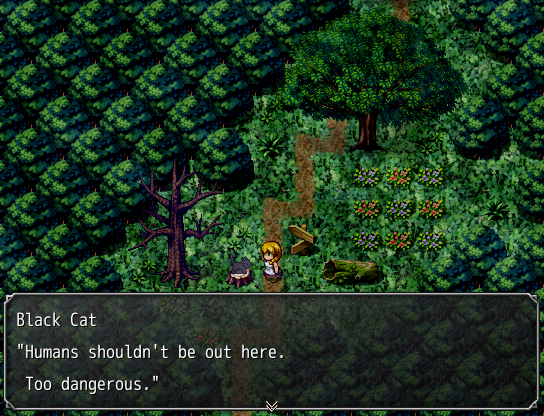
This is an alternate ending to Fummy’s The Witch’s House. If you want to play the game and not get any spoilers, do not read any further. Reader’s discretion is advised. 

Ellen already thinks that I’m gone. And that suits me just fine, really. She’s been a lot of fun, these past couple of years, centuries … Time makes no difference to me. Time is boring. But we’ve both got what we wanted, in the end.

Well, almost.

The fact is: I couldn’t miss this for the world. She got out of the house that I crafted for her, that she built on with all that pain and suffering, mixing the potion in exactly the same way I taught her to destroy the wall of roses and thorns that Viola made for her. Ah, Viola. Poor Viola.

But look at her tenacity. Ellen did quite a job on her. It was easy, from I understand. Viola was a lonely girl, without a mother, with her fearfully overprotective father always hovering over her. She didn’t have any friends her age. There aren’t many little girls that live in the woods. In fact, there are no other little girls that live in these woods. Not anymore.

Ellen used everything I taught her to get one last new “friend.” The magicks keeping her alive, for far longer than her weak, diseased, frail, pale violet-haired little form should have even existed, were waning. She was practically bed-ridden by the time she lured beautiful, healthy, blonde-haired Viola to her side. And played Viola like her musical namesake: appealing to natural sense of pity, compassion, kindness and — more importantly — her sense of loneliness.

It’s funny. They were different from each other in so many other ways, but I’ll bet if they really had time to look at themselves in the cracked mirrors of my house they would have seen that loneliness was the only thing they ever had in common.

Oh, Ellen. I taught you far too well. Maybe I’ve just been in this form for far too long. I mean, you’ve won. You could have killed Viola many times over. You could have killed her from the very beginning. The body-switching spell that I taught you only required her initial consent: after that, you could have made her rat-food.

But there you are. You just have to gloat over her. You just have to remind her about how she agreed to let you borrow her sweet young body for just one day, how she trusted you, how you cut off your own legs with that knife, blinded yourself, and made her drink that potion that destroyed your old body’s voice to render her so helpless …

You thought of everything, my Ellen. But you just had to toy with her, didn’t you? And, I see … her father is coming. With his gun. I see exactly what you want to do. It’s brilliant. He will see you, in Viola’s body and see Viola trapped in the ruined horror of your old form and kill her.

I have to say, it didn’t take much to shape you into this. I mean, you already killed your own parents before you even knew I existed. Don’t get me wrong. I enjoyed eating their souls immensely, but I wanted more. You still had some regret then, some fear over your own death, but it didn’t take much to assuage those bad feelings away with promises.

And I did promise you, didn’t I? I promised to teach you how to write. And I did. I taught you to read all those stories. I instructed you in magic and how only equivalent exchange — instead of literal, physical keys — could unlock the secret places in my house. And I told you the secret of how to exchange your body for another’s. I even said I would help you do it: that my house and I would disappear once Viola was gone and you could start your new existence.

Of course, I also told you I would miss having this form.

Silly Ellen. You really should have cut off your own hands.

You still don’t get it. She’s not just uselessly twitching those fingers in your own blood in the soil down there. She has made her final decision. The thought never crossed your mind.

Just how was Viola able to use your own magic against you?

The thing about me, that you never questioned, is that as long as there are shadows I can be in more than one place at the same time. Remember, Ellen, time is boring to me. Most of it is filled with eating souls that I can’t hunt myself, because I can’t touch this world without one of you, or playing games with my prey in my own little way.

It wasn’t as easy as you might think it was. Viola truly was a really good girl. She, like your pet frog, really did love you. I’ve never understood unconditional love, the thing you’ve wanted badly: more than discarding that rotting corpse of a body. But it is an interesting bauble to play with.

The pain of being in that mutilated husk of yours got to Viola, my dear Ellen. It didn’t take much. She had already been desperate enough to drink that potion you gave her, to “make the pain go away.” And I promised her, just as I promised you so many years ago, that I could help her if she helped me, if she listened to me, if she … fed me.

But she resisted. She was on her way though. Just as you have fragments of her memory in your body, she had pieces of yours: just enough, with my gentle guidance, to use the house, to make illusions … to create that wall of roses. It was all just to stop you, though. She wasn’t there yet.

It wasn’t until I mentioned her father, being all alone, being alone with you, that she agreed to my terms.

And even then, all I gave her was the spell. Oh, there you are my sweet Ellen. Right back where you belong. Oh, look at her abuse you. She is angry. Kicking your ruined head. What is that look in your eyes, my friend? Betrayal?

Silly girl: what did you think witchcraft was all about? It is about equivalent exchange again, about substituting one thing for another. Actually, I lied Ellen. Witchcraft is about false equivalency. Did you really think you were getting anything close to an equal exchange in our dealings? Did you think that’s what you gave all those poor little boys and girls you experimented on all those years?

But more than that, I even told you: witchcraft is about giving your familiar, your tutor, a physical form: thus making you a witch. And even more than that, Ellen, it was all about keeping me fed … and entertained.

Oh, she’s stepped on your brittle little fingers. Viola’s already learning. In fact, she’s learned so much. She will make an excellent witch. Tell me, Ellen, though we will have more time to talk soon I see Viola’s father coming with his gun, do you know what is more delicious than eating innocent, murdered souls? Do you know what is more nutritious than dining on a soul tainted with centuries of bitterness, resentment, and cruelty?

What is more wonderful is taking an innocent soul, tempting it, destroying it, warping it in on itself, and turning it into another witch’s soul that — one day — I will eat with great relish. In the meantime, I will have a whole lot of appetizers.

Starting with you, Ellen.

Ah, you were attacking his poor daughter and got some gunshots to the head for your troubles. Still trying to get the happiness you never had, the joy you’ll never feel. I see the light fading from your bloody sockets. Now that is A Funny Story. Is that despair? I bet you didn’t expect that reward. But don’t worry, Ellen. I will take my time consuming you, just to let its flavor set in a little more.

In the meantime, yes, that’s right Viola. Thank your father for saving you. Introduce him to me. He is just relieved the witch didn’t get you and will give you anything now. And look at the new house, the new life, you’re going to build for each other.

But remember our agreement, young lady. You will feed me souls. And for the soul transference spell, you promised me the very first soul that came your way. It’s not like he really understood you anyway.

Yes, I just have to say: in the end it’s really easy being a little black cat.

Black Cat