Here’s Johnny: An Introspective Look at a Life in Kan Gao’s To the Moon

All right, there will be Spoilers, so if you haven’t played To the Moon and you want to, please do so and don’t read this yet. As always, you have been warned.

So in my previous article, Going to the Moon with Kan Gao, I basically reviewed the game, its graphics, some of its game-play and story, and also talked about the Workshop I did with Gao himself as well as a little bit about the nature of video games. In that same post, I went a little bit into my personal reaction towards the game, but not as much as I would have liked. Actually, aside from getting to some of the basics, I was a little dissatisfied with what I wrote and felt that there could be more that I had to say.

I logged onto Steam and came across this Kotaku Gamer’s Guide article Steam Users Can Now Buy To The Moon, A Game About Marriage, Memories, And So Much More by Kate Cox: where she writes her interpretation of the events that occur in Kan Gao’s game. And here is where I stop talking about video games and media and go into the matter that I am really interested in: storytelling and character development.

The game itself has you and your player characters–Dr. Rosalene and Dr. Watts–going back through Johnny’s mindscape in order to find a place to create new memories for him so that you can fulfill his dying wish: to go to the moon. But why does Johnny want to go to the moon?

When you find Johnny to do your job in fulfilling his wish, he is an old man on his deathbed. You end up having to go through his mind, and his home, to find out more about him. You are told by his housekeeper that he has always been a very quiet man that keeps to himself. Then when you get into his mindscape, you do find out a lot more about him.

You follow him backwards through his life. You see him as a sad old man mourning his wife–River’s–passing, as a middle-aged man getting increasingly frustrated with fulfilling his wife’s dream and taking care of her while being deeply afraid of losing her, as a young man that is ignorant of his wife’s condition and yet still wants to help her, as a sullen and scared adolescent who wants to feel like he is different, and finally as a child who has hopes for the future.

It is easy–very easy–to get to the point where you start to think that the story is about River and not Johnny. Even the Doctors Rosalene and Watts sometimes get distracted by these memories to that point. But this isn’t about River. It’s about Johnny.

So here’s Johnny.

Screenshot

As we go back further and farther into his past to implant the new memories that will fulfill his dying wish in his mind, we look at Johnny’s life: the good and the bad.

We see a young boy watching his mother accidentally hit his twin brother with her car as she backs out of the driveway. As the investigation of Rosalene and Watts goes on, we find out Johnny was given beta-blockers to take the edge off of that traumatic memory. In fact, if it weren’t for this discovery, their own work with Johnny would never have been completed: those memories being cut off from Johnny and from their own access.

Johnny is a boy who started off with a twin brother named Joey and dreams: who’s life is shattered before it even begins. What’s worse is that he met River as a child then and they promised to meet in a place once a year to watch the “lighthouses in the sky” and by watching them, making sure they will not ever be lonely. He even gives her a stuffed platypus that she carries with her for the rest of her life. They actually promise to meet on the “the rabbit’s tummy” which is–essentially–the Moon surrounded by a star shape they created themselves. Johnny throws a hackey sack down on the spot they stand in to signify this.

But then he loses his brother Joey and the beta-blockers block or severely blunt all of those memories. In other words, he doesn’t even remember meeting River then.

Johnny gets older and he has friends. He finds himself attracted to River, also in the same high school as they are, and seeks to make a date with her. He tells his friend Nick that he only wants to be with her because she is “strange” and he doesn’t want to be “another typical kid in a sea of typical people.” He wants her strangeness–her Otherness–regardless of what she wants, to fill that … need in him: that emptiness that has probably existed since he lost his brother. On a deep and intrinsic level, Johnny knows he isn’t normal–that everything isn’t all right–and he uses the idea of River and wanting her to somehow fill that need created out of hurt and suppressed memories. Of course, perhaps on some subconscious level, there is a part of him that still feels that kinship with her from that forgotten night all those years ago when they were children, and alone, and they looked at the sky together.

Some people have intimated that River probably has Asperger’s Syndrome, but I am not so sure about that. I know that this condition manifests in different ways and there is a spectrum. I do know that River does not perceive reality in the same way as other people and is often very literal in some ways: while highly figurative in others. As time goes on, Johnny discovers that she thinks of merely being in the same room together, and being close together bodily, as pretty much the same thing. And she always asks him questions about what something means to him and what he sees in that thing. For all River is sometimes quiet, she is also very intuitive in a way that Johnny and most other people are not.

Sadly, Johnny has the ignorance of a lot of young men his age. Combined with the trauma and repressed memories of his early life, there is a disconnect between him and River that–at least initially–limits his empathy. He doesn’t understand River’s condition and he doesn’t want to: which is horrible and even more hypocritical considering how–at least consciously–this was the trait that attracted him to her to begin with. It is also clear that this decision is motivated by fear and perhaps even the guilt of seemingly being attracted to her solely because of her difference: as though he is afraid of actually further reducing his sense of her to the “illness” that her doctor wants him to read about.

At the same time, he also coddles her–even going as far as to say that marriage means having responsibility for her–and ignores statements of hers in which she tells him some very clear things about what she wants. When they do marry, he seems to even think of it as more of a responsibility than a joy while River doesn’t feel anything about it at all. At one point, Johnny admits to her the secret of why he had asked her out to begin with: revealing the shame that he felt. They are in the spot where they first met years ago as children. River ends up taking a hackey sack and throwing it on the ground. After that, she starts making origami rabbits: a lot of origami rabbits.

Maybe Johnny didn’t think she understood, or even worse, was angry and resentful at him for the “initial reason” he liked her. Finally, after a while, River begins to get sick. But before this, Johnny promises her to create a house near the lighthouse Anya–named so by River–so that “this star” that was the lighthouse would never be alone. Unfortunately, River begins to get sick and Johnny finds himself in the situation where he has to choose between spending their money on finishing the house (River’s wish), or saving River’s life.

At this point, Johnny breaks down and almost gives up on finishing the house: just to save River. But this is where River puts her foot down and reiterates her wish. Johnny doesn’t understand why this lighthouse or the house is more important than River’s own sense of health. He creates a song for River that even she can see isn’t really about her, and it is incomplete and fragmentary: a cycle that symbolizes what is going on in Johnny’s mind.

Yet, in the end, he fulfills her wish and continues with the house. And two years before the events of To the Moon begin, River dies.

It’s very easy to judge Johnny for what he did, or didn’t do until you remember and realize a few things. River was not the one who was broken. Johnny was. River seems to have a highly metaphorical mind. She threw that hackey sack down on the hill that night to remind him of the real reason he sought her out all those years ago: mirroring what he did as a boy. She always carried the stuffed platypus toy he gave her: even though he didn’t remember that either. And each origami rabbit she made was her way of trying to remind Johnny that they had promised to meet on “the rabbit’s tummy”: on the moon.

Screenshot

Although these actions were non-verbal, River showed that her mind didn’t seem to be bound by linear time. She even hated the sound of clocks: of a construct of time. Everything he told her about his selfish reason in pursuing her, in be willingly ignorant of her condition–whatever it was–didn’t matter a damn to her. All that mattered to River was the boy that Johnny was promising to meet her so that neither of them would be alone.

Then there is Johnny again. He went from being someone with dreams, to being in a haze, to having friends, to finding someone he loved and didn’t understand–and having the answers right in front of him the whole time–to living the rest of his life in the house that he built for his wife: alone. Another thing to also consider is that even though the beta-blockers made Johnny’s childhood hard to remember, he could ruminate on the rest of it: on every mistake that he ever made with River. It is no coincidence that most of the memories Dr. Rosalene and Dr. Watts travelled through circled around Johnny’s regrets. It also makes you if–when the two doctors gave him the scent of roadkill to reawaken his earlier memories of his brother’s death–if on some level of consciousness it made him remember everything. Absolutely everything.

In any case, when he was conscious Johnny had two years after his wife died to think about everything, to regret everything he had done, and make sense of it all.

Screenshot

At the same time, the mechanism of travelling through his memories only chose particular memories of his. The thing to remember is though certain memories of Johnny–powerful ones–came to the fore in this game, he and River probably had many more and they weren’t all bad. Even the prominent memories weren’t all awful. Johnny and River undertook equestrian therapy and actually had fun despite Johnny’s initial misgivings. They went to the movies. They danced in the lighthouse that Anya made. They spent time with their mutual friends Nick and Isabelle.

After River was gone, Johnny kept everything of hers: rabbits and platypus. And he fulfilled his promise to her: even after his own death by giving his house to his housekeeper and her family so that the star of Anya would never be alone. They spent practically their whole lives together and though there was tragedy and misunderstanding, they still had a life, and it was very clear to me that despite their differences they loved each other. Or, as Death from Neil Gaiman’s Sandman might put it, they got what everyone got. They got a lifetime.

In a strange way, what Dr. Rosalene and Dr. Watts do for Johnny at the end of his lifetime lets him meet River on her own terms: in a figurative reality that specifically bridges the gap between them. Dr. Rosalene herself even states somewhere along the line that what she is creating for Johnny in his memories is what River would have wanted. In essence, they–particularly Dr. Rosalene–write a plausible story based on memories and the emotions that were involved. Johnny doesn’t consciously know why he wants to go to the moon because of trauma, but he does on a very integral level. It is the same reason why River made the rabbits and threw down that hackey sack on the hill. River wanted to meet on the moon because Johnny would be there. And Johnny wanted to go to the moon because River would be there: at that meeting that he never made it to again in life.

Johnny’s story in To the Moon was a heartbreaking story about a very fallible but well-meaning man who had a life that despite misunderstanding, moments of ignorance, selfishness, and loss actually meant something. The last scene where Johnny is in his new memories and River takes his hand as they travel to the moon on their NASA rocket-ship–in retrospect–is a tremendously satisfying moment of completion and understanding beyond words.

It’s a story that really makes you look at the intricacies of a life with people. I know it made me look at mine. And, as I’ve said before, it is a story totally worth playing through.

Going to the Moon With Kan Gao

“To the Moon, Alice! To the Moon!”

The obligatory Honeymooners reference aside– a bit of humour which Doctor Neil Watts, one of the game’s protagonists, would truly appreciate–I would like to talk a bit about Kan Gao’s video game To the Moon.

Before  last Saturday, I’d heard of neither Kan Gao nor his creation. I actually saw him at the Writing for Video Games Workshop organized by Gamer Camp and the Toronto Public Library. I am interested in writing for video games and so I attended both that Workshop and the Journalism for Games Workshop as facilitated by Jamie Woo, Perry Jackson, and Emily Claire Afan: all writers for the online geeky magazine Dork Shelf.

Both Workshops were very important to me: if only to create this review. I’ve made a lot of ad hoc video game reviews–mostly with regards to Super Nintendo classics–but there was one comment that was made in the Journalism Workshop that really hit something home for me. I believe it was Jamie Woo that stated that whenever video games are written about or reviewed, a lot of the history behind the creation of them or the culture surrounding them is almost never mentioned.

I myself find that really unfortunate and makes me look at some of the reviews I’ve made as a result. I’m not going to claim that this review will be any different but, like my others, I will give you a bit of background: if only to my own introduction to this game.

I came to the Writing for Video Games Workshop thinking that Kan Gao would talk about script formats and precise ways to segment your world for potential game company evaluators. Instead, in a soft-spoken but very direct voice he talked about how to tell stories. More specifically, he talked about finding that balance between game-play–actual interaction–and a coherent story-line balancing serious emotional gravitas and the levity of humour. This preview is best symbolizes the spirit of this game.

And this is exactly what he did in To the Moon. He showed us some scenes from the game: where the 16-bit pixel characters and background immediately reminded me of Chrono Trigger: of the graphics in the last days of the Super Nintendo before the push to 3D. You’ll find that happened a lot. Older consoles would continue to coexist with newer ones and improve on the design of some of their game graphics. Look at Kirby’s Dreamland 2 on the original Nintendo Entertainment System and all the variety and sharply defined colourful sprites as another example. Gao’s work seems to borrow from that last bit of graphic grandeur and expand on it into something else and new. This, however, will be the extent of my tangential parallels and where To the Moon is completely different from even the 16-bit reference I used.

To the Moon is an interactive psychological adventure RPG story created by the Independent company Freebird Games. It is about two scientists, the empathic and grouchy Dr. Eva Rosalene and mischievous slacker Dr. Neil Watts, who enter the mind of a dying old man named Johnny to “grant his wish” before he dies. They attempt to do so through using an advanced technology that allows for altering memory from childhood. Essentially, altering memories this way is fatal and that is why it is only used on terminally-ill patients who want to have a wish granted: to do something in their life over again if only in their mind.

Johnny’s wish is to go to the moon: but he doesn’t remember why. A few days after the Workshops, I downloaded the game for Steam and played it all the way through. If I had to sum up this game, I would say it has 16-bit graphics reminiscent of the Super NES’ last days, a lot of mystery, puzzles, a very intricate pattern of linked objects and events, a whole lot of incredibly poignant tear-jerking moments, and occasional interludes of hilarity.

Kan Gao is a masterful storyteller and musician. He and Laura Shigihara–the lead composer of Plants Vs. Zombies–created a soundtrack of haunting melancholic and heart-warming musical themes that represent memory and the past. What I really like about Kan Gao’s work here is how he integrates all of it together: to find that balance that he was talking about in our Workshop. In addition to combining a fine mixture of pathos and comedy, he interlaces his narrative with a whole lot of popular cultural references from the mid-nineties and beyond, and then even goes as far as to parody aspects of the video game RPG medium. If you have played the game, I am only going to mention two words: squirrel battle.

Gao doesn’t stop there however. He also really loves meta-narrative: placing moments where you can tell the video game creator or writer is winking at you through the characters. Essentially, as far as I consider it, one of the main criteria of a classic or a masterpiece is something that comments on the medium that depicts it. In other words, there is a very self-aware element to the storytelling of this game and it is very poignant.

I will say that it took me a while to get the hang of the puzzles. Essentially, most of them were Mementos: physical representations of way-points to travel farther back into Johnny’s memories. You have to decode them and take blocks away from them. I did figure it out after decoding the first Memento. Then there was the latter part of the game where suddenly there was combat and it confused me to the point of being very uncoordinated. It felt a bit like a break in the spirit that Gao was trying to make, yet at the same time it makes sense.

If someone were to ask me what my favourite part in this game was, I would say it is the place where things started to become fragmented and cyclical. If you have played this game, you will understand. Another thing I liked was the various ways that Gao graphically depicted memory. Sometimes you would see sprites interacting, and other times you would see duplicates of them frozen in sequential order. In a way, this game is also reminiscent of Chrono Trigger in that there is “time-travel” of a sort, but you are travelling through one man’s memories and not actual time: whatever that is.

But my favourite thing about To the Moon is how it really makes you think. I know very little about Game Theory, but I am intrigued by the idea of perspective in a video game. What perspective is this story being told from? I know that I said that Drs. Rosalene and Watts were the protagonists of To the Moon, but you could also argue that Johnny is as well: or that his character becomes the mindscape they traverse. You can even say that the game is a third-person limited narrative: a kind of sustained consciousness where we don’t see into the Doctors’ intimate perspectives, but we do see and determine what they discover about Johnny. Looking at perspective in a video game narrative always an intriguing thing to consider.

It also makes me wonder, if I were like Johnny–an old man on my deathbed–what kind of new memories I would like Rosalene and Watts to place in my mind and how I would feel if they had to go throughout my original memories to place that “seed” of a new one. If I really had to pick what my favourite element about Kan Gao’s storytelling in this game is, I would say that it is the characters and how he depicts human nature. I mean, he takes 16-bit sprites and he uses them as the litmus of human behaviour: as both flawed and incredibly beautiful. The relationship between Johnny and his late wife River–in how at times they don’t relate and yet at the same time actually do–and thinking about Johnny dying alone after a life of all these good, bad, awkward, regretful, joyful, and ultimately human choices he makes is just … humbling. I can’t think of any other word to describe that.

I will also add another comment that doesn’t make sense without context: Kan Gao is such a great storyteller that he made me cry over a platypus. A freaking platypus.

I will add a concluding note. In retrospect, I think it’s no coincidence that Kan Gao gave us the assignment he did in the Workshop. It was funny actually: here I was thinking the Workshop would be like a seminar with questions and references to new Indie games I had no idea about because I’m “out of the loop” (of which there were several references anyway) and that was it. Instead, Gao challenged us. He challenged us to take a memory of ours and make it into the last scene of a video game.

It was hard. I pride myself on being a writer and I had this challenge sprung at me. The trained perfectionist in me wanted it to be good. Gao also told us that when he created To the Moon, the last scene was the one that he wrote first and the rest of the story came from it. The Workshop and the game actually makes me want to do something. I’m not sure what yet–because I have a few projects already in the works–but we shall see.

To say that I would give this interactive story a five out of five is a foregone conclusion if you’ve read this article up to this point. Its atmosphere also makes for an excellent autumn game: something you can play on your desktop or laptop computer at home with a cup of tea at your side as the leaves change colour, the air outside turns cold, and the light of the sky becomes a faded gold. I would suggest that anyone that likes games with a powerful story-line should totally download this game: if only to play through Part One of what promises to be a transcendent epic story cycle.

So To the Moon, my friends. To the Moon.

I Would Have Gotten Away With It Too, If It Weren’t For Those Meddling Squids! A Review of Cephalopods: Co-op Cottage Defence

I played this game for one day–just one day–and I hate green Squids.

Not the luminous blue ones, or the black ones. Not even the exploding fiery orange ones. The Greens. Just the Greens.

So I made an unexpected trip to Canzine 2012 this past Sunday: where I was reintroduced to the Comics Vs. Games-premiered The Yawhg, given a paper ninja-star, and talked with a few artists and game creators before finding The Hand Eye Society’s Torontron game cabinet arcade machines outside. I always loved arcade games when I was younger and I never got to play with enough of them. So finding these there was just an added bonus.

My friends and I started to play this game that I later found out was called Cephalopods: Co-op Cottage Defence by Spooky Squid Games. At the time, however, I found myself controlling a 16-bit sprite with a shotgun in a house along with my hammer-wielding friend as we were being surrounded by floating Octopi.

I didn’t have time to admire the Lovecraftian settings of the house’s interior: such as the book with the Squid imagery or the almost Victorian laboratory feel. I also didn’t realize that the hammer-wielding sprite–that the character was a female scientist–nor that her clearly non-human shot-gun wielding companion was a clockwork automaton of her own creation. All of these revelations came later when I looked at them online.

No, instead I was either killing mass-Squids that electrocuted and devoured heads, or hurriedly knocking Squids unconscious with my hammer as I was trying to repair the walls of the house to offer us protection against these tentacle-armed hordes.

This game was fun. I admit, I really liked killing those Squids. I also felt some satisfaction in repairing the walls and seeing those plus numbers come up: which probably represented how much time or durability it had before it fell again. There was another quality to the game in that, aside from the two-player cooperation that is utterly necessary to your survival, you also need a certain amount of coordination as well. Essentially, it is integral that your gun-shooting companion fires as the most of the Squids while you repair the most isolated of the walls: such as the walls that are not being massed by tentacles of doom coming to suck your face in the middle of the night.

However, there is also the option of exchanging tools: throwing your gun or hammer to your friend. It takes timing and coordination and, sadly, we did not manage this. Sometimes the sprite’s maneuverability was a little awkward and stiff. I remember at least a few times I tried repairing a plank and not realizing I had to get very close to it to do anything with it. Apparently, according to the Game Over text, we had something to the effect of having as much coordination and teamwork as a bunch of “golden weasels.” Suffice to say, it wasn’t complimentary, but certainly made us laugh.

But then, as the game went on (after each time we died I mean), it began to occur to me that something was very … eerily familiar about it. It was the Squids that obviously made me start to think this. And I knew I had seen them somewhere before: these 16-bit luminous deceptively cartoonish tentacled monstrosities. I knew it was from some research I did before but I didn’t know the name of the thing. Then much later I realized they were related to this:

Night of the Cephalopods was something I had read about when I was looking at Spooky Squid Games (god I love this studio’s name) for my article Dreams of Lost Pixels and if this is anything like the game I played tonight–and the voice-over narrative actually happens in this game–I may well download it. This is a big thing for me because, like I have said many times before, I don’t often play games. I watch them being played sometimes, and I play a lot of selective games on older Nintendo consoles, but this game makes me happy. In fact, Spooky Squid Games seems to really love H.P. Lovecraft as a thematic influence of theirs and it is one of those influences that makes me want to write a Lovecraftian story tribute of some kind.

My friend today was talking about going to some Indie (Independent artist) Jams sometime: to make ad hoc independent creative collaborations together. I remember Comics Vs. Games and I’d love to collaborate as a writer with a video game artist. I would really love to do a Game Jam sometime. Just as long as it is not a slime. If Cephalopods has taught me anything, it’s that I hate being stuck in slime … and Green Squids.

Oh, and even though I only played the game today and for a little while, I want to give it a five out of five.

Legend of Zelda: Link’s Enlightenment

I’d like to say that this is another video game review, but that isn’t exactly true.

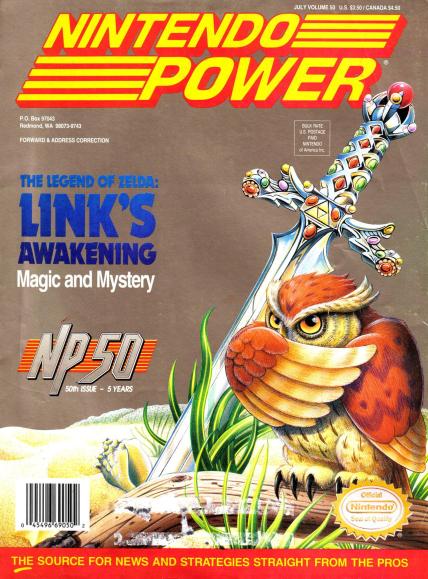
I first heard about Legend of Zelda: Link’s Awakening back when I used to get Nintendo Power Magazine. I remember that day. It was the summer time and the bus dropped me off from camp in front of my old elementary school. My Mom was there with Issue 50 of Nintendo Power that I’d been waiting impatiently for. This is what I saw:

http://countzeroor.files.wordpress.com/2010/10/magazine-nintendo-power-v6-7-of-12-legend-of-zelda_-links-awakening-1993_7-page-1.jpg

This mysterious owl sat near the sword. Originally I was annoyed that my copy of this issue got tattered, but it and the faded tan-bronze cover only added to the mystique that Nintendo no doubt wanted to build around this issue and the game they were featuring in particular. Well, for me, it worked.

It didn’t work in getting me to get the game however. Not initially. And when I did get it I didn’t really have as good a head for puzzles and video game combat strategy back then. By that point, my friend who’d gotten the game before me proudly spoiled the ending: or maybe I asked him. I don’t actually remember. So I don’t know why I picked up the game again years later, but I did. By that point I had a little more common sense and I’d played a few more games. Also, I’d read some philosophy: a lot more philosophy.

You are Link. You are on a ship in a storm that leaves you marooned on a strange Island. You figure out that the only way to get off of the Island is to awaken the Wind Fish in its egg on the top of the highest mountain.

There are puzzles and mysteries and secrets. You have many moments: most of them fun, a lot of them dangerous and you get to know the mysteries of Koholint Island. There are strange people, weird creatures, a talking owl that periodically advises you in riddles, a man who eats things he shouldn’t … and a girl who likes to sing and just spend some time on the beach with you.

I’m going to go into Spoiler Territory right now. Unlike Super Mario Brothers 2 where the “it is all just a dream surprise ending” just seems like a cop-out, in Link’s Awakening it is a gradual realization that comes with some sadness at the end of the game. In fact, the spirit of this game is perhaps even more emblematic of mono no aware–of understanding and having empathy towards the impermanent beauty in life–than even Terrangima.

Then you take the chronology that Nintendo claims the Zelda games all have into account. Personally, I liked the idea that each game in the series was a “legend”: a story with some elements of history but each being an account that has ultimately been changed over time as memory fades. However, in this case, I like that Link’s Awakening apparently happened after A Link to the Past as I’ve understood it.

Let me explain my take on Link’s Awakening and what I feel is really significant about it. From my North American understanding, there were three games before this one–the two Nintendo and the Super Nintendo ones–and all of them involved Link rescuing Zelda and dealing with the Triforce.

Here is how I see Link in this game. He has done all of these heroic things, but after he has completed them, he’s tired. In Hyrule, he is known as the rescuer of Zelda and the hero of the Triforce. If he had a normal life before this, it is gone. Maybe he just wants to get away. Maybe he lost much of what matters to him. Maybe he just doesn’t know who he is anymore.

The fact is, before this point Link didn’t seem to have an identity outside of being Zelda’s hero and the gatherer of the Triforce. Link’s Awakening, despite the franchise title, is Link’s story. It is not only a hero’s story, but the story of a man who journeys into his own subconscious. The owl that he finds on the Island is that part of him–the wise being or animal archetype–guiding him through this inner journey. Every creature and obstacle is his unconscious mind trying to keep him in a state of ignorance. Every time Link reclaims or gains a new item, he starts to remember more of who he is: or begin that process of knowing who he is.

You can  get even more Jungian and say that Marin–the girl he meets–is his anima: the feminine aspect of his mind that reveals things through subtle intuition and actually has him pay attention to the things he has taken for granted in the other games. He plays around, he laughs and he learns to enjoy the sunset and the sentiment that can feel when watching it. He also has to face Eight Nightmares that could represent emotions or attachments: seals of power that keep the Wind Fish–or Link–from waking up, while the ultimate Shadow Nightmare at the very end of the game symbolize the essence of his greatest personal fears and then ultimate universal horror.

He has to gather eight instruments to create music from a tune that Marin sings him to get into the egg that the Wind Fish sleeps in. And when the Wind Fish wakes up … it can fly. And it does.

It is a symbol of awakening: of enlightenment. It is a symbol you would find in some Eastern thought or even in a very mythological way. I know you can easily say that the Wind Fish dreamed Marin, the Owl, the Nightmares and the entire Island: that they were all aspects of its dreaming mind.  Link might even be a part of its mind and it has awakened to another reality. It is a valid interpretation given how Link physically wakes up on a floating rafter in the ocean. Does a man dream of being a pebble or does a pebble dream about being a man? Does Link dream about the sleeping Wind Fish and its Island, or does the Wind Fish dream about a sleeping Link?

The thing is, when I talk about all this, I believe I’m actually talking about Link as a symbol and not necessarily with regards to the ambiguous continuity that Nintendo is trying to make between games. I think, that at that moment above when Link destroys the last Nightmare and wakes up the Wind Fish, he is really awakening himself. At that moment, in that moment, Link is more than just a silent hero that goes around fulfilling tasks and doing what Zelda cannot or will not.

When Link wakes up the Wind Fish, when the illusion of maya that is the Island disappears, when Link regains consciousness: he actually gains consciousness. He expresses emotion through his interactions with everyone on the Island: each one of them aspects of himself. He realizes he has a whole world in himself that is a part of a reality outside of him as well. He experiences mono no aware: that sorrow and acceptance with regards to the passing of beauty in life. In one tiny hand-held 8-bit console with grey graphics or crayon-colours, Link is depicted as having achieved enlightenment and self-knowledge. For the first time, the hero of Hyrule knows who he is. He someone who dreams and is dreamed of. He is an archetype.

For the resources of the time that made this game, isn’t that just … beautiful? I’d really like to think so. I know many of you might think that I am reading too much into this and that it is just a game. Certainly I would not say that Link’s Awakening is a tool for personal enlightenment, though it is tempting to say in a creative sense, but it does depict some cultural depictions of it well. It is a beautiful artifact and I’m glad I knew it. Obviously, if this were an official review it would be getting five out of five.

I would like to leave you with just one more thought. When Link wakes up, it’s as though it was all a dream. When we finish playing a video game, the game is over. We put down the console or turn off the computer and go do something else. Our interactive electronic dream is over. Yet do all of those challenges and experiences: and those touching moments all fade away and mean nothing because they were not physically real? Did they not happen? Somehow, I don’t think so because, even when we finish sleeping, our dreams never really go away.

They continue stay with us. Because dreams are memories too.

https://i0.wp.com/www.projectcoe.com/wp-content/uploads/2012/04/tumblr_legu6rTqGz1qaaf7po1_500-300x269.png

Video Game Review: Terranigma

Imagine a game where you play as a person who needs to create–or resurrect–an entire world. With each challenge you solve, you restore not only continents but the cycle of life and the souls of all living beings as well. Then you find yourself in a battle between good and evil over what you have brought back. You find yourself between two worlds. You find a world awakening in yourself. Things are definitely not what they seem to be and eventually you wonder just what it is that you are fighting for.

You’re not exactly what might be considered hero or saviour-material. In your village, you’re known as a bit of a trouble-maker and something of a brat. You cannot leave things alone and this is what ultimately precipitates your ultimate quest and the strange, terrifying and wonderful places you will find yourself in.

Your name is Ark and your game is Terranigma. Terranigma was an action role-playing game created for the Super Nintendo in the mid-90s. It was never released in America: which is a really great shame, but it was launched in Japan and Europe.

To say I like this game would be an understatement. What I wrote above is merely a summary of a very fun and poignant story. This game has a wide range of emotional depth and covers a whole lot of themes like death, reincarnation, and life itself. I keep thinking myself whenever I think of Terranigma that if there was ever a video game with a Buddhist paradigm, this would be it. I do not exaggerate when I say that you, as Ark, have to create or recreate the world. You also help civilization evolve while becoming a part of it as well.

The character of Ark is interesting because with his mischievous and good-hearted nature and his staff weapon he reminds me a lot of Monkey in Journey to the West: a reluctant god-trickster hero–with something of a magic staff weapon–who is impelled by forces in the outer world to help others. So in some of that sense, Ark does fit the hero archetype. And believe me, this game does not skimp on archetypes or the hero’s quest.

https://i0.wp.com/rpgcorner.pagesperso-orange.fr/Terranigma/Terranigma_art.jpg

This is also an action game. It is not turn-based and you don’t gain spells when you level up. Instead, you fight. You have to think on your feet and adapt to your enemy. Defeated enemies explode into a satisfying cloud and often leave some gold behind for you. There are puzzles as well and those can be challenging but not difficult. I confess that when I played the game, I looked up a lot of guides to help me through it because I wanted to see how the story unfolded more than getting stuck in places at times.

What else can I tell you? The areas that you visit are great … fond stereotypes of places that exist in our world but they are fun to interact with. I wouldn’t learn history from this game though, just to warn you, but just take it as it is meant to be: a game with its own logic.

All this said, I feel I should definitely mention that in addition to its lush 16-bit graphics and memorable characters, Terranigma has one other very great element: its music. In fact, its music does what any video game music should: it complements the story and the characters. It is integral to the emotional complexity inherent in the game. The music can be playful, grandiose and conflictive, and sad. Really sad.

But there is something about “Terranigma Sadness” that is different. It portrays this … transitory sorrow, this acceptance of loss and gain as a cycle of life. It–and really the entire game–has this resonance with the Japanese concept of mono no aware: an awareness or an empathy towards the impermanence of life. You can really hear it at towards the end of the main musical theme in the above link. It reminds me of an old man dying peacefully in his sleep under a sunny tree or an unnamed and unsung warrior resting after a long life of battle: leaving forgotten but satisfied by the depth of his life and accomplishment.

As I mentioned before, the spirit of the game has an almost Buddhist nature or a distinct link with some aspects of Far Eastern culture: a perceptual lens which has a very unique way of looking at the world.  Being able to combine these elements with fun gameplay is a mark of genius as far as I am concerned.

All and all, after a few years of not playing this game, I would still give it a five out of five. A friend sent it to me and it only reinforced the fact that I’m glad I got over my reluctance to play old games. No, this isn’t an old game. Games like Terranigma are never old games. No, this game is a classic, and this is what a classic truly is.

I’m going to leave you with this last video. I don’t know how long it or the above link will be on here. The following was a fan video created by one TheStarOcean. I thought it was lost forever years ago and while it doesn’t use the original track, it truly captures the heart of this game. Do not watch if you don’t want spoilers and you want to play this wonderful game for yourselves. If you have played it though, I hope you will enjoy it for what it is.

Dreams of Lost Pixels, Hand Eye, and More Video Game Ramblings

I know I’ve said this before, but I am not a video game expert. Like I’ve said, I’ve played some video games in recent times but I have been very eclectic about what I will play, or even watch being played. It doesn’t mean I hate them and I do keep track of some that really catch my eye. I’m very partial to role-playing games and the only reason I hadn’t played as many as I would have liked is because I have had issues with time and money: in that I don’t always have a lot of either.

But I am interested in video games: specifically their game-play, their story lines or premises, and their choice of aesthetics. I like the idea of an interactive story that can translate itself or spread itself across multimedia.

I don’t say this often, but at one time I wanted to be a graphic designer in order to make video games and animation. Unfortunately, I didn’t really have the programming skills and the teachers that I had couldn’t teach me in a way that I could engage or absorb. It’s funny because, once, I really used to love technology. Some of you might laugh at this: those of you who know me personally. I used to think that video game technology, for instance, along with the Internet and computers would only get better with time and it could only go up from there.

I’m not sure what happened. I think I was into PC games a lot and I never had a good enough computer. I also didn’t want to get sucked into online games and I saw the quality of some console games change and not for the better. Also, in my How to Turn a Medium into a Genre I mention how I felt a misguided amount of shame for playing “old and obsolete childish games.” I’m also glad I really got over that nonsense. I do think the real reason I don’t like to play many video games is because I know I will get invested into them if they are really good and I get worried about losing time and also getting too … attached to something: to the point of being sad when it is over, or upset when my skills fail me past a certain point. Sometimes, as weird as this sounds, I get concerned about caring too much about a game.

Now, let me say this: I was really happy to be at the Comics Vs. Games element of TCAF this year. I really loved just playing some of the games with some person I just met there. It felt different and new. To make this story, if you want to call it that, even more interesting as a person who has not played a lot of contemporary video games and likes to watch a lot and remember old games, I have been interested in writing plots for and–really–just writing video games.

I know: now I am just a paradox. Now before anyone starts to tell me how foolish these thoughts are, I am aware of that. I have read and heard enough from some people in the industry–or who are getting into it–to have a little bit of an idea as to how hard it is to get into the industry and to do the amount of work and research to create a game. It isn’t something to do on a whim.

So, like I said, I came across Comics Vs. Games and saw this situation where artists were being paired off with video game creators to make games together. And … I don’t really know what to say: something in me just felt really happy to see that. Another part of me also felt immensely jealous because–once–it was a dream of mine. I am a writer. I have not really published anything for monetary gain as of yet and I am not exactly at a stage where my writing is popular. I know I am not there yet.

So I went back on to the above website and saw that Miguel Sternberg–the indie game designer and pixel artist who organized Comics Vs. Games–has been working on a new project. You should definitely check out his page Spooky Squid Games because there are a lot of very innovative and intriguing goodies on there that you probably all know about because you’ve kept with the times: including the game Guerilla Gardening: Seeds of Revolution where the object of the game is to play as protagonist Molly Greenthumb who gardens to subvert a totalitarian regime. Essentially, you grow plants to not only improve your city, to make it “green” again, but to also allow provide morale to other citizens to peacefully overthrow the State. It sounds like a cheerfully subversive game that creates a social commentary about our own culture and also refers to a few similar instances of this phenomena that have actually happened in our world. In fact, it has resonance with Roger Doiron’s TED Lecture My Subversive (Garden) Plot.

But the game that has really gotten my attention–just today–is one called They Bleed Pixels. God, I can’t begin to tell you just how beautiful I find that title. Imagine a pixelated Goth girl character who can change her hands into claws as she goes and kills creatures with pixelated stylized violence and blood. You literally see tiny squares of red gush in fountains as she creates combo attacks–with numbers appearing above them–in midair sometimes. I really like the deceptively simplistic aesthetic and the music suits the background.

It makes me genuinely happy to see something like this. There is also another interesting gameplay element in that “save points” have to be made by you and you have to expend your own points gained in battle to make them. In other words, it costs you to make save points and makes the game more challenging and forces you to be more versatile. It makes you interact with that world much more: giving you the power to manipulate your reality but also having to play by the ad-hoc rule you make for yourself. The controls are apparently very easy and precise to make without having to resort to ridiculously complicated button-mashing to fight, though I am just repeating what I have more or less read. Also, I read that they are making a silent comic to tell this character’s story about her interaction with a Necronomicon-like book and beyond.

I would definitely play this game: if only to relieve some blood-lust, which is always a plus for a game in my opinion. It might not be an RPG, but it looks fun and I like fun.

You know, sometimes I feel like I’m a fake for writing about video games and other things of which I do not have expertise. But do you know why I am writing about this? It’s because it interests me. It is partially the world-building and interactive parts, but it also appeals to a part of me I don’t always get to express. I’ll let you in on a secret too: I actually wrote a very rough script for a RPG video game: one that would definitely need a Restricted Sign if I ever posted it serially here or anywhere else: if only because of its sometimes tasteful, though definitely (if somewhat questionably) mature content. It was a 16-bit game with some ideas for interactive game-play. I actually think of it as a parody of an RPG video game script with a lot of meta-narrative fourth-wall breaking.

I’ll also say this: if I ever get to the point where I am considered a professional or well-known “artist of words” and someone ever offers to do a video game collaboration with me, I will probably not turn them down. In the meantime, I have been looking at the Hand Eye Society which is a non-profit organization that deals with organizing video game projects and supporting Toronto’s video game community. I’m not sure if they are still having socials, but they have mentioned volunteer opportunities on there and I am contemplating finding out more about this.

I may well be an amateur writer and general enthusiast, but when I look at these links I realize that these people do things with the medium of a video game that I never thought possible or really thought about and I think that is just bad-ass. I also really love creative things and it would definitely be something new. In any case, it is something to think about. I hope that this has been an interesting, if somewhat long post.

The End?

Fire Emblem Blazing Sword, Games as Silent Dramas, and the Tragedy of Kishuna

During the last years of my Undergrad, I bought two used games (and no, this is not the beginnings of a creepypasta): Final Fantasy I and II and Fire Emblem. I got through the first part of Final Fantasy pretty easily and then the until part held no more interest for me. It was too simplified and hadn’t yet reached that point of complex plots, captivating character development, and entertaining gameplay. So then I started playing Fire Emblem Blazing Sword.

I have to say: I was astounded. Up until that point I’d never found a strategy RPG more captivating, more fun, more incredibly frustrating to the point of me throwing it across the room than Fire Emblem. Up until this point I’d thought that there were no other games aside from Final Fantasy that had that combination of complex characters and fun gameplay. But it was the characters and the extra content that intrigued me the most.

And so today, I am going to talk about a character that doesn’t get mentioned a lot in the game or anywhere outside of the Fire Emblem Wiki site. I am going to talk about Kishuna.

Who is Kishuna? And this where we get into a bit of spoiler territory. When you first run into Kishuna in Fire Emblem, he comes unannounced and unexpected. He is a red-robed being whose very thin and pale face is covered by a hood. Kishuna is accompanied by a group of very immensely powerful Morphs–mystically artificial beings that you encounter more and more as the game progresses–and they are hard to kill. Another thing you need to know about Kishuna himself is that he doesn’t attack you. No. But his mere presence–his aura–is powerful enough to neutralize all of your offensive and healing magic. So as long as you are in the blocks affected by his red aura, you can’t use your magic at all. He is called a “Magic Seal” for that reason.

So Kishuna–who is an enemy–arrives to mess up another enemy’s plans: the enemy you have to defeat. I can only conjecture that he is there out of pure spite: because he pretty much hates everyone for what happened to him. So, you can kill him with conventional weapons: however, he is very hard to hit and your speed and accuracy has to be exceptional to do so. If you do manage to kill him after some considerable effort in the protagonist Eliwood’s Chapter, he dies and that is the end of him. But if you are playing Hector’s Chapter, that is a whole other story: a whole other story indeed.

I won’t go into any more particulars about game-play requirements to do all of this. You can find all of this stuff pretty much here. As you come to the Nabata Desert, you see Kishuna again in an underground complex. The screen transitions into a flashback of a blurred naked spindly pale being in a magic circle standing in front of Nergal: the main antagonist of this game. Nergal created Kishuna as an experiment to see if he could make an alchemical being with emotions. The screen transitions back to Kishuna–surrounded by an army of his elite Morphs–and his only dialogue just as it was in the previous time you met him is, “…”

When you come to him here, you sense a lot of hostility and anger. But then if you beat him he seems to die again. If you are doing things properly, towards the end of the game you will encounter Kishuna one more time. He is in another set of underground ruins and he is having a flashback of Nergal coldly and callously rejecting him: telling him he was a mistake and that he should go and rot somewhere for all he cares. All Kishuna ever says as the flashback transitions away is, “…”

As you go towards him, you have a character in your group–the same one who sensed him earlier–who detects him again but also feels from him loneliness and intense sadness. After you kill his Morphs–and I always wondered where he got those Morphs from since he was a reject: I assume he either made them himself or they were more rejected Morphs from Nergal that he just gathered together in silent, resentful company beneath the bowels of the world–you have to kill him.

Your characters never learn Kishuna’s name or even know what he is. He never speaks. And at the end, when you finally kill him, it’s almost like he has just given up. It’s as though the failed Morph wants to die.

I don’t think I ever felt so … sorry for a fictional non-player character until this point. Imagine a being who was made as an experiment–with feelings–who is abandoned and then meditates on his creator’s abandonment of him for what seems to be centuries. Each flashback and transition shows this sprite meditating on the futility and loneliness of his existence. But that is only one aspect of the tragedy of Kishuna.

You see, assuming you did everything right game mechanics-wise, by encountering Kishuna in these ways you also unlock Nergal’s back story. You find out more about the Dark Druid: that he really had been a good man once and the road to hell for him had been paved with good intentions. In that first flashback with him and Kishuna, Nergal seems less hostile towards his creation–having just made him then–and seems more intrigued by his existence. He says something to the effect of, “It is said that man was sculpted by the hands of the gods. If so, then you, who was sculpted by these, my hands …And I, whose labours gave you breath and life… What are we then? What does that make us? In your fabricated heart, which I gave unto you, what is it you believe Kishuna?”

It is almost as though Nergal made him to appeal and examine feelings he cannot–or will not–examine in himself anymore. But I think what is even more telling than his creation of Kishuna is his violent renunciation of him. When he calls Kishuna–one of his earliest experiments–weak, a pale imitation, and worthless he isn’t so much calling Kishuna that as he is referring to the last of his lost humanity. And I think that is the saddest thing of all: that the tragedy of Kishuna isn’t just his existence, but how he represents Nergal’s double: as the dregs of humanity that the Dark Druid ultimately rejects. When Nergal talks to Kishuna–like any artist or creator–he is really talking to himself.

Some people might say to me that I’m reading too much into this: that this is just a video game and has no more value beyond simple entertainment. But a video game is a medium for storytelling. In many ways, video games–such as role-playing games–are a lot like interactive silent movies with dialogue and mimed movements of characters. The fact that with these sprites and words the creators of this game managed to convey such nuance and depth of emotion and character is a tremendous feat of creativity.

I’ll also tell you something a little more personal. I started playing–and continued to play–Fire Emblem in my last years of Undergrad because I’d had a really difficult breakup: my first one. So I engrossed myself into this game. I immersed myself into that world that wasn’t my own. I got attached to characters and situations there. In some ways I felt like I was doing more in that world than in mine. I know how that sounds, but that is also how–to some extent–it was.

What I really liked about this game is that it makes you into a character. You are a tactician and you can name yourself. Your characters refer to you and ask you for advice. When I first met Lyn, the Sacae plains-woman and master swordswoman, she–to an extent–began to feel like the friends I felt I didn’t have in reality anymore. But when I ran into Nergal, he reminded me of all the mistakes I made and just how far from my goal I became. And with Kishuna, I emphasized with what it felt like to feel abandoned and left filled with rage and sorrow.

If a game can do that, it is a good game and–as far as I am concerned–an excellent art-form. So here is my tribute to Fire Emblem and Kishuna: perhaps an under-appreciated but an ultimately very important and human character.

Do Video Games Devalue the Concept of Money?

This is something else I made a fairly long time ago, but it is still timely I feel. Also, I appreciate the irony in that while I state what’s in the above title I am still applying it to a money-making capitalist industry. But irony is what makes for interesting stories throughout history and–in particular–our current time period. It is a really short article or, really, a meditation. I’m sure–and I know–that there are others that are far better researched, more detailed,  and passionate out there. But that said, like always I hope you will find it interesting. And it’s something that has to be said.

In most video games, money is meaningless except for what you can buy with it.

I mean think about it for a few moments. In Super Mario Brothers, you can hit a floating block and get as many gold coins as you’d like. In Legend of Zelda, you can cut bushes and enemies down for rupees. In various role-playing games, you can kill as many enemies as you’d like or open a random treasure chest and you will get a whole ton of gil or money to spend it on weapons, armor, other items and anything you’d like.

What is interesting to note about this video game logic is that currency can be found relatively anywhere–whether on the ground, earned through battle or trade, or even stranger places–and that is its only significance: that it is something you can find almost randomly or make easily to facilitate your journey through that reality. There is almost a very understated Communist or at least Socialist aspect to how the “economic” state inside quite a few video games work and if I got this idea from someone or something else–which is more than possible–then that person is more clever and perceptive than I am.

It is … immensely hard sometimes to see someone get an easy 99 coins, or 999 maxed out or over billions in gil and know that–in real life–you have to struggle just to get a twenty dollar bill. And you don’t get to fight and defeat bosses to get this money. You have to work for them and not in the good evil henchman way.

What it comes down to is that the object of the game of reality is to survive and, unlike a video game, you cannot easily replenish your bank account after a splurge … and you rarely get any game Restarts–or start overs– if you screw up.

How to Turn a Medium into a Genre: 8 to 16-Bit Video Games

So, I am not a programmer. I am not someone who games regularly–online or otherwise on computer and console–and as such I have not played many of the modern games that exist out there. I played all the way to the 64-bit and then the wii era. For all I haven’t played in a while or even having never been an expert player I am–like many children from the 80s–a Nintendo child.

I watched video games evolve into more or less what they are now. I know that there are some older than me who grew up in the 70s that saw what video games were like before and I have watched enough–and read enough–to see that they have come a long way in a lot of ways. I remember the day I saw my first Super Nintendo. It was at a friend’s house and the graphics looked like they were from a cartoon. They were lusher than the 8-bit pixels that existed before and possessed more expression. The music sounded less transparently synthetic and more … fuller in a lot of ways. I am not knocking or putting down 8-bit video game music however: after all, 8-bit tracks sound very expressive in how synthetic they are with clear beats, beeps and keening noises.

But when I saw the Super Nintendo I wanted it. I wanted it so badly. My brother and I scraped together everything we had to buy one. And we weren’t disappointed. The Super Nintendo and many of the games that followed on that console had excellent game-play, good graphics, wonderful sound, and in some cases some brilliant story-lines and expressive characters. There was a lot of innovation for gameplay and mechanics then as well. 8-bit was functional and fun but it was seriously like going from the second to third dimension. At the time, I thought that video games would improve and keep going up and up: that more realistic graphics symbolized this advancement.

There was a point where I actually stopped playing old games because I began to believe that they had become old-fashioned and obsolete: that something that didn’t look as realistic as it could be couldn’t be taken seriously anymore. Yes, back in the day when all one could do was make 8 to 16-bit games, it was all very well and good. But in a more modern age with newer games, I got into the habit of thinking there was no excuse to go back to those and that one had to advance with the times.

I was obviously wrong.

I found Final Fantasy VI and Chrono Trigger long after their console was obsolete. Chrono Trigger in particular was one of those Super Nintendo games made towards the end of that system and it was so sophisticated and its pixels were made in such intimate detail along with its unique choice of game play that it made me happy to see it. There is something very archetypal about the pixel cartoon that others like Scott McCloud (at least with regards to comics) that to some degree one can relate to and emphasize with much more than the gritty and the realistic. They made me start to replay old games and instead of them making me depressed in that they were from the past and a time that didn’t exist, I just wanted to have fun with them.

If you ask me, I would say that my golden age of video-gaming was the Super Nintendo age. Even Sega’s competition added to that. Now fast forward a few decades. Now you have independent game makers and programmers, as well as those working on Internet and cellphone games, going back to those exact 8 to 16-bit forms. They do this for a variety of reasons, but the main one is that what was once a medium–the only way of expressing and symbolizing interactive programming in a game–has become a visual-audio aesthetic. In other words, an old medium has become a genre: it has become a creative choice and I think that is wonderful.

I mentioned that a month ago I went to the Toronto Comics Arts Festival and one thing that I made sure to see there was an exhibit called Comics Vs. Games: the result of collaborations between comics artists and independent video game programmers. I will admit that I have more than a passing interest in writing scripts for video games–and writing for video games–and what I saw and even played at TCAF was excellent.

One of the games that I actually played was The Yawhg: which was basically a game where you had to improve your skill-set before a cataclysm so you can help civilization rebuild itself. It had static screens with expressive backgrounds and artwork and a skill modifier number system: for example you got +3 if you completed a task you selected on a menu. It’s reminiscent of the Math Wizard game on the old computers at school, but it was so much fun because it made you use your imagination and the game mechanics were dynamic enough to make you want to play quite a few more times.

Then you had We’re No Angels where you play these 16-bit music celebrity sprites trying to escape from God and Heaven to go back to the real world and party. I didn’t really get to play the other two games, but as you can from the link they are very interesting. For example, The Mysterious Ambroditus is like an intricately illustrated Victorian Mortal Kombat game using a rock, paper, scissors method of card combat.

I’ll let you in on a secret. I actually enjoy watching people play certain kinds of video games. Often, you’ll find me watching Let’s Play videos on Youtube: particularly those of Boltage McGammar and HcBailly. But I haven’t played many video games myself in a long time. You can even ask my friends who had been trying like crazy to get me to play Knights of the Old Republic. But I played these games. They were even two-player and I played with them along with some random person I met at the Festival.

I know this entry seems a little random considering the other things I write about here, but I think it relates a lot to my mindset as a creator and as someone that enjoys interactive stories. I find it amazing what our time is doing with old games and cartoons from the 80s and onward: things that were once the present day of many of us and I like how there is new life in them. Old mediums are being made into new genres and new mediums and, you know what? I am glad to be here: just for that.