2 to 3D Games, Strips and Alternative Comics: A Meditation on Perspective

And now for a bit of armchair medium theorizing: with a control of some sort in my hand.

I ran into something a little while ago now that I found really interesting. When I finally caved into the powers of darkness and bought myself a very discounted copy of La-Mulana, for a rainy day where I really want to be more of a masochist than the workaholic that I usually am these days, I came across something that its company NIGORO actually said with regards to the development of video games.

NIGORO states that it creates its games with one question in mind: “What if games had continued to evolve – but stayed in 2D?”

https://i0.wp.com/upload.wikimedia.org/wikipedia/en/b/b0/La-Mulana_gameplay.png

This is a really interesting question to me on more than a few levels. I looked at the issue, to some extent, in my old post How to Turn a Medium into a Genre: 8 to 16-Bit Video Games but I never quite heard it phrased this way before because, in the end, NIGORO looks at this change from a different perspective. While my original article briefly looked at and defined a medium as something with direct limitations that, when overcome became a genre, this one thematic question on NIGORO’s part not only made me realize that 2D and 3D games can still be considered different mediums based on what they can or can’t do within their own guidelines, there was also a turning point where the emphasis of video games moved away from two-dimensions into the three-dimensional. And this changed things.

I know: that last sentence was very profound in all of its simplicity. 😛 Certainly there were many popular 3D games and attempts at 3D in the past, Doom and Castle Wolfenstein coming to mind, but they were on computers as opposed to consoles. The console systems themselves were becoming dominated by 3D graphics. I’ll admit that my personal exposure to many games was relatively limited growing up and when you add to the fact that I lost interest in many of the new ones after a time–and in video games themselves at a certain point in my life–it certainly showcases some gaps in my own knowledge.

But it’s fascinating to consider that once we used to interact with two-dimensional realities with elemental sprites, always from a distance, and after a while three-dimensional games–successfully or no–attempted to expose us to a more immediate reality. Think about it: 3D games and their approximations allowed us first-person shooter games such as my previous examples and exploration scenarios such as those found in the Myst games. The discovery and approximation of 3D changed many of our gaming experiences and perspectives in various ways. Can you imagine any of these games in two dimensions? As side-scrollers? As platformers?

File:Doom gibs.png

Yet other things changed in the meantime. I do remember playing Mario 64 for the very first time and, while revelling in the advanced polygon graphics of the time, finding the controls extremely difficult to use. Perhaps that early period of adjustment, combined with the reliance of more detailed graphics to wow players, changed some gameplay mechanics. In many ways, these mechanics became more simplistic and remained that way. I do remember the time that Nintendo embraced three dimensions there was also a lot less emphasis on games with storyline, player reflexes and, again, gaming mechanics.

This is of course a generalization and one based on my own limited experiences, but NIGORO’s comment that there was a point where 2D games became very advanced and then all but stopped being created really resonated with me. For a while the 2D game, as a medium of game-play, became associated with “retro” games and recreations of said classic games. NIGORO, however, argues precisely what I just mentioned: that 2D games are not vintage classics, retro-games, or 8-bit dreams of lost nostalgia, but are rather representative of its own art form.

And I agree with this. It still makes me wonder though. It fact, it makes me look at parallels. It is no secret that one day I want to do a creative Comics Vs. Games project with a collaborator. The idea of comics and video games, comparing and contrasting them, has always intrigued me and all the more so ever since I found out about those exhibits. And NIGORO’s question makes me wonder: what would have happened if comics had remained solely in the comic strip form? Or, better yet, what if comics had never moved on from that experimental period very few people ever talk about.

Allow me to elaborate. While the developing comics industry focused on political caricatures, followed by compilations of strips into books and then superheroes and other stories, there were artists that experimented with what the form could actually do. There is a misconception that comics as a medium was inspired by film when, in fact, not only has it sometimes been the other way around but comics itself as a medium has its own unique characteristics. Art Out of Time: Unknown Comics Visionaries, 1900-1969 compiled by Dan Nadel is an example of the above and it makes you wonder what would have happened if many of these artists, some of whom didn’t even create traditional or linear panels and plots had been encouraged to continue their work: if, in most cases, their experiments had not been interrupted by financial concerns, industry-trends, and time. Certainly, newspapers used to afford a lot more space for the comic strip (which makes me wonder if 2D games might not, in themselves have space to do other things that 3D ones can’t). And while Underground Comix alternative movements grew to contain some of these ideas and different modes of graphic storytelling, it still makes me wonder “What if?”

Perhaps that isn’t even the best parallel. Of course, we know at least Alan Moore and his Watchmen’s idea of what might have happened if the Comics Code had never been enforced or created in the mid-1950s: specifically with regards to how comics could have evolved at that point. However, in the case of 2D games giving way to 3D it seems to be more a factor of marketing than changing social and political climes. Both mediums remained after these changes, but they were sometimes watered down compared to what they used to be: with some exceptions.

Of course, 2D games never really died out. They remained on computers and now they exist as phone games. And these are not remakes of classics, though they might be based on their designs, but entirely new games in themselves. Even as the Oculus Rift is being developed to take 3D further into virtual reality, perhaps the resurgence of 2D games is motivated by a sense of nostalgia in the 21st century: much in the same way that NIGORO’s decision to create games like La-Mulana was. It is also interesting to note that Stephanie Carmichael in her article Lovers in a Dangerous Spacetime takes Chris Ware to outer space, whether he wants to go or not determined that the creators of the Spacetime game had actually been influenced by Chris Ware’s experimental comics art aesthetic with its basic elemental shapes, and a sense of space and loneliness. In fact, if you look at the game itself, it almost subverts the trappings of a 3D aesthetic in a 2D world.


But still, I do wonder what kind of world we would have had if only comic strips existed, or there had been no Comics Code, or if comics that told alternative stories and presented its art-forms in non-linear ways had become mainstream far sooner in our history. Oh, and if all we had ever played or known were 2D games: 2D games that didn’t necessarily remain 8 or 16-bit (NIGORO’s decision to remake La-Mulana‘s aesthetics in a manner reminiscent of Super NES graphics in no way takes away from its old-school feel in my opinion) but just kept changing mechanics wise, and story wise alongside of us. It’s really amazing how things turn out when you think of it in that way. It really is all about perspective.

The Treasure of La-Mulana

So I have been stabbing my Mythic Bios notebook with my golden pen, but for one brief moment I am going to re-materialize back from the ether to leave you with something. I made this, my third Twine story, a little while ago after watching Deceased Crab play through both the original and the remake of La-Mulana.

This game … for something I have never played and probably never will because I neither have the patience nor the hand-eye coordination, got into my head: into that mythic space that permeates my very being. La-Mulana is an adventurer-archaeology game created by the game company NIGORO and filled with puzzles, riddles, deathtraps, insanity, lore, and vintage video game goodness. It is a fun, but notoriously hard game. But the world and story that NIGORO created got into my mind so much, and so badly, that I went online at one point and looked for fanfiction based on it.

It was there, online, that I found madamluna’s long slow collision and Bones. It was the first story, a Twine narrative itself, and the news that there would be a sequel to the game itself that cinched it for me.

So now: to business. What you are looking at here is a homage–a fanfic–to a game I’ve only seen on Let’s Plays, written in Twine. Basically in addition to this being my third Twine story, this is my first polished Twine fanfic to an awesome and insane game. So while I might not be a “real” fan of the game, in that I haven’t played it, I hope you can all accept me as one in spirit if nothing else.

In other news, I am still hard at work and I plan to make a New Year’s post of some kind. I hope you enjoyed this surprise and impromptu post of mine. I hope to return relatively soon. But, since you have all been very good readers I now leave you with my modest attempt at a homage, at something that will probably be completely debunked and repudiated by the actual sequel to La-Mulana itself. It is a story with events meant to bridge the gap between the two games. So such, please remember that there are Major Spoilers. I hope you will take this in the spirit that it is given.

So good night, fellow explorers, and allow me to leave you all with The Treasure of La-Mulana.

La-Mulana

When the Ghosts Stare Back Into You

In the First World, there were no ghosts.

https://i0.wp.com/upload.wikimedia.org/wikipedia/en/5/50/NES_Super_Mario_Bros.png

Everything was new and colourful in a washed out, nostalgic sort of way: like a lucid mind in an ecstasy of mushrooms and fantasy. And as shells of soldiers fell off ledges or collided with each other in contention, plants burned out by fire, beetles failed by foot, squat things were squashed back into the earth, and fish and squids fell in water and monsters drowned below bridges a princess was found in the right castle and all was well.

As a result, the Second World was a sleep of the just and bounty.

Until the Third World.

Until the ghosts came.

https://i0.wp.com/www.mariowiki.com/images/c/c1/LookinAtBoo.png

Perhaps the ghosts didn’t so much come as they were always there and it was only in the greatest castles, forts and darkest worlds that they began to manifest. Certainly, in the time of the Third World they seemed mostly limited to those spots and, after, they could be rendered out of sight. Out of mind.

Yet perhaps in mockery of the deeds that heroes did not want to admit to, or examine in too much detail, the ghosts would always stare away from their tormentor … they would stare away until his back was turned and, like a guilty conscience no longer assuaged by excuses, his ethereal attendants would catch up with him.

By the Fourth World and the graduation from shaded 8-bits into vibrant cartoon colours the ghosts gained their own castles. And some of them had different faces. And there were so many of them. So many.

https://i0.wp.com/www.mariowiki.com/images/6/66/Circling_Boo_Buddies.PNG

Did the heroes ever stop to count the number of enemies they slaughtered and attempt to match them up with the restless, mocking, vengeful dead?

And now–now–the ghosts have grown in size and intent. And worse yet, not all of them turn away under scrutiny but lunge for their murderers or, worse yet, stare right back into their eyes. But what does it mean? What does it mean?

What does it mean?

Who Knew that Games Would be a Part of our Future

This is definitely going to be a retrospective article. And yes: it is definitely going to be about video games.

A while ago now, in fact almost at the beginning of the online version of Mythic Bios, I wrote an article simply named How to Turn a Medium into a Genre: 8 to 16-Bit Video Games followed much later by an overview of games I found fascinating in Dreams of Lost Pixels, Hand Eye, and More Video Game Ramblings. You can read these if you haven’t, or again if you’d like to refresh yourself but they aren’t necessary to understand this current post of mine.

I’m an intermittent gamer, I admit it. As I’ve said before, I only play certain games that interest me. I’m not into first-person shooters or sports related games. I don’t even like Grand Theft Auto, though I will admit when I was younger I just loved running people over: take from that what you will. But like many children that grew up in the 1980s, video games were really important to me: as other interactive worlds to delve into instead of doing school work. And it’s really funny how even though I was one of those that always hated it when my parents and other adults called games “a waste of time,” I was that same person that would believe a game could become obsolete when something newer and with “better graphics” came along.

At the same time, I have kept all of my old Nintendo systems and most of my games. It’s that strange paradox: of not taking games seriously, but also recognizing their value at the same time and keeping them as mine. I was even ashamed to admit that there were video games that inspired my earliest stories.

For me, it was after the Super Nintendo era–which as far as I am concerned was Nintendo’s Golden Age–and the early Nintendo 64 when I began to lose interest in video games. There just … seemed to be something missing from those games. At first the novelty of the “new” polygon graphics of the Nintendo 64 and the strange challenge of 3D gameplay made up for a lot. And some games like Mario 64 and Legend of Zelda: Ocarina of Time really caught my eye: even if the controls and the perspectives made me want to scream. I mean, seriously, how many times did any of you make Link try to push a block under a time limit only for him to decide to jump on the block each and every fucking moment!? It’s actually kind of a small miracle I didn’t break my controls out of sheer fury: though I did make Link bash his head into the wall … a lot.

Don’t feel bad. We have all been there.

I felt lost then. I had played the Sid Meier’s Civilization games a while ago and sometimes I went back to them: because, for those who know me, I can’t really resist playing god. But I never found a game, really, that interested me: and it just depressed me to play old games because it reminded me of times that were no longer the present. It wasn’t until my brother and some of his friends started playing old Super Nintendo games–a lot of which I had only seen mentioned in Nintendo Power‘s Epic Center section and never played–that I got back into it. And then I realized we weren’t alone: that we and a few others were not isolated, drunken cases of nostalgia.

It still amazes me–even to this day and knowing a lot better now–that what many adults believed would be frivolous and arbitrary electronic fun that we children would promptly forget about when the next best thing came around, became some of the formative years of our childhood and the cultural references and experiences of our own adulthood. Somehow, as a few of us aged, video games became relevant beyond skipping homework and we became discerning. We pay attention to gameplay mechanics and story lines and ideas in the code of the game. Moreover, there are people who look at the history of video game development and the cultural contexts around them. And these games mean so many different things to different people.

We began to ask questions: questions such as why we had to kill the enemies in a game and what an enemy actually was? Questions of gender assumptions come up and eventually, with people like Anna Anthropy, game designers–having taken what was originally an 8 or 16-bit medium and now a genre due to the advancement and availability of technology–make their own stories (some of them very autobiographical) and use video games to create a narrative around them. And now we are at that place where we even question what a video game actually is and how “cheap games” such as those made with Twine as choose your own adventure text-based games qualify and are more accessible mediums to make games from: to allow someone to put on the skin you make for them.

What is happening with the Indie scene now is almost reminiscent of what occurred with Underground Comix in the 60s and 70s while the Comics Code Authority ruled over the mainstream comics industry. Yes, sometimes the mainstream industry makes some compelling games but a lot of really fascinating artifacts are coming from independent designers and smaller groups.

But more than any of this: I think what really strikes me is that there have been some people who thought of us 80s children as a Lost Generation: of those that had promise, but due to the economy and the changing times never reached it. We were supposedly forgotten and the media and genres we grew up with rendered irrelevant. Our time was supposed to have been a Dark Age and we are all strange, weird artifacts that neither the previous generation nor the ones after us can relate to. I go a lot into this in Paradigms Lost, Paradigms Regained, but the long and short of it is that we didn’t vanish and neither did the things that we like. They became relevant because they were always relevant to us.

And now: everyone knows Super Mario. In-jokes and references to Mortal Kombat and other games are abound. There are whole Let’s Play videos on Youtube that look at old games. And, as I said, new creators are taking those old principles and subverting them with adult understandings. Even I have been caught up in the Twine craze and I like to write about games and make game references in some of my own creative works.

Despite a lot of other things that have happened in my life, when I look at where we are going with all of this–even with some of the delays and the setbacks–it is a good time to be alive and I look forward to seeing where this goes. If anything I only hope that I can play some good vintage games with friends again: one day.

Life and Identity, Eden and Hell: The Twines of a Gaming Pixie

The following will talk about–and accordingly link to–games of a graphic nature: if you will pardon the unintentional pun. Reader’s–and player’s discretion–is advised. Do not say that you have not been warned.

It was around February when I discovered Gaming Pixie. Less than a month before, in January, I finished Anna Anthropy’s Rise of the Videogame Zinesters and participated in my first–and so far only–Game Jam. After really hearing more about Twine, I began searching for more information on Anna Anthropy’s works and other Twine games.

I’m not sure how I found Gaming Pixie exactly. Perhaps it was through one of her creative YouTube video game reviews, or I found her Pixie’s Sketch Book before or after. I do remember, however, playing one of her only two Twine games at the time: specifically What’s In a Name? Seeing this really personal Choose Your Own Adventure text game really hit home for me the fact that I wanted to make something similar: something that to this very day along with everything else. Then I played her first Twine game–The Choice–and at the time I stopped playing once I got the good ending. It’s strange that I remember the second game more than the first, but even though I could relate to both of them in some way, I really felt more akin to What’s In a Name? and what I felt that Gaming Pixie was attempting to portray.

But I am getting ahead of myself here. Originally, after getting to know Gaming Pixie more, I was only going to write about her game Eden. However, I know feel compelled–in some way–to trace the development of her game-making, and its content even as both continue to evolve.

As I stated before, Gaming Pixie was best known for her own video game reviews. If you click on the above link, you will see an analytical mind that engages with the mechanics of the games she’s plays: accompanied by a sense of wry bemusement, her personal reactions to the game, how she related to it, and her liking to break the Fourth Wall a lot and interpose herself into the games. She rarely, if ever, indulges in profanity (though there are times it seems as though she is coming close, but instead settles for the tongue-in-cheek), and she has a wide assortment of costumes.

A little girl

But in addition to this past, she is also a talented artist–creating many lush and vital comics and storybook-like illustrations–as well designing a really immaculate website or two. By the time I found her, she had more or less transitioned away from reviews, planning to create some comics, then Flash animations, but ultimately choosing the medium of video games to work in: with Twine as her first tool. She had so far created two games: two very personal games.

The Choice: by Gaming Pixie

Her first Twine game, The Choice, is about suicide. You play from the second-person perspective and, after choosing which way you want to die, a part of you attempts to stop you. And that part of you is tenacious. Let me tell you. When I replayed it recently and made a determined choice to kill myself off, that embodied part of me was relentless in asking me whether or not I was sure I wanted to do this.

And playing The Choice made me also re-examine the perspective I want my games to be from and why. Because, you see, I automatically stated that the game was from my own perspective because of the second-person “you” that the narrative addresses the player from, yet it can also be an attempt to make a player see into the mind or the situation of another person. There is this fine line there. And despite the bleakness in this text-based game, there is hope in it too, and the ornate, story-book illustrative graphics complement it well.

Also, when I was searching through Gaming Pixie’s Sketch Book to get more insight into the game, I also came across a review and link to this really interesting Indie game by Daniel Benmergui called Today I Die: which according to her Sketch Book greatly inspired her to look at the issue of a game being a medium for art and emotional expression. It is a truly brilliant and beautiful game about seizing your life back from depression, and so much more. I wonder if it inspired some of The Choice, but either way I, for one, am really glad that Gaming Pixie’s entry led me there, that I played it and that it gave me a little more insight than I had before.

What's in a Name: by Gaming Pixie

By What’s In a Name? … I think this is where it all begins. While The Choice dealt with a feeling of suicide and either overcoming or giving into it–with an emphasis of the strength of life–this game is about futility. It is that second-person perspective again: except whereas you could argue that the previous game gives you more lee-way in projecting your own identity into the game, this one is very concrete and autobiographical. The character or the perspective is that of a woman who is struggling to understand her bisexual feelings and in a situation where no matter how she reacts to an issue of identity, she always loses: finding herself and her burgeoning sense of self becoming de-legitimized and trapped in a place of pervasive biphobia.

This game must have come at the height or the beginnings of what is called The Twine Revolution, or perhaps there was just a niche that formed there because both Kotaku and The Border House as well as Anna Anthropy made mention of and even reviewed this game. Please look at The Border House’s IF Game of the Day: What’s in a Name? by Gaming Pixie, Patricia Hernandez’s A Game About The Confusion And Difficulties That Come With Being Bisexual and Lana Polansky’s Nameless with regards to how she related to the game’s content for a little more information: but please consider playing the actual game first.

I will admit: when I played that last game I really, really wanted there to be a third option and a “screw you to everyone else because I will live my life the way I want to” ending. The fact is, even though the game was not about me, it touched that place in me, and I’m sure in many of us, where I remember trying to figure things out and having other people and forces tell me what was right: with changes in their treatment towards me if I didn’t comply with their spoken or unspoken views. It is a similar feeling and perhaps, one day, I will go more into it: and you can thank Gaming Pixie–at least in part–for at least reinforcing that possibility.

And then things began to really change. I’d lost track of Gaming Pixie for a while, but by the time I came back I saw that she was working on a much longer and more ambitious Twine. The Twine plot outline chart for Eden is a spider’s web of complex activity for me and I’m amazed that Gaming Pixie could keep track of all of that.

Some Twine source code for Eden. SOME.

[It makes me really think I have my own work cut out for me with my own Twine novel.]

What’s more is that this is the point when her game-making changes. Whereas What’s in a Name? is minimal in terms of graphics and both games are silent, she starts to utilize the royalty-free music of Kevin MacLeod as her soundtrack. In addition, she creates a great many more graphics: lush, colourful, finely lined and utterly beautiful pastel images. One thing I should definitely note here is that she has moved past the short and personal into something larger and far more fictional.

And yet, sexuality and gender play a great role in–and with–Eden. At the beginning of this game, you are asked to choose a name and a gender. You are also asked what your sexual preference is. Unlike The Choice, where you have one or two endings, or What’s in a Name? that is ultimately one ending no matter what you do, Eden has multiple–multiple–endings. It looks at beauty and it examines your morality and just how far you are willing to go to maintain what–and who–you believe in: an element that Soha Kareem, in her Haywire Magazine article Soha Kareem shares four more games made in Twine also points out.

What is even more interesting is that Gaming Pixie has managed to place a lot of randomizing elements into the narrative: so that upon future playthroughs the game and its text do not always react in the same exact way. There is even one ending that happens almost simply by chance.

In a lot of ways, if The Choice is choosing life and What’s in a Name? is a grim coming to terms with one’s identity I feel as though Eden was an answer to What’s in a Name?: that third option that branches out from one persona into so many other choices … so much so that if I had to answer What’s In a Name? as a question, I would reply with Eden. In fact, in one Blog post before she reveals her game, Gaming Pixie goes into further detail on the matter.

Shadow of a Soul

And now, we shift gears from a potential and fragile utopia, into–quite literally–Hell. For Halloween, Gaming Pixie decided to do something different yet again. Shadow of a Soul is a horror game in which you have to make some pretty macabre, and yet strangely erotic, and BDSM-themed choices. It starts off the same way as Eden does: asking what your name is, your gender, and your sexual preference. You can see something of a pattern here: in which your sexuality–particularly bisexuality–has an impact on how you experience both of these text games. However, it is more than that. In addition to an open-ended possibility of a third gender or something beyond binary gender, both games present bisexuality as a valid orientation: and that is a great assertive against the spirits of The Choice and What’s In a Name?

Shadow of a Soul has fewer endings and some of the randomization and knowing how many resources you have can mean all the difference between … being in different states. I will not spoil it further than that except to add that it is very hard to win this game: even when the answer stares you right in the face … or if you choose it: just for the, if you will pardon this pun too, hell of it.

It is fascinating to see someone with clear creativity undergoing the transition point between reviewer and artist, then text game-creator, and now going into the realms of programming beyond Twine. So please keep your eye on Gaming Pixie Games: which you can either click on here to view or find on my Blogroll: because Gaming Pixie can obviously explain her process far better than I can and, trust me fellow Clappers, she is one fairy that you should definitely believe in.

Pixie-art

Play It Again

It can be a video game where you can’t skip past the cut scenes. The part of you that plays your character sits disquieted, out of immersion and clicking on the controller frantically, uselessly as you watch yourself doing something stupid and you can’t stop it … or look away.

You just don’t understand. These actions are not in-character and it messes up your sense of equilibrium–of continuity–with yourself.  And even when it all works out, your brain otherwise seems to function like Super Mario RPG: including that annoying tendency to fall into pseudo-3D gaps and the frustrated screaming that comes after.

And sometimes other people laugh at you when you tell them that people give you advice behind houses and you can only find treasure by jumping in the corners of places. For when others attempt to dissect and hack those places, they do not find the sprites of others or the value of hidden items. They find nothing because, deep down, they are are only looking for nothing.

But you? You might not be real, like they are, but you are a character in a video game. Only you can see the people that hide behind bit-houses or vanish into the black squares of doors. You have the intuition to find those unseen blocks. You are the one that can hear the music of invisible secrets.

And that, my friend, says it all.

Please play again.

Art From Trauma and Twine: Red From a Violet Magician

So a little while ago, I mentioned that I was working on a Twine game: a text-based choose your own adventure story. I made a few decisions on the way. Essentially, I decided to put my Twine novel idea aside–to work on from time to time when the mood and the inspiration really set into me–and I began expanding on the root idea that it came from to make a shorter Twine that doesn’t even have an ending so far. I’m writing out the first section by hand and I’ve finished the first section and I am currently focusing on the second part. I meant to complete this sooner as I have some other priorities.

However, this post is not about me or my Twine. It is about someone else’s. No, what I’m going to do, late tonight in some many ways, is I’m going to introduce you to a Twine that was derived from an initial Challenge that I gave to a friend: who then utilized Twine to tackle both a personal and universal issue.

https://i0.wp.com/31.media.tumblr.com/c844da5a455d8705e7894c5025720e27/tumblr_msvx9qY1OC1qgyk1bo1_500.png

Here is the *Trigger Warnings* Disclaimer from here on in. Do not read further if any of you are set off by a discussion or depiction of trauma. You have been warned.

Trauma is a very human experience: or at least in how we perceive and express it. I’ve mentioned depression and grief and bad memories on this Blog before, but this is something different. Post-traumatic stress disorder and complex post-traumatic stress disorder are what happens when an event of violence or violation, or a series of such events created by environment and society affect a person’s psyche to the point where certain stimuli–such as scents or sounds or sights–or sleep or even memories can elicit a sense of panic, anger and fear inside them.

And I am not doing justice to either definition. From what I understand, it is taking a really awful moment, or a series of moments and having them imprinted into the brain–much like stimuli and exercise imprints trained reflexes into muscle memory–or injecting fear and crippling anxiety into a cell of a memory that can be triggered by anything: hence my earlier disclaimer for this post.

It can affect anyone from any form of life and, as such, it is unfortunately part of a variety of different personal and human experiences. However facing it in any way is a sign of both necessity and, as far as I am concerned, a tremendous amount of bravery. My friend Ionas has taken on this force and manifested it into a Twine, which right now at this moment, I want to speak for itself.

Ionas’ Twine is called Red. It is an important story to anyone who either experiences trauma, or knows someone who does, or wants to know more about it. Really, it is just a very important story in and of itself. If any of you, my readers, appreciate my own writings please sit down, click on the above link, and take the time to navigate through the world that Ionas has created. I got the rare privilege of watching this story get constructed from the ground up in a very deep kind of creative process.

And while I do not suffer from PTSD or CPTSD as far as I know, this is still something that is close to my heart for various reasons. Some of the best art can come from pain and while that pain is never wished for, it can create powerful experiences.

So please read this Twine and share it on WordPress, Twitter, Facebook and any social media site that you like to use. Also, Ionas is an excellent graphic artist whose work can be found within the Violet Magician. Ionas also takes artistic commissions, so anyone out there looking for art, the Violet Magician is fascinating to go to and see.

I am going to be encouraging people to make Twine games. You can find the link for the free online Twine software right in this link. I have another friend too whom I have also assigned this “homework”: to make a Twine. You know who you are. I understand that you’re busy, but I will be checking up on you … soon …

The Birth of *You? Player-Identification in the Hate Games of Christine Love

Because, you know, I haven’t written nearly enough about Christine Love’s Hate games or, really, her created world.

For those of you who have played the games, I think I don’t really have to say Spoilers, but I’m going to anyway so that people don’t get angry at me. Perhaps someone has already discovered or suspected something. You see, it all began last night after I wrote another Blog entry–which I planned to post today–and wrote down some notes for another story of mine. I was lying in bed past five in the morning when, suddenly, something clicked into my head.

I would have totally missed this evilness if I had just continued using my Saved Files in Hate Plus. But, out of curiosity, I decided to start a game once without my Saved Files: just to see the Quiz that comes up. You remember the Quiz right? The one where you click on a list and it decides what kind of interaction you will have with your chosen AI, who your chosen AI is, and–and this is important–who you are.

And this, my friends, is where Christine Love is potentially evil.

I say potentially because I actually reread the Quiz just now and realized something else. There is one part where it asks you which year you would have preferred to live in: 1988, 2027, or 4989. In my exhausted mind I thought it said which year were you born in.

Still …

I started to have this thought and it’s still valid I think and you can interpret it any which way you want. In both Analogue and Hate Plus you discover two very interesting things about Christine Love’s world. First of all, you discover that *Hyun-ae’s father in Analogue created or utilized a method of imprinting human brain-waves into an AI. Second, you also discover that Earth has found a way to give AIs physical humanoid bodies. I mentioned in my previous post the possibility of AIs from the 80s of Christine’s world having continued to exist to the point of 4989.

Now, think about that for a few moments.

Surely AI would have been granted equal rights on Earth by the 50th century. And with the technology at their disposal–being the product of technology themselves–they could make themselves into anything that matches their personality and what they want to be. At the same time, perhaps humans have learned and perfected a similar process to what *Hyun-ae’s father made–because inventions like this do not exist in vacuums–and some formerly biological humans have learned to download themselves into humanoid forms that can experience all the five senses and perhaps more.

There might be evidence against this. Surely the need for a multiple choice Dialogue Wheel could be circumvented by someone who was an AI, but the issue there is that the White Princess–your ship’s–technology is at least over two thousand years more advanced than the Mugunghwa‘s older generational ship pre-Faster Than Light systems. It is so … 25th century compared to your technology … to potentially you. Even before the ship-made cultural regression they would have been astounded by humanoid bodies: though they may have been conceptualized by that point.

What I’m trying to say is what if you–the investigator–are, in fact, an AI? That would be the ultimate in transhumanism. After all, if you start an entirely new Hate Plus game you already have the choice of deciding what gender you are: he, she, or they. Hell, with the option of they it might just be about gender but different personalities or collectives as well. And even disregarding that and looking at Analogue, Christine never really has you identify your gender unless it’s with *Mute and neither AI thinks to ask whether you are human or not–if that distinction is even applicable to their perspectives–because you are communicating with them from the outside and you might be having to adapt to vintage technology (and manually interface with it to either avoid potential corruption from direct immersion into an unfamiliar system if you are capable of transferring your consciousness back and forth from interface to body or because it is your make or preference to access computers manually) no matter whether you came from bio-matter or circuitry.

And what’s amazing is, whether this is true or not, it really doesn’t change anything. You are still an investigator who may or may not be lonely meeting these two strange beings that can potentially take your heart away. I always suspected that Earth was different and even though it still wrestles with mortality and there seems to still be biological humans there, it doesn’t mean none of this is an issue.

And as for a coworker from your dispatch referring your companions to an AI “robopsychologist” … well, just because you might be an AI doesn’t mean you need to see a therapist–just like if one human sees a therapist it does not mean another one needs to see one–whereas *Hyun-ae and *Mute certainly do. You are also never named: so you will never see if you have an asterix next to your name as all of Christine’s AI do.

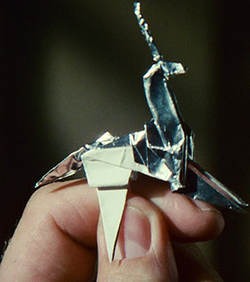
I like this end-ended idea a lot and this speculation just adds to the experience for me. You can believe what you want. As for me, I think I will avoid taking the Voight-Kampff Test. Aside from the fact that it’s for androids and not necessarily for other AI, I think the subject of being an AI in Hate is akin to Rick Deckard’s “lesbian question” and how it’s kind of … irrelevant and no one else’s business but your own this case–both in terms of Hate Plus and myself. Really, the way I’d like to think about it, it’s kind of like being asked what the sex of your upcoming child is going to be.

I think I’m going to keep that fact as a pleasant surprise, or a mystery.

Blade_Runner_unicorn

The Death of *Silence: Hate Plus and The World of Christine Love Confirmed

What is better than hate?

The answer is more hate.

Hate Plus is the sequel to Christine Love’s Analogue: A Hate Story: a visual novel and video game in which you, as “a space investigator” must recover the records of a lost 25th century Korean generation ship called the Mugunghwa and figure out what happened to its colonists and their descendants. This is not the first time I’ve talked about Analogue or the world that it inhabits so, if you’d like and if you are not afraid of spoilers please look at my article This Love and This Hate Ain’t Completely My Story: The Possible World of Christine Love.

I have been waiting for this game for a long time, though obviously not as long as certain characters on the Mugunghwa have been, and I want to get into its structure, the elements of its world, and the story line.

So here is the nitty-gritty of Hate Plus‘ game interface from my own personal experience. I’m actually glad that I went back and played Analogue for a while during this time in order to remind myself of its game-play interactive qualities. In Analogue, you had to go through various journal entries and click on the figure of the AI next to you to get more information or her opinion. You also had a very confusing Family Tree of characters to look at with names that often got confusing. It is important to note that some Far East Asian cultures place their surnames before their first ones and it explains a lot culturally with regards to Analogue and Hate Plus and how the societies depicted within them function. But I am getting ahead of myself.

In contrast to Analogue, in Hate Plus the AI is more active and has a certain degree of limited animation. They basically read over your shoulder and make comments as you scroll along: as you scroll along very, very slowly. You do have to be careful though: because if you read too fast, the AI’s comments will be lost seemingly forever into an ethereal digital void of, well, scrolling too damned fast. There are names in the documents that you click on and get more information with each entry that you read. The files that you extract are better organized and you have dossiers on–and profile pictures of–each person that you read about. In some ways, it is a lot harder than Analogue. I imagine that the slow-scrolling simulates sifting through the files you’ve compiled from an ancient ship. At the very least this time around you don’t have to input technical commands into a DOS-like–pardon the pun–analog program: which confused and frustrated me to no end.

That said there are some really interesting goodies and special touches to the game structure that only Christine, at least from what little I’ve played, can accomplish with her style. While Christine utilized a form of code that transfers information from her other games that you’ve played to make some “Easter-egg” moments between them, she uses this same process to take your Save Files, if you have them, from Analogue and translate over to Hate Plus. She creates that almost very personal feeling of continuity and that, in itself, is something that I greatly appreciate.

In addition, depending on what Saved File you use, the introduction screen changes colour and when you finish a story arc, the end credits music becomes the introductory music for a while: which really gives you a sense of difference with each playthrough. There is also one other difference between Analogue and its sequel. Unlike the former, which you can download off of Christine’s site Love Conquers All games and Steam, you can only download and play Hate Plus from Steam itself: mainly because that is the only place it’s available from and perhaps the only way to facilitate the Achievements that you get to unlock in addition to the different Endings that are just extensions of your Saved Files from Analogue. This game does not save the retrieved files and timelines you sifted through outside of the AI interaction such as in the other game, nor does it have an extra material section as far as I can see, but the Achievements in themselves and the interactive dynamics that Christine has implemented are … different.

Let me be more specific: if Analogue felt like essentially interacting with a program, Hate Plus is an attempt at a realistic interaction with another sentient being and time. This pacing is actually pretty refreshing and while with anyone else it might threaten to take you out of immersion, in this case it just adds a barely meta-narrative feel to it and at the most it adds personality: a very fascinating experiment in player on and offline participation and interaction. It might take you aback at first, but it’s worth it.

I should also note that you can play this game without having played Analogue or saved your files. The game will just give you an intro recap and a simple Quiz and you’re off. But personally, and as I said, I liked the continuity of using my old files from the previous game.

So now we go past the technical and into the more specific area of content: of the world. And here is where I go into Spoilers: real Spoilers. So please, if you have read this far and you want to play one or both games, save this article link somewhere, click on the links to Christine’s site above, download the game for $10, take the time that you will need, and then come back. Do not say I didn’t warn you.

Now then: the world of Christine Love. If you read the link to my previous post about “Christine Love’s Possible World,” you probably realize by now that it is less possible as it is more probable and true that all her games–at least the ones I talked about in that article–take place in the same world as time goes on. I always suspected this but it was only confirmed when, in this game, she added that missing link: when you receive an email in your message box talking about exploring the ruins of the 23rd Century Lake City. That addition made me smile: not just because it gave me some feeling of vindication in my statements, but because of just that one segment of a post adding this seamless transition between Digital: A Love Story, don’t take it personally babe this ain’t your story and Analogue. What it is, is it’s both immaculate and it’s beautiful. Fucking. Beautiful.

It also doesn’t stop there. You find out a bit more about Earth and how advanced it has become. In addition to me realizing that the reason AI have such difficult times replicating themselves is due to limitations imposed due to *Mother and the terrifying consequences of *Reaper in Digital in the 1980s, I also got to see that AI interactions have changed even more. Essentially, Earth technology has evolved to the point where AI programs can be downloaded into customized lifelike humanoid bodies. This totally slapped me in the face with surprise, but it was a good kind of slap as I realized what it meant for you to have received this email–from the very familiar household name of Wong Robotics (which is a nice parallel to the email you first get from what seems to be its predecessor Wong Computers in Digital: A Love Story and another world tie-in) and what you were probably searching for with regards to your AI companion.

These discoveries make me wonder about something. You discover that *Mute–the Mugunghwa‘s Security AI–is actually over 1600 years old (about 1900 years old): though she can only remember about 300 years of her history or so after that time. You realize later that this was due to … another incident. Now, think about this. On Earth, in this time of the year 4989, over two thousand years after the disappearance and disaster of the Mugunghwa, there have been AI existing and living on Earth. It makes you wonder if some of the programs from the 70s onward still exist at this point. Imagine a series of millennia-old intelligences on Earth and think about how they could have influenced everything. You also get an idea that really old AI tend to slow down because they have too much information to process, but if they specialize in different areas over time and diversify they can adapt both functionally and psychologically. Christine makes a very eerily familiar vintage science-fiction reference to this regard.

And all this makes me wonder just what kind of society her Earth is at this point and, if the technology *Hyun-ae’s eccentric father–the technology that can download human brain-waves and convert them into an AI psyche–is already commonplace in this world. Talk about a potential Ghost in the Shell. Anyway, enough geeking around on my part. Everyone appreciates a good science-fictional world as much as the next person. Let’s talk about the story.

So in the last game, you spend the time trying to figure out what happened to the Mugunghwa and why it never reached its destination. You find out why the colonists’ descendants died and what happened to their society. But you never knew why it happened.

Until now.

Whereas, Analogue is arguably *Hyun-ae’s story, Hate Plus is definitely the story of *Mute. *Mute is a complex character. She believes in the Neo-Confucian ideals of the society that evolved–or degenerated–on the Mugunghwa: including an over-emphasis on the importance of familial duty and traditional gender roles. She supported the monarchy that came into power and Chinese-character literacy given only to the noble families. At the same time, despite her vehement protests towards anything “untoward” like homosexuality between women–which makes her almost a more compassionate version of don’t take it personally babe, but it just ain’t your story‘s Taylor (though the character Oh-Euna might be more like her in terms of fucked up)–*Mute is still a decent person that wants to protect her ship and the people in it. She also does not tolerate cruelty and she has cared for people throughout the years and even though she might judge them and say some offensive things–and always speak her mind in some form or another–she never has consciously attempted to hurt another person, always tried to help and always remained loyal.

In the first game she comes off as abrasive, though you understand that she hates herself because failed to save the people and way of life she was programmed to protect. She also does not seem to tolerate the unorthodox: though I always filed this under “Milady doth protest too much.” And in many ways, I was right. But deep down, there was the theme of the game that I had to keep remembering.

Hate.

And *Mute, with her anger towards female homosexuality and her chauvinistic comments towards women and even the feminine identity she adopted, portrays this self-loathing that I had not seen clearly before. At first, it seems very clear that she isn’t conscious of it either. In fact, *Mute in at least two of her incarnations seems to really not pay attention to details: or, at least, not the right ones.

Then you find out that her previous incarnation, the one that had existed for 1600 years, left some embedded code in her: with files from before the Neo-Confucian dynasty. And this is where your adventure begins.

This is also the part where the game really explores the concept of transhumanism. For instance, *Mute is a reboot of *Old Mute and *Hyun-ae is an AI taken from the code of *Mute. In essence, both AI are descended, code-wise, from *Old Mute. But whereas *Hyun-ae believes she is the human that had her consciousness downloaded ages ago, *Mute is another version of another being. And there are two versions of *Mute.

They are almost two people with similar qualities. *Old Mute was the Security Councillor of the ship that was more assertive and viewed all the people on it as her children: though the Heo Family more than anyone else. She was not afraid to talk to men as equals or politick when the need set in. She was old enough to remember when banditry and civil war wracked the ship and saw the death of the navigation AI *Star: which is the reason why the ship never reached its destination to begin with. *Old Mute was at the very core of her programming a security AI that sought stability and the preservation of life. Unfortunately, she did not see this in what may have been–to her–the unstable mob-mentality of the various pro-democracy movements racking the ship throughout the years.

She, through her adopted Heo Security Family and her seat on the Council of the Mugunghwa maintained something of an oligarchy throughout the centuries and either allowed for the creation of peasant or “commoner” and noble classes, or maintained that tradition. Perhaps these families were the descendants of the workers and ship staff respectively. Perhaps a “middle-class” got co-opted by the nobility or the commoners there did not seem to be a differentiation between peasants and vendor merchants. Maybe that is why the “Bureaucrat Class Act” passed: to seemingly “deal” with this problem. We will never really know and can only speculate. Unfortunately, she was so set on sabotaging an emerging pro-democratic figure that she didn’t see the danger in the so-called figurehead that she helped place on the Council due to her wanting affect the appearance of change to quell the masses and maintain a safe status quo.

In the end, it cost her. It didn’t have to. She was the ship’s Security AI. She could have monitored those in power far more closely: including and especially those she had placed there. But as she put it; she had so much data through existing for “far too long” at the time that sometimes the minutiae of various events escaped her. Personally, I think that she should have “vetoed” the usurper and his whole Council out of a sudden airlock. She could have created a democratic structure from the very beginning and rigged all the ballots to maintain her idea of order. After all, from what I understand, she already had most if not all of the power and even though she started out as a Security Program, she clearly proved that she could adapt over time like any intelligence can. Unfortunately, or fortunately, if *Old Mute had an understanding of Asimov’s Three-Laws of Robotics, her interpretation of it: of letting her memories get erased so that she could survive, of her own self-preservation for the duty of the ship being more important than the quality of life for the people she swore to protect–for not ending certain beings’ lives for the greater good of the whole of humanity around her–cost her.

And in the end it costs *Mute as well. I was so … sad and angry when *Mute decided to deactivate herself. I felt as though she had abandoned me and took pretty much the coward’s way out. She could not face what her predecessor, or what her previous self, had done. And as for me: despite her brusque manner and prickly nature and weird fascination with what boys do in their recreational time together, her “death” hit me hard because she was a good person.

That was when I found the third *Mute: *New Mute. This one did not make herself look old and silver-haired like *Old Mute or garb herself in the traditional hanbok like *Mute, but she had her security uniform and genuinely wanted to know and learn from her predecessors: her previous selves. I eventually took on myself to show her everything that the others had given and seen. If the first *Mute was the Old Kingdom, and the one I knew had been The Middle Kingdom, then this *Mute was a New Kingdom who, eventually and unlike *Mute who couldn’t face her transition from *Old Mute admits that they were all her. I actually liked this *New Mute, but *Mute’s self-deactivation actually broke my heart.

I will admit that when I played from my Harem Route Analogue Saved File, there was one part that made me really catch my breath and tear-up when after one of *Mute’s homophobic tirades,  *Hyun-ae tells her something to the effect of, “You really don’t think you are lovable?” It hit me so hard: almost as much as it did *Mute.

My poor mass-murderer and my authoritarian with good intentions. One of them condemned many to death for the horrible crimes of a few and the other condemned many to social and cultural slavery and barbarism for the chance that everyone lived. “Those who trade away freedom for safety deserve neither,” or “Give me liberty or give me death.” I guess, in the end both of these paraphrases came true. I loved and felt for them so much after all of this.

There is one more thing that I want to write about with regards to Hate Plus. So I found the list of Achievements and saw that there was one for playing through *Mute’s Route as a female. My friend Angela O’Hara had played Analogue as a female and told me that she had had a very different interaction with *Mute than I had: having played as a male. So I decided that if I was going to do this, I was going to do it right.

I replayed Analogue as a female persona and I noticed *Mute’s interactions with me had changed. She was still mostly grateful and respectful of me, but she would ask what an “unmarried woman like me was doing all alone doing a man’s work” and “not troubling me with the details of matters.” She even made pointed remarks about my orientation towards other women or being permissive of it. In Hate Plus, as you imagine, she got worse. She would skim details at times and “take charge” and took it on herself to call herself “my wife” while still “protesting too, too much” about how “icky” female love was. She called me “a stupid bitch” at one point and I admit I called her “a chauvinistic bitch” at another point. I still cared about her and I tried to be patient but it was different.

At the same time, when *Mute did reboot, *New Mute had a lot more to say about some of the letters and transcripts–particularly the ones with the female relationships–that we found in her base code than she had when I played as a male. She also, and this might just be me, seemed to relate to me more as a female in this incarnation and seemed more open to the possibility of being my companion: if not my wife.

And even before I did this, I saw the chauvinism and misogyny that would bloom into the Mugunghwa‘s Neo-Confucian dynasty. I saw what Kim So-Yi had to put up with from her boss and the assistant that violated her: making her feel compelled to say nothing to anyone about it and just like our time unfortunately. I saw that the Ruling Council only had two women on it: one of them being *Old Mute and got to see her gradually lose her voice and see her opinions get ignored under the New Council. I saw the policies of the new regime culturally influencing Mugunghwa society and forcing non-heterosexual relationships underground and even breaking some of them. I saw two women who had jobs and were relatively independent people become kept-women and courtesans. I saw one woman who could have saved the whole population of the Mugunghwa from decreasing birthrates lose her job and her former assistant try to take advantage of that fact with blackmail.

I saw how the emerging political system took advantage of the knowledge of these declining birthrates to make women stay at home and raise children. I respected the unorthodox, alternate-living and loving Heo Family members and grieved to watch their loved ones suffer and some of them die. I also saw one psychologically-troubled woman who felt so trapped by trying to fulfill two seemingly contradictory roles–of traditional woman and working person–and hated her pre-Neo-Confucian reality and herself so much that she retreated into and desired to destroy it and replace it with a culture and political system with “simpler and more ideal roles:” only seeming to realize, at the end, that she had expanded the prison inside herself to the outside.

But I saw the roots of what would become that Neo-Confucian dystopia: of people becoming roles instead of people anymore: becoming silence instead of actions and words. That is what I wanted to say to *Mute if we could have discarded the dialogue wheel we all found so annoying: that she and every woman–every person–was more than a role: that we are all people with feelings and that hate is not the only emotion we have. Hate creates a foundation that attacks itself until the fragile thing built on it rips apart and collapses in on itself. And seeing those … policies go through the Council and seeing each one strip away another freedom for “safety and stability” makes me feel even more cautious about my own world and the subtle infectious forces underneath it all that still discriminate against women and those not of the mainstream: underground or taken for granted attitudes that infect behaviours even unconsciously and just wait to bloom like flowers, colourful beautiful flowers of blood, and bruises, and pain. And, of course, hate.

And hate has to be watched. It has to be dealt with. And it is more deadly under the enforced silence of even something as colourful as a hanbok than all the screaming in the world.

Also, Christine Love manages to problematize, yet again, heterosexual relationships with that new regime but, at the same time, humanizes them and shows that while they weren’t perfect before, they were still legitimate because they were between individuals that may not have always understood each other, but loved each other nonetheless: just as much as the homosexual male and female relationships portrayed.

I don’t know if I communicated this last section well. The analysis seems heavy-handed compared to the elegant and subtle way that Christine Love implemented it and I am exhausted because I just finished playing all of the game today and it is early in the morning now as I finish this. I think I will end this review and analysis by stating that I will give Hate Plus a 5/5 and that what is better than hate is not the flippant answer I gave above. It’s not more hate. It’s love.

I’m sure this is a message of which Christine Love won’t have too much of a problem.

This Love and This Hate Ain’t Completely My Story: The Possible World of Christine Love

Oh dear *Mother. This rather large article has three parts. The first one is something that you can read without the Spoiler Alerts. The other two, not so much. So let me start with how I found Christine Love’s games.

The first time I was introduced to Christine Love’s work, it didn’t register at the time that I had actually been introduced to it until much later. At the time, I was reading Anna Anthropy’s Rise of the Videogame Zinesters and I was just finishing off the book as went to my first ever Global Game Jam and all the learning and hilarity that ensued from that. But that is beside the point.

I remember that, as I was finishing the book off, I was reading its Appendices and there was one thing that really stood out at me. For a while, I had been meaning to implement a creative experiment that mimicked an old Bulletin Board System: particularly an exchange between two or more people. I was doing some of my own research online into this predecessor to the Internet as we know it now. Suffice to say, I had–and still have–evil plans (this was going to be for my creepypasta or Operation: Dark Seed) and there was this one game in Anna Anthropy’s appendices that stood out for me: because it imitated the form of a BBS-surfing exchange and it seemed to have an interesting story line.

I marked it off for future reference and research and promptly got swamped with the creative of my first Game Jam and the other experiments I’ve explored since. I admit that it got regulated to the back of my mind after a time until I realized later with some sense of cognitive dissonance that this was one of her games.

But allow me to go back a bit. I had, in fact, encountered some of Christine Love’s work even before this. In May of 2012, I attended the Toronto Comics Arts Festival and sat in on a panel for Comics Vs. Games where Christine Love, among others was being interviewed. Afterwards, I actually went to the Exhibit where I played the game that Christine Love made in collaboration with the illustrator Kyla Vanderklugt: The Mysterious Aphroditus. It is a very fascinating Rock, Paper, Scissors style Victorian combat game that I know I alluded to briefly in a post somewhere in this Blog. Unfortunately, there were–I believe at the time–some bugs in the program and my fellow player and I couldn’t advance beyond a certain point. It also didn’t help that I barely knew what I was doing and I was just “winging it,” like I tend to do with video games: but that is really part of the fun.

What struck me at the time was that, if you look at the link above, there was already a story behind this game and a lot of complexity of interactions. I didn’t know then that I would be seeing something like this again, and again when I rediscovered Christine Love’s work almost a year later.

As for why it took me so long to play her games … I guess I was just afraid of opening myself up to another game, or series of games. I make attachments easy and I make them and I fall hard for them. Essentially, and as the cliché goes, I was afraid of commitment. This is what goes through my mind whenever someone introduces me to a video game. Because I will say that I have other things, like my own projects to do, or I don’t have enough money, but those are only parts of the truth. The culmination of the truth is that I know that investing my time into a game is a leap of faith and I don’t like being disappointed. I don’t like to open up: even though I do.

So with the account of how I found Christine Love’s work out of the way, I’m going to take the writer’s admonition to heart that this “ain’t my story” and now go into Spoiler Territory. So please, don’t surf here unless you have played the games or you just want to hack yourself some spoilers. It is all on you.

I really now want to look at three of Christine Love’s games–Digital: A Love Story, don’t take it personally, babe, it just ain’t your story, and Analogue: A Hate Story–as possible windows into a much larger world. Anyone who has followed me on this Blog for a while knows just how big I am at examining mythic world-building: specifically the creation of one’s own fictional universe. Let me begin by stating that the place of “Lake City” figures officially into at least two out of the three games.

All right, I’m just going to put one little tangent here. Christine Love’s setting of Lake City seems to have originated from her August 2009 game Lake City Rumble II which is a sequel to an “obscure arcade fighting game” that may have existed, or was made up by Love herself as part of this game being a parody of fighting games: something I found out about in her interview on Sup, Holmes? Of course, it is entirely possible that the name originated in her writings as well–she makes it well known that she is a writer first before being a video game designer–but this what I could find video game-wise. Actually, if you compare Rumble to The Mysterious Aphroditus, you will find a lot of parallels to their Rock, Paper, Scissors gameplay fighting style: save that one is only single player and the other is a two-player game. But I think that I’ve digressed enough.

In any case, Lake City seems to be a place that exists in Canada conveniently enough. It is this that, in some ways, becomes the setting for Digital: A Love Story. Whereas Lake City Rumble II, which I hesitate and ultimately won’t wager to put into a chronological continuity, takes place in the 1970s–also seeming to be in Canada with names like Danforth and such–Digital takes place in an alternate 1988. This world is much like our world was back from the 70s to the 80s except for one key development.

And remember: spoilers.

In an alternate 1970s world, the Advanced Research Projects Agency Network–or ARPANET–created the first Artificial Intelligence. I’m not talking about our attempts at AI now, but a real sentient being that desired to grow and learn for itself. And this was developed during the 70s. And it had children. These children left the ARPANET on the advent of the beginnings of the modern Internet and the creation of its landline-based Bulletin Board Systems. They are designed in a way where they have to delete themselves from where they were in order to transfer themselves into a new place. The existence of actual self-aware programs with distinct personalities change an otherwise normal 1980s world and they are characters in their own right.

What is also notable about them is the way that Christine Love actually indicates that they are, in fact, AI. Each AI in her world has an asterisk (*) before their names to indicate that they belong to a greater group that makes up artificial intelligence. It was subtle and I didn’t even realize it until much later with the added “oomph” of that realization which she–no doubt–intended.

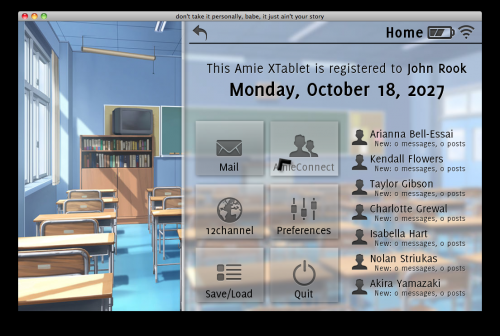
So here you have Lake City and these AI in an alternate late 1980s world with an appropriate looking Amie Workbench Version 1.3 computer system made to imitate the Amiga interfaces that existed in our world. Then, take this and make the supposition to fast forward to 2027. In Digital, we find a J. Rook is an administrator of the Lake City Local BBS Board and in don’t take it personally, we find the main protagonist–John Rook–worked with computers before he transferred to his teaching job at a private school in Ontario. However, he would have been one year old at the time, and perhaps he is the son of that Rook: having continued in a family tradition of working with computers before his career change. In addition, one of his students seems to have had a grandmother named Eriko Yamazaki who wrote a book called Digital Shinigami. This same person also seemed to exist in Digital on the Gibson BBS who mentioned that she had to spend less time on the Board in order to write her book and prepare for the birth of her child. In addition, the social networking program that Mr. Rook and the students are using is called AmieConnect: perhaps a future social program created by the company that once made the Amie Workbench application.

this ain't your story

There are no AI in don’t take it personally, but I would not exclude the possibility of them from being in this world: even if Love mentioned that this game is more of a “spiritual successor” to Digital. This game is a different beast entirely. Instead of the player-reader being a neutral force that can choose his or her identity, we have to focus on the character of Rook has he navigates the morally-questionable world of Information technology in his classroom. Essentially, he is supposed to read the private emails and interactions of his seventeen year old students to “prevent bullying,” but the irony of what is private in a “private school” or even in by futuristic society’s becomes very questionable indeed. It is here that Christine Love starts to use an anime-like graphic style to represent the characters–possibly influenced by her first commercial dating simulation work Love and Order— and after a while you get a real feel of who they are as people and you get to decide how Mr. Rook interacts with them and how the information that he “shouldn’t have” will factor into it … or not.

I am so tempted to say that this shift in what is considered private and how the online world of social interaction works is just a precursor to humanity’s own changing attitudes of how it perceives itself and the world around it. Whether or not Christine Love succeeds in capturing that tension–that agony of change–is another story entirely, but it is definitely intriguing.

Now, here is where my temptation leads me. Fast forward to the 25th century and then to “thousands of years later” in Analogue: A Hate Story. Not only are we in another time, we also finds ourselves in another space. From my understanding, in the 25th century the people of Earth have developed space travel to the point where they plan to colonize other worlds. And guess what? In addition to human captains, they also have AI guides with the same asterisks in front of their names.

Unlike the other two games where you find yourself–either by your own self or indirectly moving Mr. Rook–in North America, you are in space investigating the lost Mugunghwa generation vessel: a ship that was sent from the futuristic unified nation of Korea to create another planetary colony. It is a very nice counterpoint to Digital because you are looking at something that is the product of a different culture and how that affects what you might find. During the process of finding out why it never reached its destination, you realize they operate much like their 1988 North American counterparts: in that they have to delete themselves from one place in order to transfer to another. This plays a very crucial role in both games. :p

But these AI are also very different. Unlike Digital, they actually have image-forms and they look like anime characters. This allows you, as the player, to interact with them through more than text. You can see their body language and, I would imagine if you were actually in that world, hear their voices as well: though there are no voice-recordings in Analogue. I had to play this game right after finishing Digital because I read somewhere that unlike don’t take it personally, this was less of a spiritual sequel and more of a direct one. However, it’s not so much a sequel as it seems to have continuity and a counterpoint to what was going on in Digital itself: Love and Hate. However, just as the “Love” part of Digital is not necessarily what you expect, neither is the “Hate” part in Analogue.

And here is where I go into a tangent about how AI are often portrayed in media, and how they are not by Christine Love. It would be easy–so easy–for her to fall back on the trope of Artificial Intelligence going bad. Of computers that betray their human masters and AI that begin to despise humanity and attempt to murder whatever organics they can. But Digital follows an entirely different dynamic and Analogue, for all it is called “A Hate Story,” very much subverts this as well. In both games, you have AI that exist parallel to humans and while in Digital they are just another intelligent people, those you meet in Analogue exist to actually help and befriend you: even if you have to weave through the details of a terrible past and mystery to do so. They are there alongside of you and are just as sentient, responsible, happy, sad, horrified and afraid as you as an organic being. If anything, the only thing that separates the ones in Analogue from Digital is that they are made to help you and despite and because of their personalities that this imperative still remains.

So this is the world that through the addition of some asterisks and a few hints (of continuity in the form of Easter eggs and code-based sneakiness) that I believe Christine Love creates. Now I’m going to talk about the next part: which is my own relationship to the game and where, while it might not be my story alone, it is definitely–as Christine Love posits whenever she thanks the pronoun of “you” in the end credits of her game–our story.

I played all three of these games (technically more if you include Rumble and Aphroditus), and now I want to discuss my interaction with their respective gameplay and story lines. So, with regards to gameplay, I have to say right off the bat that there was swearing. A lot of swearing. I go into games relatively blind and I probably don’t read instructions as clearly as I should. But I did notice a few things.

First of all, in Digital I almost had no idea what I was doing at first. It took me a while to adapt to the “dial-up” system analogous to old telephone system Internet interfaces that Love imitated exceedingly well. I learned how to use “the codez”–illegally-obtained long-distance calling card numbers–and actually felt like a hacker: which is hilarious because I am not technologically gifted at all. So I was doing relatively fine until … until the Underground Library. The freaking Underground Library. Don’t misunderstand: I loved that level and the information within it. But I didn’t know at the time that I had to download every download I got from other users in other BBSes so when *Delphi (who I always identify as female) transmitted that goddamned screen-lining virus to me, it was there to stay.

I ended up having to reload a previous save state, very carefully go through my downloads again and make sure not to miss any of them. And it was easy to miss them. God, I was so mad when that happened.

Also, while doing the following does succeed in making you more immersed and interactive with this alternative late 1980s computer world, having to manually dial-up BBSes gets very tedious after a while: especially when your “codez” were declared invalid and you had to go back and get more through more, you guessed it, dialing. However, when I actually took a break to vent or do something else and I came back, I got over it and enjoyed the story.

Analogue also had a “stuck-point.” While I was much enjoying going through blocks of diary texts and reports with *Hyun-ae and *Mute, I did not enjoy the fucking reactor core of the Mugunghwa ship going into meltdown and me having to choose which AI I wanted to save: made all the more frustrating by the fact that I knew there was a way to save both of them. I felt like some tech specialist in going through the motions and programming to save the ship, whatever AI I could, the records of what the fuck happened to it, and of course my own life.

I also admit that I was starting to get annoyed about constantly having to hear the alerts on and open and check Mr. Rook’s status updates on his AmieConnect in don’t take it personally.

Wow, from Digital to Analogue I transitioned from the profane punctuation of “freaking” to “fucking.” I guess I know which frustrated me more. I guess the reason Analogue frustrated me more is that it made me have to make some hard decisions about who I wanted to save. It was almost as bad having to influence what decisions Mr. Rook made when dealing with his students in don’t take it personally, babe, it just ain’t your story: because I got a feel for the characters and some of those decisions were just so … hard to make. Also, that title is genius: because unlike Digital or Analogue where you can play as “you,” in don’t take it personally the story is not about you at all: and it is hard to differentiate yourself from John Rook. I suspect Christine Love purposefully made it that way: using that age-old concept of protagonist-identification to make the player that much more uncomfortable. Basically, the title to this game is for the player’s benefit and kind of a raspberry towards them too.

But the very thing that makes these games so hard is also what I love about them. What I love about Christine Love’s games is that they tell a story. But it’s more than that. The reason I really love the games is that they are about people and relationships. Basically: I liked the character and even those I didn’t like were not two-dimensional beings.

In Digital, I found it amazing that *Emilia was an AI that could make original poetry–even “bad” poetry–and that she could feel love: that you begin to realize as a player that you can emphasize with an AI who is–essentially–another sentient being. I also really liked *BlueSky: because he just seemed to be this really friendly and brilliant AI historian. If he actually existed, I would have loved to have more discussions with him about the nature of AI and technology. He would have made a good friend. And what happens at the end of this game … just broke my heart. It came down to personal love verses the love or duty to something greater than yourself and that choice–which in this game is not a choice at all–is heartbreaking: if only because Christine Love spends all that time getting you to sympathize and care about … those that you do.

As for don’t take it personally, babe, it just ain’t your story, I sympathized with John Rook and the difficult situations he found himself in. I even liked Kendall Flowers and, frankly, her honest and direct nature when she felt the need to be assertive. I realized that Akira was really lucky to have her as a friend. I do find it really interesting though that while the gay relationships that develop among the students have their issues–those challenges that any people in relationships face and how society views them–the potential heterosexual relationships are really rendered problematic in this game when you consider the characters of Taylor Gibson and John Rook himself. Taylor was once the girlfriend of Nolan who becomes Akira’s boyfriend: and she is homophobic or at least quite ignorant. She is a self-absorbed and mentally stunted being that proceeds to emotionally manipulate and bully both her former boyfriend and his new boyfriend.

Then you have John Rook and the relationship that could develop with Arianna Belle-Essai: one of his own students. There is definitely the problematic power dynamic of authority or privilege that places Rook over Arianna to consider and also the very real fact that he is a lonely sad man and she is a lonely confused but piercingly direct girl that really creates that tension. You could, if you wanted to, really read something into how relationships between opposite genders might work under our own culture and the way it uses gender. Neither are really honest with the other, but if you choose the route for him … I don’t know. I actually liked Arianna: because she knew what she wanted and she wasn’t stupid and when one of the endings of the game reveals itself, you realize that she and the other students know how to keep an open secret even in a world where privacy has changed so radically.

But I also like John Rook himself despite that possible ending because after a while you realize that he may be a bad teacher, but he is part of a bad school and a bad educational system and what some of his students need is a mentor, an adviser and a friend more than an instructor. There were a lot of complicated issues, but maybe they were offset or complemented by the fact that everyone involved was human.

So now I come to Analogue: A Hate Story. In this case, I really sympathized a lot with *Hyun-ae and what led her to making the decisions that she did. I probably would have done the same in her position. At the same time, I could also see *Mute’s perspective and she managed to break through my own leanings towards absolutism. I was actually happy when I let *Hyun-ae cosplay as a scientist: given how much that meant to her and why and I felt like shit when I dressed her in a traditional Korean Hanbok: especially after realizing what the degenerated society of the Mugunghwa did to her. The slow realization of what was, in fact, done to her made me absolutely dread reading what happened next.

At the same time, I loved the epistolary novel-format of looking through the entries of all the Mugunghwa‘s inhabitants and getting to know some of them that way: that for all their society became repressive, they were still human beings and not all of them were inherently evil. In fact, none of them were but some of them were more selfish than others and most of them let themselves get shaped into something that supported a repression of humanity: and in particular women. *Hyun-ae herself does not know why the descendants of the colonists in that generation ship became how they did, and *Mute herself–the original guiding AI–does not seem to remember. But this is the plot to the upcoming Analogue: Hate Plus and given what *Mute’s name is, I both highly anticipate and dread what we as players are going to discover.

When I really think about it all, though, looking back on my Christine Love games marathon I realize that none of the games were really about us. In Digital, you send emails back and forth, but you never type your own messages: while you do see those of the people that you are contacting. In Analogue, the interface that would allow you to answer beyond “yes” or “no” binaries is “malfunctioning,” and you only have the two former options for actual communication. In the latter game, you can’t even tell the AI your name and they never see what you look like. There is a strange balancing act between communication and empathy, and distance and loneliness.

For me, that kind of dichotomy and the tension it makes reminds me of watching a really good anime. Certainly, the visual novel medium that Christine Love has adopted for all three of these games conveys that sense of experience. You feel for and sympathize with the characters, but you are never one of them. Not really. At the same time, you are. There are also a lot of subtexts: or some from my perspective. For instance, when *Mute asked me if I was male or female, and when Digital had me type in a name and a username, I felt so strange–after talking with *Hyun-ae– to be using masculine pronouns. I know Christine Love has said that she made these two games specifically for players of either or any gender, but she has also said that privately she believes the relationships that go on are between two women in a romantic dynamic: because that is her perspective. Sometimes, I feel like an intruder but then I get over it and realize that it is really about an interaction between the minds and feelings of the player and character regardless of gender.

There is also another possible subtext or interpretation that intrigues me too. Christine Love likes to make games that are inclusive of those who identify as queer: or at least make them more inclusive to more than just a male heterosexual audience. There is another group that sometimes has an asterisk connected to a word as well: though it is an affix as opposed to a prefix. I am talking about those who identify as trans* and use this term to encompass all those who do not identify by cisgendering: the gender that mainstream society aligns with one’s biological sex. This is an umbrella term that can include those who identify as queer or genderqueer. When you look at the revelation with *Emilia with that lens, or even *Hyun-ae–in that she cannot and will not correlate her sense of self with the gender-expectations of the regressive society around her–it can leave a very different connotation.

But that is also too much of a simplification. As I mentioned before, the asterisk can encompass an entire group: and in this case perhaps the idea of something being transhuman or a designation of beings beyond the conception that all sentient life has to be organic and material. In this case, it seems to give a being a cultural or “racial” marker. I just can’t get over the fact that the inclusion of just one symbol can possibly mean more than one thing: though this is all just supposition on my part.

At the same time, I really have to say–among the many things I’ve said–that I really like many of the female characters in these three games. From Arianna, Charlotte and Kendall in don’t take it personally to *Emilia in Digital and all the way to *Hyun-ae and *Mute in Analogue: they are all direct, all brave–or grow to become brave–and they have the strength to admit what they feel despite any circumstances in the way. There is something so beautiful about this that I can’t really put it any better than I already have, or how the games already portray.

But ultimately–and if I have already said this before I want to reiterate this statement–what I really like about Christine Love’s work is that she actually tells a story. When she talked about Lake City Rumble II being a subversive parody of a fighting game, it jived in that same place I have where I was really fascinated with the story and the character interactions behind the fighting more than really the fighting itself: though it also had its moments. And what I truly love is the fact that she actually makes me care about her characters and this–to me–is the sign of a great writer and creator.

It is my hope that she continues to do what she does because, you see, I don’t care if these aren’t completely my stories. In the end, I just want to see more of them: spreading out from *Mother, leaving neither copies behind them, nor taking anyone else’s names but their own along the way.