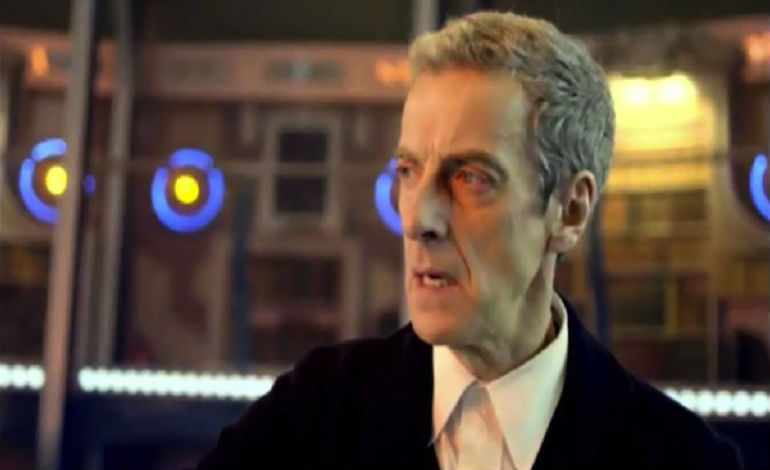
Doctor Who: That’s No Moon …

It’s hard to resist titles like that: even when they’re misnomers.

This weekend, on Doctor Who, we got to see “Kill the Moon” and the mess — the real mess — that came from it. And I’m not talking about the moon crumbling in 2049.

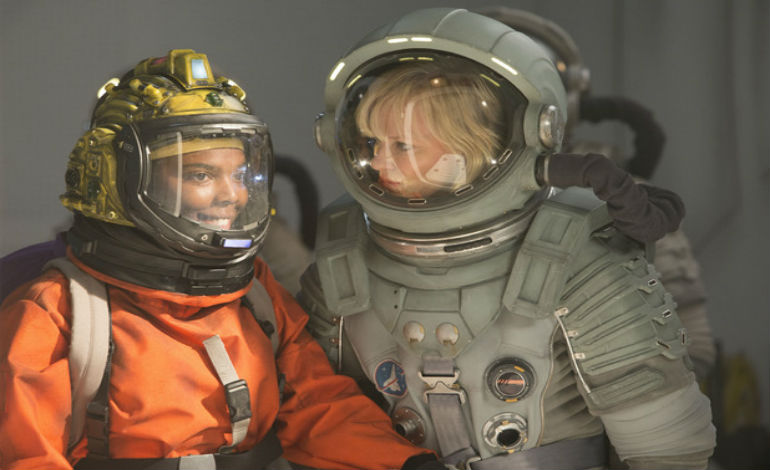
For me, the episode started off fairly slowly and, quite honestly, in a very predictable manner. The Doctor, Clara, and the young girl from “The Caretaker” episode Courtney Woods decide to travel onto the moon: so that Courtney would feel like she’s special and not just the misbehaving young girl that threw up on her first time in the TARDIS.

Courtney Kill the Moon

Then we find said company on a space ship where scientists have gone to the moon to blow it up with explosives because it is endangering the Earth below. Of course you have your obligatory monsters and a truth about the moon, that is the moon and yet not, that you begin to glean almost right away when The Doctor calls the aforementioned monsters — the spider creatures — bacteria.

Then humanity has a historical decision to make and …

The Doctor says screw this, leaves Clara, Courtney and the scientist Lundvik to decide whether kill a potentially innocent in order to save the Earth or take their chances with its survival, and leaves them. Just like that.

Yeah.

Clara Kill the Moon

You could already tell that there was a conflict coming to a head in this episode and, as I said before, it is not the moon: unless you consider The Doctor’s ego and Clara’s self-righteous indignation as small orbital satellites in and of themselves.

The episode begins with Clara wanting to make The Doctor confront the fact that he made Courtney feel like she was “not that special.” Of course getting The Doctor to do anything, even on a good day, is slightly less difficult than herding a thousand cats. It also presents another conflict. Clara is not a tutor or babysitter any more. She is not a character is “born to save The Doctor.” She is a teacher and she has a responsibility to her students, including Courtney. The issue is that The Doctor does not, in fact, have a responsibility to Courtney or anyone despite Clara’s relationship with him: save for being captain of his own ship and being in charge of the safety of everyone in it. It is this tension between them that only gets worse as the episode progresses.

Much like The Doctor perceives Time and its eddies at the best of moments, and with further description of this Time Lord sense in the episode, you can see this moment coming a mile away. Courtney being exposed to danger is a failing on both The Doctor and Clara’s parts: The Doctor not being aware in this incarnation of what a child can perceive and Clara for, frankly, not telling Courtney to stay on the TARDIS sooner after they landed on the moon and she got what she wanted: being the first woman on it. Certainly, when straits look dire Clara gets another reality check when, in asking Courtney to call her by name, Courtney prefers to keep calling her “Miss.”

Make no mistake: Courtney is a child and Clara is supposed to be her teacher. They are not friends in that way. Clara is the adult and has to make her own decisions and take her own responsibility. And it seems as though that, by extension and according to The Doctor, so does all of humanity.

But let’s not kid ourselves here. While I do believe that The Doctor genuinely thought humanity should consider the moon’s fate, and that Clara exemplifies humanity in his eyes, there is a fairly large part of this that was the result of him being quite fed up with Clara’s attitude: at least in regards to their dynamic. The events that reached their crux in “The Caretaker” with regards to Clara, Danny Pink, and The Doctor, as well as Clara’s professional and traveling lives definitely affected The Doctor’s decision here.

The fact is, it’s quite clear that The Doctor is tired of babysitting children and, by extension, humanity. He may even be resentful of how Clara tried to hide Danny Pink from him and initially involve him in their dynamic against his knowledge and will. Perhaps he thinks that Clara still unfairly compares him to the Eleventh Doctor who, let’s face it, coddled Clara quite a bit or at least comparatively so. Perhaps he is fed up with Clara thinking he should take responsibility for sorting out her own priorities.

Dr. Who Kill Moon

And Clara, at least how she has been written since The Doctor’s Regeneration, is also fed up. She can’t seem to deal with this new change of personality. In addition, what he does to her in “Kill the Moon” is just a large scale version of what he did to her in “Deep Breath”: seemingly abandoning her and breaking their trust. Her angry monologue at the end of the episode hits a lot of points home as to how this Doctor treats humans and what his place should be on Earth: at least from her perspective.

It’s painful to watch. Both characters seem to have regressed into immaturity and misunderstanding. I remember once thinking that The Doctor had grown up a lot since his early travelling days, but he is now more of a throwback to those more immature times. That said, I think that Clara has had to grow up for some time now. Travelling with The Doctor isn’t all fun and games and indulging his Companion’s whims. He asked her to act like an adult on behalf of humanity. And she did.

And it cost them.

Clara's had enough

Perhaps, in the end, it’s best that The Doctor travel alone for a while. He clearly has things that he needs to do and others seem to just be getting in his way at the moment. And as for Clara, she knew to some extent the potential consequences of traveling with The Doctor. She could have left him any time when she started her career and her relationship. I think that she has to ask herself just what she wants from him just as, conversely, The Doctor should give her some space to make those decisions.

It’s not a one-sided situation and I hope that when it comes up again, it’s dealt with in a mature manner without one side expecting the other to simply apologize.

That said, I think Danny Pink has been the only character who has been acting even close to rational between the three of them: becoming the voice of reason for this episode and I want to see more interaction with him. Even though the relationship between Clara and The Doctor was the highpoint of this episode for me, I truly appreciated that Bechdel moment where three women: a school teacher, a student, and a scientist decided the fate of the Earth and for some time talked only about the consequences.

I can be snide and make a reference to the title of a Heinlein book and state that “The Moon is a Harsh Mistress,” but sometimes it is something simply that heralds the end of the day and the promise of an interesting night.

Doctor Who: Things Get Messy

A caretaker is someone that maintains a particular space and cleans up messes. The Doctor manages to almost spectacularly fail in both of these roles: at least for this episode. For a Time Lord who is excellent at running, he is dismal at hiding for extended periods of time without drawing a great deal of attention. For a Doctor Who episode that is called “The Caretaker,” the events that unfold are the antithesis of that word.

Doctor Caretaker

In fact, it seems as though The Doctor is not the only one good at making messes for the purposes of attempting to fix them. Even as The Doctor — and I use the term lightly — infiltrates Clara Oswald’s school in order to lure an alien weapon called the Skovox into neutralization, Clara herself is on a tight-rope balancing act between not telling The Doctor about her boyfriend Danny Pink and not telling Danny Pink about The Doctor. It’s in this episode in particular that we get to see the complexities of the relationships between these three characters and just how messed up they become, at least initially, when they finally reach a head.

Clara … does not handle this well. For someone who is a Companion to a two thousand year old Time Lord, who has reached the point of opening the TARDIS with a flick of her own fingers, who had her sense of self spread throughout space and time, she comes across as quite immature in dealing with and making sense of romantic and even platonic love relationships. However, I’d like to think that this can be forgiven to some extent as Clara has spent most of her life, with or without The Doctor (if the latter is at all possible) doing other things and not focusing on relationships. She might be an excellent Companion, but as a girlfriend she is still learning. And as a character outside and away from The Doctor she is still growing too.

But The Doctor has far less of an excuse: especially with his hostility towards Danny Pink. I think, however, that Danny Pink opens up another facet to the show and this is the episode, where everyone is stepping on each other’s toes, that he really starts to shine. It’s here, when he finally confronts The Doctor that we learn two things. First, that The War Doctor still exists inside of our favourite Time Lord in a lot of ways and, second, there may be something of a story behind Danny’s hesitancy in talking about his past as a soldier. This man is no Brigadier or Wilfred Mott and The Doctor is not the same being he was before he left Earth in his fateful Eighth incarnation. I will say that the words “soldier” and “officer” come into play and they explain a lot about those two characters.

Danny Vs. The Doctor

In a way, the monster in this episode was almost quite incidental and just a plot point to get all three characters truly acquainted. I do find it ironic that The Doctor, who creates an invisibility watch, is really bad at hiding and the mechanism that he wears on his back to deal with the second coming of the creature looks like a Ghostbuster proton-pack. I also think the question, “What’s a policeman without a death-ray?” truly made my day.

Doctor Pack

It was also fascinating to see this Doctor deal with elements of his past: particularly his reference to River Song (the first time this incarnation ever refers to her), the adoption of his age-old moniker John Smith, and the red herring in the form of an excitable younger man in a bow-tie whom he believes that Clara is in love. Even the title of this episode is a misconception, “The Caretaker” being a word sounding awfully close to Tom Baker’s “Curator,” but The Doctor is a long way from becoming a kindly, sedentary old man. Right now, he can barely even deal with a small child throwing up in his TARDIS.

As a result “The Caretaker” ends up leaving more loose ends than resolutions. We have yet to see the further dynamic between Danny and The Doctor: or just what orders might have been too much for Danny to follow back in the day. And then there is Missy again, and someone else who is working for her in the Promised Land … dealing with the dead.

No matter what you think of this series, I think we can all agree that no matter what this is going to be messy indeed.

Doctor Who And The Misadventures of Team Not Dead

A team of four amnesiacs: a cantankerous Time Lord, a hapless human, a hacker cyborg, and a shape-shifter walk into the most dangerous bank in the universe …

This is the joke that begins this episode of Doctor Who.

However I would like to point out that while most jokes end with one punchline, “Time Heist” ends with at least two. Imagine some Mission Impossible combined with a bit of the creepiness (though not the gore) of Saw and some Memento for good measure. Then add this concoction to some Doctor Who zaniness that almost always borders a bit on camp or kitsch (the very strange tone that almost turned me off from the series altogether, at the very beginning of my watching experience until I recognized even weirder rhythms and human interactions of the Whoniverse as presented from Davies and onward).

Essentially The Doctor, Clara and their other two companions find themselves trying to rob the Bank of Karabraxos on behalf of a mysterious figure called The Architect after having been exposed to some memory worms. The convolutions and the reversals of fortune (and the re-reversals thereof) throughout the episode were extremely clever and tied back into the nice neat package of a Steve Moffat self-contained episode.

What I mean by that is that, once again, this could have branched out into the overall arc of the series (whatever it is that seems to be happening with Missy, the robots and the Promised Land we keep hearing about) but it doesn’t seem to be the case. In that sense, it’s a lot like “Listen”: in that it begins with something of great import. “Listen” begins with The Doctor becoming fixated on an idea that threatens to become a psychic meme, while “Time Heist” starts with someone actually phoning the TARDIS.

And just how many people are capable of doing that?

Doctor Who What's In the Vault

This episode definitely caught my interest in wondering who could have phoned The Doctor, who The Architect was, and just what could the only Time Lord in current existence possibly want in the Bank of Karabraxos. I will also say that “Time Heist” plays with the idea of just what a Whovian monster actually is, the various ways in which The Doctor deals with it, how self-hatred and regret can manifest, and the novel way that he handles a conflict that someone might solve differently with a gun.

I definitely appreciated seeing a lot more of The Doctor’s humanity and the fact that, unlike his other recent incarnations, he actually gets angry at people attempting to question him: and he is not above putting them in their place. Sometimes I really like this Doctor when I’m not somewhat cautious or outright want to slap him.

And I hope I don’t spoil too much when I state that, not only is this episode constructed immaculately like the trap that it is, but Team Not Dead succeeds in breaking through it: and definitely lives up to its name.  I just hope that Moffat can something similar with the series overall story arc.

So tell me my fellow Whovian watchers, just how long did it take you to figure out this episode’s punchline or two?

Doctor Who Teller

Doctor Who: Listen

The last man on Earth sat alone in a room. There was a knock on the door…”

End of the Universe

I find it simply amazing that a Doctor Who episode can begin with a similar creepy premise to Fredric Brown’s short story “Knock” and end with an incredibly heart warming sense of pathos. But what I truly find engaging is the fact that, for the first time in a while, Steven Moffat managed to create a Doctor Who episode whose monster, whose threat, was rather … ambiguous.

I have to admit that I found the last three Doctor Who episodes of this season to be rather heavy-handed at times. In fact, I didn’t think very much about “Listen” from its television preview. I thought it would follow the contrivance of “Robot of Sherwood”: with a new creature and some half-hearted horror resolved within an hour at best.

It should have been clear that something was up when the episode begins and The Doctor just can’t let go of the idea of some ultimate hidden creature. I mean, it could have easily been one of the Silents but that would have, by now, been a familiar, if somewhat forgettable, being. You already have the interplay of some subtle psychological elements: such as The Doctor seeing messages to himself in his own handwriting that he doesn’t remember making and coming to a strange conclusion that the reason people talk to themselves or “misplace things” is because of some hidden shadow that follows them.

Doctor Who Listen

This is not some forgettable terror or something at which you shouldn’t blink. You know it’s there and watching you. You also know that if you look at it, it will manifest and have power over you. And it seems to feed off of fear itself. It’s very tempting to say that Moffat follows an age-old rule of horror when he doesn’t, in fact, reveal what the monster looks like and lets us as the audience imagine the worst for ourselves.

Doctor Who Hidden

But the dark magic involved here is even deeper than that.

The horror in “Listen” is about the things that the characters don’t want to acknowledge. I have to admit that it was refreshing to see Danny Pink finally call Clara out on some of the thoughtless “cheap shots” at his previous life as a soldier, while also having her find out more about his own fears and the motivations that shaped him into the man he is today. And this fear that plagues The Doctor, Pink, Clara and others is often associated with the dark. At the same time, this darkness is a fear of others and loneliness: both with a young Pink alone in his room, the Pink descendant time traveler at the End of the Universe (which was awesome to see again, this time without anyone), and … one other child.

This particular review has been referencing the horror genre quite a bit, but there are two more things that I’d like to add. H.P. Lovecraft liked to say that humanity’s oldest fear is that of the unknown. However Clive Barker, in his own horror writing, seems to posit that what we fear is also what we desire. I don’t want to give any further spoilers as to what The Doctor and his Companion find in this particular adventure, but it is notable that The Doctor, who is always running, tends to also run towards those things that are frightening — that he is ultimately afraid of — and that at when he faced down that hatch door opening at the End of the Universe he very much wanted to see what, if anything, lay beyond it.

Doctor Who Unlocked

It was immaculately done. At the end of the episode you wonder if the monster, if there ever was one, was just a figment of everyone’s imagination. Perhaps someone did pull a prank on the young boy who would become Danny Pink. Maybe The Doctor did write those messages to himself while still adjusting to who he is. Perhaps the stranded time traveler Pink was going insane from isolation and had to believe he wasn’t alone at the End of the Universe:  those messages to himself to keep from suicide.

It might all just be coincidence?

Maybe all everyone in that episode needed to do was simply listen, to pay attention, to what was actually being said to them. The footsteps that never pass your own could be the decisions of your ancestor, the shadow of your past, or even the trepidation of a life not yet lived: or soon to be lived when you place time-traveling into the equation. And then there is the possibility that the monster, the fear, is just hope that you didn’t listen to properly the first time around.

Clara

It’s easy to forget, much in the way that you would encounter a Silent, that Steven Moffat — for all his other faults — is a master of the short episode. We get reminded that there’s so much about The Doctor we still don’t know. We get reminded just how dark Doctor Who can get. But at the same time not only do we see just how far Clara and the TARDIS will go to save their Doctor, but just how much more opportunity we have to learn something new about characters that we thought were long established: that the unknown is both terrifying and fascinating to that regard. I only hope that “Listen” is telling us that this will be the turning point to episodes and an arc of a similar nature.

Doctor Who: Robs From The Rich and Gives With A Spoon

At the end of “Deep Breath” The Doctor tells Clara that he’s made many mistakes and that it’s time for him to “do something about it.”

I’m just wondering when he’s figuring on doing that.

Oh, don’t get me wrong. I understand that in “Deep Breath” he had to get something of his bearings back from his recent Regeneration and forgetting how to pilot the TARDIS. And while I do wonder what he was up to before encountering the Dalek “Rusty” in “Into the Dalek,” to me the episode made sense as it gave him, and the rest of us, some potential further insight into the arch-nemeses of The Doctor.

But then we have “Robot of Sherwood.”

Doctor and Robin Hood

In my last two reviews I mentioned how Doctor Who seemed to be distancing itself from the fairy-tale atmosphere of the latter stages of the Eleventh Doctor’s run and going right back into horror, folklore, and dark science-fiction. Even so, there are aspects of this episode that are really fascinating to look at when you compare Robin Hood to The Doctor. For a Time Lord who has some mistakes to do something about, he sure has time to go on some “side-quests”, or rather “requests”, from his Companion Clara Oswin Oswald. I also find it as hilarious as Clara does that The Doctor believed Robin Hood to be merely a legend: especially when you consider that this sentiment is coming from the Oncoming Storm himself.

There was something really lampoonish and almost satirical about how Robin Hood and, as Clara calls them, his band of “Merry Men.” Here are these swashbuckling and larger than life outlaw heroes that, as the old story goes, “rob from the rich and give to the poor.” But the way that they’re portrayed in the episode — as flat and almost two-dimensional caricatures — makes them out to be people that are “too good to be true” all the way to the point where you can almost believe, like The Doctor, that this is going to go to the “actually a robot” trope: something that does tend to happen a lot in science-fiction and, really, Doctor Who itself.

Still, it is interesting to contrast Robin Hood with The Doctor as he is now. Whereas previously The Doctor himself is a swashbuckling larger than life character himself — especially in latter years as the Tenth Doctor — the Twelfth Doctor seems to be far more cynical. He likes to poke and prod at phenomenon that he has never seen before, and is far less trusting of the process. In fact, it seems as though his discomfort with soldiers is even more amplified when it comes to those that seem to be heroes. Of course, it’s pretty clear that the main reason The Doctor is particularly uncomfortable with heroes (who may or may not exist) is because of his own experiences. Even at his most heroic, The Doctor has never been comfortable in the role of hero and never seems to want to acknowledge this.

But unlike a few of his other incarnations, he doesn’t just shrug off the presence of heroism or acknowledge it in any one other than himself. As the Twelfth Doctor, and when he isn’t sulking like a spoiled child, we see him literally analyzing and becoming critical of the hero: not just in what may or may not be Robin Hood, but the archetype of heroism itself. It is a somewhat heavy-handed reminder to the audience that The Doctor may not be that striking heroic figure that we have been blessed with these past couple of seasons. At the same time however, that question is still in doubt: especially when Robin Hood, having talked with Clara at length, makes The Doctor realize that Clara thinks of him as her hero.

Really, this whole episode just brings a lot more uncertainty as to where this Doctor is going. I mean, in addition to “doing something about his mistakes,” he also has to find Gallifrey at some point: his home world that still lives if “The Day of The Doctor” and “The Time of The Doctor” are of any indication.

Robot of Sherwood

There are some other fascinating elements in this episode. For instance, we have more robots — this time in medieval aesthetics — seeking their “Promised Land” when not helping the Sheriff of Nottingham. It makes me wonder if the “Heaven” of Missy is the same place as this “Promised Land” and just why the robots have been introduced twice in three episodes. It’s also good to see Clara developing more as a character in her own right and calling people on their nonsense  as opposed to someone who is “born to save The Doctor.” But when all this is said and done, I will add this. Even though the element of Robin Hood and his Merry Men was a red herring, I like how The Doctor still has elements of ridiculousness, albeit with something of a nasty streak.

Doctor Vs. Robin Hood

He should really make it part of his new catch-phrase.

Tick Spoon

Or perhaps the Twelfth Doctor should moonlight as a Ginosaji.

Ginosaji

Or maybe he was just trying to demonstrate to Robin Hood that a spoon full of sugar really does help the medicine go down.

Mary Poppins A Spoon Full of Sugar

It’s all right. I’m done. For now.

Doctor Who: We Go Into The Dalek

When The Doctor tells Clara that they are going to travel “into darkness,” what is the first thing on your mind? Is it a blackhole? An abyssal planet? A pocket dimension of death or pure nothingness? And what does this have to do with Daleks?

Well, in the case of the second episode of Doctor Who season eight we have the answer in the title.

“Into The Dalek.”

Dalek Eyestalk

But what does that mean? In my recap of “Deep Breath” I talked about Doctor Who becoming less a fairytale now and more of a folktale: a cautionary tale or a horror story. Now, since 2005 we have seen hints of what is “inside” of a Dalek: the ultimate bogeyman of the Whoniverse. We know they are genetically engineered beings of pure hatred that were once humanoid, either Kaled or even in some instances human. They are bred to destroy anyone that is not them and even those among them that aren’t “pure.” Moreover, they are placed into advanced cybernetic carapaces — essentially miniature tanks — that allow them to obliterate anything at will. They rarely feel touch or light. They are just plain self-hatred and living bile made to kill everyone and everything else in all existence.

Russell T. Davies truly explored that Dalek condition and the horror of them. But Steven Moffat’s attempts to do something of the same somewhat pale in comparison. This time, however, Moffat attempts to do something particularly ambitious. This time he makes us see what a Dalek is from the inside out.

It’s pretty much a misnomer to call any Dalek a “good Dalek.” By the time The Doctor finds himself captured at a secret base studying a damaged Dalek that claims to desire the destruction of its own species most fans aren’t really taken by the novelty. I mean, you had the episode of “Dalek” with the “last Dalek” becoming “infected” by Rose Tyler’s DNA and therefore developing more complex feelings: actually making you feel sorry for it. Then there is Dalek Caan who, after viewing all of time and space, goes insane (or sane) and plots the destruction of his own species.

So it is not new to see a Dalek that hates its own kind. Most of them do so anyway. And honestly, when it explains to The Doctor and the team attempting to repair it, about how it saw the birth of a star and understood the concept of beauty, I was thinking Dalek freaking Caan and all of time.

Even The Doctor’s revelations about his (hopefully) evolving new self hearken back to “Dalek” where he is told that he would make “a very good Dalek” though in this case the Dalek in question tells him that while it is a “bad Dalek” he is “a good Dalek.”

That said, I can appreciate what they attempted to do with this episode. The technology to shrink The Doctor, Clara and their team into the Dalek’s very body, its cybernetic nervous system, is a throwback to some vintage and often B-rated science fiction film. However, I still think a lot more detail could have been put into the function of the Dalek’s immune system: elaborating on the ghastliness of its construction in a more visceral way and the horror of it. It’s actually very similar to some of my issues with the “Asylum of The Daleks” episode where, again, I definitely thought that Moffat could have expanded on the horror of, well again, insane and broken Daleks.

Broken Dalek

It is fascinating to see The Doctor investigating a Dalek from the inside considering his long history with their species and, of course, the inevitable issue that by doing so he is also exploring himself. And, oh boy, does The Doctor deliver for us.

His other incarnations had their moments of sheer terrifying presence: from Nine to even Eleven. But there is something cold about Peter Capaldi’s Doctor: particularly in the way that he clinically and detachedly informs a female soldier of the death of her brother, and writes off a member of their party as dead and even expendable. Not even The War Doctor himself, a battle-hardened ancient forged in the awfulness of the Time War was this seemingly callous.

Doctor 12 and Clara

We remember, again, why The Doctor needs to have his Companions when Clara does something that I totally thought she would do in the first episode and pretty much slapped The Doctor hard across the face. This, of course, serves to get him to help deal with the Dalek, but I will say that if the happy conclusion of this story is the creation of a Dalek serial killer of its own kind — inspired by “the beauty of The Doctor’s hatred” — it speaks volumes about him at this point.

There are two other things of note. The Daleks in this episode do not seem to know who The Doctor is: or at least not this Dalek. I thought that by “The Time of The Doctor” they would have disseminated that intelligence back into their collective conscious across space and time. But one element I found very fascinating was The Doctor’s very heavy-handed and vocal dislike for soldiers. Perhaps this can be explained by his memories of what he did during the Time War, but perhaps seeing the female soldier Journey Blue reminded him of his Eighth incarnation and the encounter he had with the pilot Cass during “The Night of the Doctor.” There were definitely some nice resonances there: not to mention some potential foreshadowing with Clara’s new attraction to the former soldier and current school teacher Danny Pink.

It seems like “Into The Dalek” might as well have been called “Into The Dark” and it does make you wonder where The Doctor’s sheer near-ruthless drive to “correct his mistakes,” as a comparison and contrast to that of his arch-enemies, will actually take him.

Doctor Who: A Deep Breath Against Uncertainty

Do you happen to know how to fly this thing?

This was the question posed to us at the end of the last season of Doctor Who. It might as well be the quintessential Whovian question directed towards both The Doctor and the writers of the show. The program itself always explores what it is, always changing, while at the same time attempting to keep the core of itself the same. After watching “Deep Breath,” the first episode of Season Eight, this weekend I realize there are a lot of ways you can look at it.

A little while ago, I was examining the different eras of Doctor Who and comparing them to the Ages in comics. I had a theory that, after “Time of The Doctor,” we would be moving past the dark angst-ridden era of Doctor Who revisionism begun by Russell T. Davies and into a reconstructionist phase: a place where everything went back to basics with a modern sense of storytelling. I actually thought the presence of Tom Baker in “The Day of The Doctor” hinted on a season that was a return to wonder and adventuring. I thought, with the rescue and quest to find Gallifrey, that the darkness would finally be banished or at least heavily minimized.

Of course, I was very wrong.

You see, I forgot something when making these comparisons. I forgot about the so-called “Golden Age” of Doctor Who. Just like the Golden Age of comics, those early adventures could be dangerous, sinister, and downright creepy. And The Doctor himself was not always a trustworthy Time Lord and you always had to kind of watch your back around him. If the Eleventh Doctor’s run felt like witnessing a fairytale, then it really seems like the Twelfth Doctor is a throwback to the terror of the original: like the ancient cautionary folktales of old attempting eat their sanitized offspring … only far grittier and even more discomfiting.

“Deep Breath” is almost a warning to the audience. It starts off with a dinosaur running amok in Victorian England and spitting out the TARDIS that Peter Capaldi’s Doctor hasn’t yet learned to fly. You have the Paternoster Gang: complete with the Silurian detective Madame Vastra, her wife and maid Jenny, and good Sontaran Strax. It seems to begin like any strange wild, wacky Doctor Who adventure. 

Doctor Who Dinosaur

It’s not.

It’s no surprise that The Doctor is confused and disoriented in his new Regeneration. We’ve seen him deal with similar situations in the past. But this time, when you consider how he was an old man in “Day of The Doctor” and all the other events he survived, watching him attempt to remember things and fail is actually quite unsettling. The part where the Gang brings him to a bedroom at Vastra’s home really stands out at me as he was actually terrified of being in a small enclosed space that was small on the inside and separated by different rooms. He just couldn’t understand it and, if your last memories are of being in something like the TARDIS, this disorientation — along with his Time Lord conception of space and time around him — makes a fair amount of sense.

I think it was actually hard for me to watch Clara deal with this. She is watching her best friend, who she doesn’t even recognize any more, suffer from what looks like dementia. This new man is not The Doctor that she loves and it takes her a while to admit that to herself.

It takes Madame Vastra, with Jenny to moderate her patience, to make Clara face this. The Silurian makes a very fascinating point about how The Doctor’s previous Regeneration — if not the other two before it — were attempts to fit in among humankind: almost like a veil. For me as a fan, I was both sympathetic to Clara — as she was very much in love with the Eleventh Doctor — but just as annoyed with her too as Vastra was: though for a different reason. In the previous story arc it was very clear that Clara jumped into The Doctor’s timestream and created different versions of herself throughout his various timelines. While I’m not sure how extensive her memories are of her other scattered selves, the fact is she has seen him in all of his incarnations. Even in “Day of The Doctor” she met the Tenth Doctor and The War Doctor. She knew he could change and that he had been different people. But suppose what we are seeing here is the loss of her Doctor and her process of having to accept this.

Clara Disturbed

Meanwhile, The Doctor himself is trying to get used to the person he has become: or rather becoming the person that he now is. Even though some of his traits are familiar, such as his need to talk to the point of babbling and getting lost in his own thoughts, his anger is much more apparent now.  After running away from Vastra’s house, he calls everyone around him “pudding heads” and promptly dives into a river. At one point, when he demanded a man’s coat I was genuinely concerned that this person — whom many of us saw as a hero — was going to attack and rob some poor, scared drunk old man.

And then there was the part in the show when he seems to actually abandon Clara to their enemies.

I have to admit: even though I’d had some impatience with Clara before, and on some level I knew he wouldn’t just leave her I … actually wondered. Clara’s shock and grief were very clear and a part of me hoped that when she got out of her predicament, she’d get the chance to outright slap him.

That all said, I really loved the monsters in this episode. They were essentially Clockwork droids that had crash landed on Earth ages ago and used human flesh and organs as spare parts to keep them going. They mostly reacted to humans, but there is something very grisly about watching them move around jerkily wearing motley suits in various stages of decorum and decay. Basically, they are from the sister ship to the SS Madame de Pompadour and wear human skin. It’s even at a point where they have absorbed so much human matter that they believe they are attempting to rebuild their ship and find a “promised land.”

Deep Breath Robot

The fact that a “repaired escape-pod” of theirs utilizes a hot-air balloon made of human skin really tells you a lot about the spirit of this episode right there.

What I find fascinating is the clockwork element in this episode and potentially others. The introduction sequence is composed of a collection of synchronized golden-worked gears. At one point I was under the impression that Steven Moffat was attempting to sabotage the Miltonian clockwork perfect universe of Russell T. Davies by creating his “tears in space and time,” but it looks like I was wrong again. In fact, there is a very steampunk look to this episode: even and especially when you look at The Doctor’s new suit with its white shirt, black coat and red in-lining the very end.

I think that, for me, this episode actually — for the first time — made me afraid of Doctor Who. The monsters were genuinely disturbing. The Doctor himself seemed to display more anger, ruthlessness, and a lack of dependability hearkening back to the First. And there was one time I wondered if the Gang was going to survive.

I wondered if The Doctor was even going to come back for Clara: and that sense of abandonment of her and our expectations was a horror far more terrible than any human-harvesting robots.

This isn’t even mentioning the ad in the paper that brought Clara and The Doctor back together, or why The Doctor’s new face seems so familiar to him. There are some hints that go back to previous episodes on those little details alone. And then there is the presence of a mysterious woman named Missy at the very end of the episode.

It’s funny. When Doctor Who began in 1963, it was meant to be a children’s show. At the same time, however, the monsters were always meant to be terrifying and the adventures truly harrowing even as it was clear that The Doctor himself wasn’t necessarily meant to  be a hero. In fact, his new musical theme  such as it is — sounding like a wind raking the night with a hard cold edge — is something I still need to get used to.

Twelfth Doctor

So where might this all be going? Does Steven Moffat know how to fly this thing? In the past, the shaky episodes and moments of questionable continuity have made me wonder. But if “Deep Breath” is any indication of what we might expect in the future, we might be looking a season that isn’t going to pull any punches.

Because there is a difference between personal angst and dark speculative fiction, and while we might have moved past the former there is still a whole wide multiverse of uncanny adventure for which to look forward.

My So-Called Secret Identity Or Carnival: When A Drama Becomes A Game

This is going to be a review of issue #4 of the comic My So-Called Secret Identity by Will Brooker, Suze Shore, and Sarah Zaidan. There will be spoilers and, as such, please read the series on their website first: it’s still ongoing and definitely worth the read.

When I last left off introducing My So-Called Secret Identity as Dr. Will Brooker’s response to a lack of strong female characters in mainstream comics, I talked about how its protagonist Cat just is, and she should be.

My So-Called Secret Identity Issue  4 Part One

Unfortunately and as you can see, as this latest issue of the series starts off, both of these qualities are called into question. In Issue #3 of the comic it becomes very clear that Carnival, one of the main antagonists in Gloria City’s “theatre of heroes and villains” created a public ad in a newspaper addressed specifically to Cat and her method of linking different ideas and elements together.

As personal responses go, I felt a chill go down my back as I began to wonder what this meant and if there was some link between Carnival and Cat: especially given how he seemed to know how her mind works. Feliciano Carnival, as a villain, is something of a mixture between the Joker, an old-style crime boss, and a game show host with a Spanish background. He is the direct antagonist towards two of Gloria City’s celebrity superheroes: the Major that rules the City as Mayor and the black-masked Urbanite, seemingly both Captain America and Batman analogues respectively. In my last article on My So-Called Secret Identity, I compared its heroes to those in Garth Ennis’ The Boys when, in fact, they and their antagonists also have some nice resonance with the ironic and public superhero parody team the Five Swell Guys and their nemesis the Painted Doll in Alan Moore’s Promethea series. They too play the same parts, the same hero and villain cycle over and again which Moore lampoons and subverts.

My So-Called Secret Identity Issue  4 Part Two

The situation with Cat and Carnival is different. Cat is different. Whereas Carnival’s other opponents have their agreed upon script with him, she actually wants to stop him from, presumably, blowing up the World Trade Center. The fact that this story seems to take place in a different but parallel world from our own aside, while Cat seems to disrupt the scripts of the heroes — the “theatre” that they have created for two decades — she greatly intrigues Carnival: to the point where you really begin to wonder what’s actually going on.

Where Urbanite symbolizes a rough and authoritative patriarchy that threatens citizens and spouts out empty platitudes for everyone’s “own good” — to the point of his chest monitor displaying some ridiculous words and onomatopoeia, Sekhmet represents a woman attempting to survive a male-dominated profession to the point of becoming viciously competitive with other women in addition to her status as a woman of colour, and the superheroine Kyla Flyte is more of a shallow and empty doll — a token symbol of female empowerment — Carnival is the opposite side of the coin that is patriarchy: violent, misogynist, casually racist and having no regard for human life. The only difference, of course, is that he is a lot more honest about these traits compared to his heroic counterparts.

After all, as Dahlia — Cat’s landlady and fast friend — pointed out in Issue #3, women in “the theatre” tend to become permanently injured, or die. DC’s Oracle, formerly Batgirl, is an antecedent that comes to mind along with all those who become women in refrigerators. I also admit that I almost forgot who Dahlia even was and considered her a superheroine herself when heard her name: confusing it with the historical figure of Black Dahlia. After the events that unfold in this issue of My So-Called Secret Identity, I wonder if this was intentional: and I truly hope I’m wrong.

The fact of the matter is, when it comes down to it, after Cat manages to disable Carnival it is Urbanite who takes him away — who threatened to “silence” Cat “permanently” a few times if she got in his way again and who wants to do “things by the book” and not let his organized “war descend into anarchy” — who ultimately loses Carnival on his way to the asylum of Bedlam (where he usually “escapes” from anyway).  At best, this is what happens when a lunatic is allowed to exist in, or is even created by, a world of superhero and villain culture in the place of guns with blind-spots towards their overall behaviour. At worst, it is complicity: especially when you begin to wonder just where Carnival gets his resources from and how he recruits his cell-agents. Either way, it is useful to remember that Urbanite and Carnival are ultimately two sides of the same coin.

It should also be noted, again, that Will Brooker is a Batman scholar and it does make me wonder just how much his studies and perspective on Batman have informed his creation and psychology of characters like Urbanite.

My So-Called Secret Identity Issue 4 Part Three

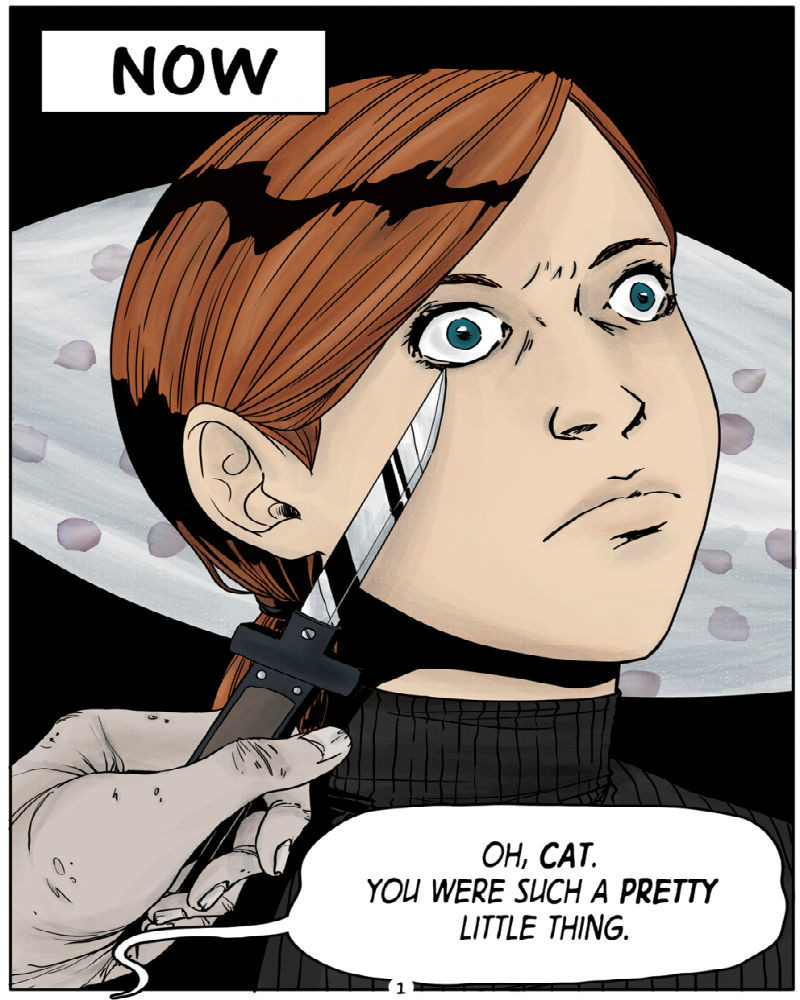
Cat goes back to her home only to find it in burned ruins along with Carnival, who was supposed to be in custody by the authorities, waiting for her with a knife. Dahlia even warns Cat earlier in this issue that not only does she endanger her life in participating in this “theatre,” but the lives of all those around her as well: including Dahlia’s young daughter. But it becomes very clear that this “theatre” means something very different to both Cat and Carnival.

For Carnival, the addition of Cat is just another excuse to treat the “theatre” for what it is: a game with hers and other people’s lives. In this case, he doesn’t even need to keep on script to deal with her. Her continued life isn’t necessary. It isn’t even made clear if he even meant to go for the World Trade Center or just left that threat to lure Cat to him. And as for Cat, this entire situation is her life writ large. After having spent most of her life with her intelligence and insights ignored or disparaged, she enters a world she has no other resources to draw on ruled by men who maintain power through violence and silence. If she hides, she and the people she cares for might get injured or die in this power-struggle. If she participates or speaks out, she will definitely make herself — and others around her — vulnerable.

She can’t win.

She just can’t win. This isn’t a drama. This isn’t a mythic cycle. Rather, Gloria City has become a game which — by the nature of its creators and participants — Cat cannot win. Even Urbanite’s sidekick — the Misper — warns her that his boss will take her to Bedlam, effectively gaslighting her if she gets in his way again. This is, of course, assuming that he won’t actively or passively kill her by letting Carnival do the job for him. In some ways, however, gaslighting is even worse for Cat than death: as it would be a method of making her doubt the source and question her sanity with regards to her true powers: her intelligence, her memory and her sense of agency.

In the meantime, though, Cat finds herself at the mercy of a system where patriarchal officials turn their heads and cluck their tongues as a madman holds a knife to her face: making her into another play piece, another statistic. For someone who values literature and philosophy, this is the ultimate dehumanization. This is the structure of fear and debasement — this coerced choice between becoming a symbol or death — that she wanted to save Dahlia’s young daughter Daisy from growing up and living in. And, right now, it’s iffy if Daisy will even grow up and if Cat will continue to be.

So Issue #4 of My So-Called Secret Identity leaves us with a lot of questions. I won’t lie. I do think that there are areas of this story that I feel need improvement. Pacing in comics panels can be a very tricky business and sometimes I felt that Brooker’s storytelling was rushed and condensed at times. I’m talking about the entire series so far in addition this current issue.  For instance, I wanted to see more interactions with Cat and Enrique — also known as The Misper — and see the growing relationship with her, Dahlia and her housemates.

Sometimes Brooker repeats himself as well: such as when Cat repeats the thoughts she narrates about Carnival and the other heroes. And I am really curious as to what Cat thought she was going to accomplish walking into Carnival’s lair without weapons, backup, or seemingly even a plan. Was she simply hoping to scan her surroundings for more information to use against him in a form of logical argument or manipulation? I don’t really know.  Perhaps this will be addressed in later issues.

My So-Called Secret Identity Issue 4 Part Four

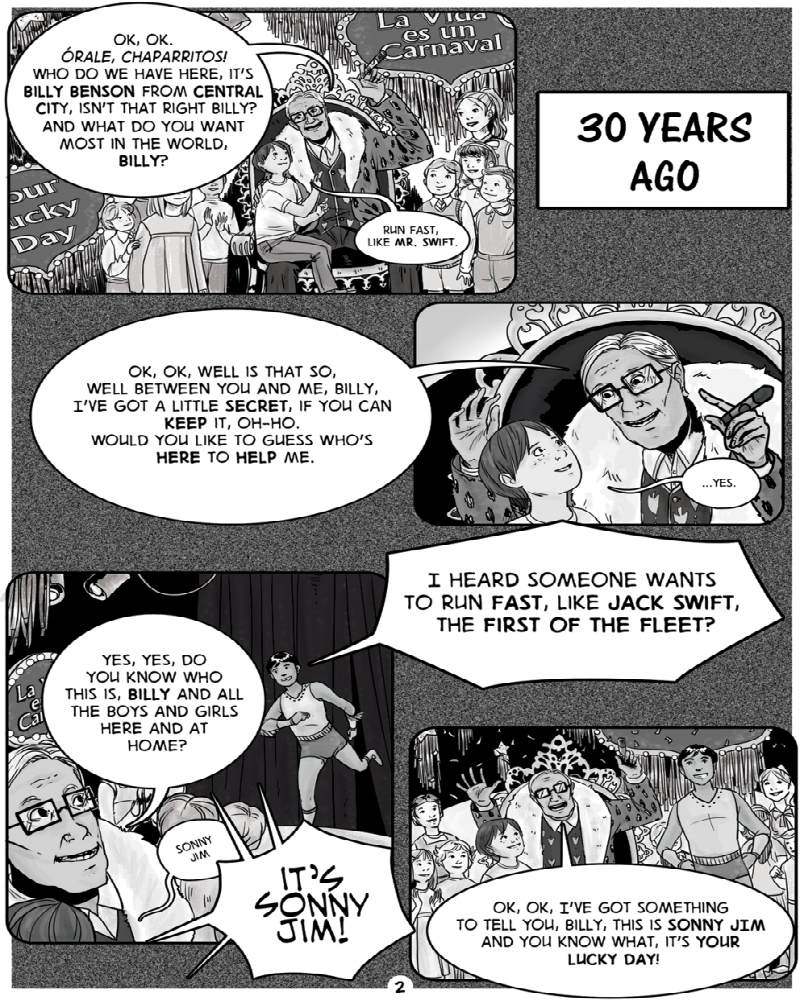
But I will say that I love the characterizations and the mysteries that Brooker continues to keep in reserve. For instance, that whole flashback dating thirty years ago to that children’s show. Was that host Carnival? Why are his sclera black? Is there some kind of relation between him and the current Misper? Is there any significance to the fact that this show occurred ten years before Gloria City’s “theatre” began? Is Carnival as responsible for the Meta and Trans drugs as The Major’s family?

In the reverse of what Painted Doll turned out to be for Alan Moore’s Five Swell Guys but no less a parallel, when I saw Carnival sitting on those crates like they made up his throne, it gave me this eerie feeling — in addition to Cat’s words about him being the “King of Gloria” — that I was looking at the real power in Gloria City: with all heroes as his figureheads and all civilians his playthings.

Because make no mistake. Carnival is no longer an actor: if he ever was. But while he is not an actor, he is definitely a player.

My So-Called Secret Identity Issue 4 Part Five

There are other questions too. Are there real superpowers in this world or just more smoke and mirrors? Also, who is Doll’s Eyes? Are Cat’s friends still alive? For that matter, where is Cat’s policeman father? We know that her mother is dead, but he is left ambiguous: though the fact that she wants to avoid his old colleagues might say something about this matter.

And, more importantly, how will Cat get out of this? Will there be long-term consequences for Cat as a result of this? It’s doubtful that The Misper will save her again, or at least it would be very repetitive. Will Brooker kill her off and have someone else learn her method and continue her work years later? Like Daisy (if she has survived)? Perhaps Cat’s character arc might go the Oracle route and teach other younger women to listen to City beyond merely recognizing its dangers: to actually save it.

I have to say that I doubt that Brooker will go all G.R.R. Martin or DC Comics on us given how much work and his collaborators put into Cat and how much that would border on the refrigerator woman trope: just as much I highly doubt as Carnival will kill her right now. At the moment, she is entertaining him. Her presence is, as he put it sickeningly enough, “porn”: an object to entertain and titillate him even in a non-sexual way. Is this the point where this story truly branches into a reality not unlike Mark Millar’s Kick-Ass: where a would-be hero truly and physically suffers, and dies for trying to be a superhero in an unforgiving reality?

Or will she survive and realize that she will need help and a different way to approach this game?  Is there is another way of approaching this game? Is there a way to go beyond the mentality of losing and winning to deal with reality?

Is Cat another casualty, or has her presence changed the game?

My So-Called Secret Identity Issue 4 Part 6

Will Brooker, Suze Shore and Sarah Zaidan have some questions to answer and I look forward to finding out the answers to these questions, and more, in “Second Life.” It is a fitting title: as My So-Called Secret Identity is being launched soon on June 16. So please support it and remember to Like the series on its Facebook page.

I Don’t Want to Go: An Adventure in Space and Time

There will be spoilers.

While Doctor Who has always been about traveling through time, it’s in Mark Gatniss’ docudrama An Adventure in Space and Time that we find ourselves at the point where it all began.

But just like the program itself, An Adventure in Space and Time neither begins nor continues in a completely linear fashion. The film starts off with William Hartnell, played by David Bradley, contemplating a blue police box in front of him, in his car in the night as a policeman asks him what he’s doing there. Hartnell looks far and away as the events of the film, from 1966 to 1963 and back again, unfold on the original TARDIS console’s counter display.

Before watching this docudrama, I didn’t know much about how Doctor Who was made beyond some very superficial details.  We see Verity Lambert attempt to function, and gain recognition as a producer in an “old-boys’ dominated field. She finds solidarity with the British-Indian director Waris Hussein as he faces a background of racial discrimination. I will also admit that I did wonder why BBC executive producer Sydney Newman didn’t have a British accent and seemed to sound more American than anything else, until I realized at the end of the movie that he came from Canada.

It was also very fascinating to watch the development of Doctor Who: from the rudimentary production arrangements, the pioneering of certain forms of cameras to deal with the program, and all that difference between a character called “Dr. Who” and The Doctor. “Dr. Who” is a character that Newman envisions, and Lambert and Hussein sell to William Hartnell who is tired of playing soldier and “tough-guy” roles but he is not The Doctor as of yet.

As for William Hartnell himself, he is portrayed as both a cantankerous old man with a bit of a temper and a lack of patience towards stagehands and, at one point his own granddaughter, but at the same time he is a friend to his co-actors, emotionally attached to Verity Lambert, and always seeking the role of the old man with the twinkle in his eye.

His “Dr. Who” is at first gruff and cold to a point where it both bothers Newman and himself. Perhaps some of this dissatisfaction comes initially from his hesitation in attempting to portray a children’s show’s protagonist. After a career of playing soldiers and authorities, attempting to become a children’s hero might have seemed a considerable stretch to him. Yet An Adventure in Space and Time makes it more than that.  It shows a man in poor health, in his mid-fifties wanting to do something more and different, to no longer be type-cast while at the same time trying to keep up with a hectic television actor’s schedule and his own professional standards. For instance, it really bothers Hartnell that the scenery of the TARDIS doesn’t even exist yet when he is rehearsing his lines in the studio and it takes a special kind of iron-willed effort on Verity Lambert’s part to make sure that the TARDIS and its console room happens.

But once the console room happens, we see that transition from “Dr. Who” into The Doctor, even if the producers and staff still refer to him as the former. I will admit it is still hard for me at times to look at David Bradley as William Hartnell, or at least with regards to his voice as the First Doctor. Hartnell has a higher voice that, while deep, has a trill at the end of his sentences that Bradley doesn’t seem to master.  It could also be, based on what is left of the First Doctor’s episodes that his put-on voice sounds different on the audio at the time. It might also be that David Bradley’s previous roles like Argus Filch from Harry Potter and Walder Frey in Game of Thrones has biased me against him.  However, what he may not completely capture in sound, he definitely expresses in spirit and presence.  I suppose the difficulty here, at least for me, is that you have to remember that this is the story of the program’s production and William Hartnell’s role in it. This is the story of Doctor Who, not just William Hartnell, nor the character of The Doctor.

Nevertheless, the docudrama makes it abundantly clear just how close this whole argument came to becoming a moot point. From the bad conditions of their studio and its sprinkler system, to a lack of scenery, as well as Lambert’s authority being questioned and challenged, their first episode airing on the day that John F. Kennedy was assassinated, and even Newman’s old insistence that Doctor Who be a show without “robots or bug-eyed monsters,” there were many instances where this program could have ended after the very first episode: becoming just another obscure, failed, black and white science-fiction oddity.

As the film progresses, we also get to see the development of the early Doctor Who fandom and Hartnell’s growing love for being The Doctor. He even interacts with children in the role off-screen and seems to enjoy it. But this docudrama is not ordinary. It isn’t linear or solely based in reality as we know it. Before it becomes too prosaic, there are at least three moments that hit me directly in the heart as a Doctor Who fan and went beyond my expectations. The first is that point when, after Hartnell is told about the concept of Regeneration (making so that, indeed, no one is irreplaceable and completing the idea of The Doctor as opposed to “Dr. Who”) he breaks down and begins to cry, saying, “I don’t want to go.” It makes me honestly wonder if Hartnell actually said this in real life and if in 2010 one Russell T. Davies wrote it into “The End of Time” for one David Tennant.

The second moment that got me was the realization that Hartnell actually knew, perhaps more than the new generation of production crewmen and staff, how to make the prop of the TARDIS console work. And then, there was the last moment which I am not going to spoil. You should definitely watch this film. I will say,  however, that in that one fourth-wall breaking moment at the end Hartnell realizes that The Doctor will continue long after his successor Patrick Troughton and that even though it is fan-service, it’s fan-service of the most beautiful kind.

Not too long ago, in “The Day of the Doctor” we Whovians discovered the existence of an incarnation of The Doctor that sacrificed his name to become a soldier. Two days before the 50th Anniversary episode we are reintroduced to a man who was tired of playing soldiers and wanted to portray something different, to a show that became something more and with many great people behind it created a legacy, one that doesn’t want to go, and one that is still with us even now.

CORRECTION: John F. Kennedy’s assassination happened one day before “An Unearthly Child” premiered, not on the same day.

Everybody Lives: A Review of The Day of The Doctor

I am going to quote River Song again when I say, “Spoilers.”

So for those of you who haven’t put on your Tenth Doctor’s 3D glasses this weekend or this coming week please don’t read any further.

Before The Day, there was The Night, and then Last Day. I am time-stamped on G33kpr0n in What Will Happen on The Day of The Doctor? as stating that it is quite impossible to predict a Doctor Who episode, never mind the 50th Anniversary Special. But I did make a few theories, just as I did in What Is a Doctor and When Does He Stop Running? in my Mythic Bios Blog.

I am not upset that my possible theories were wrong, not really. I went into watching “The Day of The Doctor,” on Space at 2:50 pm with no other expectations save for the fact that we were going to see how Gallifrey died. I mean, this is what we’ve been told since 2005. Gallifrey is no more. Gallifrey falls. The Doctor is the last of his kind and he keeps losing his Companions over and again. As the last of the Time Lords, The Doctor is alone. From 2005 to the present, this is the story that we have been told and that we have seen play out time and again. But just as we all had our theories about how this would all go down, there was what we thought and then there was what happened, what will happen, or what is happening right now to those of you watching this for the first time.

The episode begins with the original 1963 Doctor Who introduction sequence, complete in black and white, and so close to the junkyard owned by one I.M. Foreman where the adventures of The Doctor began. After Clara leaves from her new work at a school, where The Doctor’s first Companions may have once taught his granddaughter, to go see him and U.N.I.T. is in so much of a rush to get The Doctor to help him that they basically tow away him and his TARDIS by helicopter, The Doctor finds his past catching up with him.

U.N.I.T., led by the Brigadier’s daughter Kate Lethbridge-Stewart, brings The Doctor to their Under-Gallery, where Queen Elizabeth the First placed all paintings deemed “not fit for public consumption” to see a sample of Time Lord-painting. This painting is a depiction of the last day of The Last Great Time War and the fall of Gallifrey’s second city Arcadia. Suddenly, The Doctor remembers that incarnation of himself that he doesn’t like to think about, the one he and Clara saw again in “The Name of The Doctor” when he crossed into his own time stream. We are treated to a look at the three-dimensional painting, which is bigger on the inside, of a golden, blood-red ravaged Gallifrey…

And then we are right in the War.

The Day of The Doctor 2

Murray Gold’s “The Dark and Endless Dalek Night” plays grandiose and horrifying in the background as Dalek saucers and Time Lord defences battle it out. But we see something new on Gallifrey’s surface. In “The End of Time,” all we saw was the Time Lord High Council in fascist red and gold proclaiming what would be the Ultimate Sanction, or the obliteration of the universe to assure their ascension as beings of pure consciousness. The Doctor made it clear that the Time Lords had been completely corrupted and irredeemable by battle lust and war. I mean, think about for a few moments.  Imagine a whole people that can Regenerate and manipulate the laws of Time itself. Now think about Rassilon, the founder of Time Lord society and the inventor of much of their technology, removing the thirteen Regeneration limit and with modified Battle TARDISes dying over and over again. The Time Lords and, by extension, Gallifrey were basically deemed as bad as the Daleks and this was the reason for The Doctor’s terrible decision. This was the reason he used The Moment to destroy all of them.

In my own Mythic Bios article, I saw it as an act of euthanasia, of basically putting an entire people that had gone rabid with a hunger for power to sleep out of mercy for them and the Universe. I saw it as a hard, but necessary thing. But we had hints that just as the Time Lords had done terrible things, they also weren’t all monsters even at this point in this game. Look at the mini-episode “The Last Day” for instance. Those soldiers were just people. They were just trying to defend their home. You see from the perspective of a Gallifreyan or Time Lord soldier another giving you a helmet and he has this look of empathy and shared suffering on his face. This is not a madman or a monster. They are the front-line that has to defend their home and their families.

Yes, Time Lord society has families. Despite earlier versions of the Doctor Who mythos where Time Lords were Loomed or artificially woven and grown into existence, Time Lords and Gallifreyans have parents … and children. And this is where the episode punches you in the stomach. You assume that all the Time Lords were engineered adults, even if they were once children. I even had the belief that an elder race like the Time Lords would have few, if any children at this stage in their evolution. But you see them. You see the Gallifreyan children cowering with their protective and very terrified parents. All of that over-exaggerated Gallifreyan fashion that we have seen over the years is tattered and clothing essentially war refugees that die by Dalek and friendly-fire. It is truly awful and perhaps that is the reason why Moffat does not show gratuitous Regeneration scenes. First of all, I am pretty sure that the Daleks could have replicated something like staser fire, one of the few weapons that can kill Time Lords instantly, and second of all it illustrates that there are no take backs in war where innocents die.

Then we see The Doctor, The War Doctor, who has frankly become my favourite. He is a worn, haunted, sad old man who has seen and dealt more death than any self-conscious being ever need to. Even as he rescues some refugees by having the TARDIS smash into some Daleks, he uses a gun to carve the words “No more” into a wall. It is as though he is writing his own name as the artist of the Time Lord painting we see from Doctor Eleven’s perspective. He might as well be.

After some very concerned Time Lord soldiers, who are fed up with the High Council for doing essentially nothing (which is another indication that not all Time Lords were aware of, or even agreed with the Ultimate Sanction) realize that The Doctor has stolen the most powerful super weapon in existence we think we know where this is going. It is The Moment.

The Day of The Doctor 3

We find The Doctor in an isolated spot, having left his TARDIS miles away, either because she won’t have to see him detonate the device or watch him die. Despite the lack of hope in his eyes and his weathered, unkempt face he is still The Doctor. He is tinkering with The Moment and trying to puzzle it out like he does any other toy he comes across.

And then we see Rose.

The Day of The Doctor 4

No. We actually see The Moment, as the device’s sentient program, taking on Rose’s Bad Wolf incarnation and deciding to make The Doctor fully aware of the consequences of what he intends to do. She is beautiful and golden in the feral way that her moniker suggests. The Moment has taken the image of someone from The Doctor’s past, or future, to attempt to relate to him. It is her that confronts him about the children. And you can see in his eyes even before he says anything that he intends to die with The War. It makes too much sense. After all the horror and the loss even later in his life, it is a miracle that The Doctor has never committed suicide. But The Moment, Bad Wolf, or Rose will not make it that easy for him. For some reason, The Moment has decided to make him face his decisions and his future by opening warps through the War’s time lock. Talk about an excellent piece of Ancient Time Lord technology huh?

These warps are how Doctor Eleven, Ten, and The War Doctor end up meeting in 1562 England. Despite the grimness of everything I’ve described so far, there is your typical Doctor Who silliness. Doctor Ten continuously mistakes Elizabeth the First as being a shape-shifting Zygon imposter (I’m thinking his shape shifter device kept getting confused by his own energy), while Doctor Eleven threw a fez through two of the warps that brought them all together. Even The War Doctor is exasperated by these younger, future versions of himself. In the scene where he meets them for the first time, convinced by The Moment to talk with his future selves, he actually mistakes them for The Doctor’s Companions. At first, I thought he was totally messing around with them, asking for The Doctor and calling them Companions until I began to realize that he genuinely didn’t know.

I will say that at this point in the venture, I thought Eleven would react much more angrily to The War Doctor given his denunciation of him in “The Name of The Doctor.” But he and Doctor Ten just seemed shocked. And after they are captured by Elizabeth’s guards, seemingly under the Zygon imposter’s command we see them pretty much face each other down. The War Doctor asks them if they ever thought about how many children there were on Gallifrey. There is another punch in the stomach for everyone in the audience. But whereas Doctor Ten does, in fact remember, Doctor Eleven claims not to and there is this very real, very angry moment between him and Ten about how he could “move past” something of that kind. Basically, even in a jail cell The Doctor is still running from his past and what he did that one time during The Time War. Meanwhile The Moment, who is still Rose and can only be seen by The War Doctor, is feeding him lines and asking him to consider matters.  I was thinking about all those Doctor/Rose fan-shippers that were crying inside about how close this approximation of Rose was to Doctor Ten and Eleven, and yet so far away.

Then each of them is led by The Moment, through The War Doctor, to realize that despite the different appearances of their sonic screwdrivers they all still have the same software. They are about to use them to break out when Clara, who the Zygons underestimated rather stupidly, just opens the unlocked door. Yes, all three Doctors are that absent-minded: constantly searching for complex solutions, when the answer is right in front of them. It happens to us all. But then what seems to be the Elizabeth imposter leads them out to show them how the Zygons are planning to conquer Earth. With their homeworld having been destroyed in the beginnings of the Time War, the Zygons somehow reverse-engineered Time Lord art technology (perhaps through the presence of the Time War painting that is somehow at some point in Elizabethan England) send themselves into other paintings to release themselves in Earth’s future. All of these events are components to another, greater Moment that comes up very soon.

So after realizing that Elizabeth I is the real one pretending to be her imposter (that she stabbed to death in the forest) and her impromptu wedding with Doctor Ten, all three Doctors come into the TARDIS and find a way to go back to 2013 into a “TARDIS-proofed” U.N.I.T. Black Tower and stop the mutually-assured destruction of London situation happening between the Zygon infiltrators and Kate Lethbridge-Stewart. It is here that we see Doctors Ten and Eleven taking their regret over what happened in The Time War and using it and craftiness to get both sides to agree to peace-talks. Clara then has some alone time with The War Doctor, a far cry from the young energetic man she has been travelling with and says that his eyes “look young” while those of his counterparts look so terribly old.

It is here that The War Doctor comes to his decision. He realizes that his “necessary mistake” in destroying Gallifrey is the only way to get his future incarnations to “grow-up” into the people that they have become. He plans to be the force that they learn from. And I know that I, as part of the audience watching this commercial-less simulcast, braced for what was going to come.

But even though this was not a Christmas Special, a 50th Anniversary counts for something. Even as The Moment makes him pause again, the other two Doctors with Clara in tow come to where he is now. It is heartbreaking to see The War Doctor want them to leave him so that he can do what he, albeit doubtfully now, still believes is necessary and Regenerate alone. But they accept that he is a part of them, after denying his memory for so long and they are all about to activate The Moment’s Big Red Button when…

Clara comes in and reminds The Doctor why he named himself The Doctor. The Moment too takes the opportunity to show all of them Gallifrey’s families and children. There have so far been two reoccurring themes in this episode. The first part of the episode starts at a school house with children in an English public school with its old private-school trappings. It is not unlike the Time Lord Academy in which The Doctor and so many others grew up. We see the children in the War. We see them at play in the sunlight of The War Doctor’s dusty memories. And then we see them hanging up colourful ribbons and streamers despite the destruction around them. We see something that we have not seen so far in this whole episode.

We see hope.

We also see women. It is no original idea or trope for a female archetype to be the helper or saviour of a male character. The Moment does everything she can to lead The Doctor to an informed decision not determined by despair. Clara reminds The Doctor of his purpose and is always his Companion. Elizabeth the First flat out states that arrogance typifies all men. Even the TARDIS, Sexy, won’t leave The Doctor in any incarnation. She even smashed down some Daleks like a Battle TARDIS. Where The Doctors act, these characters ask and question. And yes, they help save The Doctor from the spiritual damnation we’ve seen him struggle with since 2005.

The Day of The Doctor Women

In them, we see life.

And then a potential catastrophe becomes a eucastrophe: a happy-ending.

Between the three Doctors and all of their other incarnations–including the Thirteenth Doctor–they use the time-freezing technology used by the Zygons–the “cup of soups”–to capture Gallifrey and deposit it into another pocket universe.

The Day of The Doctor 5

In this way, it looks like Gallifrey is destroyed along with the Daleks. But Gallifrey is not destroyed. Through loops and contradictions and layers of Space and Time Gallifrey doesn’t rise, or fall, or die. It lives.

In the words of the Ninth Doctor, “everybody lives.”

The ages-old and weary War Doctor leaves, finally at peace and although his later incarnations lose all memory of this crossover event, he Regenerates. We don’t see Doctor Nine, which is a little disappointing, but this is not unexpected. Ten also leaves knowing that he will not remember, but stating that they need a new destination aside from the doom of Trenzalore. But Doctor Eleven remembers.

I am almost finished. Like a TARDIS, this 50th Anniversary Special is “bigger on the inside.” As Doctor Eleven wonders if they succeeded in saving Gallifrey, and ponders embracing Elizabeth’s role to him as the curator of the Under-Gallery he … meets or reacquaints himself with someone. At first, I wondered how this was possible and who the elderly Curator could possibly be. But after re-watching the episode to write this review, I realized that The Doctor can actually decide what face he takes on in his Regenerations. He can even take on old faces.

The Day of The Doctor 6

So when an elderly Tom Baker all but confirms that Gallifrey is saved and that the painting in front of them is called Gallifrey Falls No More. It is left ambiguous as to whether or not The Curator is a future version of The Doctor, or a possibility, or someone else entirely.  Ending the episode with that gentle, wise lighthearted moment, with a potential Doctor without bitterness and regret and filled only with a kindly acceptance, changed the whole tone of the series in that one moment. And Doctor Eleven taking his place alongside his other incarnations with the First Doctor standing in back of them with his arms crossed is positively inspiring.

There is so much I know I’ve missed in this review and I have tried to capture all of it in something like a Time Lord-painting. There are those who would say that this whole Special was a cop-out: that it negated all of The Doctor’s experiences and that it leaves plot holes and weaves itself with clichés. But I think that now, this Special leaves a whole other level of possibility and paths yet to travel. I asked a question in the title of my Mythic Bios post. I asked “When does The Doctor stop running?”

The answer is that he doesn’t. The Doctor will never stop running. It is his nature to run. But he has changed. Because now, for the first time in ages The Doctor won’t be running from something. Rather, The Doctor will be running to his destination, to his end and Gallifrey and all the possibilities beyond it. Everybody lives, gentlebeings and now perhaps we can see The Doctor do that as well. Perhaps we can now see him truly live.