My So-Called Secret Identity: An Interview With Will Brooker – Part 1

(Ed’s Note: This is part 1 of our interview with Will Brooker.  To read part 2, click here.)


GEEKPR0N
:  In addition to being a Batman, Star Wars, and popular culture scholar, Dr. Will Brooker, along with his artistic collaborators Suze Shore and Dr. Sarah Zaidan, is the creator of the ongoing comics series My So-Called Secret Identity. I’ve had the opportunity to cover his work for GEEKPR0N, but after an offer to let me ask him some “difficult questions,” I found it too much  an opportunity to resist.  So here we are now: talking about the story of a woman, a city, and an entire comics world. 

My So-Called Secret Identity features Cat, a young university student whose only power as you put it is that she is, “really, really goddamned smart.” She also exists in a really fascinating place known as Gloria City: where celebrity “superheroes, villains, and anti-heroes” seem to battle for prestige, money, and maintaining appearances. It’s, as you and Cat herself put it, become a “theater” for them: a play with a lot of collateral damage for its citizens. What and/or who was the inspiration behind the character of Cat? And how did you come up with the concept of Gloria City? 

Will Brooker:  I think there were various inspirations for Cat, which I’d have to think back and tease out now, as it’s two and a half years since the project’s inception.

The underlying premise, at one point, was ‘what if there had been a Vertigo title about Batgirl in the 1990s’, so in that respect, Cat is very much inspired by Barbara Gordon and the women of comics like Shade, Sandman and Doom Patrol.

In real life terms, I’d just started teaching a student called Babs, who — because it’s not a common name in my experience — made me start thinking what Babs Gordon might be like in real life, as an undergraduate; and I’d also just met a red-haired PhD student, Claire, which was no doubt also a factor. Again, one of the main ideas behind MSCSI was that Barbara Gordon had always been a PhD student, but her life never really seemed to resemble the lives of the students I knew.

So I wanted to try to bring the two ideas closer together, combining the concept of Batgirl with the largely female students I work with and am friends with.
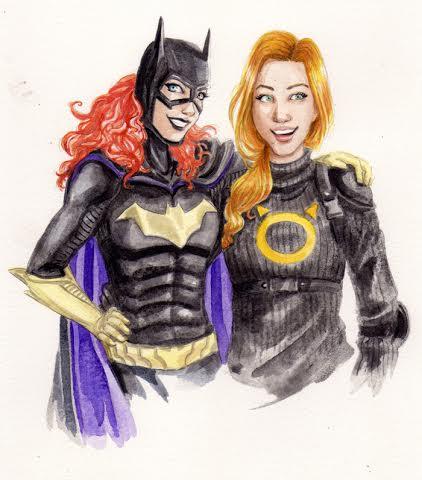
jennie batgirl cat
Batgirl (c) DC Comics


Jennie Gyllblad recently painted us a lovely portrait of Batgirl with Cat, which demonstrates just how different they are and how they diverged: Barbara Gordon is really athletic and armored, and Cat is just averagely fit if that, wearing clothes she’s bought from regular stores. Although Batgirl was the original inspiration, Cat came to resemble much more a character from the Beano comic story ‘Billy the Cat and Katie’, who was the inspiration for Tammy (of ‘Tiger Tom and Tammy) in Grant Morrison’s series Zenith Phase III.

In terms of the name Gloria City, I was looking for something a bit like the city called Vanity in the short-lived comic book Aztek (Morrison again!) I liked the idea of Cat thinking of it as a friend or big sister, and the place having a woman’s name, like the city of Charlotte (and arguably, Sydney).

There is actually some Christian iconography in the Gloria University logo, and I like that the name captures a sense of joy, promise and becoming, even though clearly it’s a city with problems. As such, it is, like most comic book cities, somewhere between Metropolis and Gotham, which are themselves of course versions of New York City.

The map of Gloria is loosely based on NYC. The various districts are pretty much where you would find them in NYC — the bohemian Village, the theaters, the largely African American community, and so on. If you follow Cat’s routes in the comic, you can tell that she’s walking through areas which very much approximate Manhattan in their relation to each other.

In terms of the look, I think a lot of the detail, such as the hanging baskets and the streetlights, came from Suze. As she’s Canadian, it may well have a particular cultural angle to it. I think I suggested to Suze that it should be a bit like Vancouver in its atmosphere, with a music and cultural scene like Austin, TX. But as with a lot of things in MSCSI, it’s hard to be sure exactly who decided what.


GP: I definitely get the feeling that Cat thinks of herself as part of Gloria City as opposed to being above it, or her if you’d like to personify Gloria with a gender. I am really fascinated with your creation of Cat’s mind maps and how they fit into her sense of relation to Gloria. It’s kind of like an intersection of geography, her educational background, mnemonic devices (memory prompts and aids), and her own innate sense of exploration and a need for understanding. Is this partially what motivated you to create Cat’s mind maps? You mentioned in your interview with Julian Darius that Sarah Zaidan drew them, but was there anything in particular that inspired either of you to make these? 

WB: Sarah created the MindMaps visually, from my directions in the script. All the details are there in the script, and a fair amount of information and suggestion about how the MindMap should look, and how the different elements should relate.

Again, a few different ideas prompted the MindMaps. I wanted to do something like Alias, where most of the story is told in a particular comic book narrative style, but there are sections where we dip out of the story into pastiche flashbacks, scrapbooks and magazine extracts, in an entirely different visual mode. (In a way,Watchmen did this with its endpapers, back in 1986).

MSCSI was always informed by the idea of scrapbooks. Ironically, it’s Jim Gordon, not Babs, who is working on a scrapbook when Joker arrives in The Killing Joke, but I felt that scrapbooking was more of a conventionally-female art form — Pinterest is the digital version — and part of the aim behind MSCSI was to foreground and celebrate alternative (again, conventionally-female) forms of art, craft and labour.

The scrapbook aesthetic works with our idea of collaboration and community, involving different, diverse versions of the cast members and a collective approach to their appearance and costumes. It embraces various art styles and encourages an approach to art as a process and work in progress, rather than just a finished page. It fits with our sense of workshopping.

Cat’s MindMaps are very much like an essay plan, I think, although they include everything in her life rather than just her academic work. They are meant to show how she makes sense of things and connects things. I imagine it’s a specifically arts and humanities way of reading the world: one reviewer compared it to Michel de Certeau’s notion of walking in the city. Her understanding of herself and her environment is visual and tactile, as well as just linguistic: it involves fabric, colours, scraps of paper, scrawled links.
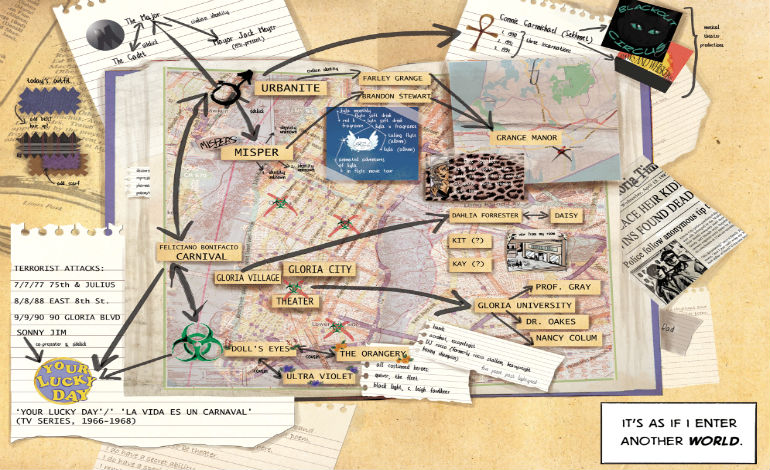
My So-Called Secret Identity Mind Map

One of the key ideas here was that while Batgirl is very, very clever, I didn’t think we often saw that in stories about her. How do you show thought processes, in comics? You can have someone piece a mystery together, but that requires a certain kind of detective plot, and Cat wasn’t going to be in that situation from the start: she’s just living a fairly normal life. So the MindMaps give us access to the way she thinks, even before she starts trying to investigate the enigmas surrounding Urbanite and Misper.


GP: That is very fascinating. I mean, in most detective comics — whether they are based on the Dark Knight or earlier and alternative stories — you have the characters telling other characters or, really, the reader the analytic and synthetic process by which they came to their deduction. It makes sense in that police forces are depicting as utilizing maps, newspaper clippings and notes on bulletin boards in order to link clues together and come to some kind of conclusion about a crime. And as for the comics medium itself, you can attempt to show processes through a thought-bubble or even some captioned flashbacks. But these maps really are the closest thing in comics to how a human mind really works: as we all think in a mixture of sounds, images, words and other senses. 

The maps remind me of the concept of psycho-geography: of places being linked with past events and emotions. Speaking of Alan Moore’s work, he has drawn on this concept through Sir William Gull’s twisted personal paradigm in From Hell, while I also know that Grant Morrison and Daniel Vallely used the model in a flat-out collage aesthetic in Bible John: A Forensic Meditation. When I say that now, I realize that these comics also deal with crime, but from very masculine perspectives — from a killer and potential investigators — and with regards to violence and murder against women. But you use the MindMap and the multimedia (I am thinking of Watchmen) of the scrapbook differently with regards to Cat and even her relation to the time and place of Gloria City.

WB: It’s true that the MSCSI MindMaps are actually strikingly similar to the bulletin boards of images and links we see in crime drama — The Wire, for instance, or more recently True Detective andFargo — where a main character is trying to connect the dots of a murder or a conspiracy. I didn’t explicitly think of that, but it’s probably the most obvious visual echo. I’d have to check the script to see exactly what I specified and what Sarah added to the concept.

The MindMaps do recall Bible John and From Hell in a way. I didn’t have them explicitly in mind, but I’ve read and enjoyed them both. I was asked last year to write MSCSI as a script treatment for a movie, by an agency that ultimately didn’t take the project on, and in adapting the MindMaps for a new medium, I came up with an idea that’s again quite similar to the pentagram across the city in From Hell, and also the Riddler’s use of the city in Batman: Zero Year.

In fact, a lot of Zero Year reminds me strongly of MSCSI now — the dispersed power of the Red Hood gang, the grim joke about demolishing buildings as ‘dominoes’ — which I think demonstrates how these ideas just float around in the creative consciousness, recurring in different forms and different texts. It’s obviously a complete coincidence that aspects of Zero Year recall MSCSI, but it probably says something about the links between MSCSI and From Hell too — that echoes aren’t always deliberate.

It would be interesting to consider whether the MindMaps are any different from the other texts because of their female perspective. On a really superficial level, I doubt Batman would have swatches of material in his head, as he plans his outfit while also trying to remember where terrorist attacks took place. But someone like Tony Stark, who seems to take more genuine pleasure in his wardrobe and social life, might do.

The videos produced by Rebecca for our Kickstarter and Sound & Vision page probably come closest to showing what the MindMaps would ‘really’ look like, as they’re animated and include sound and music.

 Video Credit: “Bright Yellow Gun,” Beccatoria

GP: I had no idea that you were asked to write a film treatment for MSCSI, but that said I can see through the videos that Rebecca created some of the MindMap material unfolding and animated. I do hope that, eventually, MSCSI and Cat get their chance to go from “the theater” to the theatre screen. 

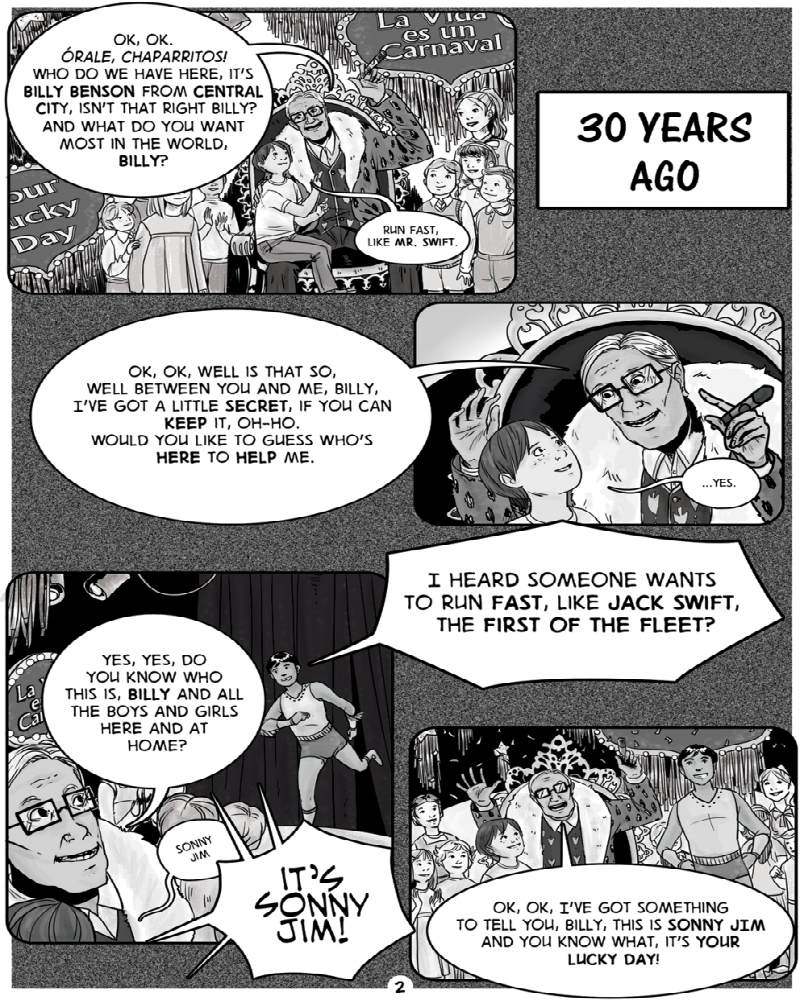
I’d like to focus a little bit on the theatre metaphor for MSCSI. There was a black and white scene in Issue #4 depicting a children’s show. This happened thirty years before the events of MSCSI. When a reader really looks at those MindMaps, they can get a hint of not only what will happen, but how things possibly relate to each other. And Carnival is mentioned in reference to this show. Did the theatre truly originate from that show? Do all the heroes, villains, and anti-heroes relate to Gloria City only through the metaphor of the theatre (aside from Carnival who, at best, thinks of it all as some kind of interactive game)?

WB: The theatre, as in the whole superhero culture of MSCSI, began in either 1945 or 1954. Nobody in Gloria City can easily remember exactly when it was — they just have those key historical dates in their head, from school or magazines, or it’s just something ‘everyone knows’, but when they try to pin it down they’re not quite sure where they heard it.

Anyway, there were some significant events that again, ‘everyone knows’ in the same way that we know JFK died and people landed on the moon, and after that, there were costumed figures who seemed to do things better, stronger, faster than normal folk, and it all progressed from there.

This is all my exploration of comic book continuity, and the fact that characters in comics have to deal with history being rewritten, rebooted and revised at regular intervals. We’ve already seen instances of this, where Dahlia can remember details about the Fleet and the female Misper that Cat’s forgotten. (Because Dahlia’s a little older and has a different sense of history). There’s further suggestion of the past in the newspaper page that recurs through Issue 3. I want to spell this out a lot more explicitly in Volume 2.
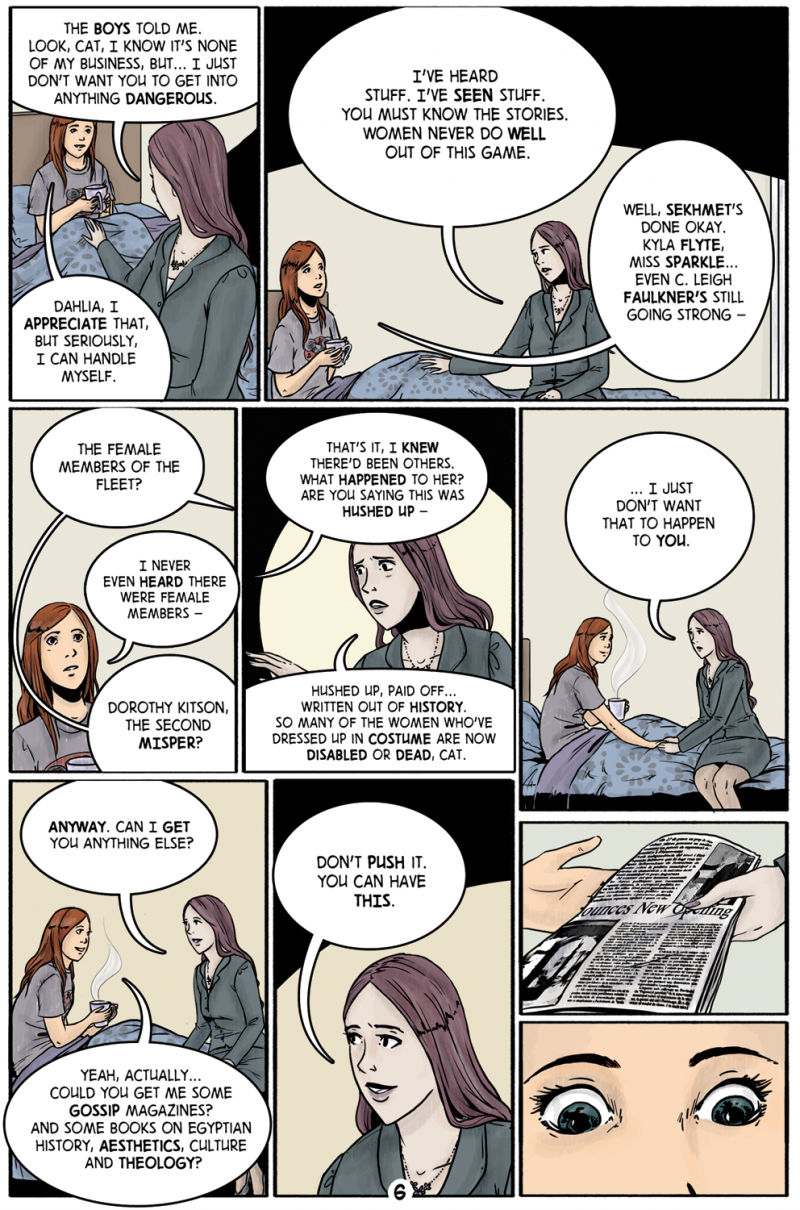
Dahlia Talks to Cat MSCSI

Carnival and Cat are, I’d say, the only ones who really recognise and admit that this whole superhero dynamic is a kind of theater or game. Carnival embraces and plays with the idea. Cat has really only just realised it, and to her that makes everything even more unethical and sickening — that other people are being damaged in a power-play between half a dozen larger-than-life figures.

Kyla, Connie and Miss Sparkle would accept that it’s all business, a staged conflict to sell product. Urbanite would stubbornly resist that idea. He needs to believe it’s a never-ending war on crime, and that it’s all entirely legitimate — that he is genuinely locked into battle with people like Carnival. Even if he might believe the truth deep down, he’d be reluctant to admit it even to himself, and would never say so out loud.

The ‘It’s Your Lucky Day’ show was Carnival’s TV series, back in more innocent times, when he was a cartoonish, avuncular persona. If we saw Urbanite guest star on that TV show, he’d be a figure like Adam West’s Batman (this would, of course, be another person in the Urbanite costume, as it all took place a generation ago). It would be pretty good to revisit that idea, in fact, and see what Urbanite was like in the 1960s.
My So-Called Secret Identity Issue 4 Part Four


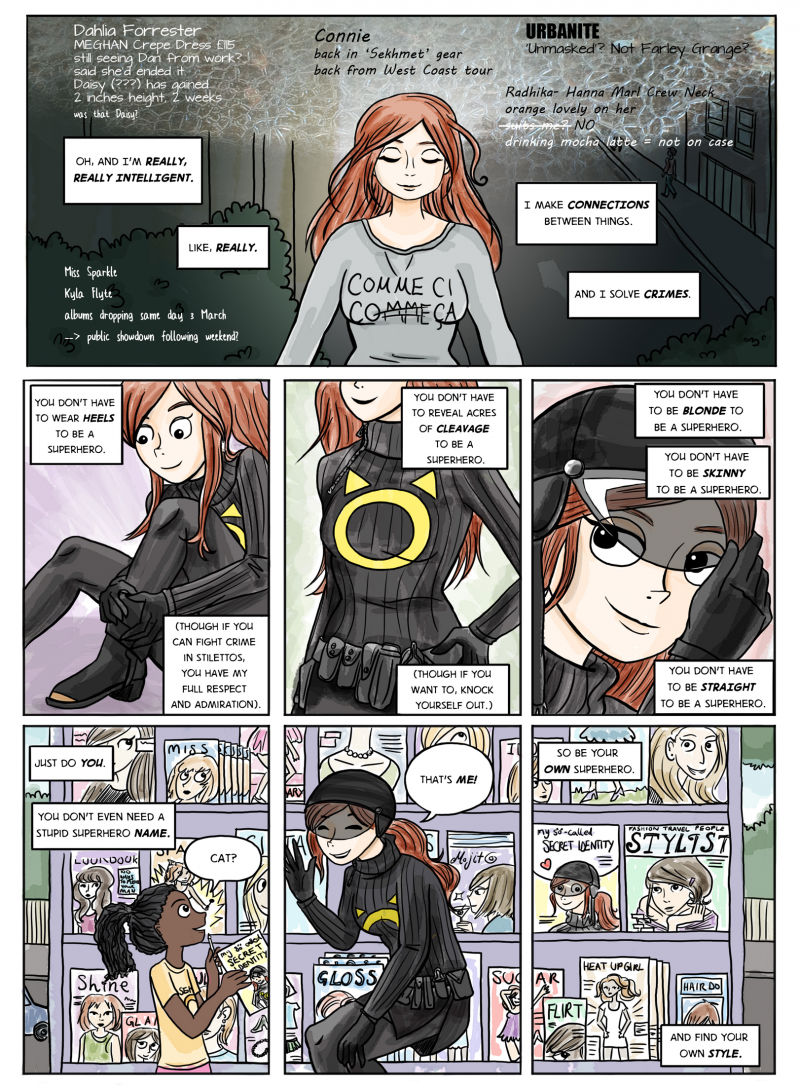
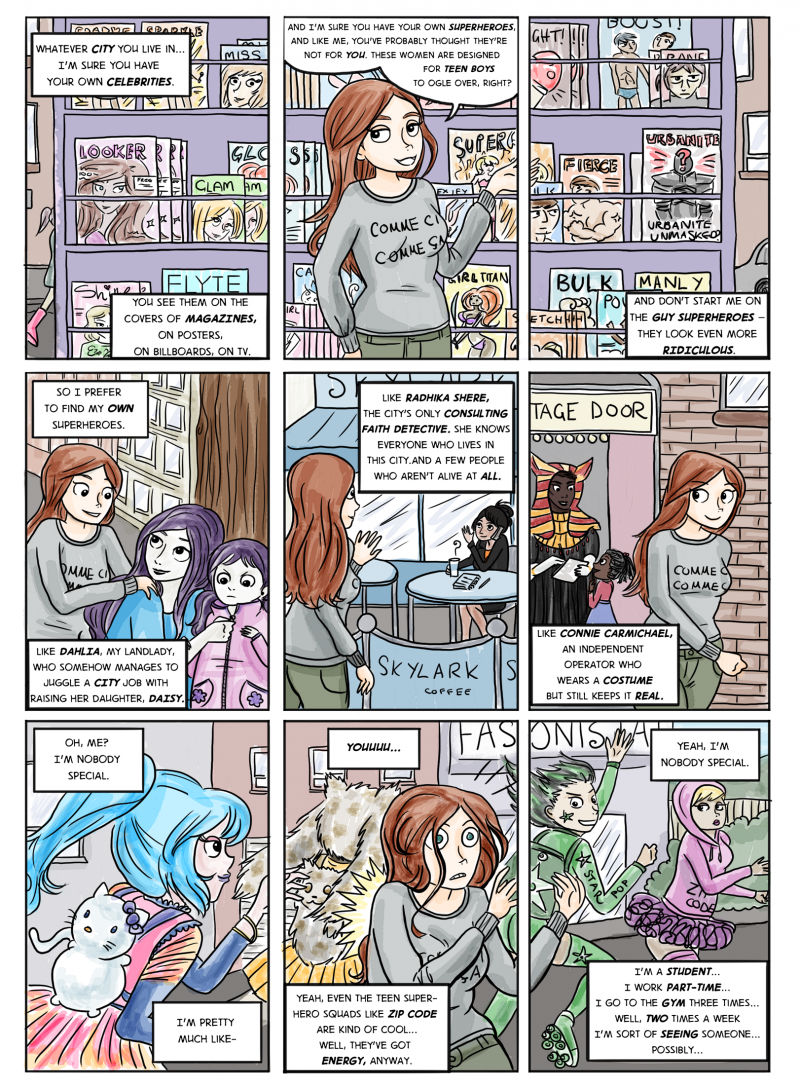
GP: An Adam West-like Urbanite would be entertaining, to put it mildly. The theatre of Gloria City and its characters can say other things about our world behind the comics culture as well. Cat herself represents something new or at least seen less often in superhero comics. After seeing Cat working with her friends Kit and Kay on her costume and reading the Extras section of MSCSI’s website, it just reminds me of the fact that many comics fans become involved in the industry in some way themselves: either becoming a part of the structure or making their own fandoms. Not only can you become a creator, you can also be like or be your own hero. Could you interpret Cat as an in-universe representation of that idea? As that counterpoint to the corporate capes and crusaders: that line between a Do-It-Yourself movement of cosplaying fans and more independent and relatable heroes? 

WB: I didn’t really have that interpretation at the front of my mind, but it definitely fits. It could be seen as exploring the kind of career path from fan to creator; a path many people have taken, within comics, novels and TV. Of course, a creator can still be (and should be) a fan, and still be critical. And in a way, Cat is engaging in a form of fan practice, or perhaps anti-fan practice: her logo is adapted directly from a commercially-bought Urbanite stencil kit. So she’s subverting official materials and making her own brand, and costume, from available materials. It’s exactly what fan scholars call ‘transformative works.’

One of the questions raised there is whether, by moving further ‘inside’ the structures, you lose some edge, distance and critical perspective. That is certainly an angle that could be applied to Cat’s position in Volume 2, which begins some months later, when her role as a kind of ‘hero’ is more established. She’s gained a certain degree of celebrity and respect from other costumed figures, and is on the level where she can actually talk to Kyla Flyte.

So if you apply that interpretation, MSCSI offers a commentary on the compromise and negotiation between becoming more popular and successful, and ‘selling out’.
My So-Called Secret Identity DIY
Additional Text: Kat Poole and Tracey Ramsden


GP: That has definitely been a question on my mind as I’ve been following the series so far: as to how far Cat will play in the theatre and if she will change the system, or become a part of it. I can definitely see her bringing some kind of unique innovation to the theatre, and Gloria City: perhaps starting a trend in empowering its citizens — particularly its female citizens — through fandom and example and showing them that ordinary people can be heroes because, in MSCSI’s promotional words, “Smart is a superpower.” 

 In your interview with Nick Ford, you mentioned that your agreements with your collaborators and sponsorships for MSCSI are based off of something called “gift economy”: which you said was something prevalent in female fan communities and is a model with less emphasis on contracts and business deals and more about hand-shake agreements, networking, and exposure. Are there any examples of female fan community “gift economy” that influenced your MSCSI collaboration and, tying it back to fandom and culture, could this concept play some part in Cat’s own potential influence on Gloria City society? 

WB: The question of how Cat will function within and change the nature of Gloria’s costumed community will be a key issue in Volume 2. She becomes a more prominent media figure and a role model to an extent, and feels she has new responsibilities.

However, the whole community will change during Volume 2 anyway, as one of the underlying plot points is that all the big hitters, who are male, have been lured away on another ‘mission’, so the people left in the city who qualify as ‘superheroes’ are second-stringers and predominantly female, of various generations from 18 to retirement age.

So because of that change, Cat finds she has an even more decisive role, as the newest and most prominent young female ‘costume’ on the scene.
My So-Called Identity DIY 2

I’ve just written a short chapter for a new book about crowdfunding, which says a little more about my debt to the notion of gift economies. Here’s an extract.

 My approach was informed by what I knew about fan communities; specifically female fan communities, and even more specifically, the communities discussed by Karen Hellekson and Kristina Busse in their book Fan Communities in the Age of the Internet. They explained the process of ‘gift economy’, where one fan does something for another – writes a story, creates an avatar – in a system of informal, friendly trade, without any fixed arrangement or desire for financial reward. The items exchanged, gestures of time and skill, ‘have no value outside their fannish context […] Gifting is the goal. Money is presented less as a payment than as a token of enjoyment.’

Every week brings new examples of that in practice. I have a friendly agreement with the ethical underwear company Who Made Your Pants? that we will cross-promote and support each other, during this period at least. I’ve literally been sending gifts to a few MSCSI fans across the world, not for any kind of expected return — but nevertheless, it feels indirectly like a kind of thanks for their positive reviews and their continued support. There have been very, very few contracts between me and the artists, even those I’ve never met and have only dealt with once. I don’t have any form of written agreement with Sequart or Geeked; it is just about a mutually respectful admiration and a shared set of ideas.

Again, I think we could see some of this in Volume 2 of MSCSI, where I envisage Cat as — initially at least — being a little like Man-Of-Bats, the Native American Batman of Grant Morrison’s comic, who works on a very local level. The introduction of Radhika Shere, our analogue of John Constantine, and her relationship with Cat, will play into this idea — people doing each other favours within the community and knowing it’ll be repaid somehow.

As in Volume 1, though, we start off on a nice, easy-going local level, with people just hanging out and enjoying every day dynamics, but comic book drama kicks in and Cat is caught up in another larger-scale dilemma before long.


GP: I see. “Gift economy” kind of reminds me of the concept of bartering: of trading items and goods instead money. There is definitely a major element of networking and promotion involved in this model with regards to your fans and supporters — and I can see those favours coming in real handy between Cat and other heroes that were left behind in Gloria City. I’m definitely interested in seeing how you subvert the “lower-tier hero” and “all-star superheroines” trope story arcs for the next volume. 

Be sure to keep reading the interview in Part 2 here!  Will talks about what would happen if a DC or Marvel superhero ended up in Gloria City, as well as giving us an exclusive look at the creative process behind My So-Called Secret Identity.

My So-Called Secret Identity: An Interview With Will Brooker – Part 2

(Ed’s Note: This is part 2 of our interview with Will Brooker.  To read part 1, click here.)


GEEKPR0N: So now, moving away from what forces Cat can represent, here is the question on my mind with regards to a core part of MSCSI. In your interview with Julian Darius you mentioned that you had a considerable number of female beta-readers. One thing I have always been told as a writer is that the best way to write women is to actually interact with women you know, ask them about their experiences, and listen. What kinds of advice did you get from them, and was there anything suggested to you in particular that really stood out for you in some way?

Will Brooker: A ‘considerable number’ might have been a vague response. To be more precise, three female fan-academics read and gave me feedback on the whole script, around Autumn 2011, before it was even drawn. They were Kate Roddy, Suzanne Scott and Carlen Lavigne, who then put together a scholarly interview-essay about MSCSI — again, this took place while Issue 1 was still in progress. It’s published here http://journal.transformativeworks.org/index.php/twc/article/view/476/362c

I also talked online with YA author Karen Healey while I was developing the ideas for MSCSI, and I specifically asked my friend Prof Bambi Haggins to read the script for Issue 3, and comment critically on the way I’d written the African American woman, Connie Carmichael.

Cat Meets Sekhmet MSCSI

And of course, Sarah Zaidan and Suze Shore read the scripts very carefully, and often gave me feedback and suggestions.

It’s hard to recall precisely what I was given by each person, but I remember Karen Healey steered me in a very important and valuable direction, away from a more conventional fate for Dahlia Forrester. Bambi Haggins tweaked some of Connie’s dialogue, and contributed one particular, small but vital point: she asked whether Cat was only realising now that she couldn’t inhabit Connie’s history, but could only observe it from outside. So I added two words, ‘of course’, to that caption, to indicate that this notion wasn’t suddenly occurring to Cat. Bambi also asked why Connie was let go from her role on a successful musical, which prompted me to provide a little more detail — she’d been replaced by a lighter-skinned performer, Stella Shelley — which in turn helped me to develop the backstory between Connie and Stella (who we now know is fellow costumed artist Miss Sparkle).On a similar note, Angel Kumar has written a detailed backstory for our newest character, British Asian consulting detective Radhika Shere.

My So-Called Secret Identity Cat's Life
My So-Called Secret Identity Cat’s Life

At least one of the incidents of sexist micro-aggression that Cat experiences in Issue 1 comes directly from a conversation with Sarah, and is drawn from a situation in her own life. I think it’s when her college tutor accuses her of cheating, because her work is too good. I’ve had one conversation with Suze in real life (and several online) and — over a few bottles of wine — we worked out loads of cool ideas for future MSCSI scenes and images, which fortunately I wrote down next day. Inevitably, the artists contribute a great deal — they are essentially co-creating the world and the characters, and their authorship of MSCSI is hard to quantify. That goes also for the guest artists. It was Rachael Smith who first drew Radhika Shere, for instance, and Laura Callaghan is currently drawing a portrait of her with Cat for the deluxe edition.

More generally, though, a lot of what happens in MSCSI is constructed from conversations with women, and just broadly, experiences with women — living with and listening to women. I’ve named the most specific and direct examples above, but if Cat and the other female characters in MSCSI are convincing and speak to people — if my writing shows any understanding of women’s identity and relationships, and experience in society — then that is thanks to the women in my life, from my mother to my students.


GP: I can imagine what Dahlia’s fate might have been and as a fan I, for one, am glad that Karen Healey helped her avoid it: whatever else might happen. Thank you for the link to the interview-essay with your colleagues and for pointing out that in addition to your artistic collaborators such as Suze Shore and Sarah Zaidan, that the women in your life have had other roles in addition to beta-reading for MSCSI.

Here is a more plot and character-related question: something I actually wondered about in my own review of MSCSI Issue #4. Getting back to Cat, just what were her intentions when she approached Carnival’s agents? Did she realize that, sooner or later, he was just going to bring her to him anyway and wanted to pre-empt it: to find some kind of advantage and perhaps disrupt a planned part of the theatre?

WB: When Cat approached Carnival’s people, it was out of a sense of inevitability. She spends that issue, essentially, touring everyone she can think of who might help her (not Sekhmet because I think she’s fairly clear of Connie’s position, just as she is about Urbanite’s) and realising, ultimately, that nobody’s going to do this but her.

As for what she intends to do: essentially Cat just hopes she can have some effect by showing Carnival she knows what’s going on, and confronting him to ask what exactly he wants. She’s solved his newspaper puzzle. It’s as if they were already having a conversation, which she realises he began, with a public message directed specifically at her. She knows he wants to connect with her. She hopes that by engaging, she can satisfy his curiosity and match him intellectually, and, by putting herself into the system as an obstacle and new, unknown element, stop him from carrying out his next move. She knows she’s the wild card, and she knows, or hopes, that she can throw off this course of events, this ‘domino’ game that otherwise is just going to play out as it usually does, with Urbanite making a lot of empty noise and thousands of people getting hurt.

She knows Carnival fascinated by her intelligence, so it’s not as if she’s planning on a big boss physical fight: she can handle herself against one or two half-hearted thugs, as we see, but she’s no match for his gang. Basically it’s like Batman with Joker in The Dark Knight: ‘you wanted me… here I am.’ She can’t see any other move to make, and nobody else is going to help her.

Coincidentally, there’s a very similar dynamic at work between Batman and Riddler in the current Zero Year,by Scott Snyder: Riddler setting challenges, and Batman solving them, then (as is Batman’s nature) roaring furiously ‘what do you want now, I played your game, I found the answer..this is the end, it’s over.’ Riddler then, at the end of the penultimate episode of Zero Year, simply shows that he still holds the cards and that the game ends when he decides it. It’s the same thing with Carnival. He doesn’t want the game to end. He’s enjoying this new development very much.

My So-Called Secret Identity Issue 4 Part Five


GP: It seems this game began a while ago: even when you get back to the creative aspect behind your series. In your article From Killer Moth to Killing Joke: Batgirl, a life in pictures on Mindless Ones, you pitched a hypothetical comics series for Batgirl that ended up evolving into your own original My So-Called Secret Identity. Since then, you have also mentioned how fashion magazine aesthetics inform your comic and the site that hosts it. How did your method of writing scripts evolve from that point and how does this inform the creative collaboration between your artistic partners? Do you write down general ideas or paneled scenes? Or do they panel it out and add details of their own? And to what degree does fashion inform your aesthetics, your creative process(es), Cat’s life and Gloria City?

MSCSI Cat Sketch
MSCSI Cat Sketch

WB: I think of my method of writing comics as moving from macro to micro. For Volume 3, for instance, I have a central idea and a visual in my head of a few key scenes, which I see as comic book pages of completed art. That’s it, in terms of the third volume.

For Volume 2, I have a plotted out set of issues (1-5) with a description of what happens in those issues. Some of the description is far more detailed, some of it is sketchy. For instance, one page might actually be written in terms of panel breakdowns and captions, and another few pages might be something far more shorthand, like ‘Cat goes home — tells others what’s happened — domestic interaction here, quarrel, “you’re meant to be my clone”.’

So, first there’s a central idea of what’s going to happen, and some glimpses of the key moments; then I’d break down that plot into 5 episodes, and then I’d break down the episodes into pages. The final step is breaking down the pages into panels.

All of volume 1, of course, is written in full. I have a clear sense of how each page looks in my head, which I’m then simply trying to convey to the artists through direction and description, sometimes with links and visual references, and sometimes just in terms of prose and ‘shot’ instructions, like a film script.

Here’s an example, from issue 4.


My So-Called Secret Identity

Part Four: Anti-Life


PAGE 1

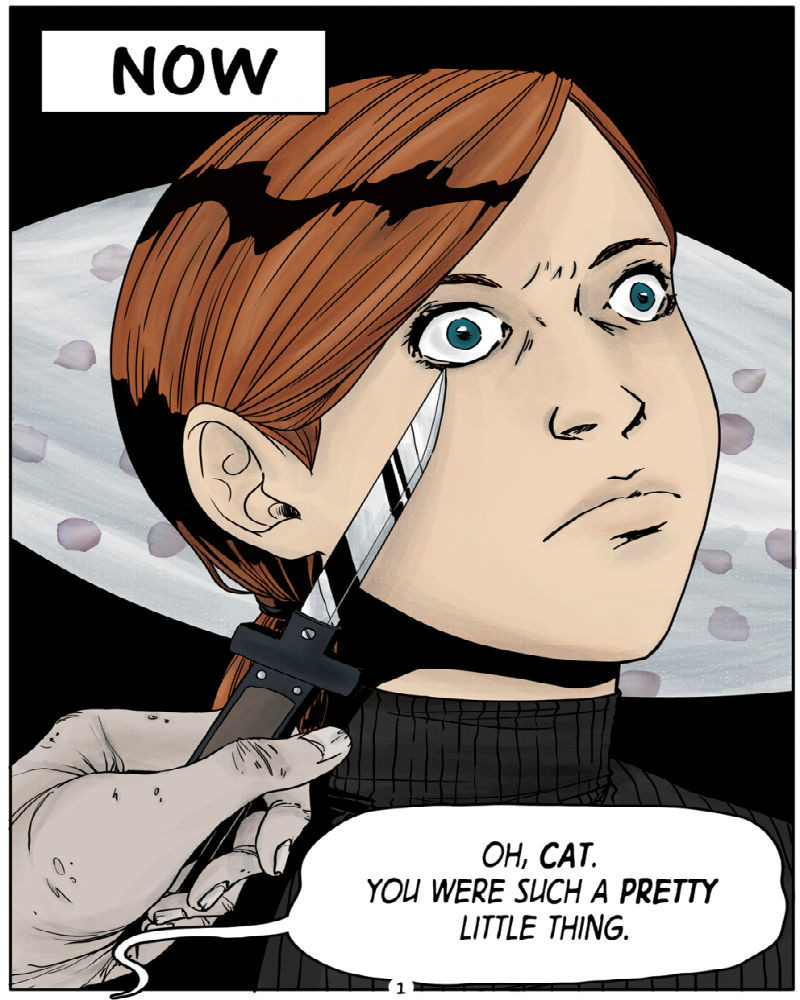
CAPTION [and these should be DISTINCT and different FONT from ‘CAT CAPTIONS’]: NOW.

Splash:

Close-up of Cat’s face. She’s frightened but frozen, not wanting to move an inch. There’s a knife-point resting against her eye, the blade held in an old man’s hand. There are traces of smoke and purple blossoms in the air.

This page is all about Cat’s expression – stiff, rigid, staring at the man holding the knife, but thinking, thinking, thinking: how did I get into this, how can I get out of it?


Voice off: Oh, CAT. You were such a PRETTY little thing.

My So-Called Secret Identity Issue  4 Part One

PAGE 2

CAPTION: 30 YEARS AGO.

Four panels, with TV-screen rounded corners

1. We are seeing black and white, grainy footage of ‘Your Lucky Day’/’La Vida es un Carnaval’ (both logos are visible in the studio set), a TV show from the 1960s starring Feliciano Bonifacio Carnival as the presenter, making kids’ dreams come true.

Carnival is around 50 years old here, slightly bizarre and eccentric but not sinister.

Perhaps a leopard-skin coat, a big cigar, trademark glasses, flamboyant hand gestures.

Carnival is sitting in an elaborate, baroque throne, with kids around him – like a strange fairytale king (could even be wearing a kind of crown) or a fantasy school-teacher. One little boy is sitting on his knee, in a ‘talking to Santa’ pose.

CARNIVAL: OK, OK. Órale, chaparritos! Who do we have here, it’s BILLY BENSON from CENTRAL CITY, isn’t that right Billy? And what do you want most in the world, BILLY?

BILLY [small voice] Run fast, like MR SWIFT.


2. CLOSER on CARNIVAL and BILLY.


CARNIVAL: OK, OK, well is that so, well between you and me, Billy, I’ve got a little SECRET, if you can KEEP it, oh-ho. Would you like to guess who’s HERE to HELP me.


BILLY: … yes.


3. Now onto the stage springs Carnival’s sidekick, a teenage boy in a ridiculous uniform reminiscent of Burt Ward as Robin, or a pantomime Peter Pan:

ward

No cape, but a tight top and little hotpants, pixie boots, predominantly red, yellow and green. His name is SONNY JIM.


SONNY JIM: I heard someone wants to run FAST, like JACK SWIFT, the FIRST OF THE FLEET?

CARNIVAL: Yes, yes, do you know who this is, BILLY and all the boys and girls here and at home?

BILLY [QUIET] Sonny Jim

KIDS: IT’S SONNY JIM!


4. All three together, looking at camera, as kids around go wild. Carnival is performing jazz hands


CARNIVAL: OK, OK, I’ve got something to tell you, Billy, this is SONNY JIM and you know what, it’s YOUR LUCKY DAY!


PAGE 3

SIX PANEL GRID

CAPTION: ONE WEEK AGO.

1. We’re in Castor’s café, from issue 2, back with Cat and Enrique. There are strong echoes of their earlier scene, in the framing and rhythm. Differences between then and now will only come across subtly. [She is in the Hanie Mohd-designed Fall sweater outfit – skirt could be longer, though]

Cat has clearly just asked Enrique something, and he is replying absolutely firmly:


ENRIQUE: NO.


2. CAT: It’s the ONLY –

ENRIQUE: No way. And YOU should forget about it too. If my BOSS sees you again, he’s going to put you in BEDLAM.


3. In the background now, behind them, we start to sense what’s different about the café this week. The front windows are half-covered in flyers and posters that we can read, backwards: they say ‘LOST’, ‘MISSING’, ‘LAST SEEN’, with text and photographs of people underneath.

CAT’s anger is now sparked: she’s not going to take this.

CAT: Your BOSS is quite literally a TOOL. And what does that make you?

ENRIQUE is silent.


4. In this frame we get a better sense of the posters, see a newspaper being read by another patron – ‘MAJOR DECLARES MARTIAL LAW’.

ENRIQUE: Anyway, you have NO chance, the way things are now, after DEMOS. The CURFEWS, the POLICE BLOCKS, you wouldn’t even be able to GET to him.


5. CAT stands up, leaving her coffee on the table. We can see the door (and the plate windows with their posters and flyers) in the background here. Enrique looks up at her, seeming helpless, slightly miserable.

CAT: Well, SOMEONE’s got to do it, Enrique. SOMEONE’S got to at least TRY.

CAT: I guess I’ll SEE you.


6. Same framing as #5. She walks briskly out of the door. Enrique stares at the table.


Cat Talks to Misper in MSCSI

In terms of fashion and design, I would say the artists add a great deal. I give a sense of what I’d like and they furnish the details. I had a great experience working with Stylist magazine, as their fashion editors actually sent me links, at my request, of current items that the characters could wear — an outfit for Dahlia, for instance, a t-shirt for Cat, various choices of shoes — and I picked my recommendations to send them to Rachael Smith, who drew that strip.

Most of the artists seem to have a very keen sense of clothes and design though, and enjoy the opportunity to provide our characters with convincing, real-world outfits, with a lot of plausible detail.


GP: Now, just for fun, what do you think would happen if a superhero like Batman or Superman found themselves in MSCSI? Or if Cat found herself in the Marvel or DC Universe?

WB: Batman would basically stomp, in the MSCSI universe. He would destroy pretty much anyone we’ve encountered so far. The Major and Urbanite are a joke compared to Batman. The Major is like Donald Trump with a cloak. He’d have private security but he’s no more threatening to Batman than the Penguin, at best. Urbanite is (as far as we’ve seen, at least) a really rich hobbyist, who can just about intimidate Cat if he swoops up on her with no warning, but really would be no match for Batman on any level. Sekhmet going up against Batman is like Solange Knowles going up against Batman.

As for Cat — I think she would intrigue him if he saw evidence of the way her mind works. I can imagine them developing a relationship something like Batman and Carrie Kelly or Harper Row — he begrudgingly learns to admire and respect her, and warns her to stay out of his dangerous business but probably tries to find a role for her — either in the ‘Batman Family’ or Batman Incorporated, depending what continuity we are in. Cat has nowhere near the strength, martial arts ability, athleticism or equipment of any of the Batgirls, so she would never work in that precise role, but she could be a kind of Oracle figure, a researcher and thinker. Maybe Batman could use an academically-trained theorist on his team. I think Cat would get along really well with Barbara in her Oracle role.

I don’t think Superman would be especially bothered by anyone in Gloria, including Cat. She’s very clever but he’s a Kryptonian and can presumably think at a speed, and on a dimension, beyond any human being. She doesn’t have the low cunning of Batman — or the wealth, or the science and technological abilities — so she wouldn’t pose that kind of risk to him; she’s not going to manufacture a Kryptonite ring. Yes, she no doubt notices things he doesn’t, and connects things in ways he doesn’t, and interprets the world in ways he doesn’t, but if we assume Superman can tap into a consciousness on the level of Dr Manhattan, I think the same rule would apply that she’s about as remarkable to him as a really clever small mammal. Granted, this is not always how Superman is written, but that’s how I personally feel Superman would operate — as a near-omniscient, near-omnipotent being who must have to scale down a lot to engage with human beings at all. Alan Moore’s Superman from the 1980s Swamp Thing series comes closest to this depiction, I think, though Morrison’s All-Star Superman also captures that benevolent, generous godliness.

However, we have seen instances (again, written by Alan Moore) where Superman and Batman face off against Swamp Thing, and it’s clear that they both have a healthy respect for plant elementals. So, given that there are characters of that nature in the MSCSI universe, they would, I think, be the only ones to present Superman or Batman with a genuine challenge.

GP: Now, here is the most important question. My So-Called Secret Identity has a Kickstarter Campaign that is going to end in about six days. In addition to funding, how else can fans support your Kickstarter and make more people aware of it? What can current and potential fans hope to expect from MSCSI? And what are some of your plans for the future?

In terms of the Kickstarter, I’d ask people simply to circulate our campaign on social media as much as they can, and also to spread the word by whatever methods they can — including just telling friends, family and colleagues. We get a lot of signal boost from generous celebrities and big-name professionals on twitter, so if our fans can put the link in front of people with a high follower count and profile, and ask for a retweet, that’s really helpful.

With about £1000 to go and one week until deadline, I do now feel we’re going to hit target; and I’m going to release details of our stretch goal very soon. But we do still have to reach that target, or MSCSI simply isn’t going to happen.

If and when we do hit the magic £8.5k, I’ll be sending the script to the art team and they’re going to start work on it immediately. We’re planning to have Issue 5 completed by September-October, and send the printed books out around November. The deluxe edition really will be very special, with full-colour art from an incredible range of guest creators, and we have a number of limited, signed prints of selected portraits and pin-ups.

In 2015, I’m hoping to develop MSCSI Volume 2, possibly as a single graphic novel of about 100-120 pages. But really, everything now depends on people pledging that final £1000.


GP: You can find Issues 1-4 of My So-Called Secret Identity, along with other goodies, on its website, but in order to see Issue #5 please support the Kickstarter Campaign. I’ve asked my questions. Now perhaps you have some of your own … along with a map to place where you can begin to have them answered.

My So-Called Secret Identity Kickstarter Promotional

Smart is a Super Power: My So-Called Secret Identity’s Kickstarter Campaign

My So-Called Secret Identity, the comic series in which a young woman named Cat takes on the terrorism and false superheroes of Gloria City with merely the power of her intelligence, ended last issue on a cliffhanger. According to Will Brooker and his co-creators Suze Shore and Sarah Zaidan, Issue #5 will be the final part of the story that completes MSCSI Volume One which we won’t be seeing online until 2015. Talk about one very long “to be continued …”

That is, of course, if you aren’t taking the Kickstarter Campaign into consideration.

It seems as though “smart” isn’t solely limited to Cat. If you back My So-Called Secret Identity, not only do you — at the bare minimum — get access to the next issue far sooner than 2015 (around October 2014), but in addition you have the potential to gain deluxe copies of Volume One, unique art work, your own name listed as a sponsor and even the signed and unreleased script for Issue #6.

Think about that: not only do you get the next issue of MSCSI in advance, but you can be listed as one of those people who aided a work that represents women in comics as three-dimensional individuals, promotes the inclusion of more diversity into the medium and, in your own way, become part of comics history. From all this, you can obviously see the minds from which Cat gets her intelligence.

I also want to make one other thing very clear. While I had criticisms with regards to some of MSCSI’s pacing, you also have to consider this. What we are looking at right here, right now, is the development of a story from its early stages all the way until the saga’s very end. As a creator in my own right, I can tell you that you can plan out everything and even follow it, but you will develop and change over time. And not only does My So-Called Secret Identity continue to have great characters, concepts and potential,  it is also my opinion that it is — and other works with strong and realistic female characters are — important.

It is very important.

And understand this. You all have a superpower. It is called being intelligent. It is called being smart.

So please: read the series as it is so far and then go My So-Called Secret Identity‘s Kickstarter and consider helping Gloria City unfold: and backing the voices of Cat and her friends.

Something Under The Bed Is Drooling As Bill Watterson Draws For Pearls Before Swine

Bill Watterson, the creator of Calvin and Hobbes, is often compared to Bigfoot: in that he is both legendary and reclusive.

But that being said, there has definitely been a “Bigfoot sighting” as of late and he has definitely left some of his prints in Stephan Pastis’ Pearls Before Swine: a syndicated comic strip running in 750 newspapers all around the world. According to Bill Watterson himself in Michael Cavna’s EXCLUSIVE: ‘Calvin and Hobbes’ creator Bill Watterson returns to the comics page — to offer a few ‘Pearls’ gems  in the Washington Post, he wanted to do a “goofy collaboration” with Pastis that could be used to help fun raise the charity Team Cul de Sac: an organization founded by Chris Sparks and the comics illustrator Richard Thompson to combat Parkinson’s disease.

The original strips with Watterson’s collaboration will be on display at HeroesCon before they get auctioned off for the Cul de Sac charity. It is fascinating to read Watterson’s perspective on the collaboration, just as it is perhaps even more intriguing to look at Pastis’ own account of how it all happened in his Blog article aptly named Ever Wished That Calvin and Hobbes Creator Bill Watterson Would Return to the Comics Page? Well, He Just Did. There is so much he says about their collaborative and creative process and yet so tantalizingly little: given Watterson’s well-known love for intense privacy.

It didn’t even seem that long ago, back in December of 2013, that Mental Floss managed to facilitate an interview with the cartoonist. In one of my earliest GEEKPR0N articles, I look at the gap of time in-between different Bill Watterson interviews. Then you also have to consider the occasional other moments Watterson briefly became public again with a painting of Cul De Sac character Petey Otterloop in 2011 and a cartoon for the documentary Stripped on February 26, 2014.

And looking at all of this, right now, and realizing that Watterson had been involved in drawing three new comic strips recently without anyone being the wiser reminds me of a conversation I had with a friend of mine about him in which we concluded that there might have been some kind of confluence, a series of events and inner workings that made Watterson realize that he might have something more to say.

But while our conversation was with regards to him actually briefly revisiting Calvin and Hobbes, it can also be applied to the rest of what he has been doing lately. If you follow Pastis you will see that a few events and needs came together to make this collaboration — and indeed this communication — happen. And indeed, it’s no secret that Bill Watterson never stopped making art, or watching the comic strip medium continue after his departure.

As for Bill Watterson’s privacy, it’s a lot like the myth of Bigfoot. He never really left.

And sometimes the best place to hide is right in plain sight.

Please tell us where you think you can find his tracks.

Why Don’t You Just Make One? My So-Called Secret Identity

“Well, if you don’t like how women are portrayed in comics, why don’t you make your own comic?”

You can substitute the subject of this knee-jerk reaction in the form of a question to other media such as film, television, or video games, but the gist of it is pretty much the same. Usually this question is “asked” in an attempt to silence critics, or to reduce their observations about pop culture into “nitpicking” or something completely non-constructive. Most critics ignore this loaded question because creative works — at least in the area of fiction — are not their focus or area of expertise.

However Dr. Will Brooker, popular culture expert and Batman scholar, decided that in addition to criticism he was going to actually answer this question: in the form of My So-Called Secret Identity.

Brooker and his fellow artistic collaborators the illustrator Suze Shore and PhD in superhero art Dr. Sarah Zaidan, realized that while it wasn’t nearly enough to criticize the portrayal of women in mainstream comics,  it would definitely be a step forward to create a comic that could represent them as three-dimensional human beings. They, along with an extensive and predominantly female creative team, are managing to accomplish this and more.

So what is My So-Called Secret Identity about? It is a comic about Cat: a student of philosophy and literature and daughter of a policeman. She is a young woman who sees and understands the links between different subjects and is sick and tired of pretending to lack the intelligence that she truly possesses: that many have underestimated or believe that she fakes.

My So-Called Secret Identity

Cat, also known as Catherine Abigail Daniels, loves her home of Gloria City and wants to do her part to save it from the terrorism of the supervillains that also dwell within it. Unfortunately, her other obstacles seem to be the self-styled “superheroes” of Gloria City: posturing and brittle celebrities not unlike those you might see in Garth Ennis’ The Boys that, along with their villainous counterparts, use the City and its citizens as “a theatre” (complete with “a backstage” metaphor reminiscent of Neil Gaiman) and props respectively in their “morality war.”

What I really like about Cat as a character are three elements. First, she is a woman that knows what and sometimes even who she wants and will pursue them with assertiveness instead of over-exaggerated aggression. Second, she will call people out on their actions and words but also be reasonable enough to forgive and recognize that same person as a human being. She is a person that cares about people and it shows. But lastly, I am very intrigued by how Brooker and his team handle her genius. Without spoiling too much of the comic, Cat seems to have a very Humanities or interdisciplinary approach to how she attempts to solve crime: linking ideas, geography, culture, history, and facts all together in the form of a “mind-map”: in a style of collage reminiscent of Dave McKean, Eddie Campbell, or even Daniel Vallely.

My So-Called Secret Identity Mind Map

It’s very psychogeographical. God, I love that word.

In a sense, Cat’s method of learning is actually through creating art: synthesizing different elements and their connections together as opposed to analyzing and taking details apart. It is, in my opinion, simply beautiful. Unfortunately, you can also see why other people — especially her teachers and bosses throughout her life — underestimate her or simply do not recognize her genius for what it is. It is frustrating to watch and understand that this stigma against her is not merely because of her unorthodox thinking: but there are unspoken gender expectations she keeps breaking because she is smart and female.

My So-Called Secret Identity Cat's Life

But Cat doesn’t let the expectations of others stop her. At this stage in her life she is determined to live her life and keep Gloria City safe: even if it means becoming an actor in the theatre of villains and heroes and especially, I suspect, when she ignores, subverts, and outright discards their rules by her very nature. I myself suspect that Cat’s story isn’t about the chic of “a secret identity” or playing the hero, but rather doing the right thing and being accepted for who she is and what she can do. Cat is not a secret. She just is, and she should be.

According to its Facebook Page, not only will My So-Called Secret Identity have a June 16th Kickstarter Campaign, the fourth issue of My So-Called Secret Identity Volume One will be coming out Sunday June 8, 2014. You can also buy hard-copies of the issues so far or read them online. So please, Like this comic on Facebook and read it. I look forward to seeing where Cat, and Gloria City’s story, goes.

David S. Goyer’s All About The Green PR0N: Starring She-Hulk

David S. Goyer seems to have an idea for a comics character reboot. And it begins with that most fundamental of tenets: going back to the basics of the character.

The very basics.

In recent a Podcast of Scriptnotes, presented and recorded before a live audience, the film director, comic book writer, screenwriter and self-professed “comic book fanatic” was given a spontaneous reboot pitch challenge by screenwriters and podcast hosts Jon August and Craig Mazin. He was not the only screenwriter presented with the reboot challenge. Andrea Berloff, Christopher Markus and Stephen McFeely, who were also part of Scriptnotes’ aptly named “The Summer Superhero Spectacular” panel also had to choose superheroes at random to make an imagined pitch and appeal to an eager audience.

Yet while they had to settle for poking fun at amplifying and ridiculing the angst of Spiderman (an oldy, but a goody), selling others on the merits of the Incontinent Hulk, keeping Ororo Munroe–or Storm– in Africa and limiting her elemental powers to an uncontrollable “Carrie-level” of temper-tantrum, and sowing some creative confusion as to whether or not Wonder Woman really should protect her ancient Greek roots in the Southern American Amazonian rainforest, Goyer took his innovation a step further.

He got the Marvel superhero Jennifer Walters–She-Hulk–to reboot. Goyer didn’t waste any time. Faster than a speeding bullet of Kryptonite, Goyer cut to the heart of the matter. He ignored all the superfluous details of continuity added to the character throughout the years: her painfully obvious intellect, the fact that she was a lawyer for Heroes for Hire and the Superhuman Law division of the New York law firm of Goodman, Lieber, Kurtzberg, & Holliway, her tendency to break the fourth wall in order to let the reader know that she was a character in a comic book, and the fact that her transformation through a Gamma-irradiated blood transfusion from her cousin Bruce Banner brought out her own natural assertiveness and self-confidence with an integrated personality instead of a propensity towards anger and destruction.

She-Hulk Lawyer

No, instead Goyer came right to the point of origin. He explained in some detail that She-Hulk is a female shadow of the Incredible Hulk–you know, the pre-reboot one that still has control over his basic bodily functions–who captures all the sexy musculature of the Hulk without challenging the sexuality of pre-pubescent boys. As Goyer himself put it, She-Hulk is “a giant green porn star.”

But that is just the starting point and she is much more complicated than that. Goyer goes on to explain to the audience that if all pre-pubescent boys identify with the Hulk’s strength and muscles, then the idealized, or fetishized She-Hulk is the woman “that only the Hulk could fuck.” If you are not the Hulk, however, you can’t fuck her and she will break you. You know, ignoring the fact that She-Hulk had lovers that were both superhuman and ordinary men she had varying degrees of affection for–who were not at least physically broken–this statement would be absolutely true. And after all,  fanboys would surely know that in order to have any real chance with She-Hulk, they’d have to relate to her, I mean literally to be related to her.

You know, like Bruce Banner: Jennifer’s cousin, the one who gave her that life-saving Gamma-radiated blood transfusion, and the very person who actually is the Incredible Hulk.

However, Goyer seemed to have a rather ingenious solution to this conundrum. It came after Martian Manhunter was chosen. After Goyer made sure to ask if anyone in the audience knew who the superhero was and then took some extra time to voice his concerns in asking  “How many people that raised their hands have ever been laid?” he proceeded to afford Martian Manhunter some of the same courtesies that he had gifted the character of She-Hulk.

He went right to the root of the issue: putting aside the fact that J’onn J’onzz had a whole life and family on his home world before becoming  a survivor of his entire race’s genocide, that he adopted his identity and even the idea of being a Martian through being exposed to Ray Bradbury’s stories, to shapeshifting into a human just so that he could help others and no longer feel lonely, and was a founding member of the Justice Society of America (the Justice League’s predecessor) in order to critique the Martian part of his superhero identity and his “overpowered nature” in spite of his inherent weakness to fire.

Martian Manhunter

Goyer’s reboot treatment solution was therefore two-fold. He decided to make Manhunter, as he’d like to call him, something angry and green grown out of a petri dish (perhaps with some influences from the aforementioned Hulk and Swamp Thing) with the sole purpose of, get this:

“Fucking She-Hulk.”

That’s right ladies, gentlemen and other beings throughout the universes. Apparently with his ongoing work on Batman Vs. Superman: Dawn of Justice weighing heavily on his mind, Goyer decided to kill two birds with one stone because, after all, what is a combination reboot and crossover other than an excuse for pornography?

But now let me talk about something a lot less serious than David S. Goyer’s ad hoc collaborations with the panel on Scriptnotes. I’m not a screenwriter or even a comics writer, so consider this an uneducated opinion. I do think that while it’s almost excusable for a panel of writers presumably involved in the Hollywood industry to generally not know what they’re talking about outside their own medium of film–save for the asinine manner in which they are making fun the fandom around the comics medium they clearly do not understand–I do think there is something very unprofessional in a comics writer and script writer of comics-based movies denigrating not just two franchises (including one that he’s already in the process of working with), but the people who love them.

Then again, I could be wrong. I mean I’m also not a woman so perhaps I might be wrong in thinking there is something terribly wrong with making fun of a powerful female character who might have started out from sexist origins but has attained some sense of self-agency with her love life and career, but hey: I’m not a woman. I’m also not a pre-pubescent fanboy. Or green for that matter. Not that there’s anything wrong with that, right?

I mean, I only have a few modest ideas of my own. After all, a screenplay where Jennifer Walters is shot, only to be saved by her cousin, having to struggle with her personal life, adjust to her powers, her apprehensions, and her newfound nature that’s really always been inside of her while the news media calls her She-Hulk does seem pretty amateurish. It’s just like my idea of J’onn having his own movie where he has to deal with the loss of his people and, perhaps as Goyer suggests, he is reconstructed in a military laboratory from basic building blocks of life, becomes a detective later after his escape and gets a partner that calls him the Martian Manhunter because of his zeal and his love for reading Bradbury fiction. He is, however, afraid of Fahrenheit 451 because if there’s anything that the Martian Manhunter knows, it’s definitely not a pleasure to burn.

But no. I’m probably wrong. Green crossover porn would be so much more interesting. Did I mention that I’m looking very much forward to Goyer’s work in Batman Vs. Superman: Dawn of Justice? And The Sandman movie?

For some more interesting insights into the Scriptnotes Podcast, please read Alan Kistler’s article on the matter in the Mary Sue. And if you’d like more information on She-Hulk, you might also appreciate Kistler’s Mary Sue article Agent of S.T.Y.L.E. – Gamma Ray Glamor With She-Hulk: Part 1!

And please listen to the original Scriptnotes Podcast Episode 144: The Summer Superhero Spectacular. 28: 14 on the track is where the rebooting fun begins.

The Wizarding World That Lives: Fantastic Beasts And Where To Find Them

It seems that after 2011 and the end of the second part of Harry Potter And The Deathly Hallows, we will get to look forward to the return of cold, darkness, winter, and the warmth of the Potterverse coming once again to the theatres near us.

Since September of 2013, it’s already been established that the Fantastic Beasts And Where To Find Them trilogy, based on J.K. Rowling’s supplementary in-universe book, will take place in the 1920s and focus on the ventures of Newton Scamander: the famous Magizoologist that examines and explores the nature of magical creatures and eventually creates his book: which is standard text-book reading in Hogwarts and the Potterverse.

I have to admit that I didn’t really expect a film like this to be made.  As I mentioned earlier, Fantastic Beasts And Where To Find Them is a lore compendium created by Rowling to expand on her universe beyond the main Harry Potter narrative. It was created for the Comic Relief Charity back in 2001. I’d seen the book around, but I didn’t focus on it in particular and I never dreamed that J.K. Rowling would write a screenplay from it. Nevertheless, there are a lot of possibilities here. Fantastic Beasts itself illustrates the fact that the universe created around Harry Potter can be considered a fully realized and complex place in and of itself without its protagonist.

Rowling herself has said that this story is neither a prequel nor a sequel to Harry Potter. Even so, it’s interesting to look at the timeline of this book in the Wizarding world. In the 1920s Dumbledore was still a young man and hadn’t had his epic duel with Grindelwald yet. And Voldemort himself wouldn’t be born until 1926. As a result of these mainstays being either too young or non-existent yet, there is a lot of ground that can be explored here.

And look at Scamander himself. Not only is a wizard that specializes in magical creatures, but when he attended Hogwarts he was actually part of House Hufflepuff. Think about that for a few moments. For those of us that have read the books and seen the films, we have seen some very notable members of Houses Gryffindor, Slytherin and even Ravenclaw. But the Hufflepuffs, at least in my opinion, have always been given the short end of the wand, as it were: even though they are known for hard work, honesty, and loyalty.

For some reason, I keep thinking to myself that a great majority of wizards and witches in Rowling’s Wizard world have come from Hufflepuff (at least in Britain) and while the Gryffindors act courageously, the Slytherins plot, and the Ravenclaws study and innovate the Hufflepuffs keep everything running. The best geeky analogy I can think of is that while the other groups are like the Jedi Knights, Hufflepuffs are the original clone troopers and commandos: the rank and file of the Wizarding world that get the job done and thoroughly so. So to see a character from that House as what seems to be the protagonist of this trilogy will definitely be something for which to look forward.

I think, in the end, Rowling’s decision to expand on this book into a new film trilogy also hits something home: namely, it is more of a misnomer to call her universe the Potterverse than it would be to consider it her own Wizarding World. It is definitely a place where you can tell a lot more stories. I, for one, would definitely not mind seeing some Rowling Wizarding World films based off of the dark witch and wizard fairy stories within The Tales of Beedle The Bard. In some ways, I liked those stories even more than her entire Harry Potter story arc.

Fantastic Beasts And Where To Find Them will have its release date on November 18, 2016.

Vuckovic and Headey Explore Jacqueline Ess: Her Will And Testament

Clive Barker’s short story “Jacqueline Ess: Her Will And Testament” is not only being adapted into a horror film by the Canadian and Torontonian film director Jovanka Vuckovic, but Lena Headey will be playing the role of Jacqueline Ess.

While until this announcement I was unfamiliar with Jovanka Vuckovic or her work, and I only know of Headey through her roles in Game of Thrones and 300 as Queens Cersei and Gorgo respectively, I have read “Jacqueline Ess” and it is a fascinating story. Beware my friends, if you intend to read this story there will be spoilers.

Books of Blood

“Jacqueline Ess” is a story found in Clive Barker’s Books of Blood. It is about a woman by the same name who, after being neglected and passive-aggressively abused by her cheating husband and being dissatisfied with her overall life, attempts to kill herself only to be brought back from death with–for lack of a better word–some strange, flesh-crafting abilities. Think of it as telekinesis that can only affect human flesh and organs. Now imagine all that rage and pain that she has suppressed her whole life in being the good wife or woman and patronizingly being told what how she feels by men.

But the story is so much more than simple revenge. It subverts stereotypes. It changes Ess from a victim to an accidental instigator of manslaughter, to a murderer, and into someone who examines the very nature of power. Her sexuality, which was used by men, becomes her most overt weapon. However, again, she is not simply a monster or a villain, or a Carrie that lets her repressed emotions completely rule her powers. She is an intelligent woman that not only wonders about this power and what it means, having gained it by temporarily piercing the veil beyond death, but she also truly examines what the meaning of life is in light–and despite of–the discovery of her powers.

The very weapon that is her power, that is her sexuality, that is her body, becomes a weapon that ultimately turns on her. What this might say about social perspectives with regards to female gender and sexuality is a whole other subject entirely that will hopefully be explored in further depth, but I will say that the story manages to move this power from the place of the stereotype into the dark, red realm of the archetypal: of that primal place where life comes from, where it is changed, in that plane suspended between sex and death and, when you get right down to it, even a sense of enlightenment and acceptance.

Clive Barker has an interesting sense of horror: at least in his earlier stories such as those found in The Books of Blood. For him, horror is not only your fear of the unknown, but your secret desire for it and that place where your anxiety is forced to meet your sense of anticipation in the language of the flesh.

Lena Heady

I suppose you can tell that I really took a lot away from this story. Certainly, I can see Lena Headey making an excellent Jacqueline. Not only does Headey have a sense of portraying women of power in Game of Thrones and 300–characters that exist in traditionally male-dominated spaces–but particularly in the first Season of Game of Thrones to me she actually portrays a more sympathetic version of Cersei Lannister: someone who has power, and knows she has power as a woman in a traditional role, but who was never trained to understand it to its fullest extent or to protect those that she loves.

Headey’s Cersei understands just how subjugated and micro-managed women in Westeros truly are and even in Season Four you can see just how powerless and vulnerable she can be when her father takes her son from her. To me, it’s almost as though Headey’s Jacqueline may well be a parallel to the character of Cersei: both start out with affluence but are limited by the men and patriarchal structure of their lives, but while Cersei stays with the trappings of power and never seems to explore their origins, hopefully Jacqueline will portray her vulnerability and continue to explore her more literal and supernatural power and its nuances on the environment around her.

As I said before, I didn’t even know who Jovanka Vuckovic was before news about her film came out. However, if she can explore the details of Jacqueline’s evolution and its effects on the men and society around her, while keeping in mind Barker’s own horror genre sensibilities we will definitely see an interesting multifaceted blood-soaked gem of a strong female character and what she says about our own world: as a master of the horror genre, the sub-genre of body horror, and the medium of film tends to do.

Given the fact that Jovanka Vuckovic was an Editor-In-Chief for Rue Morgue magazine, author of Zombies! An Illustrated History of the Undead, founder of She Wolf Films, studied physical anthropology, and the fact that she made The Captured Bird, a horror-fantasy short film about a young girl that discovers a black-inky evil underlying her world only adds to the fact that I very much look forward to seeing what she does with this film. I know that many of her friends in the Toronto geek community–including some here at GEEKPR0N–wish her and her endeavours well.

Star Wars: The Canon Unleashed

We at GEEKPR0N would like to inform you that we have some good news and some bad news.

Before we do so, however, our beloved GEEKB0T has brought us the following statement issued from a galaxy far, far away:

“In order to ensure the security and continuing stability the Star Wars galaxy will be re-organized, into a whole new canon, for a safe and secure continuity!”

This will be a work in progress.

All right. Now that the dramatic John Williams’ level music and cheering is over, allow us to tell you the bad news. Chances are, you already know what it means. It means that everything that isn’t the six current films and the cartoon series — from books, to comics, to video games, and other multimedia — is all non-canon.

This isn’t particularly surprising, unfortunately. It has been made clear throughout the years by Lucasfilm that the Expanded Universe beyond the films, The Clone Wars cartoon (and the soon-to-be Rebels) would always come second to the original source material. And then you also need to take into consideration that much of the EU has been pretty contradictory. For example I’m sure there are some fans that won’t miss the Emperor returning in clone bodies and converting Luke to the dark side in the comic series Dark Empire, the superweapon of the month club spectacles of Kevin J. Anderson’s Jedi Academy Trilogy or Leia accepting an arranged marriage in The Courtship of Princess Leia, or Chewbacca being killed by a moon in Vector Prime.

And there will be fans that will totally miss this.

There will also be fans that miss the adventures of Kyle Katarn, a whole other Jedi aside from Luke, fighting to discover what he is in the Dark Forces series, or the odyssey of Revan and friends in The Knights of the Old Republic, or looking at the origins of the Jedi Order itself in the Tales of the Jedi comics series and Dawn of The Jedi. There are the X-Wing and Wraith Squadron series with wise-cracking Rebel and New Republic pilots that will also become non-canon and a truly excellent series called Republic Commando written by Karen Traviss which truly fleshes out the Grand Army of the Republic’s clone troopers as actual characters and human beings in a wartime situation and the moral ambiguity of them being essentially slave-soldiers.

Palpatine’s origins in Darth Plagueis will be shrouded in mystery and half-truths again, Darth Vader will never have a secret apprentice such as Starkiller from The Force Unleashed and even the future of the Galaxy with regards to Cade Skywalker and the Imperial Knights in the Legacy comics is now called into question. All of these stories and adventures will be given the designation Legends and, perhaps, Lucasfilm will utilize some of these Legends’ characters and elements in their own way.

I know for myself that it will be hard, in a lot of ways, to watch the next three films, the spin-offs, and read the new books without thinking about some of the old. It would have been nice if Lucasfilm had gone through its Great Holocron and found some of the characters and stories that worked. It would have been even better if they had asked their fans to vote on what they wanted included into the canon. Of course, that last idea would have been problematic at best as we, as fans, all have “a certain point of view.”

But now GEEKB0T has ordered me to tell you the good news. The good news is that with the Expanded Universe eaten by the World Devastators, these figurative superweapons that technically no longer exist will be creating new stories and content that not even the best Force Adepts among us can farsee. And as I said, perhaps we might see some of these “Legends” manifest again. Perhaps Grand Admiral Thrawn still had campaigns during the thirty years between Return of The Jedi and the new films. Or maybe a certain red-headed Imperial assassin named Mara Jade encountered the last of the Jedi and helped train the first of the new.

One can only hope. But, as I have been further instructed by GEEKB0T, if this news does not cheer you then perhaps this new video made by the Nerdist, Revenge of the Threesome, will.

And with those vintage 1980s action figures to soothe you, we at GEEKPR0N wish the Force to be with you. Always.

Oh, one last thing…

GEEKPR0N’s Star Wars themed anniversary party is tomorrow night!  Tickets are on sale now and are also available at the door, however if you buy your ticket in advance you’ll be entered to win a BRAND NEW PS4!!!

party

Today is the last day to buy advance tickets!  Get yours today!!

A World of Darkness Closes Its Eyes

During the period of 1991 to 2004, the White Wolf Gaming Studio created The World of Darkness.

It was a dark urban fantasy, or cyberpunk near-future version of the modern world, in the form of a table-top role-playing game. In this world you could play as a vampire struggling with your inhumanity, a mage discovering the esoteric patterns underlying reality, a werewolf fighting to regain environmental equilibrium, a fae being navigating strange and treacherous faerie courts and urban decay, or a wraith exploring the realms of the afterlife. And these are only a few prominent examples of what to expect in the World of Darkness: a role-playing game created for mature players with disturbing and, conversely, intelligent and philosophical themes.

Now imagine all of this made into a massively multiplayer online role-playing game.

It’s not too much of a stretch to consider. Crowd Control Productions Games (or CCP Games), along with White Wolf, were planning to take Vampire: The Masquerade and use its emphasis on in-character or player politics to create an interesting dynamic with the rest of the dark world as a backdrop. Essentially, you as the player would know what it would be like to be an individual vampire attempting to interact with and understand undead existence amid the mortal world. It very much sounded like a multi-player expansion of the Vampire The Masquerade: Bloodlines game.

Unfortunately, CCP has been forced to cancel this project that had been in the making since 2006 and CCP Atlanta is currently in a process of staff layoffs and internal reassignments within the company. So the World of Darkness seems to have been foiled in its attempt to spread throughout the Internet. Perhaps that is just as well. MMORPGs tend to lose cohesive story development and meaning, becoming a repetitive item-drop and annual enemy killing cycle over time. Of course, I could definitely be wrong and I admit that perhaps there were different rule mechanics in this game project that might have been different from generic MMORPG game-play.

Who knows: they might have even expanded on it and added other denizens from the World of Darkness as well in a very cohesive and well-rounded manner.

I suppose we will never really know for sure now. Above is some of the first in-game footage. Tell us what you think.