Impossible Horror: Screamers

Dedicated to Justin Decloux and Nate Wilson’s horror film Impossible Horror.

The Scream calls to me.

I’ve spent my entire life, what was left of it, trying to figure out what the Scream was. I wasn’t the only one. There was a team in Toronto, Ontario of sorts. Each one of the hunters, as they called themselves, planned to define the Scream on their terms, or use it to gain achievement in their respective fields. They were varied: a mathematician, a writer, even a cook … among others. The latest hunter was a thwarted short horror filmmaker … well, at least until the end.

What they didn’t realize, any of them, about the Scream until it was relatively too late, is the truth behind it.

I’ve jump-cut a few years into the past, when I still live on residence. I’m just an Undergrad, a freshman now. I study Humanities. My previous self can’t see me. The sweat shirt and hoodie really do wonders. I fancied myself something of a philosopher, back then, with a tangential love for the movies. Even now, I’m not really a film buff: but I’ve learned some of the conventions. I can see how frustrated I used to be: how cramped, and scared of the world I was in my tiny little apartment. It’s just building inside of me, and I don’t even see it. I don’t want to see it. I pass myself a scrap piece of paper, from the shadows, on my old desk when I’m not looking. It tells me to read Clive Barker’s Books of Blood. Only the first volume. I’ll think that I wrote this to myself, and forgot about it.

Then I jump-cut again.

Right. The Scream. The Scream is a primal force. Perhaps even a primordial one. I suspect it’s been here ever since we, humanity, have been in this reality. It is visceral, but so innate that it can’t really be heard so much as felt through different media, different lenses of truth, and understanding. It roars at us, at some of us in particular, through the static of our flat, blank, little lives.

One moment. I just remembered something.

I jump-cut. It’s the end of high school. My friends have moved onto other universities and their careers. Some will start their families. I’m alone. Left behind. I’m drifting around already. My relationship just ended a few days ago, at this time. It won’t take me long to time this right. I’ve read enough poetry to realize that everything has a pulse and a rhythm. A beat.

Yes. At the library that gets closed down in a few more years, I pull out a book from the shelf. Before I learn that what you fear is what you ultimately desire, I have yet to understand that the oldest fear of all is the fear of the unknown. I leave a book of H.P. Lovecraft’s stories to slip out right in front of me, the name already tangentially in my mind,leaving it to ferment there, before letting me and my hooded sweatshirt blend right back into the shadows …

They wanted to stop the Scream. The Scream itself is more powerful than a ghost. Ghosts that just echoes of thoughts, and scattered impulses without grounding. Sometimes they can affect a place, but they only have scraps of the Scream: of the ancient, instinctual urge. But even they, these faint resonances, have to possess some kind of link, or connection to people … and it becomes too much of an effort.

I walk on one side of my friends. Then another. We are friends. We are strangers. Flickering back and forth, I explore the city and it is hard to keep track of where I am, or where I even was.

“Lovely weather, we are having.” I say. In. A. Stilted. Voice. More. Separate. Words. Than. Sentences. “I. Was. The. Person.” I tell someone else, who I grow … grew … will grow close to for a time. “Who talked to you about non-Euclidean geometry.”

That is the moment. The seed from high school grows, watered by the blood of Clive Barker, but I don’t know that part yet, blooms into different micro-filaments more intricate that the film reels the wraiths pull out of the filmmaker’s guts and I follow them through the city.

I stand still as the city grows. Sim City. Civilization. Italo Calvino. Neil Gaiman. The Invisibles. The city is built by the dead built by the living by the dead as it swallows my family, my family doctor, my dentist, my friends, my lovers, my past my future my possibilities the things that happened the things that didn’t my self my life … The City is the Book and the Book is the hungry, beautiful Night that keeps on consuming …

The burning in my gullet from freshman university, from after high school, grows.

At first, I only jump-cut around the people I knew. Day and night became the same to me. I was just there. I realize that I have always just been here.

But isn’t the city. The city isn’t blood and mortar and bones and bad modernist poetry. Non-Euclidean geometry is the architecture of reality, of a gullet, of a constricted throat … and I am about to … about to …

I watch. I’m a student. A scholar. I trace things back to the source. As far as I can go. I’m tired of these clipped sentences that should really be separate words surrounding a larger idea. I know how this supposed to end. I know how it needs to continue.

I stop hunting the Scream that keeps me up at night. That keeps me from sleeping. I don’t go as far as the mathematician that scars himself with arcane symbolic logic and cocoons himself in a girl’s worst nightmares, trying to choke the blackness back, swollen and infected. I watch what it does. I observe. I research.

Writing out my findings, in my blood, makes the jump cut faster. But I’m getting numb. And that’s when I realize it. I realize it faster than the video gamer, and it figures that the video game would be the only survivor — the only hunter left — so far due to her staccato rhythm, but slow enough for the idea to reach its natural pitch.

I’ve grown distant enough that the words in my skin don’t hurt anymore, but it’s harder to hear the words: the ones that matter. Blood grounds the Scream. It feeds it.

It makes it real.

I stop to kill a person. It doesn’t take long. It happened a thousand years ago.

I keep going. Maybe it’s someone different. Or perhaps it’s the same person, over and again. It might even be me. The loneliness inside of me, the last emotion left, keens. It wails. I’m sure it creates its own echoes, scraps of paper through the city. The video gamer rips up the Book, the source, she thinks, and I feel the roar inside me multiplying, no longer carried along by the filmmaker … I thought I needed the Book. But I didn’t. We don’t.

We don’t hunt the Scream, you and I. We take it. We embrace it. And then, like life, we let it go. I remember who I am. I’m a student. A teacher. A teacher wants to spread their knowledge, to disseminate it throughout the world, and into willing minds. I can hear it so clearly now. The Book could make it so easy to jump-cut, but it’s gone. Even so, isn’t that what I’ve been doing? Writing a pastiche? Taking Lovecraft and Barker and piecing it altogether like a ransom note in a family album organized like a jigsaw puzzle of flesh and nightmares like William S. Burroughs?

That is all right. I hear us now. Congratulations, gamer. We are released. Banshees. Scream Queens. Screamers. We feed the Scream with the blood of others. I take a deep breath. The new Book can wait. Instead of swallowing the dark tide, I rip apart the two-dimensional paper of it all, the fake gestures, the empty lives … I follow the tide of the seeds released from the pieces of the Book. Scraps of paper flying scattered throughout space and time. I take off my hoodie. I don’t need it anymore. I throw back my head into the growing Night.

And I Scream.

It’s Always Halloween At Five Nights At Freddy’s

“And under this carnival disguise the heart of an old youngster who is still waiting to give his all. But how to be recognized under this mask? This is what they call a fine career.”
— Jean Anouilh, The Waltz of the Toreadors

Freddy Fazbear

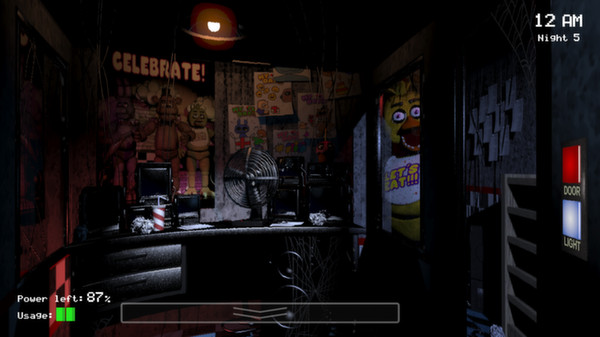
My first disclaimer, right off the bat, is that I haven’t played any of Scott Cawthon’s Five Nights at Freddy’s games. However I have been following them and, specifically, the overall story line.

The reason that the story behind Five Nights intrigues me so much is due to my own particular interests. Some of you who have been following Mythic Bios for a while know that I am absolutely fascinated with a special kind of creepypasta. You know the one: a short story told through different forms of media that become viral memes which proliferate through the Internet and user imaginations in the most strange and disturbingly wonderful ways. At the same time, I am a very nostalgic child of the 1980s and 1990s: especially when it comes to 8-bit and 16-bit video games.

In addition to all of this, for a while now I’ve been following the work of Kris Straub: the creator of Ichor Falls, Broodhollow, and the infamous Candle Cove. And, frankly, if I didn’t know any better I would say that in a lot of ways Scott Cawthon’s Five Nights at Freddy’s feels like stories that Kris Straub would create if he were working in the medium of video games and playing with late twentieth century children’s nostalgia and urban legends eroded by adult decay and a wickedly self-aware sense of humour. At the very least, it taps into a similar place of childhood nightmare fuel from which Straub’s horror work and Christopher Howard Wolf’s (SlimeBeast)’s Abandoned by Disney series also spring.

FNAF Gameplay

As it is, Cawthon takes a multimedia approach to his interactive storytelling. For the most part, each Five Nights game is a point-and-click endoskeleton requiring exacting precision tempered by a slow-burning sense of paranoia and and an ever increasing level of danger: all an attempt to survive long enough before faulty spring-traps snap down in a jump-scare that will leave your peace of mind — in pieces — for at least a night or two.

But then there is the rest of the game’s material — its costume — to consider. There are, after all,  the masks that you’re forced to wear, and those that stare at you right in the face before the long dark.

You have the newspaper clippings on the corners of your office. There are the children’s drawings on the walls of the pizzeria which you have to watch through faulty security cameras. You have an answering machine from your supervisor telling you about the dangers of walking animatronics in the night, and then more ominous references such as “The Bite of ’87.”

Then we get into the second disclaimer of this article: namely spoilers. You play this game from a second-person perspective: working six hours at night a week in a pizzeria to keep an eye on the place, but aside from seeing your character’s name on a pay cheque — should you survive to the end of at least two games — you never see your face. In fact, you don’t see any human faces in any of the three games. The only faces you get to see are those of the animatronics, the walking large, cuddly, worn, and mouldering robotic children’s mascots at night as they try to stuff your sad naked flesh “endoskeleton” into an empty suit full of pistons and wires.

FNAF Gameover

Even your supposed ally, Phone Guy, is just a voice on an answering machine: and the person who is responsible for all of this is a loathsome 8-bit purple sprite.

And here is where I think Cawthon’s genius truly shines. In the second and third games of the series, Cawthon institutes a platform game element. These mini-games are often considered reminiscent of those created for the 8-bit Atari 2600. You would totally think that with their blocky graphics and crude sound effects couldn’t be taken seriously. Of course, even if you somehow disregarded the resurgence and adoption of the 8-bit aesthetic by contemporary independent game designers, you would still be dead wrong.

FNAF Death Mini-Game 2

Between the “Death Mini-Games” of Five Nights 2 and the hidden mini-games akin to easter-eggs in Five Nights 3 — morbidly reminiscent of Warren Robinett’s Adventure and the Pac-Man level 256 perfect score glitch respectively — the mythos of Five Nights becomes more fleshed out.

While the animatronics in the point-and-click parts of the games come from a grim place where neoteny — child-like traits often incorporated into exaggerated cartoons — is combined with the uncanny valley — the notion of discomfort caused by an object that unsuccessfully tries to imitate a living being are terrifying because of how realistic they are made to look, they are creepy in a different way when rendered into pixel form. They are like 8-bit hieroglyphics, allowing you to explore the horror with a detached and almost dream-like manner. There is just something incredibly archetypal and gloomy about the graphics of the games that brings out its dark subject matter: especially when you consider that they are traditionally from a child’s medium of entertainment.

FNAF Death Mini-Game

The Death Mini-Games of Five Nights 2 introduce you to the Purple Man and his role in what might be wrong with the animatronics that are attempting to kill you while, at the same time, giving you a little more background into the development of Freddy’s pizzeria and the animatronic characters therein. And in Five Nights 3, instead of having to die in order to gain random access to mini-games, you can voluntarily search for the other mini-games to perhaps change the fate of certain characters in question.

FNAF Game

I think there are two elements that I truly appreciate from the combination of mini-games, newspaper articles, and answering machine information. First, there is what Cawthon is not telling you. There is what he implies and what he leads you, as the player and viewer, to put together. Cawthon even goes further in the advertisements for his games: implanting secret codes and clues into his messages. He makes you do all the work and all of the speculating: somehow making the dread and horror that much worse.

After all, there is a particularly challenge in another form containing the horror genre: how can you keep building up tension in the story when you reveal what the monsters look like? In addition, you certainly don’t want to reveal everything about the horror in the story or it becomes expository and rote. You have to keep a little bit of mystery in horror so that you always ask yourself why: while a part of you is always at least partially afraid of the possible answers.

These are the kinds of elements that inspire fans: that made this series into something of a viral meme on par with creepypastas. There are fan-made stories, games, animations, art, and trailers based on the archetypes that Cawthon creates. A Five Nights at Freddy’s movie is in the works and there is even speculation that Freddy’s is a real restaurant somewhere: probably based off Chuck E. Cheese’s. Certainly the mascot costumes, pizza, and arcade games taps into a resonance in me as a child of the eighties and nineties: a nostalgic feeling that Cawthon is trying to invoke and distort.

The fact of the matter is that, for the most part, the three Five Nights at Freddy’s that exist right now can stand by themselves. There didn’t need to be another game after these. However, I had my suspicions. Perhaps it was because of the empty product page he kept for some time with the discarded top hat. Maybe it was his silence about whether or not there was going to be another game.

But sure enough, come October 31, the fourth and final Five Nights at Freddy’s will arrive. And if you look at the graphic on Cawthon’s page, it is extremely appropriate if you think about it. I think it actually sums up a lot of the second element that has been on my mind, in some form, when I think about this game.

FNAF 4

I mean, of course it makes sense for the last chapter of a horror survival game to come out on Halloween, but here’s what gets to me. Imagine Freddy’s Pizzeria is like Chuck E. Cheese’s or even Disney World or Land. Certainly, a place for children would celebrate Halloween in some fashion: or at least take advantage of it commercially. Maybe “The Bite of ’87” might not come into it as many fans are speculating, but imagine how freaky it would be to be in a haunted children’s restaurant on Halloween of all days: perhaps even during the day this time around. Perhaps there are actual Nightmare toy versions or animatronics for such a lovely occasion.

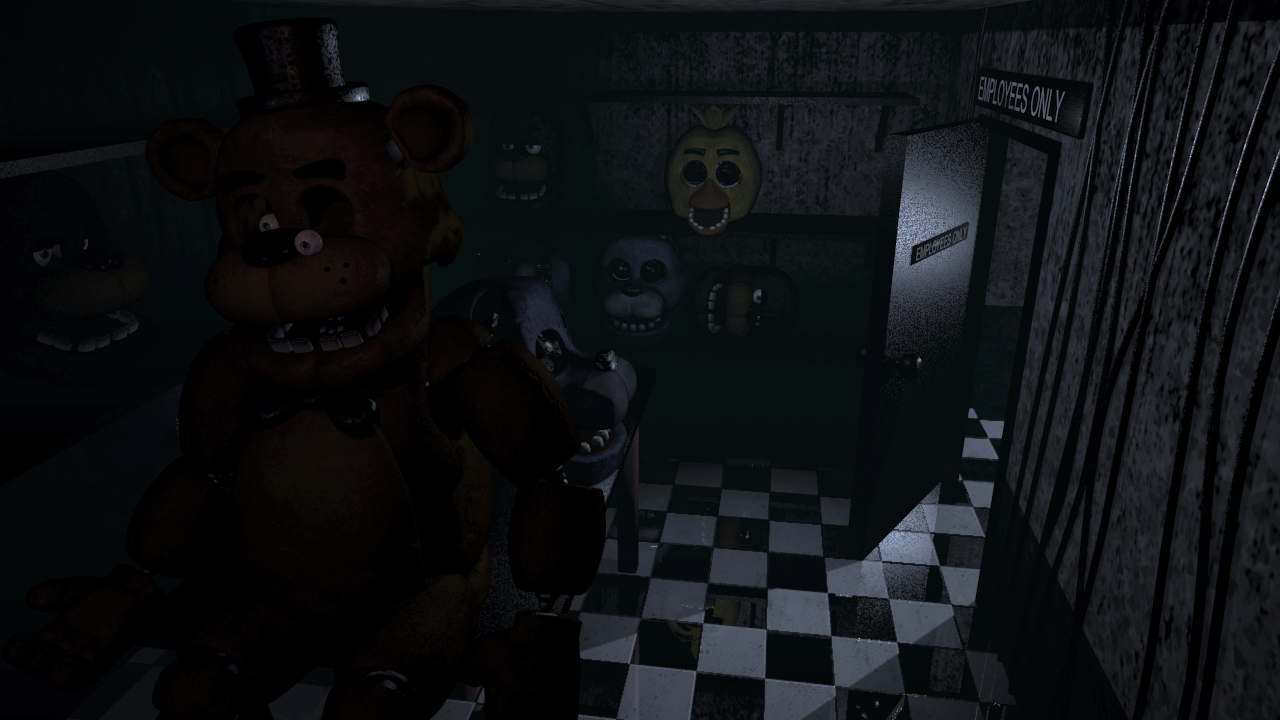
But all speculation on my part aside, take this a step further. Remember what I said earlier about faces? How you never see any human faces in any of the Five Nights games? There are always costumes involved. There are always roles to consider. You arguably wear a uniform as a security guard. A murderer might have worn a animatronic suit. In Five Nights 2 you have to hide your face under a Freddy Fazbear Head in order to survive an animatronic intrusion. And children might be hiding — or hidden — in other inside the darnedest places. Even Phone Guy, the former security guard who showed you the ropes of your new job and was your only ally for the most part, tells you that he is curious to see what is inside those animatronic suits.

Freddy Fazbear Mask

The fact is: it’s always Halloween at Freddy’s, and I suspect that it’s always been. No one is as they seem, everyone wears masks, no one rests, and everyone wants to play. Sometimes nostalgia is an illusion of the fabled “good old days” that can, when stripped away, becomes a dark, ravenous thing in the late hours of the night. Sometimes you lose track of time when you so desperately want to keep living, and you don’t always want to see what’s under that costume. After all, some seemingly innocent dreams are, at their core, rotting nightmares.

And just when you think its safe to take that mask off, to forget the night time, to mistake the performer taking off his top hat with a flourish and a bow as the end: the story only continues at an elegant pace … and the suspense will kill you.

Freddy Toreador March

The Spooky Ghost, The Spider, The Bat, And The Count

I promised you all a second Halloween post a few hours ago and so, somewhat against my better judgement, I am going to show you the first Halloween story I ever made.

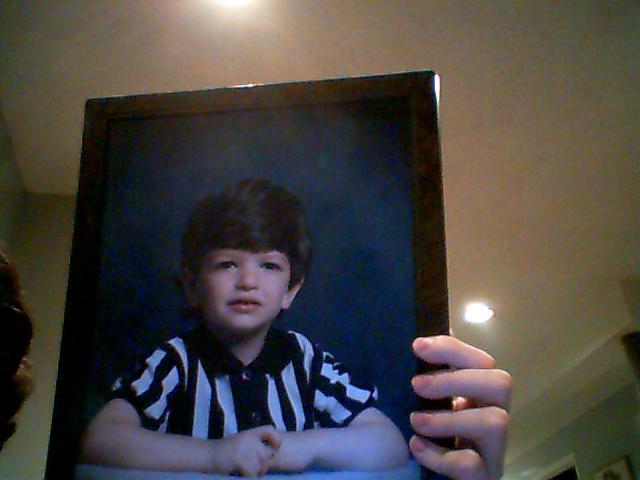
And when I say the first I mean the first. I don’t know how old I was when I wrote it, but I must have been extremely young because someone had to transcribe it for me. They may have even helped guide my ideas while somehow letting me keep my child voice. I found this creased and rusted paper wedged somewhere in my old desk drawer. I can also barely remember having toys or some figures that inspired the characters. 

And no matter how much parts of this very short bit of juvenilia make me wince, no matter how many parts of it make me want to edit it and shake my head, I have to remember that we all start from somewhere. So in honour of this Halloween and all the progress I’ve made, I just want to show you a little bit of where I used to be.

Trick-or-treat my friends. Happy Halloween, Past Child Me. 

Once upon a time there was a castle and there lived a spider, a spooky ghost and a red bat. And then count was visiting the witch. The count won’t take too long.

The next day when it was nighttime it was dark in the castle. The bat was sleeping.

“Oh!” Somebody open the door. I’m getting scared!” said the count.

The candle was lighted and one candle was turned off, and one was on, and one was dead. Then the count was sleeping, the spider was sleeping, the bat was sleeping, and the ghost was sleeping.

“What was that?”

They were all afraid.

Something said, “Oww!”

It was a wolf.

“Help!” said the bat and the spider to the count.

“There’s nothing to be afraid of,” said the count, “Just go to sleep.”

The ghost said, “Boo!”

The bat said, “Eee!”

The candles burned and they chased the wolf away. They lived happily ever after.

The end

Child Me

This is Halloween

This will be the first of two posts that you will see today.

I spent a lot of weeks before and during Halloween differently. When I was a child I would be inundated with television specials, movies, school events, and trick-or-treating. As an adolescent, I spent some time with my group of friends. In my early adulthood I spent a lot of it by myself trying to remember how happy I used to be and imagining all the other people who were having fun that I did not. I spent the rest of my young adulthood, alternatively, with friends and sometimes on my own.

I almost went to a Halloween party last year but I didn’t. I was too depressed and I did what I often do in that state: sleep and work.

This past while I’ve been doing something different for Halloween. Instead of wandering around outside at night in the dark aimlessly, or watching television, or hanging out with friends and lovers I have been busy.

I have been busy.

Last week or so, I covered six films in the 2014 Toronto After Dark for GEEKPR0N. I even covered an extra day, a Wednesday, so I could watch one film that was recommended to me. Those of you that read this Blog or my work at GEEKPR0N already know about this. I wrote reviews on The Drownsman, Wolves, Late Phases, Wyrmwood, The Town That Dreaded Sundown, and Why Horror?

And it was difficult. There were many times I thought I could just watch the films, then go straight home, and write something out that night. But even though I got wiped out, it was totally worth it. The irony is that once, long ago, I was told that I should write reviews for movies — or movies like these — and I didn’t think I was qualified to do so. It’s only in relatively recent times that I’ve realized that the only way to be qualified to do anything is to make yourself so, and start to believe it.

I got some other things published in honour of Halloween as well. Not only did I write a nice short article on the end of Kris Straub’s Broodhollow Book Two, but I got to examine and see just how a creepypasta created by Eric Heisserer the subreddit no/sleep truly lures readers into fear and trepidation. If you have read my articles on creepypastas, you know something of what you might be in for when you read this particular piece of mine.

But I think there is one achievement in particular that I can really be proud of mentioning. Do you recall, that week or so ago before I went off the Mythic Bios grid again, that I was doing another interview: this one live and in-person? Well, with the help and guidance of GEEKPR0N and Toronto After Dark organization … the following actually occurred.

David Hayter Fav and Retweet

Not only did David Hayter, the screen writer of the first two X-Men films and Watchmen as well as the voice of Solid Snake favourite and retweet my review of his movie Wolves I also got to interview him before Werewolf Night at the Toronto After Dark.

You can find my interview with David Hayter right here.

So that has been my time leading up to Halloween so far. The rest of what I intend to do, however, is as follows. Later this evening I am going to the Silver Snail Halloween Party: the same one I didn’t end up attending last year. I don’t have a costume idea as of yet and I’m having some difficulty finding make-up after my last misadventure but I’m going and to anyone living in Toronto or nearby, I hope that you will join me. It’s organized by GEEKPR0N, in part, and it makes some pretty awesome parties and I don’t intend to miss this one this time around.

The next day I’m going to the Comic Book Lounge and Gallery to pay a visit to Drawing For Deb: In Support of Epilepsy Toronto. There will be signings and a 12-Hour Comics Marathon: Special Edition there to raise money to combat epilepsy which claimed the life of Debra Jane Shelly: a well-known friend of the comics community and someone that I only began to know when I first started coming to the Lounge. She was an awesome person and there will be some good people there. I’ve realized long ago that I am just not an artist with pictures, so I will be attending to pay my respects and I may not be there the entire day.

And then the next day I will be going to Horror-Rama: an all-horror convention where I want to explore and particularly meet Jovanka Vuckovic: the brilliant upcoming director of the Jacqueline Ess film adaptation.

Then somewhere, somehow I will catch up with my Doctor Who recaps and next week get back to my fiction writing and probably sleep for a few centuries as I am bloody exhausted.

So this is both what I have been doing, and what I am going to do. It’s funny. When I was reviewing Why Horror? I started thinking about just how it is effective. When I was a child I read many abridged versions of horror stories, listened to and read written down folktales and urban myths. And I would spend time in the now-defunct Hollywood Movies store reading the backs of horror film VHS tapes. I would attempt to avoid watching them, scared of being caught in the web of their details and becoming committed, but so very fascinated with what I might find.

Not much has changed. I think the reason that horror is so fascinating is the fact that when you look at all the gore, the grisliness, and the uncanny you see what you are not and you also get to see a bit of what you are. You are ultimately safe and in sensible surroundings, or so you think, and it gives you a rush of life — of vitality — in the autumn.

That’s why some people have sex after watching horror. That’s why some people have an urge to create stories and study mythologies after watching horror. That’s why people gather around their friends and celebrate their grisly façades: the orange light in the darkness. That’s ultimately why I’m rambling right now.

I’ve spent my life fascinated by, and avoiding life. But it lures you in. It is the ultimate horror but it is also a spectacle, and best experienced in good company. I hope that, today in sharing all of this with you, that I got to be the latter.

Happy Halloween, my friends.

Writing Time Again: And More To Come

Hello everyone. I’m glad I got to spoil you with two articles last week, but this will probably be an exception and not the rule. Still, for a while there it felt almost like old times and it was all creative writing: as I obviously have Doctor Who on the brain.

Basically I am going into writing and deadline mode again. So I am going to be focusing a lot of my energies on my current assignment and, when it’s done in some way or form, I’ll be back in force. But before I go, let me tell you a little bit about what has been happening with me so far.

Very soon you are going to be seeing a lot of GeekPr0n articles. In fact, you already have in some ways. Cyan Worlds even retweeted my article on their plans to make a Myst television series. Myst was prevalent in a lot of my young adulthood and there is something very full circle about being recognized by its creators: especially as it is an article about worlds — Ages — linked to by Writing.

But that all said and done, it’s the season of Halloween and I found a lot of current news to talk about. As the zombies moan, spread the love and you know where to follow me.

There are two things of note that I’d like to mention, though, to this regard. First, I had an important interview with someone who has informed many a geeky childhood and is currently doing some good work. The second thing I’d like to mention is that I will be covering some of the upcoming Toronto After Dark for GeekPr0n.

And it’s funny. For years I had nowhere to go and nothing to for Halloween night proper and now I have two events around that time which I am going to attend. I’m excited and I feel different these days. There is still a lot I have to deal with but, and I think this has been happening for a while, I am not the same person that I used to be.

It’s hard to explain and it doesn’t involve spiritual or alien possession, cloning, mutations, or the dark side of the Force as far as I know. I’ve been producing words like a fiend and even though I didn’t get to undertake my Twine projects like I planned, I still haven’t ruled them out and they will be in my thoughts for the future.

In the meantime, I have some other writing to do and I hope to see you all soon and well. Once again, take care everyone. You are all awesome.

What Scares You Will Be Its Soul: My Dead Girlfriend and Project: Dark-Seed

This post contains horror, disturbing images and, worst of all, *spoilers.* Reader’s discretion is advised. 

When Dream created the Corinthian a long time ago in Neil Gaiman’s Sandman, his original aim was to construct a sentient dream that represented humanity’s fear of its own darkness. In the end, of course, he became more like a simple serial killer than anything as grand as a being that could make dreamers face the worst parts of themselves.

Corinthian Uncreated

The Corinthian’s initial failure as a dark mirror in which humanity could see the other part of its soul is a fitting metaphor when you hear discussions about the horror genre: particularly how gore and spectacle can take precedence over slow, creeping, uncanny elements out of the corner of your eye and the fear of the unknown or the forgotten.

And then you have creepypastas.

Kris Straub is already doing a web series called Scared Yet in which he looks at and dissects creepypastas: examining how they work, and how they don’t. He said once, in his now defunct Ichor Falls Blog, that many creepypastas fall into a formula or a series of tropes. You know: Jeff the Killer that is the result of bullying and acid being thrown on his face becoming ala the Joker analogue, a whole series of cursed video games bought from a creepy old man who may or may not vanish after a purchase, every story about Disney symbolizing institutionalized and secretive evil, and all the rest of it.

Many beginning writers can do this: they find stories that appeal to that part of them and they imitate them. Even so, many of these pastas have somehow become viral memes as they tap — sometimes even in a shallow manner — into that sense of universal horror and dread in humanity.

But then there are others …

There. Are. Others.

I have talked about Candle Cove before: created by the aforementioned Kris Straub. But a few days ago this little gem manifested itself:

My dead girlfriend keeps messaging me on Facebook. I’ve got the screenshots. I don’t know what to do. It is a story that was created on a subreddit called r/nosleep: where people seemingly write stories that commenters respond to as if they are real accounts. You can find a more polished version of it right here. But in many ways the original is much more diabolical and I will explain why.

First of all, like Candle Cove, it uses its medium to effect. But while Candle Cove emulates a Message Board, complete with user typos and all that loveliness, My Dead Girlfriend is already on a subreddit: a forum that functions as a series of comments stacked up on each other in a grey background with faded white fonts.

But goes further than that. My Dead Girlfriend also has links to what seem to be screen captures of Facebook Private and Public Chats. It utilizes Tags in empty spaces. And then there is the writing style to consider. While Kris Straub utilizes typos in Candle Cove, natesw or Nathan — which I suspect are personas — writes this from the first-person in something of a epistolary format: a series of journals or reports of the phenomenon occurring. Moreover, the writing from natesw’s persona on r/nosleep is clear, with no typos whatever, and possesses proper sentence structure, spelling, and grammar.

Yet the Facebook Chats he has “screen-captured” have the typos and fragmented sentences. And the dialogue between him and his dead girlfriend gets juxtaposed and played with like a twisted form of poetry. These two modes, the first-person of the subreddit text and the third-person and visual aids of the Facebook images complement each other. Unfortunately, if you go by the subreddit the ending could be lost: if it is indeed the ending.

Read the second, cleaner tickld version though: and look at the very last image that it shows you.

Creepy, no?

Remember, you have to find Candle Cove. My Dead Girlfriend finds you.

Ghost Writer

It’s still finding us. When Candle Cove was first sent to me, it had been around for a few years. Right now, though, My Dead Girlfriend is still spreading.

And the story had me before that image too. My friend and I were talking about this into the wee hours of Sunday and she told me that it had her at “FRE-EZING.” This was the only original word that “Emily” was able to construct, or revealed. You see, we never know whether Nathan’s torment is the result of a sick hacker, Nathan’s own subconscious mind projecting the grief of his trauma into messages from Emily, or … the fragments of Emily’s traumatized essence not completely realizing that she is dead and going to the place and person that she knows more than herself: perhaps even trying to make up for the reluctant displays of affection that she showed Nathan in life before she died on her way to their apartment.

Basically, the story is left open-ended. And there is the challenge in the recipe right there. You have to basically know that balance between detail and that open-endedness. If you have too much detail, people will question the specifics and your creepypasta will deflate into skepticism. On the other hand, if you are too grandiose and you try to encompass everything your structure will either never grow or will fall apart at the seams.

I think one element to know what medium you want to use and how you want to structure it. At the same time, you need to know what story you want to tell. Images, photoshopped or otherwise, help too. Another advantage that My Dead Girlfriend has is the fact that it has many commenters either playing along (being the poster’s friends or general fans of the subreddit) or are so taken by the Orson Welles’ War of the Worlds Effect that they are genuinely giving the poster natesw advice. But this story also manages to tap into the general and the specific. The characters and personas have names. There are dates. The accident that took Emily is revealed in slow and painful detail. The uncanny is tapped.

And that is the difference right there: that last ingredient. You can study the remnants of a miracle, but you can’t really reconstruct its soul from what is left. Or, in my case and in the case of other writers, you can’t create an original soul of a new story by purely examining leftovers alone.

I can tell you how these stories work, but it’s like deconstructing a joke. It’s just not funny after. It’s just not horrifying. And anything that I make from this, as it has been a long-term goal of mine to create a viral horror meme after my girlfriend had showed me Candle Cove, would just be a shallow or empty form.

I have many ideas for a creepypasta. It was the very aim of my Project: Dark-Seed. But after that conversation with my friend last night, I realized something. I realized just why the Corinthian was such a failure to Dream.

Dream even admitted that the fault was his own. Dream created the Corinthian to embody humanity’s fear of its own darkness, but despite the fact that Dream is an embodiment of the sentient impulse of imagination and dreaming, he isn’t human. Until his imprisonment in Preludes and Nocturnes, and slowly before with his human friend Hob he never tried to get close enough to humans to actually understand their perspective.

Dream could observe human darkness, but he didn’t really know how they experienced it. He couldn’t relate to his audience. The Corinthian, who was intended to be a classic horror tale became a gory spectacle because he only engaged humans on that superficial level. Unlike Dream’s other stories, other dreams and nightmares, the Corinthian wasn’t made from a pre-existing concept or a sentient being made into something more. He was Dream’s attempt at original creation and imitation of life and he failed.

He was an empty shell that tried to fill himself with gore and eyeballs and attention. As Dream’s creepypasta to humanity, the Corinthian falls short. That is the same reason why some creepypastas and horrors stories fail because the creator doesn’t try to relate to their audience. In terms of comedy, the joke doesn’t amuse them.

The story doesn’t scare them.

But what would have happened if the Corinthian scared Dream? What would have happened if Dream thought about what scared him and made the Corinthian in that image? What happens when a horror writer creates a monster that scares them, that makes them feel goose flesh at the mere thought of it: of that thing at the corner of their consciousness that they logically know can’t happen or exist, but deep down knows?

Who knows. Perhaps Dream’s re-creation of the Corinthian after his own imprisonment and exile changed the model. Perhaps he just needed a catalyst to tap him into that deep black pool of universal horror and white noise, take a piece of it, and fashion from its substance a soul to fill the emptiness.

Static

Perhaps a creator only needs to find something to be scared of in order to create a nightmare that can be shared with the world.

Now if that isn’t the beginning of a story of one’s descent into creative damnation, I don’t know what is. The powers help me. I think I have been writing too much in hell. But the moral of this story is that some people like their pastas filled with gore or emptiness.

I like my pastas to be filled with darkness: from the heart.

Corinthian

I Am Getting Published In Hell

I was away last week, but I had a pretty good reason: one so compelling that I actually changed the article that I was going to post up here today.

For those of you who have been following me, you know that I’d participated in the Dark Crystal Author Quest. Unfortunately, I had too many other tasks at the time and I couldn’t deliver on that story beyond the outline and crude introduction that I posted on Mythic Bios a while ago.

What some of you might also remember was that I’d been working on another project at the time. Some months before, Janet Morris–the creator of Heroes in Hell–approached me and asked me if I wanted to write a story for her universe. Of course, I agreed. Not only do I find the world she created captivating, but it would be the first opportunity I’ve had in getting a short story of mine published into print.

Of course, I didn’t want to say anything too soon. There was not guarantee that I was actually going to get my story published. First of all, it had to be accepted first. There were a lot of challenges in even creating this story, and then editing it. Two weeks ago I was going a little crazy: hitting a major learning curve in the collaboration process. This was happening for a while, but in particular almost concurrently after showing off my Twine game and attending the GeekPr0n Third Anniversary Party.

But I was lucky in that there were good people to help me through the process, including and especially Janet Morris herself. So now, let me make it nice and official.

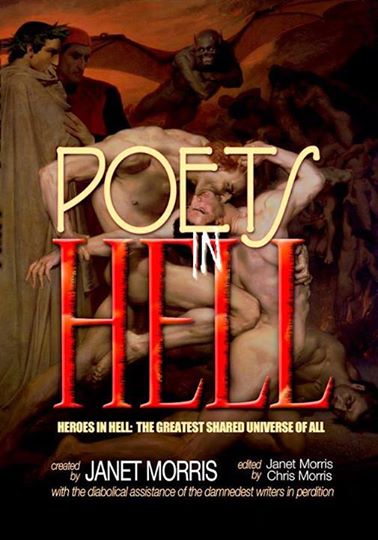
My story WHEN YOU GAZE INTO AN ABYSS has been accepted into the latest volume of Janet Morris’ Heroes in Hell POETS IN HELL.

Poets in Hell

As a bit of background information, Heroes in Hell is a shared universe that operates on the premise that anyone who has had an interesting life will have violated one of the 613 commandments intrinsic to the fabric of a moral universe and will thus find themselves in hell. So imagine hell filled with underworld gods, fallen angels, demons, monsters, mythological figures, historical figures, genii, mass-murderers, thieves, and–well–humankind in general. And make no mistake, my friends. This is literally hell.  If you think our world is bad, and it has a lot of bad qualities, reading this will make you appreciate our world a whole lot more: as all good and intelligent literature should.

My story “When You Gaze Into An Abyss” features Lilith, the apocryphal first wife of Adam, and the German philosopher Friedrich Nietzsche — amongst other diabolical friends.

I look forward to hearing what you think about this story and the volume that it comes in. I can’t reiterate enough that this will be my first short story ever in print. Expect POETS IN HELL to become available on Barnes & Noble, Amazon around June to July 2014. I also believe it will be on Kindle as well along with its other volumes. I will update you all with more images and links when they arrive.

Suffice to say, and considering all the struggle it was to get to this point in time, it feels good to be a poet of hell.

My Depression is a Ginosaji

It was Winston Churchill that called depression his black dog. I never thought of actually personifying or embodying my depression into its own form before. I suppose I’m really talking about the subject of depression due to my absence away from Mythic Bios and having thought about the matter at some length.

But there are different kinds and variations of depression depending on the situation or the person. So, after really thinking about it and with Gaming Pixie’s unintentional helpfulness in the matter in attempting to get me back for sending her a disturbing video, I give to you my loyal readers what my depression would look like.

Yes, my depression would be Richard Gale‘s Ginosaji.

A Ginosaji (which apparently means “silver spoon” in Japanese) seems to be this grotesque, dark, awkward, lurking, creeping thing that beats you with a spoon. Eventually. At first, it’s the little details that simply irk you. And you try to ignore it, or dismiss it. But then the spoon beatings keep increasing and they never stop. You can’t power through it. You can’t kill it. You can’t ever completely blow it up. You can’t become it.

You don’t know why it is even there. And just as a shovel can slowly erode a mountain given time, so can a spoon beating begin to bruise and wear you down. And it is so ridiculous. It offends your pride. It is laughable that something like this can challenge your sense of self-worth and peace of mind. It embodies all the little things that shouldn’t bring you down: the bureaucracies of the world, getting your passport, preparing your trips, even responding to potential incentives … All of these things are just one ridiculous, banal spoon blow at a time.

And when you apply this to sufferers of chronic illness, the symbol of the spoon gains a whole other kind of connotation: the irony being that while you run out of spoons, the depression always seems to get them all.

But, unlike the main protagonist of the above short film, I have my methods of dealing with this particular demon. I can at least laugh about it. Sometimes. I suppose that is the function of the Ginosaji: a ludicrous symbol of the humour in, and the parody of, human suffering and existence.

That, or he is just a douchey demon with one too many spoons.

What? Did you think I could honestly resist another reference?

Another Revolution

On Fame’s eternal camping-ground
Their silent tents are spread,
But Glory guards, with solemn round
The bivouac of the dead.
— Theodore O’Hara, “The Bivouac of the Dead”

They marched among the geometrical angles of granite tombstones, wearing simulated gore and affected awkward staggering gaits, carrying upraised signs made of stick handles and Bristol boards with bloody running red lettering.

Among the people dressed in dried red, white and green make-up, purposefully tattered clothing and horror film t-shirts, were people in uniform. Some of them wore dark helmets and dark-blue padding with realistic plastic rifles and riot gear in hand. They seemed to wave the macabre crowd along with plastic severed limbs: at least those that weren’t holding signs of a merry skeleton man with a top hat and cigar between his teeth pointing and proclaiming, “Baron Samedi Wants You!” or “Occupy the Evans City Chapel! Donate Your Flesh!”

For all the attention it received, the Chapel was a square structure of stacked old grey cement blocks with a steeple-roof of dark slate, and a chimney of faded red bricks. If someone looked closely at the base of the building, they would have seen green mould slowly and almost verdantly eating away at its foundations.

It had once been used as a storage-shed ages ago, before it was finally boarded-up altogether and left a hollow shell: its emptiness dignified with the remnants of almost forgotten hallowedness. But its simple crumbling elegance cast a long shadow of significance over the minds of its protesters, its guardians, its revellers and its other self-appointed friends as they gathered near the grounds of its long-sealed front door.

Whatever these fifty-odd some people saw on the path amongst the gravestones in front of their modest, aging Mecca and beyond the frame of a black and white reality, they all wanted to be here. Most of the Event’s participants were enthusiastic locals, some particularly devoted interstate and even international tourists. The other group that came into the Evans City Cemetery, on the other hand, did not seem local but they were–in their way–no less eager to be there.

The newcomers did not go to the Chapel. Instead, they moved past it. Some of them walked with a familiar stiffness, ramrod straight spines and a seeming lack of joints: with deep blue eyes that glittered from sallow faces in the setting sun. Others were more sombre or even more colourful heaps of mouldering robes that hopped or leapt alongside their compatriots: jumping with arms open enough to embrace the entire world.

Others wore darker investments: grey and black medieval armour, closed visors and ragged peasant garb. Some of the new arrivals hulked over the others: seeming to rise up from the ground like earthen blue-black shadows and wearing helmets of sharpened horns.

Still more followed them: large and small and some in more than worse for wear contemporary clothing carrying bits of playing equipment, tools and debris. Bloated and emaciated green things in rags crawled and whispered after them, and in the lengthened shadows it seemed as though they did not always have a shape at all. Lean beasts followed them with raised hackles and similar expressions of living greed on their muzzles and in their eyes.

Some were writhing, undulating wild-eyed women bathed in old red and cloying vinegar-wine as they alternatively fell over and prostrated themselves in erratic procession; while others were black-haired, dark-skinned, beautiful hollow-eyed women gliding in fine dresses and sporting long, long, fingernails. A significant proportion of the assembling throng were even more skeletal: shrivelled and brown caricatures that walked slowly and ably. Two of them looked like little girls in tattered old dresses holding smoking cups in their hands: their eyes silvery cobwebs of intent.

In front of them loomed a pillar of Quincy granite: nineteen feet high and surmounted by the figure of an eagle perched on a globe. As the grisly travellers surrounded it, its shadow consumed them and they became a part of the evening that it dwelled in. One side was inscribed with the names of forty-five dead men, while another was carved with an emblem of a wreath with crossed swords.

They had travelled all this way to congregate at this one point: the old Civil War memorial stone known as The Soldiers’ Monument. Anyone else in the Cemetery might have wondered why there was so much attention and security paid to the road and the Chapel, but not for the old war memorial. Yet no one other than the throng moved towards this spot. And so they waited.

They did not wait quietly. At first, the stillness was broken by a faint nearby rattling reminiscent of dry hollow bamboo tubes clattering against one another.

Gachi gachi … gachi gachi …

As though in sympathy, parts of the throng itself began to shuffle restlessly. A few gaunt forms covered with shaggy hair peered forlornly at their fellows with bloated faces and held out delicious ethereal food. This food went ignored.

Grumbling shadows seemed to shift back and forth above the closest gravestones, as the motley assortment began to moan and bang their makeshift tools on the nearby graves. The robed group began to hop impatiently in one place. The unseen ones stomped their shrunken feet in defiant rhythm. The brittle moving antiques that were the two girls walked through the throng with their two steaming cups, their soft voices mournfully chiming, “Cafe grille … Cafe grille …”

Even while the freshest among the ranks began to growl and hiss at each other, and the fat and thin green shifting creatures with their hyena brethren whispered to each other like sand and Arabic, a few of the figures in the front closest to the Monument remained solemn and patient.

One of them was a white-eyed woman with skin the texture of old coffee and dressed in the habit of a nun. Another was a man in a World War I Canadian Major’s uniform with a waxen blank-looking face and a black bag at his side. People arranged in a wide assortment of shapes surrounded him. They remained still, they and the shrivelled white-eyed brown ones. The latter held vintage bottles that seemed to flutter with eerie lights. They did not offer these to anyone as they stood near the nun. The two girls skipped to her side and she put a weathered hand on both of their wispy heads.

And so they waited. And so they wait. They wait for me. The vetala.

What is past is now present and what will be is now. Even as the evening comes, as it has come several times before, and the blue, black and pale-skinned Draugar bathe themselves in the fox-fire light of their trollskap runes, and the Jiangshi resemble Chinese paper lanterns filled with glow-worms, I come. I appear at the top of The Soldiers’ Monument: my feet balancing on the eagle statue as though I am a fallen angel perching on the head of a pin.

I smile a serene, demoniac smile as I lean forward. With a balance and flexibility that would put any enlightened yogi to shame, I hang down from the top of the pillar and my sightless eyes stare into each and every one of them. Now they are all still. I have their attention.

“The living claim to know our stories,” I begin, “but only the dead may tell them,” I look through all of them, “Speak.”

I am the vetala. I hear their stories. They speak to me. They speak to each other. They speak to each other in the rustling words and fading dactyls of our kind. Although their words are disparate, they are all unified under one scraping dissonant mother tongue: the language of the dead.

The elders speak first. Some are dressed in furs, archaic bronze, gold and rotten silk. They wail about the stories their fleshly tribes and descendants told, hidden away in their caves and ancient homes at night, while they raged outside pounding the doors: demanding sacrifice or just to be among the living again.

The Ro-Langs say they are tired of being created and hunted by sorcerers and Buddhist priests for their tongues and their golden bones. The Nachzehr contingent in the Cemetery say they have grown to despise having their graves intruded on and having coins shoved into their mouths. The few remaining native Skadegamutc–their long skeletal forms pulsing with stolen blood and their hair tied into feathered braids open their fanged maws to release whooping war cries into the air–decry the loss of their lodges, being forced to dwell in holes in the ground, and the burning finality of fire.

Many murmur among the gathering in sympathy. The shaggy Bukwus lament the fact that the living no longer take their offerings of food, nor join them in the waters. The mariner Drang nod their seaweed-encrusted heads in agreement and state in vehement Germanic that they are sick of being spat on. In equally fluent German, distorted only by the gnashing of their teeth into their death-shrouds underground, the Nachzehr rebuke the Drang with their livid, gesturing shadows: telling them that at least they didn’t have to worry about getting their heads cut off.

These exchanges bring another large murmur of agreement: especially from the Wiedergänger and their European revenant cousins. The Jiangshi say nothing but continue to jump around ignorant of glutinous rice, peach-wood, the I Ching and their own reflection while everyone else is aware of the funerary-mockery of self-transport that sorcerers first made of their bodies. Mostly, they are impatient for more qi. From its sprawling place near the corner of the Monument, the giant collection of the bones from a multitude of starved human beings called the Gashadokuro reiterates this sentiment with a loud rustling gachi gachi giving even the other assembled dead reason to pause.

Even so, the Ro-Langs are quick to mention their solidarity with the Jiangshi and add that they are also tired of having their tongues ripped out to become occult-swords. This draws the ire of the beautiful Pontianak: hissing that just as they were victims in life of the men that impregnated them and forced them to die at childbirth, so too do they still continue to abuse them after their deaths by driving nails through the backs of their necks and cutting off their long nails to make them “more docile” as wives.

Most of the ones arguing now, while a little more numerous than the elders, are fewer than the majority: with even fewer of the living in their native lands telling their stories every day. With some exceptions, theirs are complaints that have less to do with current persecution and more to do with past wrongs, restlessness and hunger.

Out of all of them, it is the Draugar that are collectively the loudest.  The walking remnants of the Northmen boast about their achievements in strength and power, how it took the will of a true hero to wrestle them back into their howes. They say that the living can cut off their heads or burn them to ash, but that they will fight it all the way and retake the world that was once their own. They taunt the other dead, calling them cowards and mindless shells: commanding them to fight.

One of the revenants laughs hoarsely and points out the ever-present truth: the Draugar are few and most of their barrow-homes have been lost. Even with their power and lore of the dead, they are too few to reclaim their own lands of ice and darkness themselves: never mind the entire world. The Draugar become angry: proclaiming they will get all the reinforcements they need from their brethren in Hel once the ships made from dead men’s nails set sail.

The wax-faced Major steps forward. Even as he points at his twisted companions, his voice comes from the black bag in his hand: explaining in a muffled yet cultured tone that he and his fellow Re-animates were the result of horrible medical experiments that forever robbed them of the gift and dignity of death that is the right of all living beings. After they found each other, they methodically hunted down and killed their creator for his crimes against them and defying the will of Nature.

The elders and the avenging dead add their cries to the Major’s words, and even the brown-skinned zonbi contingent in their silence and with their shimmering glass bottles–by their very nature still full of purpose–incline their heads slightly with mutual respect. The nun–the Mother Superior Marie M.–finally speaks.

She talks of how her young body was abducted from her grave and family by a bokor in her native Haiti where she was made into his slave: only for his wife to attempt to sell her until, finally, she was brought to stay at a convent in France where she has been ever since the early twentieth century. Until now. From my vantage point hanging upside down and slowly swinging from the memorial, back and forth like a pendulum between life and death, I nod at her and the Canadian soldier-doctor.

The more numerous modern dead are also angry and hungry. They are not as articulate as the others, but they make their case clear. They throw their debris. They roar. Some of them stagger at each other while others tense and lunge with swift viciously mindless animal instinct.

They cease just as I stop my swinging. From the Chapel, I can already sense some of those who are with child clutching at their bellies from the Draugar’s auras: not enough to kill, but just strong enough to cause discomfort for those not-yet-born. It seems that as this gathering continues, the Pontianak may yet gain more sisters.  Everyone and even the newest among us are cowed by the presence of the vision I have not revealed yet.

I am the vetala. I am the storyteller. I take the story of my being and I shrug out of it–a layer of ego–as I curl up to stand again on the stone eagle and let the tale tell itself.  I point at the words that my body once concealed on the Monument, words they have all waited to see, “We are the bivouac of the dead.”

At my words, I sense a woman at the Chapel cramping into miscarriage. I continue.

“We exist on ground without walls or protection. The living has the luxury of walls between them and the night of us. We have nothing to protect us except us: the cycle of us. The elders understand it best. This world is not linear,” I spread out my arms, “We have no walls because we do not defend. We were the fierce hunger for life given purpose incarnate. We were the agency of celestial wrath and vengeance. But then, we were usurped.”

I lose myself further into the role of storyteller, “The living began to tell our stories. They took them from us. In them, we lost our divine masters and exchanged them for fleshly ones. For millennia after,” I glance poignantly at the zonbi, “in their stories we served the will of witches and sorcerers. We were their servants and their familiars. Their slaves. And those of us that came about without human agency were considered mistakes of Nature and linear Time. There are no coincidences,” I point one long skeletal finger at them all, “and those of us that were made free to appease our hunger were hunted down, burned, decapitated, mutilated and destroyed.

“Only those few like the Ghilan were free,” I finally turn back to look at them — some of the green-fleshed ones, “They are the ghül: a word used to describe us all because of what many of us are compelled to eat … and kill. They were free … in their deserts, haunts, and the abandoned ruins of cities … until Prince Gherib’s forced ‘Conversion of the Ghouls.’”

A sullen, angry rumble begins to grow, “For all here know that it took more than just one day to accomplish and that it was more than merely one Tribe. To this day the story of what happened to the Ghilan–to the ghül–is a lie still told by the living to their children,” I spit the last word, “as entertainment.

“The Ghilan–particularly the Tribe of Saadan–lost their fortresses and treasures in Arabia for the simple crime of keeping property, for eating the meat and bones of things that could no longer move nor even feel! Some fought, but most did not. They were–are–merely survivors and scavengers of food and scraps of knowledge. Very few Ghilan even kill the living, yet even so many of them were sent anyways to ‘sup with Iblis’ during the ‘conversions.’

“The rest of us were no better off.”

I jump down to the base of the Monument, “You have heard the Ro-Langs, the zonbi, and even the Jiangshi. Most of us could not even be conceived of to exist without the aid or presence of a fleshly master. Some of us, like the revenants, occurred ‘naturally’ but were promptly obliterated by fire, prayer and mantra. But some of us learned to rebel.

“Indeed, many of my kindred were powerful enough to do so. I remember the day, millennia ago, when I came to my vamachari’s side–the mortal responsible for binding the churning spirit of me to this cold, dead matter for my knowledge–and I wrapped my fingers around his neck and slowly squeezed the life out of him with my cold, dead left hand. It was one of the few moments I truly wished my own flesh was not unfeeling,” I let the old fury of that ego dissipate as I relax my left fist and become the storyteller again, “Yet even then there were too few of us to do anything more.”

I gesture at the zonbi delegation, “It truly began in West Africa, on an island called St. Domingo in the year of 1791. Slaves taken from many African nations rebelled against their slavers for twelve years until they overthrew them. From the chaos formed an entirely new nation. However, what no one knew was that a few of the former slaves were bokors and they possessed zonbi. The zonbi, however, were not free of their masters. Yet.”

I raise my hands, “That day, in the place that would become Haiti, a new narrative was formed: a story of slaves freeing themselves forever from their masters. And this time, instead of the living learning from the dead, the dead began to learn from the living.

“1863: the very land we stand on now, the place that bought many of those living slaves from St. Domingo, undergoes the Civil War that created the very Monument that I now stand on. This same nation then proclaims manumission for all its slaves! A few freed bokors and, more importantly, their zonbi were also there. And they learned another story.”

I point at the zonbi delegation, “Do you know what they hold in their hands? A zonbi is created when a bokor takes their soul and puts it in a jar. The bokor takes away the zonbi’s name and memories. The bokor keeps their souls in these jars to increase their own strength or sell them to buyers for luck and healing. Souls have become commodities.

“Over time, Marie M. and others have tracked down all zonbi and their names and reminded them of who they are. They carefully crafted a network with others, finding the bokors and their servants. By the end of the twentieth century, all true bokor have gone slowly and quietly extinct and the souls in the jars before you now are not those of the zonbi. They are the souls of their bokors.”

The dead are silent now, but not because they have become inanimate. I hold up one hand. I am not done yet.

“As the bokors and others like them disappeared,” I nod to the wax-faced doctor and a few others, “the living began to tell each other another story. It is not until 1968 that this new narrative fully manifests. The combination of tensions caused by war creates a new era of protests all over the world and in this land: protests against violence and discrimination.

“Also during this time something else happens. Feeding off of the confluence of conflicting energies, a new story is recorded here: created to become a whole new narrative!”

I spread my arms as though to mimic the Jiangshi, to encompass the whole Cemetery, “We above all others know the earth has power. Here, we were reborn. Can you not feel the power of the founding place, in the grave soil coursing through you? We were made to embody the menace hiding right in front of their eyes!”

I turn to the newest, largest part of our gathering, “And you are the epidemic! We have masters no longer! This knowledge: this real fear of an insidious, unreasoning, creeping cancer over the whole of humanity becomes us. But what’s more is simple. I am the vetala. I see Space and Time like no other. I know the secrets and the power of names and words. It was when they called us zombies–after our first liberated brethren–that we began to understand ourselves … and our final transformation began.”

I look at them all for one last time, as I know that very soon the time of the storyteller will be over and that the story will begin soon.

“2012,” I let my voice become a whisper softer than a child’s dying breath, “From the year before, a multitude of scattered protests–only tenuously related as Occupations–crop into being all wanting one thing: change. Here, in this very town, a few of them meld together: into another confluence.

“Many believe this is the final year of linear Time and they invest into it their fear of death: into a great sense of urgency. And here, in this Cemetery, at the Chapel with its charged residue of the story that changed us, at the anniversary of its genesis, the living gather their most vital energies to save their Chapel: to save us … to join us.

“My brethren,” I proclaim, “it was our will consumed fully by our perpetual hunger that enslaved us and now the very recognition of this fact–this same eternal craving for life–will move this world forward and forever.

“I have seen this! I am the storyteller. I am the vetala and soon we will all become the story!”

And then I am no longer the vetala. There is no longer any storyteller. They are the story now. They cheer as the vetala lets himself be carried away into the throng with open arms. In unison the throng of the dead turns away from The Soldiers’ Monument towards the Evans City Chapel: an army that no longer needs walls. But before they move, something appears in front of them.

It is the shrunken brown figure of a dwarf: one of the formerly unseen Tokoloshe. The eyeless, tongueless being croaks at them all: telling them that they will not be privy to the hurting of children. The two zonbi girls stare at it, then slowly bring their cups of steaming, eerily quailing liquid to their mouths and drink. The Tokoloshe seems to consider this for a moment and nods. Then it bites down on the pebble in its mouth and disappears again.

The evening gives way to the night, as the dead smell the ambient energies of life force and blood and meat–of fate–saturating this focal point where they would now re-imagine themselves for themselves.

Then they begin to participate in the feast that is to come.

Evans City Soldiers’ Monument Photo Credit: J.W. Ocker
Evans City Chapel Photo Credit: The Terror Daves
A Film Festival Double-Billing: We Are What We Are and Bounty Killer

So I am going to be doing something different. Not only am I going to make an early Blog post, but it is going to be a movie review: or more specifically two reviews back-to-back courtesy of the Toronto After Dark Film Festival. I literally got an RSVP after applying for a Press Pass that allowed me to attend the opening gala of the Festival with one other guest–in this case my brother–for free. In exchange, however, I am to review both of the  films that we saw.

This has been a very busy but exciting time with regards to my writing, so let me get this underway: after an obligatory Spoilers Warning. The first film we saw was Jim Mickle’s We Are What We Are. However, I would like to state that the film short–which the Toronto After Dark likes to include before every film–also bears some consideration.

It is an abstract film fittingly enough named Kin: which essentially is about a boy child who is on a quest to help a group of dancing shamans with strange masks summon a giant crow or raven. There is also a knight that was travelling by horse to the hilltop where the boy stands with his own wooden sword and shield. In addition, there is a small waif of a girl with pale blonde hair and a gossamer white gown who seems to have been waiting for the boy: only for him move past her, summon the creature, open his arms, and let the gigantic mythological blackbird either devour him or embrace him. The knight gets there just in time as everything ends and he and the girl just watch the sky where the boy had once been.

For me, it was an excellent segue into We Are What We Are because what we see is a child that, at first, seems to be challenging an ancient tradition or ritual while the adult–who seems to have power–almost helplessly follows him just in time for it to be too late. In fact, every time the boy stumbled, the knight seemed to stumble as well: which makes me wonder if the two of them are linked. Is the knight is an archetype that the boy pictures in his own mind before circumstances make him discard him: or pass him onto the girl? But in any case, and in the end, the boy–faced with the sheer power of mythology hovering in front of him–lets it overcome him on his own terms: leaving the idea of the knight behind to perhaps be born from the girl one day in order to continue a new tradition. This is what I got out of it anyway.

But in any case, Kin was an appropriate title when you consider what We Are What We Are entails. Just as it was outside the Scotiabank Theatre, so too was it raining at the beginning of this film. I will admit–much to my own eternal frustration–that there was a quote at the very beginning of the film that I can’t remember and it was even repeated verbally at the funeral scene. The reason I didn’t write it down at the time was because I thought it was a literary quote when, in actually, it came from a book that exists only in the film and I have not been able to find it since. I will get to that soon.

Essentially, We Are What We Are is a film about the Parkers: a family of cannibals that live in relative poverty close to a small town near the Catskill Mountains that eat human meat for religious purposes. In addition to this, the town doctor is still searching for his long-lost daughter amid a lot of flooding: flooding that carries strange objects with it in currents of water like flotsam and … old bones, for instance.

This seems pretty straightforward and not very original. However, there is more. The mother of the family drowns at the beginning of the movie: leaving her husband, two daughters, and young son in tremendous grief. And here we see something very interesting. The family patriarch Frank Parker–who is traditionally in charge of procuring their source of meat–could easily be portrayed as a complete and totally cold-hearted and  abusive monster. But he isn’t. He genuinely grieves for his wife’s death. It makes him completely fall apart to the point where his daughters–who love him–take care of him. If anything, it is the disconnect between what this family eats and how they still act as human beings that makes this film even more disturbing because you end up having sympathy for, well, the monsters.

It is no coincidence, when the middle child Rose Parker is reading to young brother Rory Parker about a “happy monster” that he says–after accidentally seeing the “animal” they were keeping in their basement–that the “monster is actually sad.” And the monster–the secret of the family–is sad. We find out that the Parkers’ holiday of Lamb’s Day began in the 1800s when their early settler ancestors ran out of food and nearly died in the wintertime. We find this out as Iris and Rose Parker are reading the book that has been passed down throughout all the generations of their family: detailing how the first patriarch’s two daughters found their father in front of the body of a woman and partook with him of her flesh. This was the beginning of the family spiritual epiphany: of that transgression to live and then ascendance beyond the taboo of eating human meat to find new meaning. This was the beginning of their Lamb’s Day: a man making a decision to undertake it and two girls deciding to carry on the tradition through their line. And, after all, don’t most religions begin with trauma?

There are, however, obvious consequences for eating human flesh: such as the lovely addition of Prion Disease: which includes tremors and tremendous brain damage. At the beginning, when their mother is trembling and essentially dies from the illness at the general store, a man says that the storm outside will “only get worse before it gets better.” And unfortunately for the matriarch of the Parker family, it only just got worse until it finally ended.

Yet the ending … The thing to understand is that the older daughters were thinking of abandoning Lamb’s Day and trying to become normal: hoping to find some way to get past their overbearing religious father. Unfortunately, this did not end well. The father begins to notice that the old bones of their previous feasts are drifting down the river and he begins to understand–even in his Prion-riddled brain–exactly how screwed they truly are. He also kills Iris’ boyfriend as they are about to have sex: as he is right on top of her. And then to add insult to injury, he puts arsenic in their Lamb’s Day stew–yes, that kind of stew–when he realizes they will all be discovered. So not only does Frank hurt his daughters–and you notice he never lays a hand on them, though he is so imposing he doesn’t even have to–but he betrays his oath to protect the family and the tradition.

What happens next is nothing short of watching a terrifying transgressive religious reformation of sorts unfold as his daughters, both dressed like Gothic Lolitas–fulfill their Electra complexes and consume their own father while he is still alive. Meanwhile, the Doctor–who figured out that Frank killed and ate his daughter–watches this all happen and, assuming they spared his life, I’m thinking at if I were him at this point of seeing this Bacchanalian horror unfolding in front of me I would really reconsider that long overdue retirement to Florida: provided a Dr. Lecter wasn’t staying nearby.

The ending was just beautiful to me in all of its gory horror. Iris and Rose manage to consummate their love and hatred for their father: defeating that monster that he is through even greater depravity. I mean, think about it: he and the family over many years at least prepared and cooked their food. These girls are eating him raw: while he is in agony. There is something more honest about this “back to basics” religious approach and also a rebirth. Because if they didn’t eat the Doctor at the end of the film or even kill him, while they are driving away with their baby brother and the ancestral book in hand what we might be seeing is the creation of a whole new kind of familial cult: of the women–who carried out the line–taking it away from the false civilized nature of the patriarchy and making it something new.

What is even more hilarious is this: at the end of the film, we got to ask the film-makers questions and one of the things that came up was that they not only planned a prequel to the film: in which we find out how Frank meets his wife, gets inducted into the Parker family and takes on the role of matriarch–of actually killing and preparing their human food–but there is going to be a sequel as well which takes place, of all places, in Mexico.

Now, let me make something else clear.

http://www.youtube.com/watch?v=EBkNz3_pzsw

We Are What We Are is a revision, not a remake, of Jorge Michel Grau’s Mexican film Somos lo que hay which has all of the gender-roles reversed and a whole different ending. The idea was transplanted from Mexican social commentary into American religious criticism: and now is being transplanted in a weird sort of creative hybrid way back: to the point where the endings almost meet. I can only imagine Iris, Rose, and Rory Parker making a new family tradition: of only killing and eating criminals and otherwise bad people instead of the “shit where you eat” mentality and hypocrisy of their father who made them eat their town doctor’s young daughter. A shameful secret becomes a religious mystery once again and two girls come of age in blood and sacrifice. Perhaps now, when they finish reading their brother his story for the night they can now safely end it with, “And the monster was happy.”

So, after going twenty minutes later over schedule and a bathroom break my brother and I went to see the next film: which was Henry Saine’s Bounty Killer.

I don’t know how much I have to say about this one, but again the short L’Étranger was a nice and fun lead-in: an action sequence with a cowboy who, after killing and maiming everyone in a bar, was simply there to deliver a package on time. It was amusing.

As was this trailer for the following film.

Bounty Killer is a post-apocalyptic comedy action film that was originally taken from a Kick Start Productions comic book which Jason Dodson and Henry Saine also created–the latter of which seems to only be available in the iBooks Store–along with an idea for a 1997 animated series that never happened. So essentially what we are looking at is a film created from action, almost superheroic animation that didn’t completely happen, and a comic that in addition to its own self was made to help storyboard its very existence.

It is a tongue-and-cheek movie that takes place in a world that has suffered from the Corporate Wars: in which corporations eroded the world governments and caused mass chaos and suffering. In the wake of this, there is a Council of Nine formed in the Wastelands that creates the Bounty Killers: celebrity assassins that hunt down the white collar corporate individuals and their Yellow Tie minions as war criminals … though Darth Vader’s age-old admonition of “No disintegrations” seems to apply at least with regards to their heads.

As you can imagine, the violence is exaggerated not only in a stylized way–ala Matrix-level slow motion scenes cut with fast pacing–but it is literally parodied with some snappy one-liners and moments of pure, fun ridiculousness.

What is also really interesting is the way they set up two of the main characters. Mary Death is the former protégé and on again, off again lover of the first Bounty Killer Drifter: who is literally stylized violent sex. Drifter is not so much this, but he is an extremely pragmatic and clever man who used to be the head of a corporation before his company betrayed him by making weapons and he hunted most of his business partners down. As he put it, he was “sick of being behind a desk.”

In a sense, training Mary Death was one of his best decisions: as she unknowingly distracted everyone else from really looking at his celebrity status and into his past as a former Corporate. In fact, as I think about it now, Drifter most likely purposefully botched his kills–such as, well, disintegrating him–so that people wouldn’t pay too much attention to him compared to Mary Death and start hunting him.

Of course, this all changes as a bounty is seemingly placed on him by the Council of Nine: under his true identity.

Mary Death herself is a former member of a raider and infiltration group known as the Gypsies of all things. She approached Drifter ages ago to be trained by him in the arts of Bounty Killing: though how she actually knew what his real skills were like is unknown. She is a dangerous woman. Aside from my previous description of her, it is the best way to sum her up: although she does like to give autographs. She and Drifter a strange relationship in which she exercises independence and love by stabbing him non-fatally in the spleen and leaving him to chase her: at which on two occasions he has said, “She cut me … deep.”

What is really interesting is that Mary Death is set up in a way that makes her look like the protagonist of the film–even the film’s advertising has her as the central aesthetic figure–but the focus isn’t always on her. The film’s perspective alternates between Mary and Drifter: ending with Mary in an iconic sort of way. This film is also inter-dispersed with Heavy Metal-like animation and illustrations: making it not unlike, as others have pointed out, Kill Bill meets Mad Max.

Really, the film is crazy: just plain crazy. But it is crazy in a fun “what the fuck” way. It is also fascinating to consider how the “white collars” and Bounty Killers evolved as their own cultures in this post-apocalyptic future and how when you strip away that veneer of civilization a lot of this 1% to 99% we keep hearing about would become tribes of a different kind and the film definitely reflects the current cultural reaction against the former.

That said, there is one regret that I share with Henry Saine: namely, the exclusion of one aspect of Mary Death’s origin. He told us in the Question and Answer period that originally Mary Death was supposed to have been a child on an airplane during the Corporate Wars and that when the plane was being attacked; she was actually by what was essentially a bad-ass stewardess. Even though Mary Death was taken by the Gypsies after this, she never forgot that woman who defended her to the death–even though she had once worked for a corporation–and modelled her new uniform in her memory.

I did like this movie, but I have to admit that I was put off by the moral of love and independence being a knife in the spleen. But hey, if you are into that sort of thing who am I to judge?

And, after that film based after the Corporate Wars was over, we appropriately stopped off at the After Dark’s event at The Office Pub.

So this has been an ad hoc review of the Toronto After Dark’s opening salvo. I hope you enjoyed this and please, when you get the chance, watch these films. As for me, after seeing the last one I now definitely need to somehow watch Saine’s The Last Lovecraft: which was shown at an After Dark opening gala a few years back.

And I definitely need to do this sometime again.