I Would Have Gotten Away With It Too, If It Weren’t For Those Meddling Squids! A Review of Cephalopods: Co-op Cottage Defence

I played this game for one day–just one day–and I hate green Squids.

Not the luminous blue ones, or the black ones. Not even the exploding fiery orange ones. The Greens. Just the Greens.

So I made an unexpected trip to Canzine 2012 this past Sunday: where I was reintroduced to the Comics Vs. Games-premiered The Yawhg, given a paper ninja-star, and talked with a few artists and game creators before finding The Hand Eye Society’s Torontron game cabinet arcade machines outside. I always loved arcade games when I was younger and I never got to play with enough of them. So finding these there was just an added bonus.

My friends and I started to play this game that I later found out was called Cephalopods: Co-op Cottage Defence by Spooky Squid Games. At the time, however, I found myself controlling a 16-bit sprite with a shotgun in a house along with my hammer-wielding friend as we were being surrounded by floating Octopi.

I didn’t have time to admire the Lovecraftian settings of the house’s interior: such as the book with the Squid imagery or the almost Victorian laboratory feel. I also didn’t realize that the hammer-wielding sprite–that the character was a female scientist–nor that her clearly non-human shot-gun wielding companion was a clockwork automaton of her own creation. All of these revelations came later when I looked at them online.

No, instead I was either killing mass-Squids that electrocuted and devoured heads, or hurriedly knocking Squids unconscious with my hammer as I was trying to repair the walls of the house to offer us protection against these tentacle-armed hordes.

This game was fun. I admit, I really liked killing those Squids. I also felt some satisfaction in repairing the walls and seeing those plus numbers come up: which probably represented how much time or durability it had before it fell again. There was another quality to the game in that, aside from the two-player cooperation that is utterly necessary to your survival, you also need a certain amount of coordination as well. Essentially, it is integral that your gun-shooting companion fires as the most of the Squids while you repair the most isolated of the walls: such as the walls that are not being massed by tentacles of doom coming to suck your face in the middle of the night.

However, there is also the option of exchanging tools: throwing your gun or hammer to your friend. It takes timing and coordination and, sadly, we did not manage this. Sometimes the sprite’s maneuverability was a little awkward and stiff. I remember at least a few times I tried repairing a plank and not realizing I had to get very close to it to do anything with it. Apparently, according to the Game Over text, we had something to the effect of having as much coordination and teamwork as a bunch of “golden weasels.” Suffice to say, it wasn’t complimentary, but certainly made us laugh.

But then, as the game went on (after each time we died I mean), it began to occur to me that something was very … eerily familiar about it. It was the Squids that obviously made me start to think this. And I knew I had seen them somewhere before: these 16-bit luminous deceptively cartoonish tentacled monstrosities. I knew it was from some research I did before but I didn’t know the name of the thing. Then much later I realized they were related to this:

Night of the Cephalopods was something I had read about when I was looking at Spooky Squid Games (god I love this studio’s name) for my article Dreams of Lost Pixels and if this is anything like the game I played tonight–and the voice-over narrative actually happens in this game–I may well download it. This is a big thing for me because, like I have said many times before, I don’t often play games. I watch them being played sometimes, and I play a lot of selective games on older Nintendo consoles, but this game makes me happy. In fact, Spooky Squid Games seems to really love H.P. Lovecraft as a thematic influence of theirs and it is one of those influences that makes me want to write a Lovecraftian story tribute of some kind.

My friend today was talking about going to some Indie (Independent artist) Jams sometime: to make ad hoc independent creative collaborations together. I remember Comics Vs. Games and I’d love to collaborate as a writer with a video game artist. I would really love to do a Game Jam sometime. Just as long as it is not a slime. If Cephalopods has taught me anything, it’s that I hate being stuck in slime … and Green Squids.

Oh, and even though I only played the game today and for a little while, I want to give it a five out of five.

The Power of the Original, the Creativity of Change

In The Source and Its Creative Feelings, I wrote about the emotions and energy that can power inspiration and ideas. In this article, I’m talking about the material and the quality of it that can fuel that kind of inspiration.

So I was watching the classic 1963 film Jason and the Argonauts last night, and it occurred to me just how much it was tangentially in there in the culture of my childhood. It wasn’t so much the movie itself as it was the aesthetics and the attitude of it. In fact, the only film that really comes to my mind with that same spirit is Cecil B. DeMille’s The Ten Commandments.

Whenever I thought of the ancient past or mythology as a child, I used the imagery of these movies and others like them to inform myself of how both should have looked like. Then I fast-forward this concept of mine by a few years. I used to think that the fantasy genre were all stories like The Hobbit and Lord of the Rings, followed by Dragonlance and Forgotten Realms, and I tried to write exactly like them: especially the latter two series.

I thought that some of my more weirder story ideas–including an alternate storyline with The Ten Commandments–were silly and a waste of time, or at the very least beyond my means and personal faculties to create at the time.

This was before I realized that there was original source material.

Every story ever made is an echo of another story that exists before it, or coexists alongside of it in another form. But every story as a source: a prototype or “Ur-Text” (Ur being a term for the mythical first of something, such as the first ever human city-state) or place that is tapped into.

I believe that every creator taps into that source. However, I also think that the strength of a creator’s link to that source all depends on where and how they tap into it. Originally, I was going to say that a creation inspired by an original source–or the closest known or accessible thing–depends on one thing, but after thinking about it a bit more I realize there are two elements involved.

The first element is, like I said, finding the earliest myths or art-forms that you can read, understand, or learn to understand and take inspiration from them. They are the closest things to the source, or what the famous mythologist Joseph Campbell called “the mono-myth”: the supposed first story that all sentient human stories come from. I feel that once you learn to understand the spirit of the earliest story or source that you can find with regards to your work–and specifically use it to gain your own personal creative slant on it–then you have gained something powerful and you are more than on your way to augmenting or discovering your own creative voice.

But then there is the second element that I thought of very recently: which is that once you gain an idea of the original source material that created the story or story-type you are working on, you must make it timeless in a way that everyone can relate to, and therefore make it relevant. Take what you have learned or understood and apply it to your time and the issues and themes that are important to you as a creator, a person, or even both.

Think about it: before DeMille’s Ten Commandments, or Jason and the Argonauts, all there was to determine how the ancient world was, and how their myths functioned were books, broken sculptures and fragments of art. The creators of both films had to go through all of that material and decide what they were going to use or change. I won’t even go into Ten Commandments, because there have been many other films and stories created from that Biblical tale at different points in time, and even the ancient Greek myth of the Argonauts has changed throughout time and culture as well.

But what I am saying is that the creators of both looked at the original sources as much as they could and made something, and added character and motivations that audiences could relate to. Even J.R.R. Tolkien looked at ancient Nordic tales and history in the creation of his Middle-Earth: which in turn informed how a lot of the fantasy genre derived from it would be for a time.

Like I said, I do think that knowing the original source of something gives you a special insight into that thing and in making something that is either a homage to it, or a unique derivation. This is what I have adopted for a lot of my writing and creation process. It gives you more to work with and more to change should you choose to do. And that is the key here: knowing the closest source gives you more choices … especially with what you want to reveal what is important to you about them and other people.

When I was growing up, I took films like Jason and the Argonauts with its stop-motion clay animation less seriously than I did the developing CGI graphics coming around then. But now, looking back I realize just how much of that influenced the creation of CGI and what film-making could be: as well as storytelling. Maybe it’s because as a culture now almost everything that is “retro” or considered old is popular and new again. Of course, as some other popular cultural articles suggest this could be all be just part of a cycle that happens with every decade or era.

My era of the 80s and onward, as well as the things that inspired them in earlier years, has become a lot of my source material and now I am starting to realize that I can express it. This is a good thing. The possibility that some of the quirky weirdness in some of my stories may have been inspired by Joss Whedon’s irreverent flippant dialogue in Buffy and other shows is an added bonus: from my perspective anyway.

Really, I just like creatively messing around and reading and watching old, good things and good new things for universal and innovative storytelling ideas. I probably could have summarized this whole post into that one sentence, but there you go. 😉

The Man That Makes Horror into a Science-Fiction of the Ridiculously Sublime

H.P. Lovecraft envisioned a universe where humanity is a small minuscule particle of sanity in a vast morass of evil and madness. In this kind of universe normalcy is an exception and not the commonality: where humanity is either ignored by vast alien intelligences, or horrifically used by malign entities.

Even trying to understand this vastly liquid and alien universe beyond human understanding is dangerous because the person that tries will go utterly insane … or cease to be human entirely. This is a view of the universe created by Lovecraft in his works and you can see how difficult it would be to make a television program out of such a thing or even a movie.

And what’s worse is that Lovecraft was born before the time of Gene Roddenberry: the latter who decreed in his Star Trek science fiction universe that all aliens have to be portrayed as humanoid in order to convey similar human expressions of emotion. Lovecraft’s creatures aren’t even that, and the most polite things you can say about them–when you can envision what they are from how they are described–is that they are the stuff of nightmares. We don’t even have the monster to relate to in this strange place just behind our own existence.

So how can a viewer relate to a universe that is terrifying beyond human comprehension?

I believe that a human answer to a Lovecraftian universe is Doctor Who.

The Doctor is basically Christmas-incarnate with nonsensical wonderfulness, ingenious bluffing skills, and a bad-ass core of fire and ice. And when I say he is Christmas-incarnate, I don’t mean that he’s Christian but that he is just the embodiment of an event that you look forward to at least once a year.

He is a renegade Time Lord on the run that understands time and existence far differently than we do but is light-hearted enough, and wise enough, to appreciate the little things that the grandiose horror of such inhuman non-humanoid horrors like the Daleks miss every time. The Doctor lives in and adapts to an intrinsically frightening, potentially nihilistic universe by being as ridiculous and as tangential as possible: while unifying everything into a haphazard way that–quite miraculously and somehow–works.

It may be that he is insane: and by our human standards he might be. Hell, even by his former fellow Time Lords’ standards, he is probably considered crazy. It doesn’t hurt that he Regenerates into different people each time when he dies, refuses to fight with a gun, and that he travels through time and space, or that he is over eight or nine hundred years old his time. He is the weird. He is the strange. But he is also the laughable: the person the viewer laughs with but also sympathizes with.

The Doctor is the Other with a very humanoid face: but he is still the Other. I appreciate the irony of this statement on at least two levels in that I use the Other as someone who is other than human, and that there is a possible back-story to the Doctor’s character in that he was once an older Time Lord and founder Time Lord society called The Other. But more than that, The Doctor–whose real name we never know and we fear the unknown–is portrayed as the champion of normalcy and sanity against the more destructive and twisted elements of the universe that humanity doesn’t understand.

At the same time though, he challenges normalcy and sanity through his mostly human Companions: changing their lives forever in what they see with him. He shows them that the alien universe, for all it challenges human preconceptions, still has wonders and isn’t always evil. Sometimes, it is quite relatable–the other aliens, worlds, and stars–and although not humanocentric, humanity is definitely a part of the strange and entertaining mosaic.

I’m sure that there have been other articles and essays about The Doctor and the Lovecraftian. Certainly, some older series of books put them both in the same universe: including run ins with the Great Old Ones and so forth. But even if you look at The Doctor’s universe and the villains within as influenced by Lovecraftian literature, I think the thing that really hits home for me–when I look out at how large and terrifying and insensible the world can be–is the image of The Doctor as a hero: armed against all that strangeness and eldritch horror with only his telephone box-fixed TARDIS, his sonic screwdriver, some strange suit, a new face, daring, and a whole lot of curiosity.

And somehow, when I think about it like that, he is one of the few heroes that can make me smile–make me glad to see him–each and every time.

Now, I wonder who or what will be the answer to a Vonnegut universe …

Steampunk, Cyberpunk, Dieselpunk, Mediums, Genres, and Making Choices

Going to the Steam on Queen Fair on Saturday made me think about some things. And despite the adage that if there aren’t photos it didn’t happen, I was there. There were booths with various things: including a squid-headed cane (which I still insist was Cthulhu without his batwings), a decoration of a spider made out of metal parts, some vintage-looking ray guns, and so on.

What really got me–though–were the costumes. Some people really got into the spirit of the thing in an insane way: with women in elaborate bodice-dresses, hats and coiffed hair, men in suits, and people even wearing turn of the twentieth century summer dresses, bowler hats and suits that looked more at home in the Prince Edward Island of Anne of Green Gables and Road to Avonlea than twenty-first century Toronto. Add some clock-work props and Steampunk aesthetics and you pretty much see what you get. It was like going into a time-warp.

The event took place at the Campbell House off Osgoode Station and it was like being in a shady verdant bubble of alternate Steam Age reality while being surrounded by a busy and summery contemporary world. The inside of the house had various Steampunk exhibits: one drawing room looking like a makeshift Victorian workshop and laboratory while outside were singers and even a bawdy dance or two. But one group of people that really caught my interest were two women sitting on a blanket in the grass dressed as though they came from Avonlea: The Lost Ladies of Zion Schoolhouse.

These lovely and adorable ladies–having found themselves lost from 1910–are on a quest to find their way back to it again. They also represent the Gibson House Museum and Zion Schoolhouse which hosts birthdays, historic dinners and special theatre events using said “costumed” interpreters to immerse people into a Victorian-Edwardian frame of mind.

But after going to this Fair, I started thinking about Steampunk: as well as more pesky considerations of how to view a medium’s growing complexity. Steampunk is a science-fictional genre–with consequent costume aesthetics–that generally operates from an alternate nineteenth to early twentieth century that utilizes the power of Steam in its day-to-day technology. Yet I have always felt it was more than that. I always believed that Steampunk hearkens back to that old Victorian utopian mindset of Science being a power of benevolence and constant progress. You can see it in a lot of Victorian literature and media of that time. Yes, in the genre there are people who use Science and Steam Age technology for evil, but they are always countered by “the good guys.” There is swashbuckling, an ideal of honour, and a lot of anachronistic versions of modern technology powered by steam and sometimes–if it is very special–there is still magic and the supernatural coexisting alongside all of this as well.

It seems a sunnier world, doesn’t it, or at least the conception I’m talking about. I have a friend who thinks Steampunk is all about the costumes now and a certain kind of elitism: which I think is hilarious seeing where it derives itself from historically and culturally. But on Saturday, all I saw was people having fun and one can never get tired of seeing that. I also think that Steampunk is our time’s way of creating a genre–a sort of retroactive genre–of an alternate form of progress where Science and Adventure are still seen as these great forces with good intentions.

Because of course you have Steampunk’s alternate: Cyberpunk. If Steampunk is an attempt at utopian fiction, Cyberpunk is dystopian. It is a world where generally technology and science have invaded the lives of its people to an insane degree. These worlds are generally polluted and corruption is everywhere and no one of authority can be trusted. There generally aren’t “good guys” in the traditional sense, but there are definitely survivors. I think that for a time we leaned more towards Cyberpunk because it was exemplifying just what our world was turning into. I also think Steampunk was a reaction to that dark mindset: because while Cyberpunk seems to talk about where we are heading, Steampunk seems to be a deceptively nostalgic genre that talks about what could have been … and yet by doing so, it encourages what could be too.

These are both obviously generalizations. It is tempting to get caught up in them. For instance, there are some historians that say that the Western world’s general optimism about Science and progress was ultimately destroyed at the advent of World War I: when that same knowledge that should have helped people was used to destroy and degrade them instead. It is tempting–at least for me–to wonder if there would have been a World War in an alternate Steam Age. Of course, there could have been: just with different tools because human beings do not change that much with different technology.

But I sometimes wonder what our world would have been like without World War I. What would have happened if those generations of young soldiers hadn’t died? Or what would have happened if the Holocaust had never occurred? Who would they have become? What would our world have been like?

You see how tempting those lines of thought are. I guess you could say: “Okay Matthew, maybe you should write a book or story about that or something instead making these suppositions,” and I’d say sure: when I am more qualified or there is an angle that catches my mind and I can build on with the knowledge that I have.

I’m also tempted to talk about Dieselpunk: about a genre (some say a sub-genre of Cyberpunk) that has 1950s technology and a 1920s or 30s culture. You can definitely find influences from Steampunk and Cyberpunk: save that it is a genre that centres around the internal combustion engine, diesel fuel, and the discovery of nuclear power while computers and the Internet are not quite there yet. I believe it is still a contested or developing genre and subgenre and I find it amazing just what can actually be classified under it. It is a genre I am really interested in and I think I can relate to a lot more because it is closer to our world and time-line in a less nostalgic way. Of course, there are a lot of Buck Rogers and Flash Gordon moments in this genre as well: as exemplified by Sky Captain and the World of Tomorrow. Hell, you can even say that Captain America and the Hulk are some examples of Dieselpunk superheroes if you’d like: with the retro-50s aesthetics, science-fiction serial feel, mentality as well.

And here I go on a tangent again. As I was thinking about all of this, I started thinking back to what I said about video games–about how mediums can turn into genres–and I began to ask myself this question: what does it mean when a medium can turn into a genre? What does that mean? And I think that if I had to give a one-word answer, it would be choice.

I think that when you can choose to go beyond the technical and ideological aspects of a medium–of what you can materially and creatively do–then you can create a genre or something that defies genre entirely. When you have the options, or make the options to do something different with a familiar convention, when can choose to do so, that is the moment when everything changes and variances can be made. It’s about there being an option and therefore being able to make a creative choice.

Because, in the end, that is what being creative is about. It’s about making choices and knowing that we can always do so: whether you want to dress like a grease-monkey, wear a soldier’s uniform with a clock-work eye, look like a hacker, draw it, or write about all of it.

I think I’m going to let the “Lost Ladies” end this entry off. Though I imagine it to be somewhat frightfully inconvenient to become lost from your own time period, there is just something encouraging to see them making do with their picnic basket and afternoon tea. If only getting lost in time were that convenient and pleasant. Say your hellos, ladies and gentlemen.

Star Wars: Back to the Basics

So this is not a new argument. I have been thinking about–and talking about–the Star Wars films and their effectiveness for years. I’ve been talking about George Lucas’ universe to the point of being obnoxious. I have readers on here who have heard me say many of these things before in some way or form: mainly in the form of ranting. I might have even written something like this in another forum, but after a few more years and really not talking about Star Wars for a while I think I can better articulate some of my views.

Let me begin by saying that you would be right if you guessed that I like the Old Trilogy far better then the New one. I will also tell you why, and I will tell you why by delving into something I’d spent some years studying in my Grad Program: mainly mythic world-building.

In the Old Trilogy, you have a universe that is already established. It looks worn and the aliens and droids are its indigenous cast. In other words, they look like they belong there. You have very archetypal environments that these beings can play in and there seem to be stories behind everything. What’s more is that the universe–or Galaxy–presented to us is filled with mysteries. These mysteries are what make the Old Trilogy: the mysticism of the Force, the background of certain characters, the unspoken history behind particular groups such as the Jedi Knights and just how old some places and people really are. There are a lot unspoken stories or rumours in this galaxy as well and when you first enter it amid the swashbuckling and space-fights you really get immersed in it.

It like you just came to this place in the middle of the story–which you have–and there is so much you want to know even when the three films are over. The Old Trilogy is filled with darkness and old history, but also with the hints of glory and just a mythical greatness that pulls you in with the scenery, the hinted upon lore, and John Williams’ musical score.

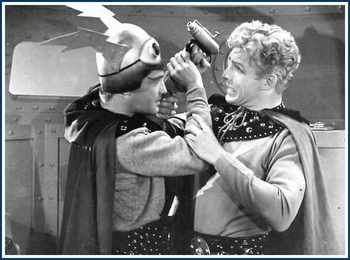
George Lucas has explained that his inspiration for Star Wars–in considerable part–came from the Flash Gordon and Buck Rogers science-fiction shows he watched as a child. These “space-opera serials” helped to inform and create his own. You can see it in the devil-may-care blaster-toting Han Solo, all of the space battles, and even in Luke’s wannabe adventurer character: at least in the beginning. Basically, these old science-fiction elements are integral to Star Wars’ existence.

I just thought this scene from The Star Wars alternate reality comic–the one adapted from an original draft of Star Wars itself–would be appropriate on some many levels considering the subject matter and the character resemblances. But what is definitely from my perspective is the following.

Then you have the Prequels, or the New Trilogy. One thing that most creators of worlds tend to do when they make a world for the first time, or try to re-imagine a pre-established world is to “go back to the basics.” You see a lot of this in comics nowadays: using Golden or Silver Age characters and expanding on them or taking a different slant on how they might be. What I think happened was George Lucas looked at the Star Wars universe he created and decided to “go back to basics”: to tell the story of what caused a lot of the events that happened in the Old Trilogy and at the same time re-imagine Star Wars. Of course there are two kinds of re-imaginings: which are reboots (which the Prequels were not) and matters of continuity.

From my perspective the Jedi are evil … no, George Lucas brought Star Wars closer to the spirit of the source material that informed his own childhood enjoyment: that of Buck Rogers and Flash Gordon. In fact, I believe he said as much in an interview or two in the past.

Flash Gordon aesthetics …
Meet Revenge of the Sith.

I believe that with the Old Trilogy, Lucas started out with those inspirations and expanded from them into something that looked older and actually resembled that strangely wonderful and mysterious phrase, “Long, long ago in a galaxy far, far away” that never gets explained but is still beautiful. With the Prequel Trilogy, I feel like that Lucas “went backward” and started to make something closer to the old shows he was inspired from. It wasn’t old and established anymore. The lines and creases weren’t there: the organic elements were stripped away to reveal this prototypical place.

Not all of the ideas in the New Trilogy were bad. Some were very intriguing and even did expand on certain elements in that galaxy. But unfortunately, they were elements that were poorly executed: if only because they seemed rushed. There was only so much lore you can throw into even three films to hold someone’s interest and sometimes things can get lost when you try to be succinct and “to the point.” Also, and I think you might know all too well the example I’m thinking about, it is a lot like humour: sometimes you can hit that place and sometimes you get far off the mark and actually offend people. Jar Jar, I am looking at you.

But some wooden dialogue and unfortunate caricatures aside, I think there were a lot of concepts that just couldn’t be fit seamlessly into the Prequels. I don’t like all of them and I would have liked to see some different things happen than what did, but I can sympathize with those limitations. That is probably what The Clone Wars CGI cartoons are for: to fill in the gaps between Episodes II and III. Again, they seem to hearken back more to Flash and Rogers and there are some intriguing concepts in them but they can be clumsy and awkward to watch: never mind how they can mess with continuity. And then, of course, there is the humour too.

Some people might even find the closeness to those old science-fiction serials outdated for our time, but I can see how it can be pulled off. I will tell you though that the galaxy of the Prequels does feel like a different galaxy from the Old Trilogy and sometimes it s a jarring thing to realize there supposed to be the same. I miss the mystical elements and mysteries of the Star Wars I grew up with.

And then there is Stars Wars: The Old Republic. I haven’t played this online multi-player game but my friends do and they have been trying to get me on this habit for a while now. But from what I have seen, this galaxy has gone back longer ago, but unlike the Prequels it does not seem farther away. Here you have the grittiness of the Old Trilogy mixed with a massive amount of Jedi and Sith lore. Both Jedi and Sith do not feel as watered-down as those in the Prequels: in fact from what I have seen they are what I always expected them to be. You have your bounty hunters, dynamic smugglers, and all of that stuff with plenty of story and mystery to explore.

I feel that for this game, the creators went back to the basics of Star Wars: but instead of merely just the science-fictional basics, they went back to the archetypal mythological building-blocks that I love so much. And I feel that is a place where the New Trilogy should have gone: that if we had gone to the mythical gravitas of the Jedi at their peak, Anakin Skywalker as a hero, Obi-Wan as a wise mentor even then, with Yoda still in the place of sage, and seeing Anakin go from something of a combination of Luke and Han into a tragic monster instead of the flash of ship and droid battles, and an actual romance between him and Padme in the films it would have made all the difference. Also, seeing Darth Vader slaughter Jedi in his suit, and even seeing the populace turn on and allow soldiers to take away and commit genocide against the Jedi–who’d otherwise been a natural part of their galactic population–would have really been far more striking and effective: from my point of view anyway.

Still, I am glad the New Trilogy exists and has inspired me and others. I like it in that it seems like a prototype or an outline of a movie or another world. But I would go with the timelessness of the Old Trilogy any day.

I would like to mention one more thing though. There are some people that wished Star Wars would be as dark and gritty as the Old Trilogy and remain so. Some people do not like the “cutesy” elements of it. You know the ones: the talking battle droids, the Gungans and the Ewoks.

Let me tell you something about Ewoks. I know that many consider them to be a blemish on Return of the Jedi. I don’t. Long before I watched the movies, I used to watch Saturday afternoon cartoons like Ewoks and Droids. They were the things that made me aware of the Old Trilogy. I really liked the Ewoks and the droids and seeing them in live-adventure with other bad-ass characters made Star Wars seem so much more real to me and that made my childhood self so happy: as though they–my friends–could exist somewhere out there past all we know in our world.

Sometimes when I get annoyed at the droids or Gungans, I ask myself what would it have been like if I hadn’t seen the Ewoks in Episode VI: if Star Wars had remained completely gritty all the time to the very end? People decry marketing the films solely to children, but children have made this universe. I was a child when I saw the films and they changed my life. Do I think that children can handle grittiness, violence, and the concept of the struggle of good verses evil? Of course. I definitely don’t think that things need to be “dumbed down” or completely censored out for children to like them. I also don’t believe good quality films for children should be three-hour long commercials.

At the same time, I also believe that a little light and levity and the comical–when done well–are also good for children and adults too. I wouldn’t have liked Episode VI if Han Solo had died the way it was originally planned or if there had been no Ewoks. They are also a necessary “basic” in the Star Wars universe: almost like a living cartoon–a neoteny–that is different from us but definitely something we can relate to. I always find it funny how we can relate to something that is more simplified than we are more than something that is supposed to be as complex and “serious” as us.

That too is something to keep in mind with regards to Star Wars, or Indiana Jones, or many similar adventure films: that while archetypal dangers and challenges are key, it is only when they are set with humanity and warmth that they feel like you are taking your first step into a much larger world.

Addendum: I DO like Lucas’ film work paralleling scenes between the Old and New Trilogy: especially with regards to what Luke does and what Anakin does. Also, Anakin Skywalker is a very good subversion and critique of the vintage reckless, daring hero archetype.

Horror as a Universal Power: The Function of a Creepypasta

So in my previous Blog entry, “Horror as a Universal Power,” I talked about how I believe horror is a slow-growing epiphany or realization of just how beautiful and terrifying the seemingly normal reality around us truly is: how it is a feeling we are both repulsed by and attracted to in a kind of feedback loop. It’s this kind of perverse fascination with something very strange and uncanny right in front of us.

After something of a Blogging dry-spell, I was watching a few horror movies such as Insidious and Don’t be Afraid of the Dark: you can, in part, blame these films for today’s horror craze on “Mythic Bios,” but it was also due to finding a unique “creepypasta” that I also began this.

When I first saw the term “creepypasta,” I had no idea what the hell it even meant. What first came to mind was a strange of twisted pasta with a pale hollow-eyed doll’s face on the end of it, or a malignant white spiral-worm with a single blood-shot eye. So after I really read a definition of what a creepypasta is, I realized it is derived from a term called “copypasta”  in which someone supposedly copy and pastes a body of text over and over again onto different websites and message-boards. So basically, the pasta is taken from the word “paste,” while the “creepy” part is pretty self-explanatory.

The link I provided above pretty much lists different kinds of formulas or tropes that creepypastas fall under, but that is not why I want to write this article about. I want to look at just how the creepypasta is such an effective medium of communicating the essence of the horror genre.

My first experience with a creepypasta was when I was sent the “message-board transcript” Candle Cove. I actually didn’t know that this was a work of fiction because the person who created it, Kris Straub, did a superb job in crafting the narrative aesthetic. It actually looked like a message board conversation would: complete with screen names and typos in discussion. He also tapped into that place of barely recalled memory and nostalgia–into the zeitgeist or spirit–of 70s children shows to great effect: along with an incredibly effective sense of pacing and different voices for each “poster.” The element of television static and white noise within the story was even more inspired because it plays on the depths of the imagination and just how far someone–particularly a child–can fall into it.

I really liked “Candle Cove” because you don’t know that it is a story and it is written that way. It is also written in a way which taps hard on that collective unconsciousness we all have and actually in some ways made it real. And that is the thing right there. Candle Cove, though fiction, made itself real.

This is what I really want to talk about. Other creepypastas have managed to do something similar based on the characteristics I listed above from “Candle Cove.” The thing that actually influenced me to write these two recent Blog entries was a creepypasta called Ben (or the Haunted Majora’s Mask Game). I came across an account of it on Youtube purely by coincidence. You can read a very long written account of it here or watch the video “footage” that the creator made to complement it here. What we have here is a mixed-media story: a combination of message board posts, a text file, a Nintendo 64 game-hack and video recordings by a user named Jadusable. But look at what he does here.

First, he turns a game made twelve years ago–a Nintendo work firmly entrenched into this generation’s or at least this gaming generation’s collective unconscious–into a medium for his story. He purposefully glitches parts of this hacked game and uses elements of the game itself to add to this story. Bear in mind, Legend of Zelda: Majora’s Mask is a very unsettling but wonderful game to begin with taking place in an alternate dimension from the usual world of Hyrule with various characters and elements to work with: not the least of which being the graphics, soundtrack and some of the dialogue.

Some parts of this creepypasta are, however, somewhat stereotypical and cliche: such as the protagonist and creator Jadusable buying “a haunted bootleg” from a “creepy old man” but that is a trope part and parcel with urban legends in general. Most people would have a lot of trouble suspending disbelief for this–especially gamers–but it does have some very creepy moments: especially for me given that one of the text messages on one of the videos associated with the piece referred directly to a person named “Matt.”

I think the reason I find this creepypasta fascinating is because it uses elements of our generation–specifically video games and the medium of the Internet–to attempt to relate to us in a way might not have affected other generations. Other creepypastas that have utilized Nintendo such as Pokemon Black and Pokemon Lost Silver really tap into that shared popular cultural consciousness, but they do more than that. You’ll find that if you Google or even click on the above links (pardon the unintentional pun), that after these stories became memes–cultural information that spreads to different people–people started creating works based on these pastas to make them more real. Candle Cove now has surviving televised scenes on Youtube. The haunted Majora’s Mask game has many imitators and parodies. Even the Pokemon games I mentioned have been made into actual bootleg games by readers of the things. Basically, they are not only Internet memes, but they become living stories. They become alive inside the people that want them, and I think that is an incredibly bad-ass concept.

It makes me really want to create a creepypasta of my own. I’ve had ideas for some, but I never really followed through with them. You have to get that mixture of intentional typos that look unintentional, a compelling and readable but realistic-looking narrative aesthetic and revealing the horror but not revealing the full origin of the horror down pat because not only do you have to contend with a reader’s disbelief, but also the myriad of other creepypastas out there that share so many–and in some ways too many–characteristics to make yours unique. I tend to get very elaborate in my works and that would definitely count against me in creating such a potent literary hoax.

Still, I know I can’t help thinking about it. It is no coincidence that a loved one chose to give me the strange and wonderful gift of an old newspaper article talking about the effects of the legendary War of the Worlds radio broadcast on its audience at the time.

A creepypasta functions as a horror story pretending to be real and yet even when revealed as fiction, readers make it real by believing in it and paying homage to it. In other words, we make our nightmares real and we actually seem to enjoy doing so which leads me back to my original question of why?

The Internet allows creepypastas to exist: to replicate and spread across not merely servers, message boards, and chat-rooms but imaginations as well. Where is that line between the machine and the human mind these days? What happens when we interact with an increasing body of knowledge that we can manipulate and shape to our whims (technology permitting)? I believe that, in the end, creepypastas exist for three reasons: the first being entertainment, the second being that they are a form of oral storytelling around a pixelated campfire, and the third because we want to believe and make real and manifest the idea that the wondrous and the terrifying can exist in a world where we all live: where something like the Internet exists and not only contains the growing sum of all knowledge and information of what we think exists in our supposed certainty, but also human experience and its less concrete intuitions as well.

I also believe that in light of all of this creepypastas–along with their verbal and written urban legend and folktale predecessors–demonstrate that horror is not only the fear of the unknown. Rather, horror is the love for the unknown–for an unknown–and the sheer limits of human understanding.

Ray Bradbury Enters the Pantheon of the Book-People

No doubt by now there are–and there will be–a whole bunch of articles dealing with the recent death–and long life–of Ray Bradbury. I feel strange writing about him. The fact is, I didn’t read very many of his works, and I was not a fanatical fan. When I first saw news of his death today, I was originally going to just leave a sad Facebook status message and leave it to better writers and fans than I to write the obituaries that he deserved.

But something stopped me. It was in high school. I was in a dystopian mindset, if not reading a lot of the fiction and literature around it. I don’t remember what Grade I was in or what class it was–I will assume English–but one of our required readings was the book Fahrenheit 451. I didn’t know what to think of it until I read the first sentence that started the entire story off. They tell you when you begin writing that you should always start strong–create a powerful or striking first sentence–and finish strong as well.

The protagonist Guy Montag was a fireman: in that he didn’t fire, but he fought with fire … on books. I never realized until now just how that works on so many different levels. It was a story set in a futuristic political dystopia where people were encouraged to watch television, medicate themselves, and never to read again. Books were burned when found and people possessing them were arrested and executed for having them. The slogan “fighting fire with fire” gains a whole other kind of horror when you think about it in the context of this cautionary tale: when you look at even the cultural resonance of what book-burning represents.

A lot of things happened in the course of that book, but two things stayed with me. The first was Captain Beatty, the Chief of Firemen and Montag’s boss. He was the antagonist of the story, but there were details about him that struck me. Beatty used to love books, but eventually got disillusioned by the realities they revealed. He became a fireman to destroy them and “protect others” from that disillusionment, from having their perfect ignorance destroyed yet when confronting a rebellious Montag he used that same knowledge he gained from his books to persuade the other. What struck me about that character was just how sad he really was: that despite his bitterness, he still loved those books and–in the end–he didn’t even stop Montag from burning him. He died the contradictory way he lived. Beatty was a tragic figure: representing ideals verses reality and the contradictions between them and that kind of character stuck with me for the rest of my life as a writer and as a human being.

The other element of the novel that really stuck with me was the idea of “the Book-People” memorizing and representing lost books: until society stopped burning them, or society itself ceased to exist. Think about it: each person has inside of their minds a book that they chose to memorize for the duty of maintaining the knowledge within it and restoring it one day. I can’t think of anything more noble or sacred than a duty like that. It made me think: if books were outlawed, which one would I want to embody and preserve? I think with me it would be Homer’s Odyssey: if only because I have read it several times over. I do wonder though who the “book-keeper” of Fahrenheit 451 would be and I hope that he, or she, would be a strong one.

Ray Bradbury was the one who made me ask myself that question. He brought me to that kind of dystopian world and presented me with something complex, yet when exposed to the temperature at which paper burns, very essential. I can summarize how he was one of the last Golden Age science-fiction writers still living, that he kept writing on for years, and that he had himself become a cultural icon, but the truth is, Ray Bradbury was important to me because if he had never written Fahrenheit 451, or I never read it, I would not be the same person or writer that I am today.

Rest in peace, Ray Bradbury. It was a pleasure to burn.

How to Turn a Medium into a Genre: 8 to 16-Bit Video Games

So, I am not a programmer. I am not someone who games regularly–online or otherwise on computer and console–and as such I have not played many of the modern games that exist out there. I played all the way to the 64-bit and then the wii era. For all I haven’t played in a while or even having never been an expert player I am–like many children from the 80s–a Nintendo child.

I watched video games evolve into more or less what they are now. I know that there are some older than me who grew up in the 70s that saw what video games were like before and I have watched enough–and read enough–to see that they have come a long way in a lot of ways. I remember the day I saw my first Super Nintendo. It was at a friend’s house and the graphics looked like they were from a cartoon. They were lusher than the 8-bit pixels that existed before and possessed more expression. The music sounded less transparently synthetic and more … fuller in a lot of ways. I am not knocking or putting down 8-bit video game music however: after all, 8-bit tracks sound very expressive in how synthetic they are with clear beats, beeps and keening noises.

But when I saw the Super Nintendo I wanted it. I wanted it so badly. My brother and I scraped together everything we had to buy one. And we weren’t disappointed. The Super Nintendo and many of the games that followed on that console had excellent game-play, good graphics, wonderful sound, and in some cases some brilliant story-lines and expressive characters. There was a lot of innovation for gameplay and mechanics then as well. 8-bit was functional and fun but it was seriously like going from the second to third dimension. At the time, I thought that video games would improve and keep going up and up: that more realistic graphics symbolized this advancement.

There was a point where I actually stopped playing old games because I began to believe that they had become old-fashioned and obsolete: that something that didn’t look as realistic as it could be couldn’t be taken seriously anymore. Yes, back in the day when all one could do was make 8 to 16-bit games, it was all very well and good. But in a more modern age with newer games, I got into the habit of thinking there was no excuse to go back to those and that one had to advance with the times.

I was obviously wrong.

I found Final Fantasy VI and Chrono Trigger long after their console was obsolete. Chrono Trigger in particular was one of those Super Nintendo games made towards the end of that system and it was so sophisticated and its pixels were made in such intimate detail along with its unique choice of game play that it made me happy to see it. There is something very archetypal about the pixel cartoon that others like Scott McCloud (at least with regards to comics) that to some degree one can relate to and emphasize with much more than the gritty and the realistic. They made me start to replay old games and instead of them making me depressed in that they were from the past and a time that didn’t exist, I just wanted to have fun with them.

If you ask me, I would say that my golden age of video-gaming was the Super Nintendo age. Even Sega’s competition added to that. Now fast forward a few decades. Now you have independent game makers and programmers, as well as those working on Internet and cellphone games, going back to those exact 8 to 16-bit forms. They do this for a variety of reasons, but the main one is that what was once a medium–the only way of expressing and symbolizing interactive programming in a game–has become a visual-audio aesthetic. In other words, an old medium has become a genre: it has become a creative choice and I think that is wonderful.

I mentioned that a month ago I went to the Toronto Comics Arts Festival and one thing that I made sure to see there was an exhibit called Comics Vs. Games: the result of collaborations between comics artists and independent video game programmers. I will admit that I have more than a passing interest in writing scripts for video games–and writing for video games–and what I saw and even played at TCAF was excellent.

One of the games that I actually played was The Yawhg: which was basically a game where you had to improve your skill-set before a cataclysm so you can help civilization rebuild itself. It had static screens with expressive backgrounds and artwork and a skill modifier number system: for example you got +3 if you completed a task you selected on a menu. It’s reminiscent of the Math Wizard game on the old computers at school, but it was so much fun because it made you use your imagination and the game mechanics were dynamic enough to make you want to play quite a few more times.

Then you had We’re No Angels where you play these 16-bit music celebrity sprites trying to escape from God and Heaven to go back to the real world and party. I didn’t really get to play the other two games, but as you can from the link they are very interesting. For example, The Mysterious Ambroditus is like an intricately illustrated Victorian Mortal Kombat game using a rock, paper, scissors method of card combat.

I’ll let you in on a secret. I actually enjoy watching people play certain kinds of video games. Often, you’ll find me watching Let’s Play videos on Youtube: particularly those of Boltage McGammar and HcBailly. But I haven’t played many video games myself in a long time. You can even ask my friends who had been trying like crazy to get me to play Knights of the Old Republic. But I played these games. They were even two-player and I played with them along with some random person I met at the Festival.

I know this entry seems a little random considering the other things I write about here, but I think it relates a lot to my mindset as a creator and as someone that enjoys interactive stories. I find it amazing what our time is doing with old games and cartoons from the 80s and onward: things that were once the present day of many of us and I like how there is new life in them. Old mediums are being made into new genres and new mediums and, you know what? I am glad to be here: just for that.

Film Review: The Avengers and their Mythology Revisited

There be spoilers here. You’ve been warned.

I wrote a very short review of The Avengers film a little while ago, but in light of much more detailed reviews and analyses: such as the relationship between genii Tony Stark and Bruce Banner, and Loki as master manipulator and challenger of the once and future geek status quo I thought that I might expand on some things a little more and maybe even respond to a few of these articles as well.

Remember, this is a spoiler alert: if you have not watched this film–and you should–then you have again been duly warned.

Avengers really reminded me of a lot of the lore that I used to read from Marvel cards and it totally played on the fandom that has generated around the Marvel universe and the superheroes that make up the Avengers team for decades. Again, I was at somewhat of a disadvantage myself in viewing this film because I have not seen Thor, or Captain America. Unlike Ex Urbe in the second link I posted, I knew that this wasn’t an extension of the great Ragnarok event that plagues the Nordic gods and it deals with the Marvel comics mythology instead: unfortunately I have been pretty rusty to that regard and having not been there in a very long or consistent time.

Each character was bang-on with regards to their comics incarnations as far as I remember. But like I said, I really like how they were played for the most part. If Captain America had been created in our time, he would been seen as a very transparent and tasteless living embodiment of propaganda. I know that during his Death in the comics world, there was a whole thing about selecting a new Captain America and showing just how different that Captain in our time would have been from Steve Rogers we know from WWII.

The Captain America in the film was played as a legendary hero–a relic of a certain moral structure that not even many people in his time or country embodied–and I like how he is seen as a piece of history: which for all intents and purposes he is. He is also still a human being who–while he follows orders–does not follow them blindly. After all, even after ages of suspended animation, Cap is not like the enemy soldiers he used to fight during the second World War. In fact, he makes reference to that time at one point in a very poignant but quick way that devolves into another battle.

Tony Stark is still a wise-ass that always thinks about contingencies, while Thor is still a strong being yet also very noble and cautious. I like that portrayal of the Asgard: because while his mythological archetype was generally stupid and little more than an over-sized brute that would have rivaled the Hulk in mentality and action, the Marvel Thor that we see is a being that wants to protect others and actually thinks about the implications of his advanced people’s presence and technology on the people of Earth.

I can’t say much about Black Widow and Hawk-Eye except to say that they seemed more like secondary characters compared to the others. I do like, however, how Loki plays on them: how he plays on both of them and you see as a viewer just how–for all everyone involved are supposedly superheroes–they are not all innocent. Certainly Samuel L. Jackson’s Nick Fury is as no-nonsense and as much of an “inglourious basterd” as ever: though a little more refined than the comics Fury (who I believe was a contemporary of Wolverine and Cap during WWII and he was the one who fought H.Y.D.R.A. instead of Cap) and in some ways very much more underhanded for the “greater good.”

I think though that the performances that really got me were Bruce Banner and Loki. First, let me deal with Dr. Banner. I have in fact seen both relatively recent films created around the Hulk, yet this film does something the others really don’t. Avengers looks at Bruce. You notice how I don’t say the Hulk and there is a reason why I do this in particular. In almost every other bit of media–film or otherwise–the green gamma beast is brought out for his spectacle effect and Bruce Banner simply tries to contain him. But here we see Bruce Banner as a person. We see a brilliant but haunted man who does not want to cause destruction and pain. He has suffered and yet despite this still tries to help people with his knowledge. He is a solitary person by his own perceived necessity if not by choice and in a lot of ways he is a very sad man.

A good portion of the film has people walking egg-shells around him and thinking they have contingencies in dealing with the “green nuclear djinn in a human bottle”: not realizing just how strong Banner actually is and how many “contingencies” he himself has undergone. Beth in her own review shows that the only person who doesn’t treat Banner as an accident waiting to happen or a potential resource is Tony Stark and she gives very compelling parallels between the two: to the point where I remembered Tony Stark taking a drink before dealing with Loki and actually wincing at that segment alone more than anything else in the film. They are both brilliant men that have their own demons. and they can relate to each other. However the difference is that Bruce Banner has a lot more control over the Hulk than people even think.

Personally, I think there is a difference between Banner being agitated enough to release him and purposefully bringing his alter-ego out. When he does the latter, the Hulk is in a lot more control and in fact–when it comes down to it–there is no difference between Bruce Banner and the Hulk. They are and always have been the same person. “The Other Guy,” that kept Bruce Banner from killing himself, is not just anger but a fury for passion and life and ironically as the film progresses you see Banner actually almost coming to terms with that. It is no coincidence how in the comics, Bruce Banner changes into the Hulk permanently yet manages to keep all of his intellect along with the righteous fury. Even in the movie, Banner says that the secret to controlling his power is that he is “always angry.”

And then you have the threat that brings all of these disparate beings together: Loki. Loki himself, like Thor, has his precedent in the Nordic mythological cycle. Loki is a trickster god and an agent of chaos. He is not biologically related to the Asgard deities but instead has Jotnar (or frost giant) blood in him. While Loki begins as a mischievous prankster, he ends up creating Ragnarok: the twilight of the gods. He transforms from trickster to destroyer. Perhaps in Thor, this role is prevalent as well in its own Marvel incarnation, but I want to talk about him in the film: something that I only alluded to in my earlier article on this Blog.

Loki feeds off of chaos and he is not an overt player. Ex Urbe really goes into immense detail with regards to Loki in the film, but let me just reiterate something I said in my last article in that he plays a really good game. He manipulates and feeds on the power of discord that the Avengers feel towards each other. His very presence caused their assembling and exacerbated the cracks between them. In many ways, he arranged it so that they were almost as dangerous as he and his allies were. As to how far his foresight goes–if he knew they and they particular would be chosen to deal with him–is another matter entirely.

As I said, Ex Urbe really looks at how clever Loki is. You notice, for instance, he barely ever fights and he likes to make his enemies think that they can always beat him. The moment Black Widow thought her interrogation strategy had worked on him, I knew she was screwed. Never try to trick a trickster or play their own game because they will beat you with experience. He sat back and let Captain America, Iron Man and Thor fight each other. And then, when he seemed to have failed in his mission to conquer Earth, he conveniently gets captured by Thor and they go to Asgard with the cube away from the wrath of the trickster god’s vengeful allies. All and all, I think he was right to postpone and then later ask for that drink.

I also really like the part where Loki is in Germany and he asks everyone to bow down to him and one old German man won’t who states, “Not to men like you,” and then later adds, “There are always men like you.” The thing that you need to understand is that Nordic mythology really played a powerful role in German culture. Others, including Richard Wagner, played off of these archetypes in the collective unconsciousness of the German and Germanic people. Wagner was also a really well-known anti-Semite and his operas were well loved by various members of the Nazi Party later on. Nietzsche referred to a figure of the “actor” or “demagogue in music.” Looking at Loki forcing everyone to bow in front of him–with the compelling words and presence of a trickster and “god”–with all of that historical resonance the immediate background and that old man standing up to him really put chills down my back.

In this, Ex Urbe might seem wrong in stating that Loki is attempting to help humans and gods beyond the status quo: that he is just another fascist power. Of course, there is another way of looking at this in an analytical sense: that by posing as a dictator (and one really bad at ruling apparently and inefficient in other ways), he is making humanity challenge him and the established order of things. Remember that the role of a trickster deity in mythology is to challenge the status quo and subvert authority. A trickster also helps humanity by giving it something that can potentially destroy itself and stealing it from the divine order, but also creating an order with it. In addition, trickster gods can take a lot of physical punishment–a lot of it–and they almost seem to goad others into delivering it to make them think they have the upper-hand. In this way, Loki is almost a comic mockery of the things he rebels against, a Wagnerian parody and by serving as that cardboard cut-out effigy he helps to subvert it. So perhaps in that way, Loki is more like Nietzsche’s Zarathustra than his “demagogue in music.”

Then there is Captain America’s reply to that–which actually plays well into the above idea: if Loki is leading him and others by the nose. There is also something else Captain America says afterwards. When Black Widow refers to Loki and Thor as virtual gods, he states, “There’s only one God, ma’am. And I don’t think he dresses like that.”

While this last quote can be seen as very culturally chauvinistic, because there are many different beliefs out there, it definitely shows Cap as a relic of his time: as someone who views the world in a certain way. At the same time though, if looked at from a different perspective, Cap could be seen as stating that even these perceived gods and superheroes–least of all himself–are not above a greater morality or law of some kind. He interprets that as God. The others interpret it as something else. Loki probably interprets it as freedom of power and chaos.

Of course, there are other concepts of absolute powers or incarnations of concepts as well. Long after the film is over and Loki is captured, you find out that the invaders were working with someone behind the scenes. The leader of the invaders tells his real master that invading Earth will only bring destruction and Death. Notice how I capitalize *Death.* Neil Gaiman was not the only writer who created incarnations of certain facts of life in anthropomorphic figures. In the Marvel Universe, there are beings called Embodiments and while you do not see Death at the end, you do see the being that … serves her female incarnation. And if you have read the comics, you know who I am talking about and you begin to realize that Loki is not the only being that plans things out. This is the Marvel plots-within-plots structure in film form, social commentary and mythological cycles of sequential drama all done well by Joss Whedon.

I think that I am going to leave this off right here. All and all I really loved The Avengers. I never even thought of a movie based on them and it worked very well. The mythology–both comics based and older–created excellent resonance along with Whedon’s trademark snappy dialogue. I also look forward to its sequel and I wonder … just what was that small dagger that Loki stabbed Thor with towards the end of the film? And just what role will Death and her harbinger play in the scheme of things? I hope to find out soon enough.

ETA: Here is an obligatory and intriguing article by M. Leary on gods in Avengers and Marvel. Excelsior!

Film Review: Joss Whedon’s The Avengers

So, after a basically last minute scramble to do no less than two mini-operas for the contest that Neil Gaiman posted on Facebook, I found myself tired yet at the same time also full of energies. I will talk about just what was involved in making the two mini-operas soon enough. But today was Victoria Day in Canada and my dad and I decided to go see The Avengers movie.

It’s been a long time since I’ve seen a movie with my dad. I’ve been very preoccupied lately and I had to ignore the impulse not to go out anywhere today. Also, even though many of my friends liked this movie, I was still leery of it and the perfectionist side of me also hesitated: wanting to see all the individual movies of the superheroes involved in this film. Joss Whedon’s name as the Director also helped a lot in my decision and so I went to see what this was all about. So today, you’re going to get a little bit of a film review with very few–if any–spoilers for those of you who haven’t watched this yet.

Before I go on, I just have to add that I’d known the Avengers ever since I was a child. I collected three series of Marvel cards: including the holograms. I also read as many comics as I could get my hands on and any trivia as well. I really loved to read superhero and villain origin stories and information. While I know there were a few cartoons and such, I never gave much thought of an Avengers film on the big screen.

The movie started out in a somewhat confusing way, but was also pretty straightforward. I didn’t exactly recognize the main villain at first, but once introductions were underway his identity made a lot of since. Basically, the plot structure of this whole film was adding one potential catastrophe after another and seeing how the characters dealt with this “series of unfortunate events.” I guess you can say that about any action film, mind you, but then there is another element that was really interesting to see as well.

The best way to explain it is character conflict. Imagine a few super-powered or highly skilled people placed in a single place with differing viewpoints and agendas. This has been done before, and to death, of course but Whedon excelled in bringing this out and actually making it an integral part of the film. Chaos is a central force in Avengers–one which this particular villain is traditionally gifted at causing his foes–and watching it play out was just being able to look at pure, destructive genius. As you continue watching this film, you realize that in some ways, the heroes have just as much potential to be dangerous to the world in their state of disharmony as the villains that are actively and consciously trying to cause mayhem and destruction.

Of course, there is a lot of genius and epic courage in just how that chaos is–for the moment anyway–resolved. And even all of this would have just been slightly above the par of usual events that occur in an action or superhero movie if not for Whedon’s humour, witticisms and pop culture references–especially with regards to the Marvel heroes–that he is so known for in Buffy and all of his other works.

I actually really enjoyed this movie. It was a challenge. There have been many films where heroes and villains team up from different places and become generic cast-off or one-function characters. One character in this film perhaps functioned that way, but Whedon put a fair amount of psychological dialogue and character development in there to more than make up for it.

All and all, I would give this film a four out of five if not a five. Also, I had a few guesses as to whom the real power behind the chaos was and I was not disappointed: just awestruck. And I look forward to the near future when the Avengers assemble again.