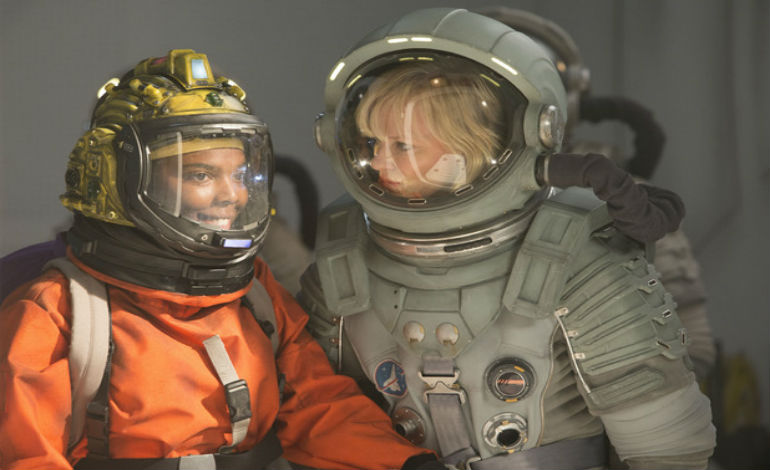
Welcome To The World of Wolves: At The 2014 Toronto After Dark

What are wolves? Are they solitary predators that attack the weak and helpless? Are they a pack of monsters? Or are they a family that merely tries to survive their environment? David Hayter’s Wolves explores these ideas well and, dare I say, quite subversively.

Of course werewolves are subversive in themselves. I mean, think about it: historically they are generally portrayed as human beings with animals inside of them, or at least as something Other that only comes out under a full moon. They are the hunger, the passion, and the violence that are parts of us and the natural world that we keep at bay until such a time as they have to be unleashed. But that, of course, is not the whole story and I will get back to that thought soon, I promise.

Wolves starts off not unlike the 1985 comedy film Teen Wolf. You have a popular student named Cayden, who seems to be a fine specimen of a young man in all ways — a good student and football player — who finds out that there is a beast inside of him. However, there are no kindly secret werewolf parents to guide him or girls attracted to his occasional hairiness. There is fear though: and blood, and horror. The first part of the film is like watching the wolf take off his human skin, his bland human life, or — if you’d like — stepping out of the sheep’s clothing and leaving a great sense of bloodstained shame, and a fear of one’s self.

It’s like watching teenage angst: only with the trappings of tropes shed and murder.

Naturally, Cayden wants to know where he comes from and what he actually is. And then we are introduced to the small town of Lupine Ridge. And David Hayter continues to play with your expectations. He presents you with the first-person narrative voice-over and perspective of an otherwise decent young man who seems to have committed horrible atrocities when he isn’t himself, and then a town of seemingly hostile people in a bar who, well, you expect to act in a certain way.

Frankly, I was surprised that Cayden didn’t get into a physical fight right away in that setting and leave battered and bleeding at the onset. And I haven’t gotten to the character of Connor yet. Connor, for all intents and purposes, pretty much rules Lupine Ridge as something of an Alpha Male. Jason Momoa certainly, in terms of physicality, fits into that role but even he is subversive.

For instance, you might expect Connor to be a thug or a beast that pummels and rips apart anyone in his way off the bat. But you would be wrong. Instead, Connor watches. He watches. He waits and he extends all of his senses out and tries to reason things through his mind even as he subtly intimidates. And for an obvious antagonist who could easily fit the thug mold, Connor has, if you will pardon the pun, a rather biting wit and a sense of honour and personal rules not unlike someone of the Lawful Evil variety. You can see a little bit of Khal Drogo in Momoa’s mien in addition to some StarGate Atlantis Ronen with his sarcasm. He does terrible things but, as you watch the film, you will begin to figure out why. Momoa’s performance as Connor is impressive and entertaining.
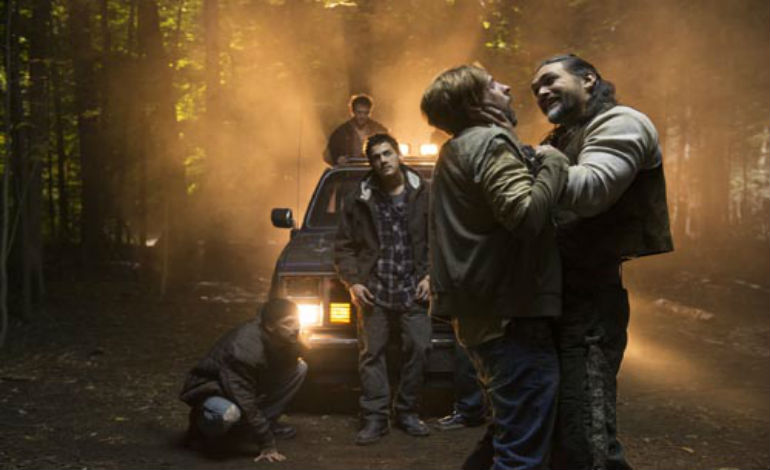
Just don't make him angry. You won't like him when he's angry.
Just don’t make him angry. You won’t like him when he’s angry.

I also like the addition of Stephen McHattie as the farmer John Tollerman. I admit when I first saw him in the bar I didn’t know whether he was a friend or foe. He was once Gabriel: an antagonist in the Beauty and Beast television series. So in a way it’s fitting that he would be dealing with a beast of a different kind in this story and he really grows on you. And you know, you definitely know when you see the enigmatic one-eyed, metal-braced Wild Joe that there is going to be some craziness and there is something strange about that man.

Some dogs don't like to follow orders. Sometimes they just like to do what they want.
Some dogs don’t like to follow orders. Sometimes they just like to do what they want.

I think I would have liked to see more character development with the female character and interest Angelina and some of the other characters. Certainly, at first she does seem very resigned to being “mated with” by Connor as only other “Pureborn” werewolf in town, though — granted — she is only doing so to make sure he doesn’t kill her loved ones, and somehow ends up liking Cayden for some reason: as what seems to be a stereotypical love interest. And while she starts off as far more advanced than Cayden is in knowing who she is, she ends up falling a bit into the powerful female assisting the protagonist trope. Still, I do appreciate the fact that Angelina sets a lot of facts straight for Cayden. She has roamed these woods, metaphorically or otherwise, before and her insights make you begin to doubt some of Cayden’s own perceptions of things: particularly about himself.

I suppose sometimes someone just knows you.

But I think what really strikes me about this film is how Hayter handles werewolves. He starts us off making us think they are monsters because of their bestial nature. We find out about the differences between Mutts (who are humans affected by the lycanthropic bites of werewolves and are always weaker than real werewolves) and Pureborns (who are born werewolves). You can also observe that even in their human forms there are tells: such as the occasional luminescent glint in their eyes, demonstrations of acute senses as well as extraordinary reflexes and strength. In addition you begin to realize that there is a difference between werewolves that stay as wolves and those that have stayed in their human forms for quite some time.

In addition, Dave and Lou Elsey are masters of makeup. They manage to combine the grace and elegance of a wolf and the symmetry and proportions of the human form.
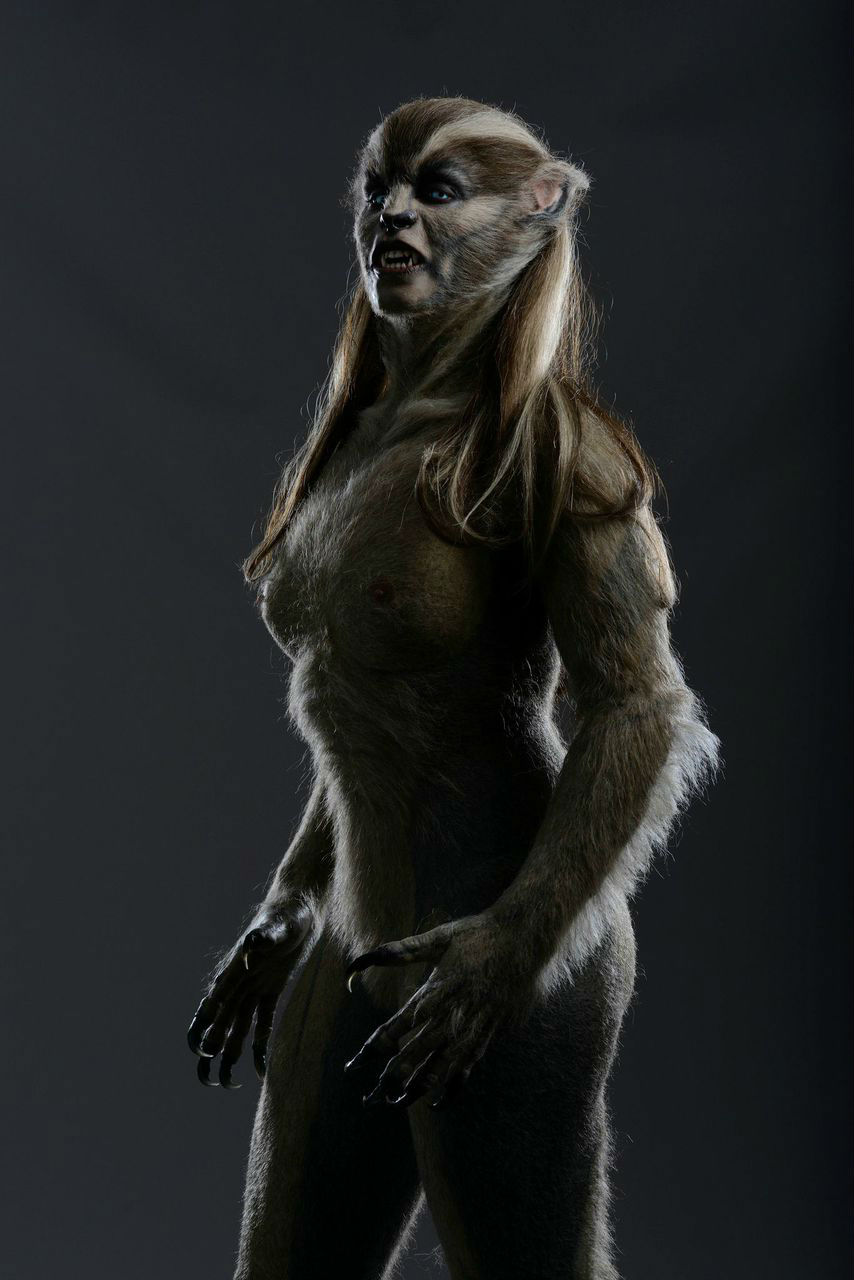
In other words, Dave and Lou Elsey make these film werewolves  distinct and beautiful.
In other words, Dave and Lou Elsey make these film werewolves distinct and beautiful.

And David Hayter plays with film expectations of the werewolf trope. I like how werewolves apparently come from “back east”:  seemingly a reference to their origins in Eastern European folklore for this film’s purposes. Yet I think my truly favourite scene was when John, his wife, and Cayden are watching television and The Lone Ranger is playing. If you didn’t think Hayter was winking at you before, he definitely does so at that point.

And just wait until you see what comes from that.

This is actually a good point to get into one other aspect of Hayter’s werewolves: mainly their nature. One expectation of the werewolf is that it is their wolf nature that ultimately makes them into monsters. Time and again we horror film watchers see this primal instinct destroy humanity and cause nothing but suffering in its wake.

But what if it isn’t the animal — the wolf — that is the monster?

If you look at ancient werewolf folklore, werewolves were often depicted as humans — sometimes witches and sorcerers —  that took on wolf skins and committed horrible acts of cannibalism and murder. Human minds, twisted by their greed, lust, and madness do horrific things. Wolves are generally more straightforward and attack humans when they are attacked, sick, or starving. Humans kill for power and revenge.

He will make you wish that he just ripped you apart.

Think about that when you see the end of the film. Think about what you actually see in the film. And then remember something else. Remember that Wolves, like its lycanthropes, has more than one skin and it doesn’t always show you its entire story … until something goads it into raw and bloody revelation.

Larry Wilson’s CINDY Kickstarter Campaign Needs Some Dust

Larry Wilson is the co-writer and co-producer of Beetlejuice, co-writer of The Addams Family, and writer and director for six seasons of Tales From The Crypt. Many of these shows informed our childhoods as geeks. Certainly, they did mine. Larry is working on a new Kickstarter Project. It is a web series called CINDY: a quirky dark fantasy and comic twenty-first century retelling of Cinderella. Larry has been good enough to take the time to tell us more about his current work and some details about his crowdfunding campaign.

GEEKPR0N:  So Larry, what is it about the story of Cinderella that motivates you to use it as the basis of your show? 

Larry Wilson: Once I had a “body of work” and enough years to look back on it, I realized that almost everything I write has this dysfunctional family at the center of it. (I’ll let you figure out what that means about how I grew up!)  For me that what’s Cinderella is really about.  If you watch the CINDY preview you see that Cindy’s first line is “I’m an orphan with no friends.” Family doesn’t get more dysfunctional than that!

https://www.youtube.com/watch?v=FpKYh9_RJYA

GP: What inspired you to include elements from the Reality TV medium in CINDY?

LW: Well, Reality TV is the Zeitgeist, right?  And a certain amount of it makes me cringe!  So I thought it would be fun to satirize and I think we’ve done a really good job!

GP: Why have you chosen a web series as your show’s medium?

LW: I chose a web series because of the flexibility and creative freedom and also because I am HONESTLY BORED with pitching things in Hollywood the way it’s always been done.  Thanks to DIY & the Digital Age the “put your hat in your hand and go beg for money” pitch is slowly becoming archaic.  Hurray to that!

GP: To what extent do you think that your previous projects, your work with “the strange and unusual” might influence the spirit of CINDY

LW:  CINDY is full of “the strange and unusual”.  It’s the creative world I inhabit.  Again, looking back, the couple of times I’ve written “straight” comedy or drama, it’s not been bad, but it’s not been particularly good either.  So I’ve typecast myself and embraced my weirdness.  Guess what?  I like it!

GP:  Let’s talk about a reward on your Kickstarter for CINDY. Is it true that not only will you sign some of posters for your previous films, but Caroline Thompson — writer of Edward Scissorhands and The Nightmare Before Christmas — is going to sign some movie posters of her work as well? 

LW: Yes.  It’s very true.  Caroline is not only my sometimes writing partner but my all the time good friend.  She wants to help CINDY succeed, God love her!

GP: Two of CINDY‘s Kickstarter pledge tiers revolve around screenwriting: one a screenplay development consultation and a personal development session with you. Basically you are offering to help donors for those tiers look over their script ideas and drafts. Many of us, including myself, are writers. Can you give us more information on what both of these rewards entail?

LW: I’ve taught screenwriting, in various classes, for over 25 years now.  I teach when my writing career is hot, cold and every temperature in between.  I’m not a screenwriter who staggered into teaching after an epic screenwriting career fail!  I teach because I love it and I think my methods are unique & inspirational.  It’s a bit of hype but not much to say I think the CINDY screenwriting consultation premiums are the biggest bargains on our list of goodies.

Fairy Manual

GP: What can fans do to help in funding your Kickstarter and making CINDY possible?

LW: JUST SEND MONEY AND SPREAD THE WORD, PLEASE, PRETTY PLEASE!

GP: These are some very impressive incentives to back CINDY.  You can find more information about CINDY on its Kickstarter Campaign page as well as some actor, staff, and character interview snippets on its Youtube channel the Cindy Series. At the moment this show is still trying to fit into some glass slippers. You still have time to donate more than a pair … along with a little bit of Dust: for fairy motivation.

https://www.youtube.com/watch?v=N0zegZ14ZmM

Doctor Who: Gone In Sixty-Six Seconds

How much can a mystery cost you?

In the case of Doctor Who‘s “Mummy On the Orient Express”: five lives and sixty-six seconds each.

And now: beware spoilers.

From the beginning of the episode, on a futuristic space vessel bearing the name Orient Express, when you see that mummy lurching towards the old woman, a horrible spectre that only she can see and you look at the timer at the corner of the screen you think that you know what you’re going to be dealing with. It’s a monster: a rotting and dessicated creature of the horror film genre in a futuristic Agatha Christie murder mystery novel.

Of course, given the nature of Doctor Who, it is never that simple. In fact nothing is simple in The Doctor’s universe. I mean, there are mysteries, and then there are non-surprises. I suppose I really shouldn’t have been all that surprised to see Clara coming with The Doctor on this cruise: for what is supposedly going to be their last trip before she stops being his Companion… or so the plan goes.

You know that sexual tension we were told about? The one that wasn’t going to be happening between Clara and The Doctor? Well, it’s true: you can take their initial time together on the cruise as something of a father and daughter arrangement but it just doesn’t ring true. Perhaps sexual tension is the wrong term. Perhaps it is a tension of an uncertain relationship: of not really knowing where they stand after everything that happened in “Kill the Moon.” But there is just a way that, when Clara tells The Doctor she thought she hated him but realized she didn’t and never could while nestling herself on his arm that made, at least me, wonder what is going on here? Is this the final moment before a breakup as two people go their separate ways?

Doctor and Clara Orient Express

I admit I really did like the interplay between them: though I personally think Clara came back far too quickly. In my last review I totally thought they would be separate for at least one episode. That said, I’m glad there wasn’t a scene where he had to apologize to her or vice-versa. We got thrown right back into them being together. But I suppose it’s something we all should have seen coming: that this is not over yet and that this “last voyage” is not as it seems.

Just like everything else in this episode.

Here is what I’ve noticed about Doctor Who episodes should I ever want to write one. Basically, you start off with a weird premise of two ideas that ordinarily wouldn’t go together, but eventually blend well and do. You focus on interpersonal relationships and working dynamics as the characters realize something is strange and try to navigate their way through the situation. The Doctor, in the immortal words of the musician Voltaire “makes some shit up” after a while or throughout the episode while making weird references and banter, the situation becomes inverted and you discover what is really going on. The Doctor tries to reason with “the monster” who becomes relatable as a selfish, pitiable, or misunderstood being, whom he either saves that being or lets it destroy itself, while sometimes he is confronting with his dark side in the process. He ends up resolving some crisis through taking a major risk, there is some wrap up with regards to the other characters, and he and his Companion go off to a new place like “Barcelona” or he leaves alone to deal with his demons: all of which to emphasize just how important a Companion is to getting him to relate to existence. And this doesn’t even include the strange moments of workable paradox that you get by including time or time travel in some of these scenarios.

Does this sound about right to you? I suppose that transdimensional “mummy” only comes for you in sixty minutes instead of sixty-six seconds, but “Mummy on the Orient Express” pretty much follows that strange, weird, and wonderful formula: the invisible mummy on the space liner, the relations between Clara and himself, Clara and Danny on the phone, Clara and Maisie, the suspicion that he and Clara both come to as they sense something is wrong, the reveal that the liner is actually a hidden laboratory to gather scientists (who have been gathered there as guests) to seemingly replicate the effects of the mummy for war-like purposes, the sarcophagus that Clara finds is supposed to be where they put the mummy after successfully capturing it for their kidnapper and jailer, the horror and cruelty of the fact that the mummy attacks those who are sick or have psychological trauma, The Doctor brushing with his dark side in letting all those people die just to find out how to stop the mummy, finding out that the mummy is very pitiable (what is with this theme of soldiers fighting eternal and horrific wars?), and then The Doctor risks his life to deal with the situation.

I will leave the rest to your imagination if you haven’t watched the episode. But let me just add this bit. There is a reversal from “Kill the Moon.” This time, after almost putting Clara in another difficult place and making her think he is using her, while revealing some information that may have been pertinent for Clara to know beforehand, he decides to take it all on himself and put himself on the line. The episode ends where The Doctor is genuinely expressing regret for his seemingly callous actions. And for all he criticizes Clara for displaying two emotions at the same time at the beginning of the episode, he does the same through displaying both clear self-doubt and grim certainty over how he would have attempted to save as many lives as he could: even if some had to die for him to do so.

Doctor Talks To Clara

As for Clara: she still needs to find a healthy medium between her relationships and work on her honesty. A lot. In addition, we are left with more questions as to who arranged this entire situation: especially considering that he seems to have received a call about it at least once on the TARDIS when he was with Rory and Amy as The Eleventh Doctor. Is it Missy and her servant that arranged this? Or someone or something else entirely?

And I wonder if every climax and moment of crisis in Doctor Who has resolved itself in at least sixty-six seconds? Well, look at it this way: at least I didn’t make the obligatory mummy joke.

Are you my Mummy

Until next week, fellow travellers.

Myst: A Television Series

It was 1995. I was finishing elementary and headed for high school and I had a major need to fill myself with epic fantasy. I remember going on yet another shopping spree through Coles and I came across a book. It looked like a battered brown notebook with a strange crest in its centre. For me, Myst: The Book of Atrus contained all the elements of a brilliant world: a universe with Descriptive Books that led to alternate worlds — called Ages — linked to by the imagination and skill of a writer through the lost art of D’Ni writing. Just the idea of a civilization that could create worlds through writing books was enough to get me hooked: that and the character of Atrus as he deals with the intrigue behind his family and the reconstruction of an entire way of life.

I was hooked. As I read The Book of Ti’ana and discovered just why D’Ni fell and then The Book of D’Ni in which we get to see an adult Atrus attempt to rebuild D’Ni and uncover more than he bargained for, I was left with many more mysteries. Then I played Myst. Oh yes. I played Myst and Riven and kept writing in the notebooks thoughtfully provided by Cyan as I found alternate amounts of wonder and frustration in navigating my way through both games. I got to discover what happened to Atrus, his father Gehn, his grandmother Anna, his wife Catherine, their children, and the fate of D’Ni. I had a very different experience playing the games after reading the books and it made me both sad and curious to know more: to interact with the world that Cyan created.

I didn’t play the other games due to technological constraints, but I followed what happened in them. I was on a forum about Riven and I always wanted a Book of Gehn: to know about the years between the fall of D’Ni and his own travels and his fateful meeting with his wife Keta. I even created a fanfic idea: a lost Age and enemy as it were.

Myst is a world of possibility. I was lucky in that just last year I backed the Unwritten: Adventures in the Ages of Myst and Beyond Kickstarter and got to write a scenario for that table-top version of the universe I love. Just once, for a moment in time, I got to be part of the D’Ni Guild of Writers that I dreamed so much of joining when I was young. I got to make the Age I dreamed of making so many years ago.

I also wanted to see more of Myst. I’m one of those people still waiting for The Book of Marrim to come out: however long it takes. And I’ve heard about the Mandalay Television Pictures program, the Delve Films DVD movie adaptation of The Book of Ti’ana, and even the Dark Horse comics prequels to Myst that never materialized or simply didn’t work out.

But they are trying again.

Legendary TV & Digital Media has made a deal with Cyan Worlds to create a Myst television series and make a companion video game: perhaps to make the show more than just a viewing experience, but an interactive one as well. I’m not entirely sure, but I’m guessing that they are making the game a mobile app to interface with during, before, or after the airing of the program. Or hopefully something that can be on a computer as well. It is definitely an interesting idea and something that I would very much like to see happen.

When you think about it, we live in a world of linking now. The Internet is all about hyperlinks and mobile apps only increase the experience. In Myst, traveling into other Ages through Descriptive Book is called linking. Hopefully, if all goes well, we will all soon be able to link to another world of Myst.

Doctor Who: That’s No Moon …

It’s hard to resist titles like that: even when they’re misnomers.

This weekend, on Doctor Who, we got to see “Kill the Moon” and the mess — the real mess — that came from it. And I’m not talking about the moon crumbling in 2049.

For me, the episode started off fairly slowly and, quite honestly, in a very predictable manner. The Doctor, Clara, and the young girl from “The Caretaker” episode Courtney Woods decide to travel onto the moon: so that Courtney would feel like she’s special and not just the misbehaving young girl that threw up on her first time in the TARDIS.

Courtney Kill the Moon

Then we find said company on a space ship where scientists have gone to the moon to blow it up with explosives because it is endangering the Earth below. Of course you have your obligatory monsters and a truth about the moon, that is the moon and yet not, that you begin to glean almost right away when The Doctor calls the aforementioned monsters — the spider creatures — bacteria.

Then humanity has a historical decision to make and …

The Doctor says screw this, leaves Clara, Courtney and the scientist Lundvik to decide whether kill a potentially innocent in order to save the Earth or take their chances with its survival, and leaves them. Just like that.

Yeah.

Clara Kill the Moon

You could already tell that there was a conflict coming to a head in this episode and, as I said before, it is not the moon: unless you consider The Doctor’s ego and Clara’s self-righteous indignation as small orbital satellites in and of themselves.

The episode begins with Clara wanting to make The Doctor confront the fact that he made Courtney feel like she was “not that special.” Of course getting The Doctor to do anything, even on a good day, is slightly less difficult than herding a thousand cats. It also presents another conflict. Clara is not a tutor or babysitter any more. She is not a character is “born to save The Doctor.” She is a teacher and she has a responsibility to her students, including Courtney. The issue is that The Doctor does not, in fact, have a responsibility to Courtney or anyone despite Clara’s relationship with him: save for being captain of his own ship and being in charge of the safety of everyone in it. It is this tension between them that only gets worse as the episode progresses.

Much like The Doctor perceives Time and its eddies at the best of moments, and with further description of this Time Lord sense in the episode, you can see this moment coming a mile away. Courtney being exposed to danger is a failing on both The Doctor and Clara’s parts: The Doctor not being aware in this incarnation of what a child can perceive and Clara for, frankly, not telling Courtney to stay on the TARDIS sooner after they landed on the moon and she got what she wanted: being the first woman on it. Certainly, when straits look dire Clara gets another reality check when, in asking Courtney to call her by name, Courtney prefers to keep calling her “Miss.”

Make no mistake: Courtney is a child and Clara is supposed to be her teacher. They are not friends in that way. Clara is the adult and has to make her own decisions and take her own responsibility. And it seems as though that, by extension and according to The Doctor, so does all of humanity.

But let’s not kid ourselves here. While I do believe that The Doctor genuinely thought humanity should consider the moon’s fate, and that Clara exemplifies humanity in his eyes, there is a fairly large part of this that was the result of him being quite fed up with Clara’s attitude: at least in regards to their dynamic. The events that reached their crux in “The Caretaker” with regards to Clara, Danny Pink, and The Doctor, as well as Clara’s professional and traveling lives definitely affected The Doctor’s decision here.

The fact is, it’s quite clear that The Doctor is tired of babysitting children and, by extension, humanity. He may even be resentful of how Clara tried to hide Danny Pink from him and initially involve him in their dynamic against his knowledge and will. Perhaps he thinks that Clara still unfairly compares him to the Eleventh Doctor who, let’s face it, coddled Clara quite a bit or at least comparatively so. Perhaps he is fed up with Clara thinking he should take responsibility for sorting out her own priorities.

Dr. Who Kill Moon

And Clara, at least how she has been written since The Doctor’s Regeneration, is also fed up. She can’t seem to deal with this new change of personality. In addition, what he does to her in “Kill the Moon” is just a large scale version of what he did to her in “Deep Breath”: seemingly abandoning her and breaking their trust. Her angry monologue at the end of the episode hits a lot of points home as to how this Doctor treats humans and what his place should be on Earth: at least from her perspective.

It’s painful to watch. Both characters seem to have regressed into immaturity and misunderstanding. I remember once thinking that The Doctor had grown up a lot since his early travelling days, but he is now more of a throwback to those more immature times. That said, I think that Clara has had to grow up for some time now. Travelling with The Doctor isn’t all fun and games and indulging his Companion’s whims. He asked her to act like an adult on behalf of humanity. And she did.

And it cost them.

Clara's had enough

Perhaps, in the end, it’s best that The Doctor travel alone for a while. He clearly has things that he needs to do and others seem to just be getting in his way at the moment. And as for Clara, she knew to some extent the potential consequences of traveling with The Doctor. She could have left him any time when she started her career and her relationship. I think that she has to ask herself just what she wants from him just as, conversely, The Doctor should give her some space to make those decisions.

It’s not a one-sided situation and I hope that when it comes up again, it’s dealt with in a mature manner without one side expecting the other to simply apologize.

That said, I think Danny Pink has been the only character who has been acting even close to rational between the three of them: becoming the voice of reason for this episode and I want to see more interaction with him. Even though the relationship between Clara and The Doctor was the highpoint of this episode for me, I truly appreciated that Bechdel moment where three women: a school teacher, a student, and a scientist decided the fate of the Earth and for some time talked only about the consequences.

I can be snide and make a reference to the title of a Heinlein book and state that “The Moon is a Harsh Mistress,” but sometimes it is something simply that heralds the end of the day and the promise of an interesting night.

Doctor Who: Things Get Messy

A caretaker is someone that maintains a particular space and cleans up messes. The Doctor manages to almost spectacularly fail in both of these roles: at least for this episode. For a Time Lord who is excellent at running, he is dismal at hiding for extended periods of time without drawing a great deal of attention. For a Doctor Who episode that is called “The Caretaker,” the events that unfold are the antithesis of that word.

Doctor Caretaker

In fact, it seems as though The Doctor is not the only one good at making messes for the purposes of attempting to fix them. Even as The Doctor — and I use the term lightly — infiltrates Clara Oswald’s school in order to lure an alien weapon called the Skovox into neutralization, Clara herself is on a tight-rope balancing act between not telling The Doctor about her boyfriend Danny Pink and not telling Danny Pink about The Doctor. It’s in this episode in particular that we get to see the complexities of the relationships between these three characters and just how messed up they become, at least initially, when they finally reach a head.

Clara … does not handle this well. For someone who is a Companion to a two thousand year old Time Lord, who has reached the point of opening the TARDIS with a flick of her own fingers, who had her sense of self spread throughout space and time, she comes across as quite immature in dealing with and making sense of romantic and even platonic love relationships. However, I’d like to think that this can be forgiven to some extent as Clara has spent most of her life, with or without The Doctor (if the latter is at all possible) doing other things and not focusing on relationships. She might be an excellent Companion, but as a girlfriend she is still learning. And as a character outside and away from The Doctor she is still growing too.

But The Doctor has far less of an excuse: especially with his hostility towards Danny Pink. I think, however, that Danny Pink opens up another facet to the show and this is the episode, where everyone is stepping on each other’s toes, that he really starts to shine. It’s here, when he finally confronts The Doctor that we learn two things. First, that The War Doctor still exists inside of our favourite Time Lord in a lot of ways and, second, there may be something of a story behind Danny’s hesitancy in talking about his past as a soldier. This man is no Brigadier or Wilfred Mott and The Doctor is not the same being he was before he left Earth in his fateful Eighth incarnation. I will say that the words “soldier” and “officer” come into play and they explain a lot about those two characters.

Danny Vs. The Doctor

In a way, the monster in this episode was almost quite incidental and just a plot point to get all three characters truly acquainted. I do find it ironic that The Doctor, who creates an invisibility watch, is really bad at hiding and the mechanism that he wears on his back to deal with the second coming of the creature looks like a Ghostbuster proton-pack. I also think the question, “What’s a policeman without a death-ray?” truly made my day.

Doctor Pack

It was also fascinating to see this Doctor deal with elements of his past: particularly his reference to River Song (the first time this incarnation ever refers to her), the adoption of his age-old moniker John Smith, and the red herring in the form of an excitable younger man in a bow-tie whom he believes that Clara is in love. Even the title of this episode is a misconception, “The Caretaker” being a word sounding awfully close to Tom Baker’s “Curator,” but The Doctor is a long way from becoming a kindly, sedentary old man. Right now, he can barely even deal with a small child throwing up in his TARDIS.

As a result “The Caretaker” ends up leaving more loose ends than resolutions. We have yet to see the further dynamic between Danny and The Doctor: or just what orders might have been too much for Danny to follow back in the day. And then there is Missy again, and someone else who is working for her in the Promised Land … dealing with the dead.

No matter what you think of this series, I think we can all agree that no matter what this is going to be messy indeed.

Doctor Who And The Misadventures of Team Not Dead

A team of four amnesiacs: a cantankerous Time Lord, a hapless human, a hacker cyborg, and a shape-shifter walk into the most dangerous bank in the universe …

This is the joke that begins this episode of Doctor Who.

However I would like to point out that while most jokes end with one punchline, “Time Heist” ends with at least two. Imagine some Mission Impossible combined with a bit of the creepiness (though not the gore) of Saw and some Memento for good measure. Then add this concoction to some Doctor Who zaniness that almost always borders a bit on camp or kitsch (the very strange tone that almost turned me off from the series altogether, at the very beginning of my watching experience until I recognized even weirder rhythms and human interactions of the Whoniverse as presented from Davies and onward).

Essentially The Doctor, Clara and their other two companions find themselves trying to rob the Bank of Karabraxos on behalf of a mysterious figure called The Architect after having been exposed to some memory worms. The convolutions and the reversals of fortune (and the re-reversals thereof) throughout the episode were extremely clever and tied back into the nice neat package of a Steve Moffat self-contained episode.

What I mean by that is that, once again, this could have branched out into the overall arc of the series (whatever it is that seems to be happening with Missy, the robots and the Promised Land we keep hearing about) but it doesn’t seem to be the case. In that sense, it’s a lot like “Listen”: in that it begins with something of great import. “Listen” begins with The Doctor becoming fixated on an idea that threatens to become a psychic meme, while “Time Heist” starts with someone actually phoning the TARDIS.

And just how many people are capable of doing that?

Doctor Who What's In the Vault

This episode definitely caught my interest in wondering who could have phoned The Doctor, who The Architect was, and just what could the only Time Lord in current existence possibly want in the Bank of Karabraxos. I will also say that “Time Heist” plays with the idea of just what a Whovian monster actually is, the various ways in which The Doctor deals with it, how self-hatred and regret can manifest, and the novel way that he handles a conflict that someone might solve differently with a gun.

I definitely appreciated seeing a lot more of The Doctor’s humanity and the fact that, unlike his other recent incarnations, he actually gets angry at people attempting to question him: and he is not above putting them in their place. Sometimes I really like this Doctor when I’m not somewhat cautious or outright want to slap him.

And I hope I don’t spoil too much when I state that, not only is this episode constructed immaculately like the trap that it is, but Team Not Dead succeeds in breaking through it: and definitely lives up to its name.  I just hope that Moffat can something similar with the series overall story arc.

So tell me my fellow Whovian watchers, just how long did it take you to figure out this episode’s punchline or two?

Doctor Who Teller

Doctor Who: Listen

The last man on Earth sat alone in a room. There was a knock on the door…”

End of the Universe

I find it simply amazing that a Doctor Who episode can begin with a similar creepy premise to Fredric Brown’s short story “Knock” and end with an incredibly heart warming sense of pathos. But what I truly find engaging is the fact that, for the first time in a while, Steven Moffat managed to create a Doctor Who episode whose monster, whose threat, was rather … ambiguous.

I have to admit that I found the last three Doctor Who episodes of this season to be rather heavy-handed at times. In fact, I didn’t think very much about “Listen” from its television preview. I thought it would follow the contrivance of “Robot of Sherwood”: with a new creature and some half-hearted horror resolved within an hour at best.

It should have been clear that something was up when the episode begins and The Doctor just can’t let go of the idea of some ultimate hidden creature. I mean, it could have easily been one of the Silents but that would have, by now, been a familiar, if somewhat forgettable, being. You already have the interplay of some subtle psychological elements: such as The Doctor seeing messages to himself in his own handwriting that he doesn’t remember making and coming to a strange conclusion that the reason people talk to themselves or “misplace things” is because of some hidden shadow that follows them.

Doctor Who Listen

This is not some forgettable terror or something at which you shouldn’t blink. You know it’s there and watching you. You also know that if you look at it, it will manifest and have power over you. And it seems to feed off of fear itself. It’s very tempting to say that Moffat follows an age-old rule of horror when he doesn’t, in fact, reveal what the monster looks like and lets us as the audience imagine the worst for ourselves.

Doctor Who Hidden

But the dark magic involved here is even deeper than that.

The horror in “Listen” is about the things that the characters don’t want to acknowledge. I have to admit that it was refreshing to see Danny Pink finally call Clara out on some of the thoughtless “cheap shots” at his previous life as a soldier, while also having her find out more about his own fears and the motivations that shaped him into the man he is today. And this fear that plagues The Doctor, Pink, Clara and others is often associated with the dark. At the same time, this darkness is a fear of others and loneliness: both with a young Pink alone in his room, the Pink descendant time traveler at the End of the Universe (which was awesome to see again, this time without anyone), and … one other child.

This particular review has been referencing the horror genre quite a bit, but there are two more things that I’d like to add. H.P. Lovecraft liked to say that humanity’s oldest fear is that of the unknown. However Clive Barker, in his own horror writing, seems to posit that what we fear is also what we desire. I don’t want to give any further spoilers as to what The Doctor and his Companion find in this particular adventure, but it is notable that The Doctor, who is always running, tends to also run towards those things that are frightening — that he is ultimately afraid of — and that at when he faced down that hatch door opening at the End of the Universe he very much wanted to see what, if anything, lay beyond it.

Doctor Who Unlocked

It was immaculately done. At the end of the episode you wonder if the monster, if there ever was one, was just a figment of everyone’s imagination. Perhaps someone did pull a prank on the young boy who would become Danny Pink. Maybe The Doctor did write those messages to himself while still adjusting to who he is. Perhaps the stranded time traveler Pink was going insane from isolation and had to believe he wasn’t alone at the End of the Universe:  those messages to himself to keep from suicide.

It might all just be coincidence?

Maybe all everyone in that episode needed to do was simply listen, to pay attention, to what was actually being said to them. The footsteps that never pass your own could be the decisions of your ancestor, the shadow of your past, or even the trepidation of a life not yet lived: or soon to be lived when you place time-traveling into the equation. And then there is the possibility that the monster, the fear, is just hope that you didn’t listen to properly the first time around.

Clara

It’s easy to forget, much in the way that you would encounter a Silent, that Steven Moffat — for all his other faults — is a master of the short episode. We get reminded that there’s so much about The Doctor we still don’t know. We get reminded just how dark Doctor Who can get. But at the same time not only do we see just how far Clara and the TARDIS will go to save their Doctor, but just how much more opportunity we have to learn something new about characters that we thought were long established: that the unknown is both terrifying and fascinating to that regard. I only hope that “Listen” is telling us that this will be the turning point to episodes and an arc of a similar nature.

Doctor Who: Robs From The Rich and Gives With A Spoon

At the end of “Deep Breath” The Doctor tells Clara that he’s made many mistakes and that it’s time for him to “do something about it.”

I’m just wondering when he’s figuring on doing that.

Oh, don’t get me wrong. I understand that in “Deep Breath” he had to get something of his bearings back from his recent Regeneration and forgetting how to pilot the TARDIS. And while I do wonder what he was up to before encountering the Dalek “Rusty” in “Into the Dalek,” to me the episode made sense as it gave him, and the rest of us, some potential further insight into the arch-nemeses of The Doctor.

But then we have “Robot of Sherwood.”

Doctor and Robin Hood

In my last two reviews I mentioned how Doctor Who seemed to be distancing itself from the fairy-tale atmosphere of the latter stages of the Eleventh Doctor’s run and going right back into horror, folklore, and dark science-fiction. Even so, there are aspects of this episode that are really fascinating to look at when you compare Robin Hood to The Doctor. For a Time Lord who has some mistakes to do something about, he sure has time to go on some “side-quests”, or rather “requests”, from his Companion Clara Oswin Oswald. I also find it as hilarious as Clara does that The Doctor believed Robin Hood to be merely a legend: especially when you consider that this sentiment is coming from the Oncoming Storm himself.

There was something really lampoonish and almost satirical about how Robin Hood and, as Clara calls them, his band of “Merry Men.” Here are these swashbuckling and larger than life outlaw heroes that, as the old story goes, “rob from the rich and give to the poor.” But the way that they’re portrayed in the episode — as flat and almost two-dimensional caricatures — makes them out to be people that are “too good to be true” all the way to the point where you can almost believe, like The Doctor, that this is going to go to the “actually a robot” trope: something that does tend to happen a lot in science-fiction and, really, Doctor Who itself.

Still, it is interesting to contrast Robin Hood with The Doctor as he is now. Whereas previously The Doctor himself is a swashbuckling larger than life character himself — especially in latter years as the Tenth Doctor — the Twelfth Doctor seems to be far more cynical. He likes to poke and prod at phenomenon that he has never seen before, and is far less trusting of the process. In fact, it seems as though his discomfort with soldiers is even more amplified when it comes to those that seem to be heroes. Of course, it’s pretty clear that the main reason The Doctor is particularly uncomfortable with heroes (who may or may not exist) is because of his own experiences. Even at his most heroic, The Doctor has never been comfortable in the role of hero and never seems to want to acknowledge this.

But unlike a few of his other incarnations, he doesn’t just shrug off the presence of heroism or acknowledge it in any one other than himself. As the Twelfth Doctor, and when he isn’t sulking like a spoiled child, we see him literally analyzing and becoming critical of the hero: not just in what may or may not be Robin Hood, but the archetype of heroism itself. It is a somewhat heavy-handed reminder to the audience that The Doctor may not be that striking heroic figure that we have been blessed with these past couple of seasons. At the same time however, that question is still in doubt: especially when Robin Hood, having talked with Clara at length, makes The Doctor realize that Clara thinks of him as her hero.

Really, this whole episode just brings a lot more uncertainty as to where this Doctor is going. I mean, in addition to “doing something about his mistakes,” he also has to find Gallifrey at some point: his home world that still lives if “The Day of The Doctor” and “The Time of The Doctor” are of any indication.

Robot of Sherwood

There are some other fascinating elements in this episode. For instance, we have more robots — this time in medieval aesthetics — seeking their “Promised Land” when not helping the Sheriff of Nottingham. It makes me wonder if the “Heaven” of Missy is the same place as this “Promised Land” and just why the robots have been introduced twice in three episodes. It’s also good to see Clara developing more as a character in her own right and calling people on their nonsense  as opposed to someone who is “born to save The Doctor.” But when all this is said and done, I will add this. Even though the element of Robin Hood and his Merry Men was a red herring, I like how The Doctor still has elements of ridiculousness, albeit with something of a nasty streak.

Doctor Vs. Robin Hood

He should really make it part of his new catch-phrase.

Tick Spoon

Or perhaps the Twelfth Doctor should moonlight as a Ginosaji.

Ginosaji

Or maybe he was just trying to demonstrate to Robin Hood that a spoon full of sugar really does help the medicine go down.

Mary Poppins A Spoon Full of Sugar

It’s all right. I’m done. For now.

Doctor Who: We Go Into The Dalek

When The Doctor tells Clara that they are going to travel “into darkness,” what is the first thing on your mind? Is it a blackhole? An abyssal planet? A pocket dimension of death or pure nothingness? And what does this have to do with Daleks?

Well, in the case of the second episode of Doctor Who season eight we have the answer in the title.

“Into The Dalek.”

Dalek Eyestalk

But what does that mean? In my recap of “Deep Breath” I talked about Doctor Who becoming less a fairytale now and more of a folktale: a cautionary tale or a horror story. Now, since 2005 we have seen hints of what is “inside” of a Dalek: the ultimate bogeyman of the Whoniverse. We know they are genetically engineered beings of pure hatred that were once humanoid, either Kaled or even in some instances human. They are bred to destroy anyone that is not them and even those among them that aren’t “pure.” Moreover, they are placed into advanced cybernetic carapaces — essentially miniature tanks — that allow them to obliterate anything at will. They rarely feel touch or light. They are just plain self-hatred and living bile made to kill everyone and everything else in all existence.

Russell T. Davies truly explored that Dalek condition and the horror of them. But Steven Moffat’s attempts to do something of the same somewhat pale in comparison. This time, however, Moffat attempts to do something particularly ambitious. This time he makes us see what a Dalek is from the inside out.

It’s pretty much a misnomer to call any Dalek a “good Dalek.” By the time The Doctor finds himself captured at a secret base studying a damaged Dalek that claims to desire the destruction of its own species most fans aren’t really taken by the novelty. I mean, you had the episode of “Dalek” with the “last Dalek” becoming “infected” by Rose Tyler’s DNA and therefore developing more complex feelings: actually making you feel sorry for it. Then there is Dalek Caan who, after viewing all of time and space, goes insane (or sane) and plots the destruction of his own species.

So it is not new to see a Dalek that hates its own kind. Most of them do so anyway. And honestly, when it explains to The Doctor and the team attempting to repair it, about how it saw the birth of a star and understood the concept of beauty, I was thinking Dalek freaking Caan and all of time.

Even The Doctor’s revelations about his (hopefully) evolving new self hearken back to “Dalek” where he is told that he would make “a very good Dalek” though in this case the Dalek in question tells him that while it is a “bad Dalek” he is “a good Dalek.”

That said, I can appreciate what they attempted to do with this episode. The technology to shrink The Doctor, Clara and their team into the Dalek’s very body, its cybernetic nervous system, is a throwback to some vintage and often B-rated science fiction film. However, I still think a lot more detail could have been put into the function of the Dalek’s immune system: elaborating on the ghastliness of its construction in a more visceral way and the horror of it. It’s actually very similar to some of my issues with the “Asylum of The Daleks” episode where, again, I definitely thought that Moffat could have expanded on the horror of, well again, insane and broken Daleks.

Broken Dalek

It is fascinating to see The Doctor investigating a Dalek from the inside considering his long history with their species and, of course, the inevitable issue that by doing so he is also exploring himself. And, oh boy, does The Doctor deliver for us.

His other incarnations had their moments of sheer terrifying presence: from Nine to even Eleven. But there is something cold about Peter Capaldi’s Doctor: particularly in the way that he clinically and detachedly informs a female soldier of the death of her brother, and writes off a member of their party as dead and even expendable. Not even The War Doctor himself, a battle-hardened ancient forged in the awfulness of the Time War was this seemingly callous.

Doctor 12 and Clara

We remember, again, why The Doctor needs to have his Companions when Clara does something that I totally thought she would do in the first episode and pretty much slapped The Doctor hard across the face. This, of course, serves to get him to help deal with the Dalek, but I will say that if the happy conclusion of this story is the creation of a Dalek serial killer of its own kind — inspired by “the beauty of The Doctor’s hatred” — it speaks volumes about him at this point.

There are two other things of note. The Daleks in this episode do not seem to know who The Doctor is: or at least not this Dalek. I thought that by “The Time of The Doctor” they would have disseminated that intelligence back into their collective conscious across space and time. But one element I found very fascinating was The Doctor’s very heavy-handed and vocal dislike for soldiers. Perhaps this can be explained by his memories of what he did during the Time War, but perhaps seeing the female soldier Journey Blue reminded him of his Eighth incarnation and the encounter he had with the pilot Cass during “The Night of the Doctor.” There were definitely some nice resonances there: not to mention some potential foreshadowing with Clara’s new attraction to the former soldier and current school teacher Danny Pink.

It seems like “Into The Dalek” might as well have been called “Into The Dark” and it does make you wonder where The Doctor’s sheer near-ruthless drive to “correct his mistakes,” as a comparison and contrast to that of his arch-enemies, will actually take him.