When You Wish Upon a Star, Far, Far Away …

So this is an unplanned post. For the past couple of weeks I’ve been writing these posts in advance so that I could have a block of time to deal with my creative collaboration and other writings. But this is something that I feel I have to address in some way.

Anyway, a day or so ago I was in the middle of playing Kan Gao’s To the Moon–an excellent game which I will talk about in more detail at another time–about the day after Hurricane Sandy when my Dad starts talking to me about something. He had been listening to the news and he told me that not only did Disney buy out LucasFilm, but there are going to be three more Star Wars films starting in 2015 and onward.

At the time, I thought was some kind of joke. It just didn’t make sense. Then after I finished off To the Moon, I went online to see what was going on and I find out that George Lucas has retired, apparently made some script outlines for Episodes VII, VIII, and IX, and that Disney is going to help make these happen.

So. Here’s the thing.

What do I think about this?

The answer to this question, as of right now, but it may change as I continue writing this post is that I honestly don’t know.

You know, once, a long time ago in a galaxy far, far away that was the last dregs of my childhood, this would have made me fucking ecstatic. I always wanted to see what happened after Return of the Jedi. I wanted there to be more. In fact, I was so attached to the characters to the point of them feeling like friends to me that I really wanted to see them again. When I first heard that there would be more films, I thought this might be it and, hell, they might even incorporate things from the books: of which I am mainly talking about Timothy Zahn’s Thrawn Trilogy.

Instead, after buying those Special Edition video cassettes and listening to interviews with George Lucas, I found out that the new films would be Prequels: the story of how the Star Wars universe as we knew it became what it was. I was a little startled, but I was still very enthusiastic. Mainly, I was kind of scared to wonder what happened to Luke and Leia’s mother: which was a source of great mystery in those days.

Then the Prequels happened.

Yeah. I wrote a post on here which pretty much sums up what I think happened creatively with the Prequels, but I would just like to add that I think a few fanatics like myself were spoiled by two things: that we were no longer children and things like Ewoks (though I would never compare Jar Jar Binks to an Ewok, because Ewoks are awesome) just didn’t really relate to us anymore, and that what we saw in the films didn’t match up with the spirit of the Expanded Universe. I’m talking about the books, comics, and video games. Yes, I know it’s nerdy and also anal to focus on continuity and that it says something about  person when they wince–painfully wince–at every preconceived notion of a creative work becoming no longer … consistent.

But then I look at some aspects of the EU, and realize that there were inconsistencies and painful moments of chagrin even then, but I think I–for one–was so hungry for extra Star Wars then that I just didn’t care. I wanted to see my friends again. Nowadays, I still like seeing them but, wow, I would tell them to lay off the ridiculousness.

I think a lot of my own issues with the Prequels are due to my own idea of what I thought the Expanded Universe was like, and my own sense of continuity (I will not link to ItsJustSomeRandomGuy right now with his “Continuity song,” I will not), but at the same time sometimes you just need to take something as it is: right there, and right in front of you.

So when I hear that there will be more films … I really don’t know what to say. Oh, I will be watching them. I’m not even going to delude myself. I remember my friends and I were talking and some of them thought that a Star Wars “reboot” would do wonders for that universe. But this isn’t a complete reboot: this is a continuation. At the same time though, it’s a new film narrative that can be written and depicted differently. I’m not very familiar with legal and directing processes, or how a corporation manages creative property and, really, the creative process, but Disney bought Marvel and we have The Avengers film. I may be propagating some sort of logical fallacy by writing this, but I felt like I definitely had to mention that.

The truth is, when this is all said and done, I still don’t know what to think. But I guess if I absolutely had to say something, I would say that as long as I am entertained, I am willing to see just how far this can go if only to see more John Williams’ Star Wars music get created … and just to watch the Internet go insane.

And who knows: maybe we will finally know what Yoda is … or something.

So I am going to be evil and wrap this up with these closing statements. When these movies happen, all I can say is may the Force be with you … and let your conscience be your guide. 😉

Art Consumes Life: The Shadow of the Vampire

I wrote this review in 2009 or 2010 in another Journal while I still lived on campus. I’ll just warn you now that I liked to use big words then: especially back in those days. When I use the word intertexuality, what I’m referring to how different sources and references–like quotations and characters being mentioned in a film, or even how different media–can actually overlap in some really cool ways. I also really love meta-narratives and stories within stories. The metaphor of Achilles’ Shield and its little moving world comes to mind again. Also, it’s the season of Halloween and I feel evil. So enjoy, fellow horror-watchers and blood-drinkers. 🙂

So two days ago I watched the whole of Nosferatu for the very first time. Then yesterday night, I watched Shadow of the Vampire. And then I watched it again in the same night with the Director’s commentary.

There is a lot to be said about this film, and I’m still trying to absorb a lot of what I got out of it. First of all, the blending between Friedrich Wilhelm Murnau’s film and E. Elias Merhige’s creation is almost seamless. Certainly, the scene towards the end of the film where Max Schreck transitions from a black and white scene into the subdued glowing light of colour is nothing short of awesome. I also liked how when they were originally filming Greta Schroeder’s scene as Emma playing with her cat, they mentioned how they had to put it on laudanum to get it to be still in front of the camera.

But that in some ways misses the point of what I really do want to talk about. When I first saw the film without the commentary, I wondered why it was that they had the diagrams at the film’s introduction, and what they possibly meant. The images displayed there made very little sense to me, while at the same time there was a strange … familiarity about them and their arrangements as well. It was only really when Merhige gave his commentary that I started to understand what he meant by making the introduction like this, and what he was attempting to do with this film.

Basically, he explains that the illustrations in the beginning of the movie represent a hybridization of ancient and medieval art along with 1920s cubism. In this way, he attempts to show how humanity has depicted itself and the world around it throughout the millennia, incorporating time all the way to the point of the 1920s and its new expressive medium — namely, film. By the very end of the film, Merhige explains how we have always tried to capture what is around us, what is magical and timeless, on our “cave” — in our cave drawings. We are all mortal, and the materials that we have used to try to capture these moments and life itself are just as frail and brittle.

Enter the camera.

The camera, as Merhige explains, is the new “cave” — the new mechanized interior where we can record these moments for posterity. All moments. It sets a new tone in the world. At the very beginning of Shadow of the Vampire, you see first Murnau’s eye, then the dark lens of a 1920s camera recording Greta’s domestic scene with the cat, and then the crew in the very cool vintage white lab coats and film goggles of that time. From this point onward, this is the entire tone of the movie — this need to capture something in the gaze forever. Once, in a third year University class I watched part of a movie called Ulysses’ Gaze, which I barely even understood. But what I do remember was our professor explaining the idea that through the gaze one attempts to capture everything — to understand and preserve it, and to some extent even possess and control it.

It is, arguably, a visceral and in some ways very patriarchal need. Enter Murnau. As this film would have it, Murnau — played by John Malkovich — is a film pioneer in a medium that is not being taken quite seriously yet. It is still in many ways a novelty. But in his own obsessive and very tightly controlled way, Murnau sees the potential in film and what can be done with it.

Enter the 1920s, a time that I’ve been told I could have fit into rather well. It is 1922, and the first WWI is not that far behind the world, especially not Germany and its humiliating Treaty of Versailles verdict. However, at the same time a whole new decadence and vitality has filled this world, and in this case Berlin. From the culmination of twisted Victorian nationalisms, and the peak of the Industrial Age’s penultimate achievements in creating mechanized death come more advanced pain-numbing drugs, along with looser morals, and social inhibitions.

Society loosens up, but the shadow of death — of the figurative vampire, if you will still lingers. It is a demon that has to be exorcised from Europe and particularly Germany. This much is something you can understand without this film or the director’s guidance. But this is the backdrop of Murnau’s world, and Murnau himself (who was actually a fighter in WWI and needed his laudanum to deal with the physical and possibly psychological pain of his injuries). So there is already this dichotomy between innovation and a new pioneering spirit of the age, of new ideologies and ideas breaking out of social stratification and, at the same time, there is still the dark spirit of the chaos not long left behind. In all of this, a few films are being created to express both principles.

In the film, Greta Schroeder, very much more sassy and sultry than her character Emma Hutter tells Murnau about how much she dislikes film — that while Theatre gives her life, Film seems to steal it away from her. Like a vampire would. But as Murnau very ominously tells her, she will get her chance at fame, and immortality. This is something that can best be expressed from the words of Murnau himself when he says:

“Our battle, our struggle, is to create art. Our weapon is the moving picture. Because we have the moving picture, our paintings will grow and recede; our poetry will be shadows that lengthen and conceal; our light will play across living faces that laugh and agonize; and our music will linger and finally overwhelm, because it will have a context as certain as the grave. We are scientists engaged in the creation of memory… but our memory will neither blur nor fade.”

In essence, Malkovich’s Murnau wants to create an ever-present, something that all people can see happening forever and all be a part of. Of course, there is a price to be paid for this innovation — this enlightenment. The Industrial Age has already cost many lives, and the camera — this neutral dispassionate lens that can supposedly capture everything (including, as some societies would have it, the soul) is but a child of this process. As Merhige attempts to explain again, the old is always replaced or supplanted by the new. And what is the old? The old is nature. It is mystery and magic. It is power, and immortality. It is fear, and it is the unknown.

This is where, finally, the Vampire fits into this structure.

Enter the Vampire. It is difficult to describe all of this without talking about Nosferatu and the novel that loosely inspired it — Dracula. Nosferatu was an unauthorized version of Bram Stoker’s story that his widow did not grant the rights to. She, like many of that time believed that the Theatre was more professional and hallowed than film. This in fact cost Murnau’s company a lot of money in terms of lawsuits, and Nosferatu itself was very nearly destroyed. At the same time, even Dracula is the child of older, much older sources. This is one context of intertextuality that is very interesting to this regard.

In Dracula, the Count is portrayed as a foreign alien menace, something beyond England and “the civilized” world. He is powerful and seductive and almost “Orientalized.” Whereas in Nosferatu and Shadow of the Vampire, the less attractive figures of Count Orlock and Max Schreck respectively live much closer to Germany, and while they do embody something “primitive, ancient and horrible,” they are not so much a foreign terror as much as an old familiar horror just below the collective unconscious of the people living in, or close to the land that they come from. These narratives neither have the luxury of thinking that their monsters come completely from elsewhere, nor that they do not have any role in the human world.

The fact of the matter is that there have always been stories about vampires or things like them — about immortal creatures that feed off of the blood and energies of the living. The analogy between the vampire and the camera can be very apparently seen here. Both feed off of the present and life. Traditionally, a vampire can even preserve a life form in a parody or imitation of the life they once had.

Willem Dafoe’s Max Schreck cannot create other vampires. He is alone and awkward, and twisted. He barely remembers how he became what he is, or what he used to be. He is a monster that unapologetically and unrepentantly feeds off of blood. It is his nature and what he is. At the same time, he is sad, and lonely. This vampire has lived too long, misses the light of the sun, and he reads the poetry of Lord Alfred Tennyson about immortality at the price of always aging. He above everyone in this movie knows how beauty can truly fade and has paid the price for this knowledge just by existing. Of course, every thinks that Max Schreck is merely a character-actor and is always in his role for professional reasons.

To me, in this situation the vampire represents something dark and ugly, but also mystical and incredibly truthful. He does not lie about what he is, or how he feels about what he is. If anyone is the liar, it is Murnau who is willing to risk and throw away all life in order to use this actual vampire in his film — a truth that isn’t revealed until it is all too late. He is the power that Murnau wants to capture, to use a figure of actual immortality to make his film even more timeless. But as I said, there is a tradition to be followed here. Like Grimm’s fairy-tales, like the Germanic folktales before it there is a price for mortals to pay for achieving any form of immortality, for dealing with any kind of it.

A sacrifice. A human sacrifice.

I will not say anything more on that matter, save that despite the theme of the modern overtaking the ancient, there is still a sacrifice — and if anything the modern makes it more clinical, and even more chilling. And the camera lens captures it all. Even as mortal life fades, and immortality ends, and all sanity is lost, the camera continues to take everything in — cold, detached, dispassionate, and hungry. It creates a story for all people to experience for ages to come. Merhige tells us that originally he wasn’t even going to name this film after a vampire: that his film was not about a vampire at all. A vampire is in it, but so are a lot of other people and in many ways they are all equal in how they captured in this narrative. No one escapes it. Not even the vampire. Especially not him.

But after viewing both movies, I felt this deep calm that I haven’t felt in ages. Like it all made sense and something was now gone from me. Perhaps it was catharsis: a powerful combination of pity and fear that are both the essential components of awe. But I wonder — was this ever-present Shadow and all it represented really purged through pity and fear? Was it in fact exorcised or dealt with?

Somehow … I doubt it. Not in the 1920s. Not here. Not now. Perhaps it will never be. But maybe … just maybe, as Merhige stated, through understanding that such living stories could last generations, this is something that can be encountered both consciously and responsibly — through film or any other medium.

Book Review: Brian Selznick’s The Invention of Hugo Cabret

One evening, when I was living downtown, I came across a book in a church-run thrift store. It was this big thick-paged book with a very luminously colourful ornate cover. I’d never ever heard of The Invention of Hugo Cabret before this point, but I saw that Scholastics had published it, and it was about five dollars or so. So I bought it and it sat in a cupboard for a while until I finished my initial draft of my Master’s Thesis. Then a day or so before leaving on a trip, I began and finished reading it.

Hugo Cabret is the story of an orphaned boy of the same name who finds himself operating and maintaining the clocks of a Paris train station while attempting to fix an old and broken clockwork automaton. It is when he attempts to steal some parts from an old man’s toy booth at the station that he reveals a far greater story and his life changes forever.

I really don’t want to spoil this book. I will tell you now, though, that it is excellent. Brian Selznick is not only an excellent writer that knows how to pace and flesh-out his characters, but he is a brilliant illustrator. Hugo Cabret is essentially an illustrated novel: with pages of text inter-dispersed with sequential pages of softly shaded drawings and stylistically-faded copies of sketches and photographs. It basically looks like a notebook or a journal: especially with the image of a lock on its cover. Given that there is a notebook that features somewhat heavily in the plot–once belonging to Hugo’s inventor father–the aesthetic follows the form well.

What I also like about Selznick’s aesthetic form is that it is on that border between an illustrated novel and a comic: in that while there are pages of words, and pages with pictures and words, there are also entirely silent panels that display interrelated sequences. It’s a nice borderline form and it adds to the content nicely.

In terms of content, this book is apparently labeled a work of historical fiction. This is an interesting designation because while there is definitely one central character that is real and historical, Selznick has taken some creative liberties. I also wonder in light of this if the other characters may be conceptions of this particular character’s work made into real personalities in a meta-narrative sort of manner. I love that kind of thing, in case you didn’t already get that, but even if it’s not true there are definitely moments where the concepts of the characters could very well fit into … other conceptual places.

But what really intrigues me about this book, aside from its liberties and ambiguities as “historical fiction,” is how it eventually focuses on the medium of film. In contemporary times, we often take moving film for granted. It had to develop from somewhere after all: both technologically and artistically. Even Hollywood itself was a small independent pioneering workshop studio at one time before it gained more resources and popularity.

While this story seems to take place in the 1920s, it refers after a while to the turn of the century when film was being developed: as well looking at the kinds of people who helped to create it. And who were these people? Some of them were magicians. I am not being figurative here. Some of them, including one of the characters in this book, were artificers, artists, and stage magicians before they became directors and creators. And it makes sense. After all, aside from the fact that vaudeville and its acts, along with theatre, and opera preceded a night at the movies in terms of prestige and guaranteed entertainment, film is kind of like watching a magician’s shadow-play on a thin skein of reality. It is a concept that reminds of Clive Barker’s short story “Celluloid”: where the silver screen is a more permeable layer of existence with our world than we would be comfortable to believe.

I love the image of the magician as film-maker and inventor, and if you read this book I assure you, you will understand what I mean. A friend of mine once said to me that if I embodied any kind of film, it would be the black and white 1902 A Trip to the Moon: something that is extremely symbolic, experimental, even comic, but also parodies and is self-reflexive and aware enough to know that by consciously parodying things, it reveals its opinions on what these things are. I mention this film for a reason that has to do specifically with one aspect of the book. What’s also interesting is that not long after I read this strange and awesome artifact, a film was released based off of it: one I’ve still have yet to see.

That digression aside, I give Brian Selznick’s The Invention of Hugo Cabret an unambiguous five out of five. Until next time, au revoir. I seem have something in my eye.

Film Review: The Batman Rises Once Again

I guess it’s about time to pay attention to the Bat Signal. It’s been pretty damned insistent. Cue in the dramatic musical score and …

So a few weeks ago I saw The Dark Knight Rises. What can I tell you. Well, first of all I’m going to make a Spoiler Alert. Then I’m going to say that I liked it. I really liked what Chris Nolan did and what he tried to do. In Batman Begins, we see Bruce Wayne becoming his “true self” after his tragedy and his training with Rais al Ghul and the League of Shadows: which I always thought was a really interesting and new approach to just how disciplined the man had become. In the second film, Dark Knight, we see Batman move away from dealing with fear and the Social Darwinist sense of justice that al Ghul attempted to unleash on Gotham in order to battle the forces of chaos and chance incarnate in the Joker and Harvey Dent-turned Two-Face.

By the third film, we see a very different Bruce Wayne. He’s become a reclusive and something of a broken man. Somehow, he has even sustained a permanent injury from his exploits eight years before. Batman has been blamed for the death of Harvey Dent: to make sure that the latter remains the symbol of justice that he rejected after his accident and has disappeared from the public eye.

Of course, Gotham is never safe ever. Someone always wants to either destroy its corruption or just watch it burn to the ground out of a sense of amusement. Bane seems to want both. Bane is a character from the Batman comics Knightfall story-arc that methodically and brutally breaks the Batman. Of course, everything is not as it seems and as Batman returns to save his city, he realizes that he must unlearn what he has learned: about having no fear.

This was a very intricate film. I really appreciated the details not only in the villains’ plot and the character of Batman himself, but also in the little things. The minor characters actually get a lot more expansion and you see that even as heroes can falter, not everyone has a happy ending and everyone receives a reckoning of some kind. Nolan tries to make everything in this third–and I think final–film come full circle: which is very hard to do considering the show-stealing manic power of Heath Ledger’s Joker from the previous film.

It was fun to figure out who some of the characters were before they were named or revealed. I also liked some of the social commentary that was going on in the film itself. Essentially, Bane creates the ultimate Social Darwinist experiment turned horrible joke where he tells everyone he has a fusion bomb with a counter in the city. Someone in the populace has the trigger and a way to turn it off. He keeps outside aid from coming into Gotham and uses his thugs with stolen Wayne Enterprises technology to help the common people–I guess the 99%–dispense “justice” to the 1% … and anyone else they don’t like. Of course, the joke is that Bane plans to detonate the bomb anyway, but he seems to enjoy watching the ad hoc show-trials–reminiscent of the French Revolutionary tribunals–condemning people to walk on thin ice anyway. Even Anne Hathaway’s Selina Kyle–who is blatantly hostile to the upper-class and steals from them constantly–begins to see just how sick Bane’s sense of “social justice” truly is.

You could read the social narrative under this movie in a variety of ways, but there was a lot of overall depth to the film’s plot and the way that Bane totally uses Commissioner Gordon’s own speech–a document of truth–to damage Gotham’s self-esteem further was genius. I don’t know if I quite agree on how the characters of Bane and Talia al Ghul were used–Talia in the comics would have respected Batman for being able to defeat her father multiple times and she carried his child as well–but for the movie they served their purpose well. Alfred and Lucius Fox were still in character too and I enjoyed seeing them again.

I did have a few other issues with the film. They might seem minor and hard to define, but I will try my best. The plot, while very intricate, seemed very spread out and if you didn’t pay attention to certain details you might have missed a lot. At times, it even seemed to drag on … a lot. Also, I admit that in the dialogue between Batman’s rough voice and Bane’s metallic one, sometimes I’d only get every other word.

Batman: *Rasp*Rasp*Justice. *Rasp*League of Shadows.*Rasp**Rasp*

Bane:*Rumble*Gotham*Rumble*You will be broken.*Rumble*

Maybe it was the theatre I was in or how the sound effects behind them in their fight might have interfered with acoustics, but I really wish I could have gotten everything that those two intelligent “bad asses” were saying.

In some ways, I feel like for all the depth and such that the film had, it fell short as the concluding movie. I find myself wondering sometimes just what might have happened if Heath Ledger hadn’t died. I mean, the Joker wasn’t killed off in Dark Knight–when Nolan could have easily had him terminated–and if all had gone well, he could have made a comeback. Would The Dark Knight Rises have been different if that happened? It would have been really interesting to see the remnant of the League of Shadows deal with the Joker. The thing about the League is that they are trained to deal with logical or sensible enemy psychologies. Even Batman is just another form of idealist to them: just as they are. All of them deal with an understanding of basic human corruption.

But how would they have dealt with the Joker: an almost shamanic madman who cares nothing for money, or power, or even has a steady personality profile. He is literally a wild card that can read his enemies well while always shifting psychologies. Essentially, the Joker’s purpose is pure chaos. He would die just to make chaos. How would the League of Shadows deal with something so unpredictable. Would they see him as a psychological reaction to global corruption? Or as chaos incarnate itself? As an ally or enemy he would dangerous at best. It could have also been a nice dichotomy between villains: between an inhuman need for justice and a sense of pure madness. I guess we will never know that now, if there was ever such a plan or if this film was the thing Nolan was going to make no matter what.

I will give this film a four out of five. It is worth seeing and it ends the trilogy fairly well. Until next time Bat-fans.

Film Review: The Innkeepers


I’ve been meaning to make this particular review for a while now. I first saw Ti West’s The Innkeepers at the Toronto After-Dark last summer as the last film of the entire festival. It was also the best film to end it off.

I actually didn’t know what to expect from this film and I only got it because it was the last feature. The title of the thing itself along with the little bit of information provided didn’t really say anything. I will say that I knew it was a ghost story or a “ghost film”: about two employees at a hotel wanting to find evidence of a haunting before it closes.

It didn’t start the way that I thought it would. In fact, the film started off with Claire and Luke–the two employees–ribbing and scaring each other. Claire herself–the protagonist of the film–was energetic, positive and very likable. Luke himself had more of a weary, somewhat laconic personality but you could tell he loved what he did: which was managing his paranormal site online. In their spare time they were both ghost hunting enthusiasts. There is something really effective in a horror movie about making protagonists that are so relatable and likable people.

I like the fact that you look at both characters and how they are dealing with their lives. For me, I really felt invested in them and their relationship with each other and they were the kind of people I would like to be friends with. I especially liked Claire and every moment in which she would ring the bell on the front desk just to annoy Luke and just do … do it. Those little touches gave a lot of nuance to the film right there. They almost make you forget that this is a horror film. Almost.

The tone changes from light-hearted interactions and antics to something very creepy and disturbing and then … sad: ultimately so very sad. You see these very human characters pursue something in a very playful way and watch as this something seemingly becomes very serious, very dangerous and very real fast. And I am not just talking about the ghost-hunting either: but rather a divergence between these two characters that costs them. I find at the end that I really wish that didn’t happen to them. That was one of the strengths of Chernobyl Diaries–to have sympathetic characters–except unlike the stupidity in them, these two were really intelligent, if only somewhat more tragically curious and naive.

What the film lacks in blood and gore, it possesses in slow-mounting psychological terror and unexplained creepiness. The Innkeepers reminds me of the ambiance in Are You Afraid of the Dark? with finer tuning, three-dimensional characters and a plausible background made all the more terrifying by hints and moments of building paranormal activity: things made all the more disturbing in that you don’t know whether they exist outside the characters or in their minds. Either way, this film is both scary and tragic.

The Innkeepers gets a five out of five for an excellent story, pacing and brilliant character depictions and interactions. I could not recommend this film more highly than this.

Film Review: Sucker … PUNCH!

I’d almost like to say that Sucker Punch actually sucker punched me, but you can’t claim to be sucker punched when you can pretty much see it coming.

So I watched this film the other day and I almost feel like just giving you my rating right now. What I can I tell you? It could have worked. It could have. All the components were there. You had this girl who was wrongfully put into an insane asylum by her stepfather who wanted her family’s money: and had her unofficially scheduled to be lobotomized to keep her silent about his dealings.

You had different realities going on after this in which you have the protagonist retreating into the fantasy that she was sold to a brothel where she’d learn to dance for the patrons there. You also had a few realities where this same protagonist is a bad-ass warrior who has to fight things that symbolize her inner demons and even has something of a guide: a man who is respectively a sage and a military commander. He is known as the Wise Man and has some pretty crisp, elegant, and pragmatic things to say with a proviso at the end that always comes after him stating, “Oh and one more thing …”

You also had other female protagonists who were also in the asylum, in the brothel and were in her teammates in the combat worlds she found herself in under the guidance of the Wise Man. One of the worlds the girls found themselves in was apparently a steampunk (though I would say dieselpunk) WWI.

Here is essentially a movie where you can play with realities and have some nice transitions between worlds. Here is a romp through the collective unconsciousness: through the subconscious of a girl who is probably being drugged and trying to save herself from a lobotomy in five days’ time. This could have been a movie of character development along with some fitting musical tracks,  flashy special effects and fantasy sequences.

Instead, it was just the good soundtracks and the fantasy sequences. A few other critics have actually stated something to the effect of being amazed at how bored they were during the fight scenes and such and I have to agree with them. They could have been cool. If the girls had been developed a lot more, it would have been.

You know, I can almost see how it could have been: like a warped dieselpunk psychological-Alice and Wonderland fairytale. I could see there being very clear, if somewhat distorted, plays between the different realities: even the point where you as the viewer might not be sure where one begins and one ends. Keeping in mind that the initial setting was in an exaggerated 1960s asylum would have been–and I suppose even is–a good start. I also think it would be fascinating to consider that a lot of the music that the protagonist is forced to dance to in the brothel reality does not even exist yet in her actual time line: which makes you wonder if what is construed as madness is something that goes beyond space and time.

Instead, what we have here is a video game with a very flimsy premise and attempt at depicting female empowerment: which did not work and I feel did the exact opposite. But the sad thing is: it could have worked. It could have been done if it had been done a little differently. For instance, in the beginning of the film itself instead of trying to depict a bunch of silent black and white sequences ala Sin City style, the film-makers–in my opinion–should have basically developed some character even then with a few verbal exchanges or what-not. I mean, even the “silent treatment” they were attempting to give us–a “show and don’t tell us” situation, could have worked for me if the body language and facial expressions of the characters weren’t so … over-exaggerated and melodramatic. It seriously made me wince to see that and I hoped it would improve as time went on.

The thing is, in creating this film, they followed a formula and a cycle. They had a quest, they had antagonists, heroines, items that needed to be found, and even a moral: which is that you have all the tools to take care of yourself you just need the will to use them and do what must be done. But it didn’t work. It just didn’t work.

And seriously? Naming the girls Blondie, Rocket, Sweet Pea, Amber and the protagonist Baby Girl made me wince. A lot.  You could argue that they are just monikers given in the brothel reality to these girls by patriarchal chauvinist forces, or that they were plays on Charlie’s Angels, but it still makes me wince. Their overly-fetishized little girl costumes did not help matters either. In fact, the way they were depicted in general wasn’t something I could really relate to or sympathize with. That, again, could have been done but it wasn’t. Also, Blue–their “owner”–for all he is a misogynist piece of garbage, and despite his moments of intelligence, really wasn’t that intelligent at all or consistent in how I would think he’d operate: especially when he doles out punishments. He might be a sadistic criminal, but I imagine he is also a pragmatic businessman and would have dealt with things a little more differently.

I do like the idea that he knew that in the brothel reality or fantasy that they were trying to escape and he figured it out, but that twist was never followed through because I’d assume the girls would adapt to it as well somehow. I don’t know how to phrase it beyond that. It just felt like a whole lot of flatness with special effects with a very forced “meaning” or “moral” stapled on at the very end and music sequence in the credits that has nothing to do with anything.

It just felt like a video game and honestly–if I wanted to see Alice with a machine gun with a similar psychological element–I’d probably play a game like American McGee’s Alice or its sequel Alice: Madness Returns. If you want to make a dark and gritty Alice story, make a dark and gritty Alice story or play one of the above games. But I’ll be fair: as a video game this film might have actually been better. If Snyder had created Suck Punch as a video game script and worked with other developers to make the game and then made a film from it, it might have been a lot better.

I guess since I am trying to be fair, it was his first original movie script and you can see these different elements coming together: but they just don’t make it in the spectacle that follows. I could also have seen this as a comic book first: with more development and time. I don’t know if that would have improved a lot about it, but with writing and time stories could have been made and maybe some essence might have been established along with form. Perhaps something along the spirit of David Mack’s excellent and insanely innovative Kabuki comics series might have been something interesting to see.

You might ask why I bothered to review this film at all given what I’ve said about it. I guess if I had to summarize it all under two words, it would be: could have. Although not exactly the same, after mentioning Kabuki I remembered a Noboru Iguchi film I saw at the Toronto After Dark film festival called RoboGeisha: the story of two sisters abducted and termed into geisha-assassin cyborgs. What I find really ironic is how even though it somewhat parodied Bandai’s Power Rangers, a lot of gore, and was in a lot of ways incredibly ridiculous, it laughed at itself and made you laugh with it. But not only did it do that, it got me invested in the characters. And while it didn’t have all of Sucker Punch‘s special effects or mien of grandeur, it was a lot more fun.

Oh, and one more thing: while I do think that Sucker Punch‘s heart might have tried to be in the right place (I appreciated that Baby Girl actually went into a fighting world when she danced to the music: something that I’ve visualized doing when I used to go to dance clubs myself), there was something about that just didn’t sit well with me. I’m glad I didn’t see it in theatres, though it has its entertainment value at times and I’ll give it a two out of five.

Star Wars: Back to the Basics

So this is not a new argument. I have been thinking about–and talking about–the Star Wars films and their effectiveness for years. I’ve been talking about George Lucas’ universe to the point of being obnoxious. I have readers on here who have heard me say many of these things before in some way or form: mainly in the form of ranting. I might have even written something like this in another forum, but after a few more years and really not talking about Star Wars for a while I think I can better articulate some of my views.

Let me begin by saying that you would be right if you guessed that I like the Old Trilogy far better then the New one. I will also tell you why, and I will tell you why by delving into something I’d spent some years studying in my Grad Program: mainly mythic world-building.

In the Old Trilogy, you have a universe that is already established. It looks worn and the aliens and droids are its indigenous cast. In other words, they look like they belong there. You have very archetypal environments that these beings can play in and there seem to be stories behind everything. What’s more is that the universe–or Galaxy–presented to us is filled with mysteries. These mysteries are what make the Old Trilogy: the mysticism of the Force, the background of certain characters, the unspoken history behind particular groups such as the Jedi Knights and just how old some places and people really are. There are a lot unspoken stories or rumours in this galaxy as well and when you first enter it amid the swashbuckling and space-fights you really get immersed in it.

It like you just came to this place in the middle of the story–which you have–and there is so much you want to know even when the three films are over. The Old Trilogy is filled with darkness and old history, but also with the hints of glory and just a mythical greatness that pulls you in with the scenery, the hinted upon lore, and John Williams’ musical score.

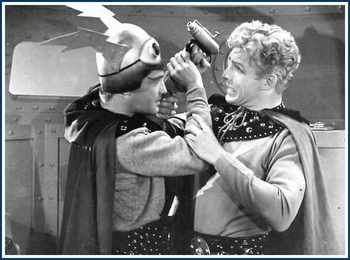
George Lucas has explained that his inspiration for Star Wars–in considerable part–came from the Flash Gordon and Buck Rogers science-fiction shows he watched as a child. These “space-opera serials” helped to inform and create his own. You can see it in the devil-may-care blaster-toting Han Solo, all of the space battles, and even in Luke’s wannabe adventurer character: at least in the beginning. Basically, these old science-fiction elements are integral to Star Wars’ existence.

I just thought this scene from The Star Wars alternate reality comic–the one adapted from an original draft of Star Wars itself–would be appropriate on some many levels considering the subject matter and the character resemblances. But what is definitely from my perspective is the following.

Then you have the Prequels, or the New Trilogy. One thing that most creators of worlds tend to do when they make a world for the first time, or try to re-imagine a pre-established world is to “go back to the basics.” You see a lot of this in comics nowadays: using Golden or Silver Age characters and expanding on them or taking a different slant on how they might be. What I think happened was George Lucas looked at the Star Wars universe he created and decided to “go back to basics”: to tell the story of what caused a lot of the events that happened in the Old Trilogy and at the same time re-imagine Star Wars. Of course there are two kinds of re-imaginings: which are reboots (which the Prequels were not) and matters of continuity.

From my perspective the Jedi are evil … no, George Lucas brought Star Wars closer to the spirit of the source material that informed his own childhood enjoyment: that of Buck Rogers and Flash Gordon. In fact, I believe he said as much in an interview or two in the past.

Flash Gordon aesthetics …

Meet Revenge of the Sith.

I believe that with the Old Trilogy, Lucas started out with those inspirations and expanded from them into something that looked older and actually resembled that strangely wonderful and mysterious phrase, “Long, long ago in a galaxy far, far away” that never gets explained but is still beautiful. With the Prequel Trilogy, I feel like that Lucas “went backward” and started to make something closer to the old shows he was inspired from. It wasn’t old and established anymore. The lines and creases weren’t there: the organic elements were stripped away to reveal this prototypical place.

Not all of the ideas in the New Trilogy were bad. Some were very intriguing and even did expand on certain elements in that galaxy. But unfortunately, they were elements that were poorly executed: if only because they seemed rushed. There was only so much lore you can throw into even three films to hold someone’s interest and sometimes things can get lost when you try to be succinct and “to the point.” Also, and I think you might know all too well the example I’m thinking about, it is a lot like humour: sometimes you can hit that place and sometimes you get far off the mark and actually offend people. Jar Jar, I am looking at you.

But some wooden dialogue and unfortunate caricatures aside, I think there were a lot of concepts that just couldn’t be fit seamlessly into the Prequels. I don’t like all of them and I would have liked to see some different things happen than what did, but I can sympathize with those limitations. That is probably what The Clone Wars CGI cartoons are for: to fill in the gaps between Episodes II and III. Again, they seem to hearken back more to Flash and Rogers and there are some intriguing concepts in them but they can be clumsy and awkward to watch: never mind how they can mess with continuity. And then, of course, there is the humour too.

Some people might even find the closeness to those old science-fiction serials outdated for our time, but I can see how it can be pulled off. I will tell you though that the galaxy of the Prequels does feel like a different galaxy from the Old Trilogy and sometimes it s a jarring thing to realize there supposed to be the same. I miss the mystical elements and mysteries of the Star Wars I grew up with.

And then there is Stars Wars: The Old Republic. I haven’t played this online multi-player game but my friends do and they have been trying to get me on this habit for a while now. But from what I have seen, this galaxy has gone back longer ago, but unlike the Prequels it does not seem farther away. Here you have the grittiness of the Old Trilogy mixed with a massive amount of Jedi and Sith lore. Both Jedi and Sith do not feel as watered-down as those in the Prequels: in fact from what I have seen they are what I always expected them to be. You have your bounty hunters, dynamic smugglers, and all of that stuff with plenty of story and mystery to explore.

I feel that for this game, the creators went back to the basics of Star Wars: but instead of merely just the science-fictional basics, they went back to the archetypal mythological building-blocks that I love so much. And I feel that is a place where the New Trilogy should have gone: that if we had gone to the mythical gravitas of the Jedi at their peak, Anakin Skywalker as a hero, Obi-Wan as a wise mentor even then, with Yoda still in the place of sage, and seeing Anakin go from something of a combination of Luke and Han into a tragic monster instead of the flash of ship and droid battles, and an actual romance between him and Padme in the films it would have made all the difference. Also, seeing Darth Vader slaughter Jedi in his suit, and even seeing the populace turn on and allow soldiers to take away and commit genocide against the Jedi–who’d otherwise been a natural part of their galactic population–would have really been far more striking and effective: from my point of view anyway.

Still, I am glad the New Trilogy exists and has inspired me and others. I like it in that it seems like a prototype or an outline of a movie or another world. But I would go with the timelessness of the Old Trilogy any day.

I would like to mention one more thing though. There are some people that wished Star Wars would be as dark and gritty as the Old Trilogy and remain so. Some people do not like the “cutesy” elements of it. You know the ones: the talking battle droids, the Gungans and the Ewoks.

Let me tell you something about Ewoks. I know that many consider them to be a blemish on Return of the Jedi. I don’t. Long before I watched the movies, I used to watch Saturday afternoon cartoons like Ewoks and Droids. They were the things that made me aware of the Old Trilogy. I really liked the Ewoks and the droids and seeing them in live-adventure with other bad-ass characters made Star Wars seem so much more real to me and that made my childhood self so happy: as though they–my friends–could exist somewhere out there past all we know in our world.

Sometimes when I get annoyed at the droids or Gungans, I ask myself what would it have been like if I hadn’t seen the Ewoks in Episode VI: if Star Wars had remained completely gritty all the time to the very end? People decry marketing the films solely to children, but children have made this universe. I was a child when I saw the films and they changed my life. Do I think that children can handle grittiness, violence, and the concept of the struggle of good verses evil? Of course. I definitely don’t think that things need to be “dumbed down” or completely censored out for children to like them. I also don’t believe good quality films for children should be three-hour long commercials.

At the same time, I also believe that a little light and levity and the comical–when done well–are also good for children and adults too. I wouldn’t have liked Episode VI if Han Solo had died the way it was originally planned or if there had been no Ewoks. They are also a necessary “basic” in the Star Wars universe: almost like a living cartoon–a neoteny–that is different from us but definitely something we can relate to. I always find it funny how we can relate to something that is more simplified than we are more than something that is supposed to be as complex and “serious” as us.

That too is something to keep in mind with regards to Star Wars, or Indiana Jones, or many similar adventure films: that while archetypal dangers and challenges are key, it is only when they are set with humanity and warmth that they feel like you are taking your first step into a much larger world.

Addendum: I DO like Lucas’ film work paralleling scenes between the Old and New Trilogy: especially with regards to what Luke does and what Anakin does. Also, Anakin Skywalker is a very good subversion and critique of the vintage reckless, daring hero archetype.

Film Review: Inglourious Basterds

I’ve been making a lot of reviews lately, I know, but this film has made itself a special place in my heart. I also made a reference to it in one of my earlier entries–with regards to Marvel’s Nick Fury–and I guess compelled to actually say something about the film now that I actually watched the thing.

If I could sum up Quentin Tarantino’s Inglourious Basterds into two words, it would be these:

Fuck History.

If I could get a mug or zippo lighter in the spirit of Garth Ennis’ Preacher with those words, I would definitely consider it. I think what I really liked about Tarantino’s film is the fact that it plays on your expectations–usually well ingrained film or plot-expectations–and then says “Nope,” and does something else entirely. There is something really exaggerated and almost lampoonish about Inglourious Basterds: from the portrayal of its characters, to the garishness of its iconography and all the way to the messed up situations that occur within it.

But while there are moments of hilarity–yes hilarity in a movie about a group of Jewish-American soldiers sent to kill, torture, and destroy Nazi soldiers in 1944–it is not a comedy or a parody. It is quite serious. It is a film that shows what happens to the best laid plans: especially in a war or an enemy infiltration situation and how quickly some interesting characters can die. It illustrates how evil wins when good men have their families threatened. In addition, it also shows how the “good guys” can be immensely but necessarily cruel in war, and how even an evil, remorseless antagonist can be one of the most captivating characters in the entire film.

There is something very … comic book action hero-like about this film and how it is put together. Tarantino himself stated that he wanted to create a World War II movie over the backdrop and ambiance of a spaghetti Western. There is definitely a resonance of Kill Bill in some of the seemingly ad hoc situations that arise in this film: complete with contemporary music set around a period piece and lots of gore and dead Nazis.

But I definitely think about super-hero comics when I think about this film now in retrospect. Hitler seems to have something of a cape, the American soldiers have a very brash gung-ho Americanism thing going on, the Nazi antagonist is very Machiavellian and over the top, and there is a very clear revenge scenario going on here. It feeds into your sense of blood-lust and satisfaction in watching something “evil” die. At the same time though, Tarantino subverts this. For all the protagonists portray the Nazis in the film as evil, and often most of the people in here are relatively two-dimensional–there are still moments of humanity from the “bad guys” that almost make you feel sorry for them being scalped, or having swastikas carved into their heads, or, you know, killed.

As for those people who think that this, well, obviously not historically inaccurate, consider my reference to action hero comics. Was it accurate for Superman to beat the crap out of Hitler? Was it also accurate for Captain America to have a few swings at him? Probably not, but I’m sure there was definite satisfaction in reading that and these comics–the result of war propaganda and good art–translated into Tarantino’s film very nicely.

But all that is either surface or merely part of the film. There is another aspect as well: more of the details. The multi-lingual segments of the film carried me through and gave me some more of the ambiance of that time. It left it no less charged. And then there is a meta-thematic element: that of film itself.

It is no coincidence that the build-up and the climax of Inglourious Basterds takes place in a film theatre, is centred around the viewing of a propaganda film, is subverted by a “revenge film” and whose antagonists are ultimately destroyed by film–by a moving sequential account of history ignited by the flames of war–itself. Because while many of the events in this movie did not happen, and many of the characters didn’t even exist, I feel like that the enemy’s “death by film” symbolizes a much greater artistic achievement over fascism: that when you seek to destroy something with art, art can ultimately change and destroy you as well.

On the television, Inglourious Basterds didn’t get any stars–which is a shame–but that only suits its personality. It’s not here for the glory, and it is not ornate or nice, but definitely has a lot of very kick-ass–literal and otherwise–moments. I think that I will give this film a five out of five.

Horror as a Universal Power: The Function of a Creepypasta

So in my previous Blog entry, “Horror as a Universal Power,” I talked about how I believe horror is a slow-growing epiphany or realization of just how beautiful and terrifying the seemingly normal reality around us truly is: how it is a feeling we are both repulsed by and attracted to in a kind of feedback loop. It’s this kind of perverse fascination with something very strange and uncanny right in front of us.

After something of a Blogging dry-spell, I was watching a few horror movies such as Insidious and Don’t be Afraid of the Dark: you can, in part, blame these films for today’s horror craze on “Mythic Bios,” but it was also due to finding a unique “creepypasta” that I also began this.

When I first saw the term “creepypasta,” I had no idea what the hell it even meant. What first came to mind was a strange of twisted pasta with a pale hollow-eyed doll’s face on the end of it, or a malignant white spiral-worm with a single blood-shot eye. So after I really read a definition of what a creepypasta is, I realized it is derived from a term called “copypasta”  in which someone supposedly copy and pastes a body of text over and over again onto different websites and message-boards. So basically, the pasta is taken from the word “paste,” while the “creepy” part is pretty self-explanatory.

The link I provided above pretty much lists different kinds of formulas or tropes that creepypastas fall under, but that is not why I want to write this article about. I want to look at just how the creepypasta is such an effective medium of communicating the essence of the horror genre.

My first experience with a creepypasta was when I was sent the “message-board transcript” Candle Cove. I actually didn’t know that this was a work of fiction because the person who created it, Kris Straub, did a superb job in crafting the narrative aesthetic. It actually looked like a message board conversation would: complete with screen names and typos in discussion. He also tapped into that place of barely recalled memory and nostalgia–into the zeitgeist or spirit–of 70s children shows to great effect: along with an incredibly effective sense of pacing and different voices for each “poster.” The element of television static and white noise within the story was even more inspired because it plays on the depths of the imagination and just how far someone–particularly a child–can fall into it.

I really liked “Candle Cove” because you don’t know that it is a story and it is written that way. It is also written in a way which taps hard on that collective unconsciousness we all have and actually in some ways made it real. And that is the thing right there. Candle Cove, though fiction, made itself real.

This is what I really want to talk about. Other creepypastas have managed to do something similar based on the characteristics I listed above from “Candle Cove.” The thing that actually influenced me to write these two recent Blog entries was a creepypasta called Ben (or the Haunted Majora’s Mask Game). I came across an account of it on Youtube purely by coincidence. You can read a very long written account of it here or watch the video “footage” that the creator made to complement it here. What we have here is a mixed-media story: a combination of message board posts, a text file, a Nintendo 64 game-hack and video recordings by a user named Jadusable. But look at what he does here.

First, he turns a game made twelve years ago–a Nintendo work firmly entrenched into this generation’s or at least this gaming generation’s collective unconscious–into a medium for his story. He purposefully glitches parts of this hacked game and uses elements of the game itself to add to this story. Bear in mind, Legend of Zelda: Majora’s Mask is a very unsettling but wonderful game to begin with taking place in an alternate dimension from the usual world of Hyrule with various characters and elements to work with: not the least of which being the graphics, soundtrack and some of the dialogue.

Some parts of this creepypasta are, however, somewhat stereotypical and cliche: such as the protagonist and creator Jadusable buying “a haunted bootleg” from a “creepy old man” but that is a trope part and parcel with urban legends in general. Most people would have a lot of trouble suspending disbelief for this–especially gamers–but it does have some very creepy moments: especially for me given that one of the text messages on one of the videos associated with the piece referred directly to a person named “Matt.”

I think the reason I find this creepypasta fascinating is because it uses elements of our generation–specifically video games and the medium of the Internet–to attempt to relate to us in a way might not have affected other generations. Other creepypastas that have utilized Nintendo such as Pokemon Black and Pokemon Lost Silver really tap into that shared popular cultural consciousness, but they do more than that. You’ll find that if you Google or even click on the above links (pardon the unintentional pun), that after these stories became memes–cultural information that spreads to different people–people started creating works based on these pastas to make them more real. Candle Cove now has surviving televised scenes on Youtube. The haunted Majora’s Mask game has many imitators and parodies. Even the Pokemon games I mentioned have been made into actual bootleg games by readers of the things. Basically, they are not only Internet memes, but they become living stories. They become alive inside the people that want them, and I think that is an incredibly bad-ass concept.

It makes me really want to create a creepypasta of my own. I’ve had ideas for some, but I never really followed through with them. You have to get that mixture of intentional typos that look unintentional, a compelling and readable but realistic-looking narrative aesthetic and revealing the horror but not revealing the full origin of the horror down pat because not only do you have to contend with a reader’s disbelief, but also the myriad of other creepypastas out there that share so many–and in some ways too many–characteristics to make yours unique. I tend to get very elaborate in my works and that would definitely count against me in creating such a potent literary hoax.

Still, I know I can’t help thinking about it. It is no coincidence that a loved one chose to give me the strange and wonderful gift of an old newspaper article talking about the effects of the legendary War of the Worlds radio broadcast on its audience at the time.

A creepypasta functions as a horror story pretending to be real and yet even when revealed as fiction, readers make it real by believing in it and paying homage to it. In other words, we make our nightmares real and we actually seem to enjoy doing so which leads me back to my original question of why?

The Internet allows creepypastas to exist: to replicate and spread across not merely servers, message boards, and chat-rooms but imaginations as well. Where is that line between the machine and the human mind these days? What happens when we interact with an increasing body of knowledge that we can manipulate and shape to our whims (technology permitting)? I believe that, in the end, creepypastas exist for three reasons: the first being entertainment, the second being that they are a form of oral storytelling around a pixelated campfire, and the third because we want to believe and make real and manifest the idea that the wondrous and the terrifying can exist in a world where we all live: where something like the Internet exists and not only contains the growing sum of all knowledge and information of what we think exists in our supposed certainty, but also human experience and its less concrete intuitions as well.

I also believe that in light of all of this creepypastas–along with their verbal and written urban legend and folktale predecessors–demonstrate that horror is not only the fear of the unknown. Rather, horror is the love for the unknown–for an unknown–and the sheer limits of human understanding.

Film Review: The Chernobyl Diaries: A Foregone Conclusion

Yes, there are going to be spoilers.

So yesterday, after my lengthy digression on The Avengers, I went to see a film I’d been intrigued by for a while. The premise of Chernobyl Diaries caught my imagination almost immediately following my viewing of the first preview. Pripyat was a city in Ukraine founded in 1970 to house the Chernobyl nuclear power plant’s workers and their families until the disaster of 1986. The city–and most of the possessions of its inhabitants–was abandoned almost immediately following a flood of deadly radiation into the area.

Think about it: somewhere out there in Ukraine is a city still stuck in the mid-late 80s Communist period–a place that could have easily seen all three of George Lucas’ Star Wars original trilogy like everyone else before its doom–gathering dust, rust, pools of water, weeds, and trees growing out of and into buildings. It is a ghost city where abandoned swing-sets still sway in the winds, old photographs lie on the floors in abandoned homes, and a ferris wheel still stands to celebrate a May Day Festival that never happened. There could even be collector’s items there–such as a tattered first issue of Action Comics–that would prove just as poisonous to a would-be collector as Kryptonite is to Superman. In a lot of ways, it is more sad than creepy. There is so much tragedy there–soaked as indelibly into the stones as the radiation that has doomed it–that it makes you wonder why it happened: makes you wish that it never did. When I first saw Pripyat and the Chernobyl reactor looming ominously in the distance, I wondered what it would have been like had the disaster not happened. But that is neither here nor there: just like legacy that Chernobyl has left us, or that we left it.

If any place could be considered cursed by human action and hubris over Nature, this area would be one of those places. When I came into this film, I thought that the protagonists would be dealing with psychic manifestations of the ghosts within Chernobyl and Pripyat–of the loss of potential and life made incarnate–while at the same time making you–the viewer–wonder if any of it is truly happening and if its not the protagonists having hallucinations by the slow encroaching inevitable horror of man-made radiation poisoning.

Instead, we have a different movie. Extreme Tourism is something I have heard of and I also know that there have been many tours near Chernobyl and possibly into the area even before this film was made. I was really surprised. I always thought that the place would be a complete wasteland, but evidently Nature is more powerful than humanity. The protagonists were young–and I personally think stupid to risk themselves to radiation poisoning despite what their guide said about two hours being a reasonable amount of exposure–but they were all likable: which I’ve not seen happen often in horror movies these days. It actually made me sad knowing that even if they got out of this, they were still going to die from radiation and cancer. That in itself is horrifying enough.

The film plays on three fears and layers them well. The first is the radiation that will slowly kill them if they do not leave and even if they do, it will still be in them. I winced every time they picked something up in the city or dipped their hands into presumably irradiated water like their guide Uri did. The geiger counter they had in their possession as it crackled louder and louder and started to beep was like a timer to their death. Then there were the wild, crazed dogs that lived in the area that they had to avoid: a case of feral Nature turning on protagonists that had few resources to help them.

The main characters had the advantage in their general solidarity, if nothing else, and even when that solidarity was challenged by fear and the realization that they would not be able to leave the city before their two hours were up was offset by their mutual need to survive and their basic empathy as fellow travelers. But then: we have the creatures.

The creepy–the truly creepy thing–about the creatures is that we barely even see them. We just have hints of them: things from the corner of the eye, a distant photograph, a still smoldering fire, a limping shape behind a table in an underground room that hints at deformity, a recording of a car being turned over and people being taken, dead eaten soldiers, a sole, solitary little girl with her back to the protagonists, a flash of a multitude of distorted faces at the end and not much else. It’s as though the director of this film observed an age-old horror genre convention in not revealing what the monster looks like. The unknown is the most terrifying aspect of horror: especially as it comes for and consumes you.

In that sense, for all the trappings of modernism around it, Chernobyl Diaries is a classic horror story: relying less on sex, gore and spectacle and more on a slow, mounting, creepy horror: with the gothic romanticism and terrible majesty of a Nature have reclaimed civilization, a contamination for which there is no cure and little hope for surviving with each passing hour, and–lastly–the presence of monsters and the unknown lurking never too far away in the dark. All of three primary fears are interlinked and even interchangeable. After all, it is no coincidence that at the end of the film the creatures are referred to as “patients”: robbed of individuality by their nature, sick, and no longer even human. It was a film that started out slow–exceedingly so–and then became fast-paced with characters dying at an alarmingly accelerated rate.

I can see why the above elements–combined with the fact that the “diaries” part of Chernobyl Diaries barely plays any role in the film–might make modern horror and movie critics pause and heap negative reviews on it, but if you are a classical horror reader or viewer, you can definitely appreciate the grim fatalism–the inevitability–of the three-fold fear and its triumph over human curiosity and common decency that lies at the heart of this film. I give Chernobyl Diaries a four out of five.