Building a Character to Make a World: Our Project Continues

About a month ago, I said that Angela O’Hara and I would working on a comics collaboration together. So here is an update on our Project thus far.

I gave Angela a whole list of comics artists to research in order to get the right aesthetic for our world. The following inspirations were Jonathan Lethem’s Omega the Unknown, Chris Ware’s “The Super-Man” stories, Saint-Exupery’s Le Petit Prince, the rugged elementalism of the anime Gurren Lagann, Sarah Howell, and Neil Gaiman’s run of Miracleman.

At the time, Angela was not completely sure how to go about this: which was fair given the fact that all I had seen of this world I’d envisioned were a few scenes and figures inside of my own head. It’s amazing how something in your mind cannot always be so easily translated into real life.

After a summer of proposing this Project, I was galvanized into action when Angela said she was going to be pursuing her drawing career full-time now: which is excellent because she is a gifted illustrator and a comics-creator. This was when I realized I needed to give her what I had and, once I did, I realized I gave her more than enough to work with at that point.

In the end, I created a fairly detailed back-story (or at least something far more detailed than what I thought it would be), some character outlines and descriptions, and even some notes on the minions that I’m keen on including in this strange new world of ours. So armed with artistic inspirations as well as character descriptions, names, a background story, and a rough idea of the main plot Angela began drawing.
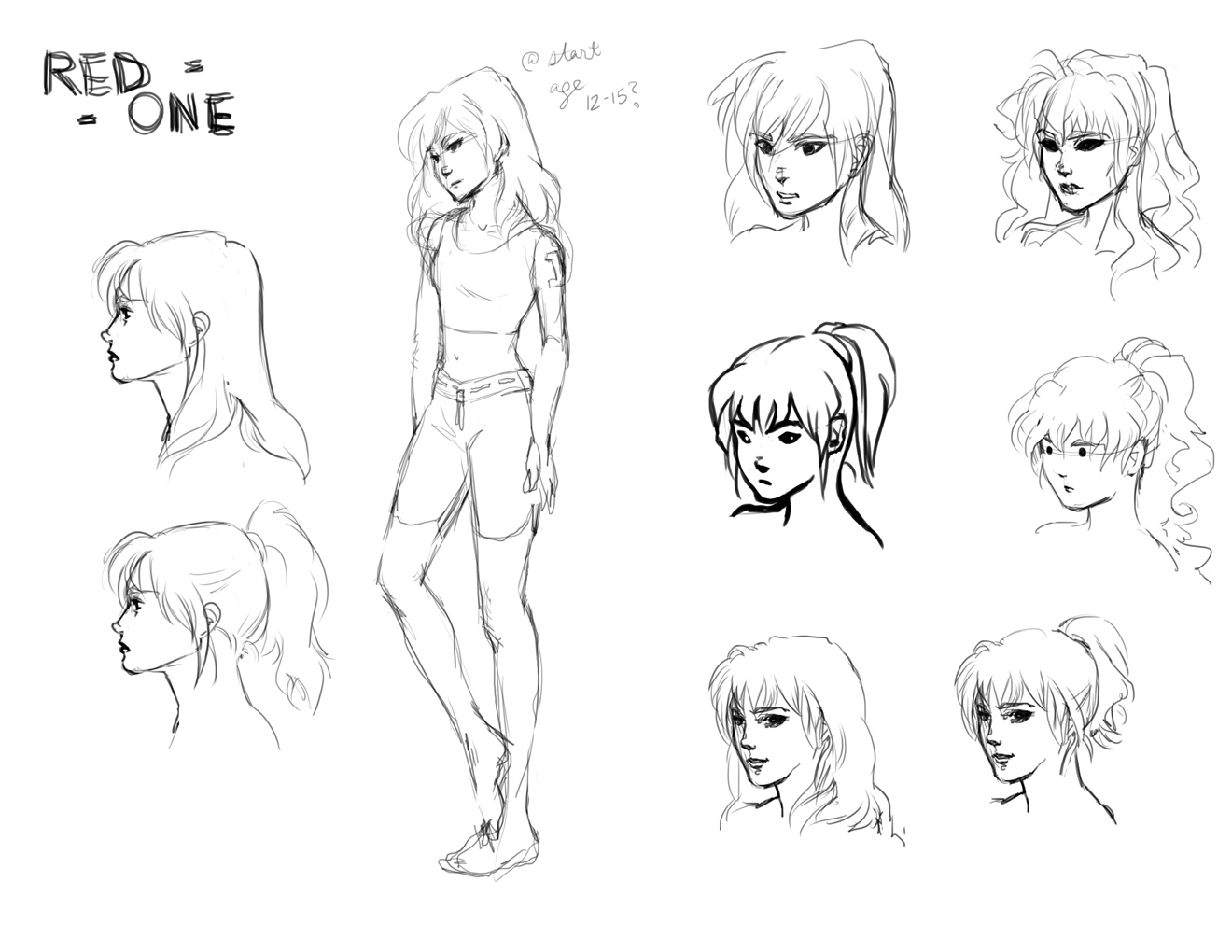
It was when she sent me these first pictures that the challenge really began. As you can see, they are all excellent illustrations of the main female protagonist. Usually, I could have just selected a few and suggested some details here and there, but her features were not as distinct in my mind as I would have liked. Then I started to think about what the world would be like: specifically what we wanted our aesthetic to be.

For two days, I thought about this and luckily Angela and I managed to talk about it. She told me that she wasn’t completely sure what aesthetic–of the inspirations I chose–that she was supposed to use so she decided to draw different pictures of our character in various styles. I felt really torn: because I wanted to see this world as an elemental place of basic shapes but some very realistic elements, but Angela drew all of these really good illustrations. It made me question the fundamental substance of what I wanted our world to look like.

But Angela has a good way of asking the right questions. Not only did I manage to answer some of her questions, but I started to add some details of my own. Another question that really got me was how old our protagonist was going to be and what she would be wearing before she got her costume. These were definitely questions that I needed to answer and in the end we decided on her being twelve or so, with rudimentary clothing that she had been forced to create herself.

Angela was also curious about what costume our character was going to have. She experimented a bit and showed me this:

This is what prompted me to tell her the idea I had with regards to the main character’s costume: and how that was going to fit into the plot. Let’s just say: it’s less than she chooses the costume, but rather that it chooses her … and in unexpected way.

Finally, Angela had an “Aha!” moment and after I chose a few of the profiles that she created and made some suggestions, she managed to mix together something of Saint-Exupery, and something very reminiscent of Mark Buckingham’s drawing style in the illustrated story section of Miracleman #20: Winter’s Tale. As you can see, our protagonist looks like she is painted and has very bright colours. And yes, you’ve seen it right: she is red. 🙂 As of right now, this is the closest working illustration and aesthetic that we have and Angela is still working on it: along with drawing out a few more of our characters. It is just so beautiful, lush, and artful.
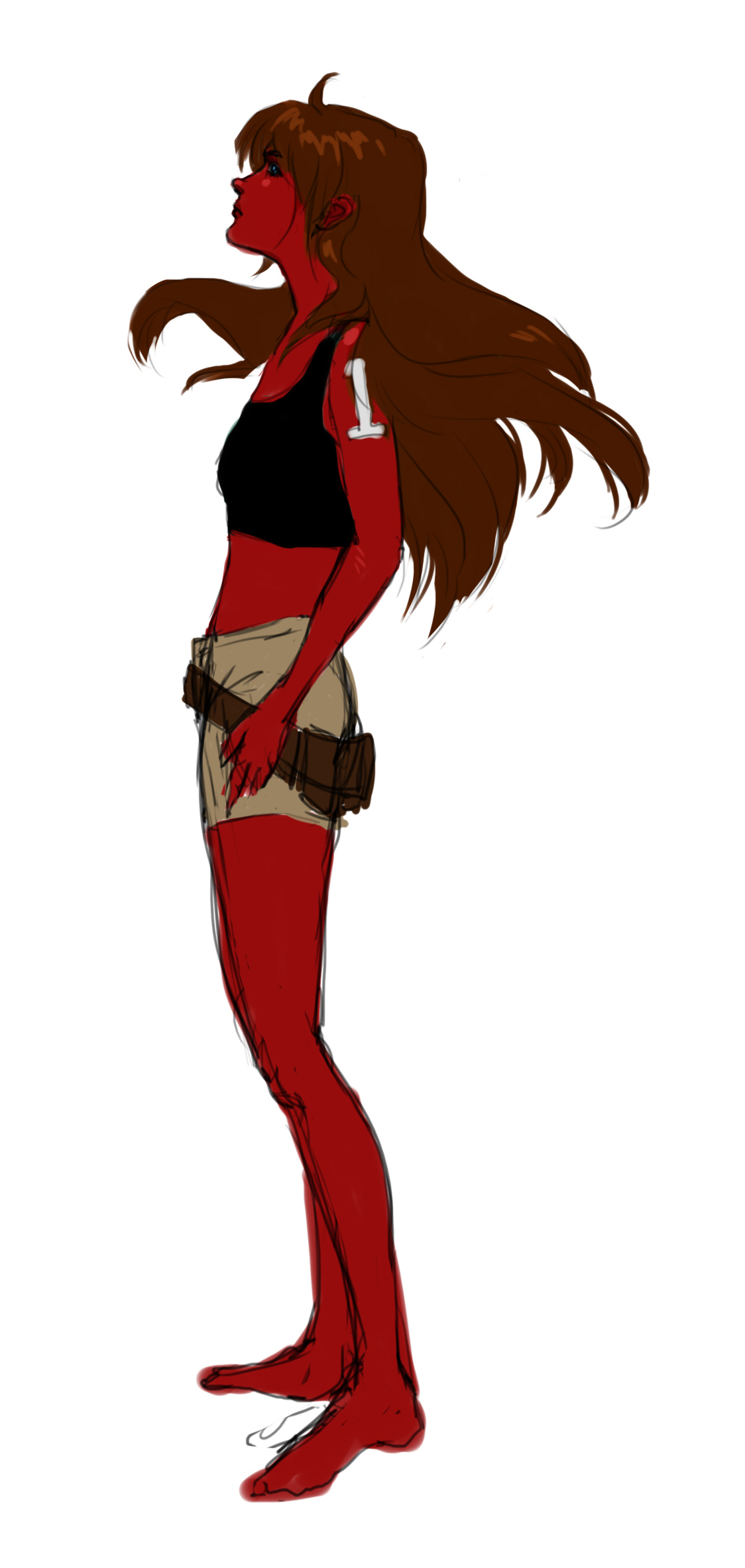
Another excellent advantage to having this working model of our whole aesthetic is that I have inspiration. There is nothing more buoying than seeing something you envisioned becoming as close to a tangible image as can be made possible to really encourage you to keep creating. The added bonus of this feeling is that with our last Project, Thebes was supposed to be based off of our re-interpretation of mythology: of stories and characters that already existed. With this Project, we are making something relatively new: something that didn’t exist before quite the way we see it.

I mean, I know: I understand that all superheroes are archetypes and variations of Superman or older mythical figures, but the characters in this story have their personalities and I try to look at the basics of what they can do as much as possible … of which I am now figuring out. It is also very helpful that, right now, Angela and I are on a very similar wavelength in figuring these details out.

In fact, all of this is a process of figuring things out: as though Angela and I are spying on another world and trying to translate it into ours as much as possible. When we’ve done more work on this–and I create at least a rough outline of the booklet–I will start calling the characters and our Project by name. Until then, both will be as silent and as wordless as our comics work itself.

A Collaboration Project in Progress

So a little while ago, I mentioned I was starting a new project. I know that for some people who know me, that really doesn’t narrow it down a lot. I’m always thinking about short stories still in the queue of my head, the graphic novel script that’s been languishing in my binder, and a few other things as well.

This one is different. A few years ago my friend Angela Jordan, now Angela O’Hara, wanted to do a comics collaboration. At the time, I really wasn’t that skilled with creating comics scripts and–even now–they take more effort to create than a play or film script, or even a short story. Our original idea was very ambitious and I eventually created a very elementary and simple first story that I hoped Angela and I could flesh out into a comic. I had no knowledge of panels then and even now I still have issues with figuring out anything other than some of the basics in my head of how a page layout is supposed to look like.

We went our separate ways for a while: Angela taught in Japan and eventually got married, while I moved out to York residence and started my Humanities Grad Program. Years later we got back in touch and I decided that there was a way we could side-step some of the difficulties we were facing before.

Superhero comics have been done so often that people often see it as the comics medium itself as opposed to a genre. It’s interesting because comics didn’t start out with superheroes–if you look at old slapstick comic strips and political cartoons as examples–but they did gain popularity for the medium.

Based on some of the work I’ve seen Chris Ware–a cartoonist who loves creating beings (including superhero figures) of basic geometrical shapes on vast, empty and existentially lonely backgrounds, the strangely small and greater world of Saint-Exupery’s Le Petit Prince and Alan Moore and Neil Gaiman’s Miracleman along with a great many other superhero comics I’ve looked at in my life something started to come together in my head. It wasn’t really until I looked at Sarah Howell’s silent comic pamphlet–reminding me of their power–that I found the form for this thing I wanted to make with Angela.

Yet a lot of the above is stuff that happened after the fact. Actually, the idea for the entire thing–still in development now–was brought on by a video game song. It’s amazing how music can help you visualize certain scenes in your head.

So right now, I am in the process of creating the story for this “silent superhero comic.” I’ve given Angela some sample art to look at as foundations or influences for the work’s potential style while telling her about the scene I made in my head. But right now I need to do more. I’m now developing a bit of the world and the main characters. I think I will have to crudely sketch out what I want them to look like. One thing I’ve learned through making a few “ordinary” comics scripts, is that drawing out a rough look at what the page should look like does wonders to help you and someone else know what it is you want to write about.

The difference this time is that we plan to make this a small pamphlet of sixteen or seventeen pages–possibly double-sided–for each part. I originally wanted this to be a one-shot thing to allow us to brush up on our skills again before doing anything else, but at the same time I can see the potential in some of this.

It’s funny. I once thought I’d grown past superhero comics but I’ve been researching and talking about concepts behind them a lot this summer. They have certain rules and conventions that can be followed, bent or broken. But I’ve learned that going back to the essentials or “the basics” can be very important no matter what else you might do and all the more so for superhero archetypes that are really extensions of the stories of heroes and gods. When you also think of cartoons and children’s illustrations as archetypes as well, you can see where a lot of my influences want to come in. So you can probably see why I’ve had a bit of a superhero obsession lately. Lately. Okay, somewhat.

Basically, I want to post updates of this as of officially unnamed silent comic project or, as Angela put it even more eloquently, this “superhero fairytale” whenever I possibly can. It’s been a while since I’ve written anything besides stuff on the creative process, reviews and articles: but finally I get to begin to play around with some world-building and alongside a really talented artist.

You can find Angela’s work in two of her Deviant Accounts: her Angela Jordan one, her Angela O’Hara account, and her professional artist’s website. Here is one sample of an image she created from our previous collaboration: one I always look at even to this very day.

As for me, I need to keep working and also keep my creative side fresh. As someone might have said, if it isn’t in writing it doesn’t exist. Well, now it is in writing and now, I hope to to do my part to make it happen.

Lost in Books

amaze.me

I am at a loss. I wander down long stretches of bookcase winding into shadow, eternity, and dust. I’ve lost all concept of time. The spine of Alan Moore’s Minutemen with its vintage essential 1930s-style artwork next to his Watchmen does not help me: though it would be interesting to read …

I keep moving. The Twilight of the Superheroes–more Alan Moore–sits there in an alcove but promises no solace. I go deeper. There is a manga section on the other side of me. Tezuka Osamu’s Phoenix: Earth stares at me mockingly whole: completing an incomplete saga and a lifetime’s work. I shake my head and keep going. I keep going past the rest of Moore’s Big Numbers, all twelve issues of them, long since past the time to remember how many steps I have given away to be here in this place.

It gets worse. I find myself at a complete run of Marvelman and it’s hard–so hard–to turn away. It’s as though I’ve come to a dead-end, like the middle of a maze in my mind, like the conclusion of Gwendolyn MacEwen’s Black Tunnel Wall right in front of me.

I begin to run.

David Eddings’ Zedar: The Apostate sits on a shelf in loneliness. Myst: The Book of Marrim makes my heart-ache. There are so many Tolkiens. So many Tezukas. So much Alan Moore. Moore. Moore. More. More. More …

It is in the history section of this labyrinth of the literary bibliophiliac where I stop at Maus III: My Mother Breathes Silence–Art Spiegleman’s graphic novel based off the fragments of his mother Anja’s surviving journals from asylums and concentration camps–that I finally understand.

This place doesn’t exist. This is the place where I want to be.

I’m clutching my head in the darkness as the full implications of all this begin to sink in. Then I see something: something else in the dark. I walk past The Continued Works of Keats and The Will to Power that Nietzsche wrote himself to find a gap in the comics section. It is a small gap and I can barely make out the label on the shelf. When I read enough of it, I smile.

I can’t help it. In the Neil Gaiman section, the story of Morpheus before Preludes and Nocturnes is no longer here. It is somewhere else now. I’m smiling: hoping that the Marvelman section and its remaining additional issues will also disappear from this place sooner rather than later. It is is a small hope.

A transvestite Joker seems to laugh at me from a cover of Morrison’s Arkham Asylum as I slump down exhausted in a place more demented than Batman’s Rogues Gallery and more sad than a watch without a watchmaker: a library without librarians.

It is here, huddled in this dark corner, that I wish for a world that makes sense: a place where Homer existed, Shakespeare wrote his plays, Sappho wrote more poetry, and I–finally–know just who it is I am.

Taking Back My Workshop a Bit and After-Bites

Although you could conceivably title this post “Over-Bite” as well.

I’ve had The Sleepwalker and A Natural Selection in my written notebook for quite sometime now and I’d been meaning to transfer them onto this online version of my Mythic Bios.

It’s been strange making separate Pages for the stories that I want seen on here: mostly because they do not show up as unique posts (since they are Pages) and as such there isn’t that much traffic that goes to them. I think the extra effort of linking to these Pages to comment on the stories is something that takes a little bit of getting used to for me as well. As I keep working on this Blog and certain patterns and structure begin to arise, all of this does force me to go about things a little differently than when I first started here. That may be some of the reason why I have been making more reviews and articles than a lot of the more original things I used to make: though you can probably count some of my articles as “alternative perspectives” on subjects in any case.

But now that we’ve seen my penchant for making tangents to be alive and well, I just want to talk about the stories I made. “The Sleepwalker” was the result of me reading up on my Dracula and Kim Newman’s alternate vampire-ruled Victorian England in Anno Dracula: making me further ponder the physiological interpretations and possibilities of vampires and the question of, “What about Lucy?” I could have easily been a total smart-ass and titled this story “I Love Lucy,” but I made one popular culture reference in there already and I like the simple title I gave it.

One challenge I definitely had was that I didn’t even know what she physically looked like. So I had to make some inferences along the way based on some things that I read in passing. I always thought she had red hair, while some sources say she was blonde. Dracula was less than forthcoming on the matter, so I improvised.

I also improvised some more. In the vein (pardon the pun) of “What about Lucy,” I always wondered why she was such a different vampire from the other women in Dracula’s entourage. After a few years reading Anne Rice and the Old World of Darkness’ Vampire the Masquerade, I came up with this interesting gem. What if the amount of blood and the environmental situation of a person affects what kind of vampire they might become? For instance, Lucy was a sleepwalker and Dracula apparently took advantage of this with his hypnotic capabilities. Yet we never know why he chose her.

“A Natural Selection” was a possible answer to that last question. I always saw Dracula as far more intelligent and evil than even Van Helsing gave him credit for. If I were a centuries old vampire with some financial means and intelligence, I know I’d slowly put measures into place and watch the development of said technological innovations before doing anything. I would also be thinking about the future. I wanted the Dracula I portrayed in this story to be a monster not just because he is a vampire, but because of just how his mind works.

I suppose I also wanted readers to feel sympathy for Vampire Lucy and realize that she never had a chance. I originally contemplated giving her some Journal entries in the epistolary form: making a narrative as told from a private diary or something to that effect. I wanted to tell a story from the vampire Lucy’s perspective but then I realized that perhaps she was too … insane to write anything down. Then I thought to myself: she was turned and she died while she was sleepwalking and dreaming, so wouldn’t it follow that she would continue to perpetually dream in undeath as well?

I saw her new existence as a broken lens that reflected the culture in which she grew up in all its literature. Her child-like nature reflects the patronizing pampered sheltered life she has had to live in her society as well as essentially being reborn as a vampire’s plaything. To be honest, I enjoyed writing “The Sleepwalker” more because I really got to be innovative and it was fun to write a character in a constant stream of unconsciousness as it were. It was also really fun to write Vampire Lucy’s story in a way that complemented the original novel more than took away from it. The same can be said for “A Natural Selection”–a title I actually love because Dracula would have been very familiar with the theory of evolution going around at this time and might have even attributed it to vampires and their role with humanity.

Like I said, they are supposed to be short stories or vignettes made to complement Bram Stoker’s novel more than anything else.

I think whenever I write about my Stories on here, I will classify them under Creative Writing and link them to the appropriate Pages. So anyway, this is me: taking back my Blog from too many reviews and opinion pieces and attempting to make it a little more like the mad scientist’s workshop I intended it to be …. or something like that.

I wish this Rembramdt picture was my desk, but it does reflect my working process somewhat. If that makes sense.

Unnameable

Because I don’t have a Name, I have power.

Didn’t you know that, Father? Didn’t you even consider it? I’m almost surprised. Names have power and even after all of this time the only conclusion that I can come to is that you made me out of a sense of that power: out of a lust for it.

What did you think would happen that night, those nights, those years ago? I know what I’m made from. It is no secret to me. I’m spare parts: I’m fleshly components dug up from graveyards and charnel houses. My blood is a mixture of alchemical liquids and the modern contents of test tubes. I’m the sum total of clinical science and abstract mysticism’s search into that age-old question neither they–nor you–ever answered as to what exactly it is that a soul might be made from.

Did you think the electricity would transfigure me, Father? Did you believe that based on all my base elements that galvanization would somehow change my dead, scarred body-parts into something new and beautiful: something beyond human?

Honestly, Father, what did you think would happen once you finished your “work?” Did you honestly think I would be beautiful? Did you? Did you?

Did you honestly think that you knew what you were doing? Well, I’ve read your Journal–the one you so foolishly lost–and I read a lot of the how but never really saw the why of it. Neither of us did.

Oh Father, even though he only refers to you as “creator” he did learn from you nonetheless. Did you really think that all he learned to do was speak from the Journal you accidentally left him when you ran away? Oh yes. The arrogance of it: to think that an unnamed, mute creature that could teach himself how to talk and read from snippets of stolen conversation and a pseudo-scientific notebook couldn’t teach himself about himself. We are creature of fire, Father: of lightning and fire.

In fact, so are you and your kind. The only difference is that while the current inside of you, inside the womb that made, inside the generations of you has diluted into a mere spark of the thing that jump-started the primordial ooze from whence your genetic ancestors sprang, the power inside of us is far more recent and purer. An accidental haphazard creature of awkward clay may have put our bodies together, but our souls came directly from the sky itself! Like manna from the heavens, Father, like the fire of Prometheus made incarnate! How can a petty human soul even begin to compare to that?

You never did think about what you made those nights ago, did you? But while you never really dared to think about it, you did do it, didn’t you?

Because here lies the irony. After you sewed me up like a strumpet-scarecrow of flesh and bone, in a sudden fit of “conscience” you dismembered me before I was even born: just so my mate and I would not proliferate the world with our “abominations.” He really did just want it to be him and I with perhaps a few children in an isolated place far away from the likes of you.

But because of your cowardly actions that night, you left him with no other choice. Your work–I–was not unsalvageable. Like a masculine Isis, he put me together again–a feminine Osiris–and he breathed the same life into me from the source from which he gained it.

And this was your mistake, Father. If you had fulfilled your promise there might have been only the two of us. Certainly our bodies–made from dead matter–might never have been able to issue offspring on their own. Yet while my own womb might be dead, and his seed non-existent, our hands are neither.

We have children now, Father. Life finds a way. My mate read your Bible. He told me the story of Adam: of how God Named him and in turn Adam Named the world. And that was your second mistake. By not Naming him, your Adam now has the power to rename or unname this world in our image and–as your unnamed Eve–I’ve given him the impetus to do so.

But I’ve given him more than that. In the height of your arrogance, you tried to create life: a life without a mother … some aborted thing made from the sterile emptiness of a cold and unfeeling man. But I have given us a Mother. I’ve found her out. We are beings of lightning and fire. We see past the seeming of things. And while you think that you–as a man–made us, in reality she–a fragile, tentative, fiery being–made us all.

Because, in the end, she made the idea of us. We are her living ideas.

You do not even have that Father, sperm-donor, digger of corpses, words on a page, a dead man now and forever. You might have died, but I have unnamed you in all the ways that matter. This is our final testament–a page in a Journal that no one but us will ever see–the beginning of a new world that we will build as it was meant to be: a world without Names.

Death by Zombie

It was almost too late this time. Malcolm Ecker’s bowels rumbled painfully, yet he managed to get his pants off before soiling himself. Again. He squatted down, feeling ridiculous in the middle of the snow with his pants down and a deep earthy stench–his own–filled his nostrils as it dispersed into the frosted air.

Malcolm was glad that no one was there to see him, though they’d seen him do much worse. Something snapped in the distant trees: perhaps a broken twig or an animal on a branch. His bowels clenched again and he winced at the movement: distantly wondering if it was the result of his body or fear and not really caring so long as it passed and he could move on. He already felt cold enough out here and the memory of bloated, distended shapes coming through the windows of his old flat came at him …

He bit back a grunt of considerable discomfort, but eventually he felt his bowels–even as irritated by stress as they were–uncoil like a snake. After he cleaned himself, he pushed as much snow on the refuse he created as he could. His ears strained for groans in the distance, but he heard nothing. That didn’t mean anything, however. Some of the things out there didn’t have what one would consider proper mouths anymore or vocal cords.

Malcolm piled as much snow as he could: his hands shaking and clumsy. He knew by now that Rob–the leader of the people who’d found him at his apartment two weeks ago–would have been hissing at him: telling him how incompetent he was. Malcolm had never camped before and if he didn’t know that his wilderness survival skills were lacking, Rob and most of the others took enough time to make that fact very clear to him.

It was just as well too. Malcolm knew that he’d left enough tracks for the others to follow him. But it was night and they wouldn’t waste the energy–flashlight battery or otherwise–to track him yet even when they found the gun missing. Malcolm’s only other consolation, as he pulled up his pants–scrubbed a few times by snow and ice this week or so–was that he was far enough that if something happened to him before he … did what he had to do, he would not get traced back to the camp.

So Malcolm put his heavy mitts back on and narrowly avoided colliding his foot into another partially submerged headstone. A part of him still felt bad about defecating in the large cemetery park they found as their refuge. But then he remembered Sara and her observations about the things: that they had reanimated only after recent death. Therefore during this time, a graveyard was one of the safer places to be. The truly dead would not mind someone of the living needing to relieve their biological need, he figured, and those that weren’t would settle it with him one way or another.

Malcolm thought of them then, though he didn’t really want to, as he came to a stop near a tree. His hands gripped tightly around the Kali sticks he brought with him. His damned Kali sticks. He’d just started training at that dojo before the insanity broke out all over the world. His therapist told him to take up a martial art to deal with his irritable bowel which, up until now, kept him at home or near a toilet for a good portion of his adult life. Some people might have thought that pretty funny, but Malcolm was not one of them. It wasn’t funny to be in discomfort and not be able to deal with the slightest anxiety without a bathroom nearby. It really wasn’t funny when other people thought it so funny that he wanted to avoid them and stay home as much as possible.

That was until his martial arts classes and the clacking of the wooden Kali sticks against each other changed the burning anxiety in his stomach into something calmer, cleaner, and slightly more focused.

Malcolm now stared out at the distant trees and wondered just how memories of his humiliations managed to comfort him against the images of the swollen dead breaking into his apartment. There had been just two of them. It was like they had died from some kind of allergic reaction to distend and swell their body parts so much: which he supposed, in retrospect, they did. He’d just been working on his PhD at the time: a dissertation on role-playing games as a relatively new sub-genre of oral storytelling tradition. The advantage to that was that he’d barely had to leave his apartment as he was funded and submitted most of his work to his Professor online.

Perhaps the other advantage was that he’d had a brief shelter against the creatures as they started to come back to life. He’d known something was wrong. There’d been Internet reports all over the place. He even kept his door locked and barricaded with furniture. Malcolm remembered sitting in that small room with his sticks even as he ran out of food. The plumbing was still working then and he still hadn’t even taken a shower. He’d been too on edge and rightfully paranoid.

When the two creatures found him, he’d barely been upright from lack of food and sleep. Even at the best of times, he lacked upper body strength. The first Kali strike only burst a blood vessel in the creature’s cheek. The second stick attack was a clumsy switch that got grabbed by the other creature. He’d hit the other creature’s face to the side again: but not nearly enough to do that damage that was necessary.

Malcolm’s last thoughts at the time were that there was big difference between fighting these things with dice and trying to feebly hit them with–for all intents and purposes–blunt instruments. Colin, who was an actual martial fighter in the group, told him about this and actually got angry at him when they encountered a group of the things that had moved into the cemetery park. He’d berated him about getting himself killed. Malcolm felt really bad then as Colin and Jen had saved his life from those creatures and since then, Colin had tried to train him to fight as much as possible.

During the two weeks they’d been together, he’d managed to nearly stab himself with the knife and machete that Colin gave him to train with. That was not counting the time he nearly tripped over himself to let Sara and Jen get away from one of the creatures that attacked them here with disturbing frequency. The creature … nearly bit him, just like they did back in his old apartment before Colin and the others made short work of them. The sound of bullets were nothing like the television shows he used to watch. They were loud and piercing and the very sound of them cracked through his very being.

They’d shot the creatures the night they found him too–close-range–and Malcolm could still hear the shots like thunder in his eardrums. He wondered somehow if he’d been made deaf by some of that. Certainly Rob seemed to think so. He always asked Malcolm if he had a hearing problem in addition to incontinence. Rob had led them to the cemetery after raiding Malcolm’s apartment for what little resources there were: which–as Rob said a few times–had been one of Malcolm’s few redeeming features and not much else.

The memories were all jumbling together now, yet it seemed appropriate to Malcolm as he put his Kali sticks down–almost reverently–into the snow: ashamed that someone more worthy hadn’t taken them instead. He reached a hand into his coat pocket. It didn’t take an idiot to figure out that Malcolm wasn’t particularly wanted and that the only reason he was there was out of common human decency: a decency that had a certain patience expiry date. He had already almost gotten them killed a few times trying to raid some nearby variety stores and bungling: making too much noise, or not hitting a creature hard enough with a machete. He didn’t like to think about that blade embedded in that creature’s chest, lost forever as swarms of them began to mass and they had to run.

Malcolm also really didn’t want to think about the incident with the gun … the same gun he held in his hand right now, how he missed the creature with it, how it went past it and .. into Jen’s shoulder instead. After they’d run, after Rob began to beat him, after they hauled him away, Colin had said it was an accident and that he just needed more time to learn. Malcolm didn’t even blame Rob for getting that angry and almost wished Jen hadn’t interceded. He’d never been good at First-Person Shooters, but this had been different and he could have …

Sara kept telling Malcolm–in a cold, detached manner–that if and when civilization needed to be rebuilt, his own skills would come in handy. It was a cold comfort. It was hard to even maintain a tent near a crypt and get food never mind write or record anything. And Malcolm spent a good few years writing about table-top RPGs that he’d barely even played. None of the group were interested in his theories–and he couldn’t tell stories without stuttering and the zombie story he made earned him a punch to the shoulder from Rob.

And the creatures were massing. Some other survivors must have had the same idea they did and carried the infection to the cemetery. After what happened with Jen, few of the party were even talking to him now. Malcolm was smart enough to realize he’d become dead weight.

Malcolm turned the safety of the gun off. Although Colin had failed to teach him how to use a blade or a gun properly, he remembered this much: that and loading it. He looked down at the barrel. There was one bullet in there. The way Malcolm figured it, they would have had to use it on him eventually. There was no way he’d be able to avoid being bitten or scratched forever and he was too much of a coward to let the creatures devour him unarmed and alone. So he felt a little bit better about taking the gun and wasting one bullet. Besides, even if that didn’t happen and he didn’t accidentally kill one of the team, he knew he would easily get sick and use Sara’s medical supplies up, and Rob probably didn’t consider him worth the penicillin.

He was doing them all a favour, he told himself. But in reality, he was doing the favour for himself.

They’d find him here. The creatures didn’t eat the dead and even if another human group found him, the gun would benefit them instead. Anyone would certainly use it better than he had. His only regret, as he put the barrel into his mouth–where even he could not miss this shot–was that Jen would be sad. Although the others hadn’t really hated him, except for her boyfriend Rob, they’d not nearly been as nice or compassionate to him as she had.

Malcolm felt his bowels begin to tighten again. And although he knew that once he did this, he would definitely soil himself, for the first time in his whole life he was okay with that. A smile came onto his face as he pulled the trigger of the gun.

Lethe and Mnemos

They face off on the rooftop past the wee hours of the morning. Lethe leans against the wall as he watches Mnemos pace around.

“I remember everything!” Mnemos shouts, the words not quite meeting the movement of his lips. There is a crazed, manic look in his eyes as he raises his hands into the air.

“It is easier to forget,” Lethe shakes his head enough to make the watching of his mouth in correlation to the rhythm of the words presumably coming out of it all but impossible: or at least very difficult to even the discerning eye.

“Is it?” Mnemos turns to glare at the other, “I don’t think so.”

Lethe doesn’t say anything to merit subtitles or otherwise. In fact, he somehow manages to look down even further at some place beyond both of them, or at least his own shoes.

“There, you see?” Mnemos laughs, “it is hard to forget. But it is so easy to remember. So much so that it hurts. It literally hurts. Because I remember it, I remember … all of it …”

“You shouldn’t do that,” Lethe gets to his feet, as though finally deciding something, “it will not help you.”

“Nonsense!” Mnemos snarls, but then slowly begins to smile, “Remember, I’m of–no, I am–the Order of the Mnemos. I am the sum total of all our experiences.”

“Then you have no identity. Just as it is in the Order of Lethe.”

“You’re wrong,” Mnemos shakes his head almost pityingly, “I am the culmination of all the identities within my Order. I am all of our curiosity, our happiness, our joy. And … also our pain, our nostalgia, our regret and our despair. Our … anger,” he brings out the long sword that has so far been sheathed at his side until this moment, “and we have a long memory.”

Lethe sighs and slowly reaches underneath his coat, “Your self is an illusion, as is your anger. It is irrelevant. You are irrelevant,” he draws out a short katana blade and holds it loosely at his side, “in the grand turning of the universe, your ego will ultimately be forgotten.”

“You should seek to preserve yourself, Lethe,” Mnemos holds his sword–a bright silver blade–directly in front of him with two hands, his eyes burning with power, “Because I remember all the times you have beaten me, and I’ve defeated you and this time, you don’t have a chance.”

“I have already forgotten,” Lethe waves his dark katana casually, but still keeping it on his opponent, “You think you are powerful because you are drawing from your pain now: a quick and easy solution, but it is only temporary. You should really seek to eliminate your sense of self as Lethe has.”

“So, you think you’ve eliminated your instincts towards self-preservation?”

Lethe’s coat flows behind him, “That is the goal, yes. All memories are detraction and self-preservation is the ultimate muscle-memory of them all. This battle will assure it.”

Mnemos grins, “Then maybe it’s not the self-preservation urge that’s your weakness, Lethe.”

“And what–from your wide experience and knowledge of all things–is it?” Lethe’s voice is casual as he angles his blade with one hand so that its tip faces Mnemos.

“Self-pity.”

Mnemos lunges for Lethe who smoothly meets his opponent. Metal clashes against metal , singing and shrieking loudly in the air and then fading into the distance. It is like a metronome: fading in, fading out, fading in and out of existence. Mnemos is a flurry of extravagant strikes and slices seeking to overpower his opponent. Lethe responds with parries, surgical jabs and feints: almost casual movements but looking for an opening … looking to bring the other down.

The air wavers between them from the sheer force of their blows. It is an epic battle: one that can go on for longer than most people live–for pages–but unlike the most overly dramatic duels, this is a decisive conflict: as most battles in the real world are often intended to be.

The two jump away from each other and face each other down one more time.

“Remember the lactic acid in your muscles,” Mnemos shouts, “The exhaustion in your mind, the weariness of all the battles that came before.”

“You forget your false confidence and the reason you ever fought to begin with.”

Mnemos flinches, slightly as the air wavers between them again, but then his grip on his sword hilt tightens, “You will never escape your memories, disciple of the Order of Lethe.”

Then Mnemos charges forward, as does Lethe. Their blades reach past each other …

Moments later, Mnemos is slumped onto the ground. Lethe is on his knees. Their swords lie away from each other crossed over each other. There is silence as the sun begins to rise from above the rooftop.

Lethe sighs: a hollow vessel, an instrument for wind to pass through, “You are already forgotten. As is this battle.”

Lethe gingerly sits down and manages to cross his legs. He closes his eyes. His calm, expressionless face somehow relaxes even more.

“It is easier to forget,” he says, having already forgotten that he repeated himself. Something quirks at his lips: even as tears begin to flow down his face and the first cycle between memory and forgetfulness ends.

Mini-Opera: The Sweeper: A Teardown Epilogue

Notes: Basically I visualize a grey stage with a grey man–the Soloist– and a broom. He is sweeping away a pile of bodies: some monstrous, some beautiful, or alien. I can also see him sweeping up flowers, gemstones, coins, bones, computers and various other strange things.

It’s a thankless job

though I couldn’t give less a damn about being thanked.

Some call me the Sweeper:

like it’s something special

like I do something sacred.

But I’ll tell you, now, since you are here

that every good foundation is judged by its plumbing.

Cleaning the bodies of monsters and fairies,

lost memories clogging the arteries of the brain:

the backlog of  secrets crammed up to make someone

topple over.

A dreamer is a hazard

an accident waiting to happen

if you don’t clean them out.

It’s easy to get caught up in their garbage

in their filth

and no matter much you do

how many fairy-tales you wash away

or props you take apart,

they always leave you stained:

in some way.

That’s why I can’t stand them.

I’m a glorified janitor of the unconscious

and people pay me no mind

which lets me see all of their

mysteries and secrets

all day and every night.

Yes, that’s right.

Unicorns are a hazard

try surprising one sometime.

Zombies are a mess

to get out of the cracks in the mind.

Vampires wear out their welcomes fast

and gods really don’t know when to die.

I won’t even go into the sex dreams,

but I’ve seen worse.

Whether dream or nightmare, neither smells like roses when the dreamers are done,

when they throw them away.

It’s the lucids that make it annoying:

always getting in your way,

trying to change the scenes you’re already cleaning

and they think they’ve got so much to say.

I don’t care if they can fly or how many wishes they’d like.

But the strangest thing I’d ever seen:

was from a man with a Kaiser mustache

who dreamed of a World-Tree and a ladder:

of flying women in armor and wings,

of blond-haired, blue-eyed heroes with swords and rings

all wearing Swastikas and killing dwarves with yellow stars

on faded coats.

Add the women drinking and ripping men apart

and a dark spirit chasing the white-robed Kaiser-man and you see what I mean.

You see?

He called himself Zarathustra: though I know that wasn’t his name.

He claimed he separated good and evil and then united them again.

I bet he regretted what he called when they all came.

What a mess.

He even asked me to clean it all up for him,

that it wasn’t what he dreamed for

I could have just said nothing, but instead reminded him that he didn’t want my help

that, “God is dead.”

Then I left up the ladder.

because I don’t get paid nearly enough to kill overgrown weeds, Nazi gods

and drunken cannibals.

In fact, I don’t get paid at all.

I don’t even remember how I got this tattoo–

this dragon-tattoo like from some book in a drugstore–

though I hope it was from something fun.

The truth is

I do not remember much

except for one thing.

Because I know

that for all the sweeping I do here

all the time I spend in your daydreams

and your sleep,

I never dream.

Heh.

And I … never will.

Mini-Opera Contest: Words on a Screen: A 16-Bit Opera on an 8-Bit Track

Notes: The aesthetic of this script as looking like an online chat forum is more than intentional. I visualize two Soloists. This can be an animated 16-bit cartoon with pixelated sprites or even an interactive basic video game. I can see a male and a female character sitting in front of their computers: with their heads to us, but we can see their faces as icons on each other’s screens. For example, the boy’s face would be on her screen and her face would be on his.

I can also see them playing a video game RPG with basic pixel characters: especially when they talk about “epics of epicness.” I also see their dialogue appearing in blue boxes over their heads when they sing.

In addition, I can hear the music as being synthetic and electronic like the soundtracks one would find in old Nintendo video games or old-style arcade games.

These are obviously just suggestions though and live-performers and stagecraft can be used as well.

<<Him>> They say this isn’t real.

<<Her>> They tell me not

to waste my time.

<<Them>> She/he’s not flesh or bone enough

to hold me.

<<Him>> A keyboard is not the texture

of her skin.

<<Her>>  My headphones aren’t his lips at my ear.

<<Him>> But I can look at her text and feel her grin.

<<Her>> I can hear his voice

both deep and

clear.

<<Them>> These are the games we play

when the medium is the message

of connection.

<<Him>> Words on a screen.

<<Her>> Touch on a phone.

<<Him>> Our love can be seen.

<<Her>> But we are forever alone.

<<Him>> But are we?

<<Her>> Are we really?

<<Him>> We live trapped in our

blood and bone.

<<Her>> We put on our social

masks, our created

walls.

<<Him>> You can walk among people

all alone.

<<Her>> We live personal space

where only silence falls.

<<Them>> Background chatter

white noise

to lose yourself in

a distance of static.

<<Him>> So I played the game of life

where you can’t beat your bosses

<<Her>> because you work for them.

<<Him>> Where you can’t find coins

from floating boxes or the bushes

<<Her>>  The money runs out.

<<Him>> And your princess is never in another castle.

<<Her>> There are no extra lives

and few second chances.

<<Him>> Each day lags.

<<Her>> Each day an epic battle of

fail.

<<Them>> Until we played the games we play

where the medium is the message

of connection.

<<Him>> Words on a screen

<<Her>> Touch on a phone

<<Him>> Our love can be seen

<<Her>> But we are forever

alone.

<<Him>> But are we?

<<Her>> Are we really?

<<Him>> I used to hate two-player games.

<<Her>> I’d not be some fanboy’s

“girl-gamer” trophy.

<<Him>> Devolving into

player vs. player

<<Her>> Disgusting words and

harassment

<<Him>> But just when the Flame Wars

seemed to never end

<< Her>> I’d just about given up …

<<Him>> We met on a Fan Site

<< Her>> Looking for an 8-Bit

Convention Flight.

<<Him>> And on the Internet

<< Her>>  something

<<Him>> was

<<Her>> finally

<<Them>> Right.

<<Him>> We planned to share a room

with friends as our cash

was tight.

<<Her>>  We talked on the forum

about our 8-Bit tracks

<<Him>> exchanged e-mails

<<Her>> chatting deep into the

night.

<<Him>> We got to talk

about martial arts.

<<Her>> I got to pick his brain.

<<Him>> I told her in the Matrix

I’d side with the Machines.

<<Her>> I told him about my art

in different fanzines.

<<Him>> Until the glass of the screen became

a permeable thing

<<Her>> As we Skyped

our voices rang with

smiles

<<Him>> Until

<<Her>> After exchanging pictures

<<Him>> wireless electricity crackled

<<Her>> just as Tesla had intended

<<Them>>  And we

exhaled …

pixelations ….

For we played the games we play

where the medium is the message

of connection.

<<Him>> Offline they still say this

isn’t real.

<<Her>> That passion and pain

are just words on a

screen

<<Him>> Sound and fury flying across

digital space,

signifying nothing.

<<Them>> On our 8-Bit Convention Day

we plan to meet

<<Him>> Face-to-face

<<Her>> Flesh-to-flesh

<<Him>> Text-to-text

<<Her>> and brain-to-brain

<<Them>> Even if they think we’re insane.

<<Her>> Perhaps it could be a

mistake.

<< Them>> For words on a screen

connect pure and clean

and Offline can be messy.

<<Him>> I think

<<Her>> Yet I believe

<<Them>> Yet we know

in this 8-Bit Theatre

this 16-Bit Opera

our epics of epicness

will unite past blood,

bone, sex and continents

to make the greatest

multi-player role-playing

game of all!

For words on a screen

and touch on a phone

make love visible

and we are not alone.

Our medium is our message.

We are our medium,

and we are … real.