Something Under The Bed Is Drooling As Bill Watterson Draws For Pearls Before Swine

Bill Watterson, the creator of Calvin and Hobbes, is often compared to Bigfoot: in that he is both legendary and reclusive.

But that being said, there has definitely been a “Bigfoot sighting” as of late and he has definitely left some of his prints in Stephan Pastis’ Pearls Before Swine: a syndicated comic strip running in 750 newspapers all around the world. According to Bill Watterson himself in Michael Cavna’s EXCLUSIVE: ‘Calvin and Hobbes’ creator Bill Watterson returns to the comics page — to offer a few ‘Pearls’ gems  in the Washington Post, he wanted to do a “goofy collaboration” with Pastis that could be used to help fun raise the charity Team Cul de Sac: an organization founded by Chris Sparks and the comics illustrator Richard Thompson to combat Parkinson’s disease.

The original strips with Watterson’s collaboration will be on display at HeroesCon before they get auctioned off for the Cul de Sac charity. It is fascinating to read Watterson’s perspective on the collaboration, just as it is perhaps even more intriguing to look at Pastis’ own account of how it all happened in his Blog article aptly named Ever Wished That Calvin and Hobbes Creator Bill Watterson Would Return to the Comics Page? Well, He Just Did. There is so much he says about their collaborative and creative process and yet so tantalizingly little: given Watterson’s well-known love for intense privacy.

It didn’t even seem that long ago, back in December of 2013, that Mental Floss managed to facilitate an interview with the cartoonist. In one of my earliest GEEKPR0N articles, I look at the gap of time in-between different Bill Watterson interviews. Then you also have to consider the occasional other moments Watterson briefly became public again with a painting of Cul De Sac character Petey Otterloop in 2011 and a cartoon for the documentary Stripped on February 26, 2014.

And looking at all of this, right now, and realizing that Watterson had been involved in drawing three new comic strips recently without anyone being the wiser reminds me of a conversation I had with a friend of mine about him in which we concluded that there might have been some kind of confluence, a series of events and inner workings that made Watterson realize that he might have something more to say.

But while our conversation was with regards to him actually briefly revisiting Calvin and Hobbes, it can also be applied to the rest of what he has been doing lately. If you follow Pastis you will see that a few events and needs came together to make this collaboration — and indeed this communication — happen. And indeed, it’s no secret that Bill Watterson never stopped making art, or watching the comic strip medium continue after his departure.

As for Bill Watterson’s privacy, it’s a lot like the myth of Bigfoot. He never really left.

And sometimes the best place to hide is right in plain sight.

Please tell us where you think you can find his tracks.

Why Don’t You Just Make One? My So-Called Secret Identity

“Well, if you don’t like how women are portrayed in comics, why don’t you make your own comic?”

You can substitute the subject of this knee-jerk reaction in the form of a question to other media such as film, television, or video games, but the gist of it is pretty much the same. Usually this question is “asked” in an attempt to silence critics, or to reduce their observations about pop culture into “nitpicking” or something completely non-constructive. Most critics ignore this loaded question because creative works — at least in the area of fiction — are not their focus or area of expertise.

However Dr. Will Brooker, popular culture expert and Batman scholar, decided that in addition to criticism he was going to actually answer this question: in the form of My So-Called Secret Identity.

Brooker and his fellow artistic collaborators the illustrator Suze Shore and PhD in superhero art Dr. Sarah Zaidan, realized that while it wasn’t nearly enough to criticize the portrayal of women in mainstream comics,  it would definitely be a step forward to create a comic that could represent them as three-dimensional human beings. They, along with an extensive and predominantly female creative team, are managing to accomplish this and more.

So what is My So-Called Secret Identity about? It is a comic about Cat: a student of philosophy and literature and daughter of a policeman. She is a young woman who sees and understands the links between different subjects and is sick and tired of pretending to lack the intelligence that she truly possesses: that many have underestimated or believe that she fakes.

My So-Called Secret Identity

Cat, also known as Catherine Abigail Daniels, loves her home of Gloria City and wants to do her part to save it from the terrorism of the supervillains that also dwell within it. Unfortunately, her other obstacles seem to be the self-styled “superheroes” of Gloria City: posturing and brittle celebrities not unlike those you might see in Garth Ennis’ The Boys that, along with their villainous counterparts, use the City and its citizens as “a theatre” (complete with “a backstage” metaphor reminiscent of Neil Gaiman) and props respectively in their “morality war.”

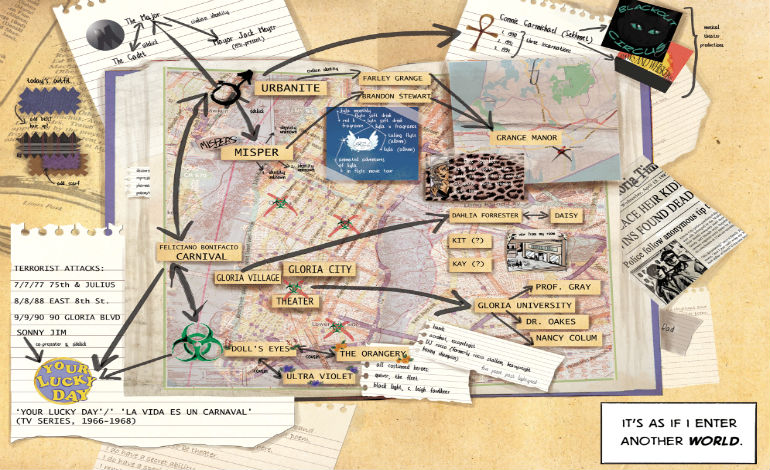
What I really like about Cat as a character are three elements. First, she is a woman that knows what and sometimes even who she wants and will pursue them with assertiveness instead of over-exaggerated aggression. Second, she will call people out on their actions and words but also be reasonable enough to forgive and recognize that same person as a human being. She is a person that cares about people and it shows. But lastly, I am very intrigued by how Brooker and his team handle her genius. Without spoiling too much of the comic, Cat seems to have a very Humanities or interdisciplinary approach to how she attempts to solve crime: linking ideas, geography, culture, history, and facts all together in the form of a “mind-map”: in a style of collage reminiscent of Dave McKean, Eddie Campbell, or even Daniel Vallely.

My So-Called Secret Identity Mind Map

It’s very psychogeographical. God, I love that word.

In a sense, Cat’s method of learning is actually through creating art: synthesizing different elements and their connections together as opposed to analyzing and taking details apart. It is, in my opinion, simply beautiful. Unfortunately, you can also see why other people — especially her teachers and bosses throughout her life — underestimate her or simply do not recognize her genius for what it is. It is frustrating to watch and understand that this stigma against her is not merely because of her unorthodox thinking: but there are unspoken gender expectations she keeps breaking because she is smart and female.

My So-Called Secret Identity Cat's Life

But Cat doesn’t let the expectations of others stop her. At this stage in her life she is determined to live her life and keep Gloria City safe: even if it means becoming an actor in the theatre of villains and heroes and especially, I suspect, when she ignores, subverts, and outright discards their rules by her very nature. I myself suspect that Cat’s story isn’t about the chic of “a secret identity” or playing the hero, but rather doing the right thing and being accepted for who she is and what she can do. Cat is not a secret. She just is, and she should be.

According to its Facebook Page, not only will My So-Called Secret Identity have a June 16th Kickstarter Campaign, the fourth issue of My So-Called Secret Identity Volume One will be coming out Sunday June 8, 2014. You can also buy hard-copies of the issues so far or read them online. So please, Like this comic on Facebook and read it. I look forward to seeing where Cat, and Gloria City’s story, goes.

Kids Games Never Finish: Urasawa Naoki’s 20th Century Boys

Children are excellent at creating mythologies. And some of the mythologies that you make with your friends can affect you for the rest of your lives.

That is one of the first thoughts I probably had when I began reading Urasawa Naoki’s manga series 20th Century Boys. Much in the way that its protagonists struggle to remember all the details of their childhood, I find I’m having difficulty recalling how I even found this series.

I found some of the Viz Media-translated books at the Toronto Public Library and read Books One through Fifteen from 2011 to early 2012. They didn’t have all of them yet and I suspect that some of the books themselves weren’t even translated for purchase during that period. I admit: I was attracted to the simple prototypical white, grey and black elegance and faded colouring of the covers and, of course, the premise on the backs of the books themselves.

Yes, it’s not so much that I judge a comic book by its cover, but more specifically its back cover. And I was also intrigued by context.

It didn’t hurt that 20th Century Boys title is was actually taken from the catchy song 20th Century Boy by a music group called T. Rex, that the twentieth century itself covers so much ground with regards to modern history, and footnotes. Yes, a manga series that has footnotes about Japanese culture and–specifically–manga, anime, television, and geek (or otaku) culture. There’s this special magic in starting off a story of any kind with literary and cultural references: hence the reason why I tend to start some of my narratives with epigraphs, or quotes from other works real or imagined that appeal to me.

You can blame Frank Herbert’s Dune for that.

I’m also really hesitant in committing to most series. I admit it. There is this vulnerability in opening yourself up to a story that is bad, becomes bad, or is so good that you get attached to the characters and you just wince at what is about to come: especially when it hit something home for you much in the way of a children’s baseball game.

But as I was saying, it was the story premise that got me. In 1969, the time of the first Moon landing and Uri Geller’s spoon-bending psychic phenomenon, a group of children create a story where they are a society of heroes rising up against a league of evil that has destroyed the world. They create together a Book of Prophecy that outlines all the events that will lead to their battle. This is their symbol: that of friendship.

20th_Century_Boys_symbol

Eventually, when they lose the field with their “secret base” they leave a time-capsule with the book and then, as childhood friendships are want to do, they move and drift apart. However, just as the symbol above represents an image in some manga that tells the reader to turn the page (with an eye drawn over it), this story isn’t over yet.

Years later Endo Kenji, one of the group and the creator of the Book of Prophecy, is an adult and with the suicide of one of his old friends notices the rise of a cult led by a mysterious figure named “Friend:” a man that uses and wears their childhood symbol as a mask. Kenji and his other friends begin to reunite and realize that someone is reenacting the scenarios of their childhood into a very grim adult reality.

What I really liked about this series was how it took the tropes of the superhero, the supervillain, and even Japanese mecha and juxtaposes them over an adult and human world. Even as the protagonists themselves have to suspend their own disbelief and, indeed, try to remember the distant memories of their childhood in order to find out who “Friend” is and to stop him, “Friend” himself subverts the archetypal story and creates something truly horrific. It’s almost as though his actions and their consequences on the world around him not only mock the characters, the genre of adventure hero manga but our own expectations as well.

Friend

[Welcome to the *Real* Friend Zone]

From my perspective, reading 20th Century Boys is like Alan Moore having been born into an alternate universe where he came from Japan and was influenced by Tezuka Osamu, Yoshihiro Tatsumi, anime and manga for most of his formative years and became the person that exists in our world: Urasawa Naoki. However, don’t let my bad analogy deceive you. This is not a comics Revisionist series. While Urasawa did make a grittier and darker version of Tezuka Osamu’s Astro Boy world of robots through his series Pluto, 20th Century Boys is its own world and story that utilizes, parodies, subverts and pays homage to the otaku and twentieth century symbolism of his, and so many others’, childhood and culture.

In fact, now that I think about 20th Century Boys reminds me of the realistic and gritty style of gekiga. I wrote a sloppy Blog post about this a while back with a focus on a lack of superheroes in Japan, but this book is making me reconsider some of my original points. It actually does remind me of Julian Darius’ explanation about Reconstructionism.

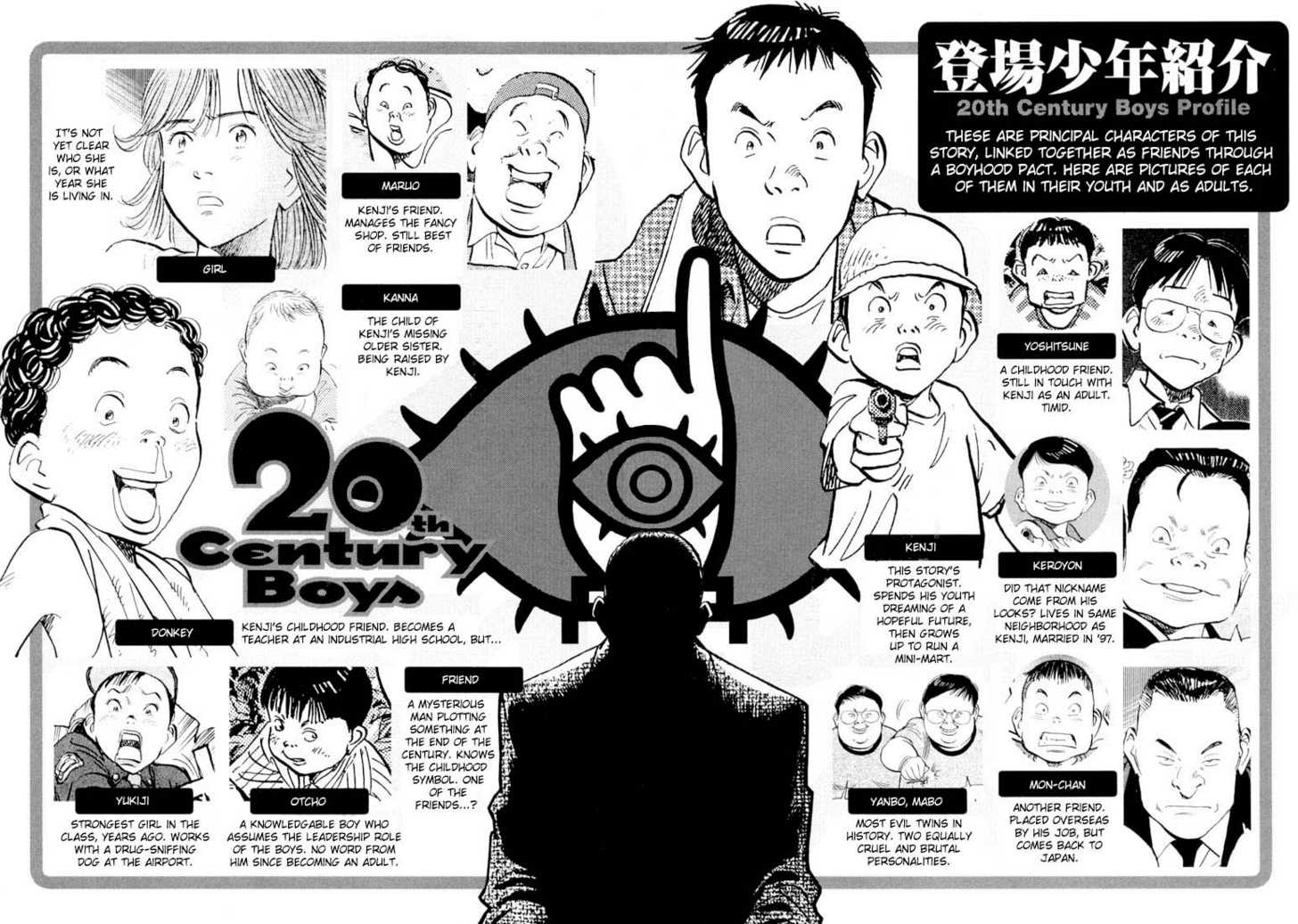
20th Century Boys Characters

As children, the main characters are very iconic and essentialized while they are surrounded by a realistic background. In fact, even when they grow older they still maintain traces of that youth–of that neoteny–only matured and “grown up.” And isn’t Reconstruction what creating stories is ultimately about: especially when you consider that children form stories in much the same way that put Lego pieces together. You have your basic building blocks that exist in reality and then you rearrange them to create some other kind of meaning. That’s what Kenji’s Group does. And then imagine the story continuing to build itself after them. Later in the series, a character even flat-out states “But kids games never finish.”

And sometimes reading 20th Century Boys is like watching a child’s game continue imperfectly. It’s true. Between the introduction of ESP into the story which seems to serve little significance to the characters but to hearken back to the spirit of the late twentieth century, people miraculously being able to walk away from explosions that should have killed them, the use of some stock and stereotypical characters, and a lack of visual closure with regards to the narrative build-up of some emotional relationships (which I hear is typical of Urasawa in his other works as well) the story is not exactly perfect.

However, consider this: the plot of 20th Century Boys is that “Friend” made a children’s playground out of the destruction of the world: turning a childhood dream into a dystopian nightmare used against its dreamers and all humankind. It was like Urasawa combined Field of Dreams with The Prisoner and 1984. It is terrifying and fucking beautiful in that the only way the protagonists can beat him is if they play the game that they all made together.

It makes me wonder what would have happened if some of the roleplaying games of my childhood and long-term friendships were ever applied to the real world. A long time ago, some of my friends, influenced by the Dune II computer game, created a whole world of interactions that I had a part in creating to this very day.

I won’t lie: becoming the secret Emperor of the world does intrigue me from time to time. But what 20th Century Boys illustrates is how even a childhood dream can cost the lives of billions. Even so, what a beautiful story that makes in fiction.

I would definitely recommend this series. It was only recently that I finished reading them online. Unfortunately the ones I read were not Viz English translations: which was one of the reasons why I hesitated in looking elsewhere for so long. No translation, from Japanese to English or any language for that matter is the same. So if you can find those Viz English editions, please read them. If not, consider the following:

The Friend cult sometimes has to purge some of its members. While the literal translation of their euphemism is generally translated as “banish,” the Viz version uses the word “reject.”

So tell me, my … friends, doesn’t the phrase, “Reject him,” sound so much more satisfying? And doesn’t it remind you of childhood: where acceptance and rejection can make all the difference in how your perceive your identity if not your very life? Keep that in mind when you read 20th Century Boys and you wonder who the heroes are, who the villain is, what their motivations are, and how some parts of childhood affect you forever. There is never full closure.

The games of children never end.

20th Century Boys True Friend

David S. Goyer’s All About The Green PR0N: Starring She-Hulk

David S. Goyer seems to have an idea for a comics character reboot. And it begins with that most fundamental of tenets: going back to the basics of the character.

The very basics.

In recent a Podcast of Scriptnotes, presented and recorded before a live audience, the film director, comic book writer, screenwriter and self-professed “comic book fanatic” was given a spontaneous reboot pitch challenge by screenwriters and podcast hosts Jon August and Craig Mazin. He was not the only screenwriter presented with the reboot challenge. Andrea Berloff, Christopher Markus and Stephen McFeely, who were also part of Scriptnotes’ aptly named “The Summer Superhero Spectacular” panel also had to choose superheroes at random to make an imagined pitch and appeal to an eager audience.

Yet while they had to settle for poking fun at amplifying and ridiculing the angst of Spiderman (an oldy, but a goody), selling others on the merits of the Incontinent Hulk, keeping Ororo Munroe–or Storm– in Africa and limiting her elemental powers to an uncontrollable “Carrie-level” of temper-tantrum, and sowing some creative confusion as to whether or not Wonder Woman really should protect her ancient Greek roots in the Southern American Amazonian rainforest, Goyer took his innovation a step further.

He got the Marvel superhero Jennifer Walters–She-Hulk–to reboot. Goyer didn’t waste any time. Faster than a speeding bullet of Kryptonite, Goyer cut to the heart of the matter. He ignored all the superfluous details of continuity added to the character throughout the years: her painfully obvious intellect, the fact that she was a lawyer for Heroes for Hire and the Superhuman Law division of the New York law firm of Goodman, Lieber, Kurtzberg, & Holliway, her tendency to break the fourth wall in order to let the reader know that she was a character in a comic book, and the fact that her transformation through a Gamma-irradiated blood transfusion from her cousin Bruce Banner brought out her own natural assertiveness and self-confidence with an integrated personality instead of a propensity towards anger and destruction.

She-Hulk Lawyer

No, instead Goyer came right to the point of origin. He explained in some detail that She-Hulk is a female shadow of the Incredible Hulk–you know, the pre-reboot one that still has control over his basic bodily functions–who captures all the sexy musculature of the Hulk without challenging the sexuality of pre-pubescent boys. As Goyer himself put it, She-Hulk is “a giant green porn star.”

But that is just the starting point and she is much more complicated than that. Goyer goes on to explain to the audience that if all pre-pubescent boys identify with the Hulk’s strength and muscles, then the idealized, or fetishized She-Hulk is the woman “that only the Hulk could fuck.” If you are not the Hulk, however, you can’t fuck her and she will break you. You know, ignoring the fact that She-Hulk had lovers that were both superhuman and ordinary men she had varying degrees of affection for–who were not at least physically broken–this statement would be absolutely true. And after all,  fanboys would surely know that in order to have any real chance with She-Hulk, they’d have to relate to her, I mean literally to be related to her.

You know, like Bruce Banner: Jennifer’s cousin, the one who gave her that life-saving Gamma-radiated blood transfusion, and the very person who actually is the Incredible Hulk.

However, Goyer seemed to have a rather ingenious solution to this conundrum. It came after Martian Manhunter was chosen. After Goyer made sure to ask if anyone in the audience knew who the superhero was and then took some extra time to voice his concerns in asking  “How many people that raised their hands have ever been laid?” he proceeded to afford Martian Manhunter some of the same courtesies that he had gifted the character of She-Hulk.

He went right to the root of the issue: putting aside the fact that J’onn J’onzz had a whole life and family on his home world before becoming  a survivor of his entire race’s genocide, that he adopted his identity and even the idea of being a Martian through being exposed to Ray Bradbury’s stories, to shapeshifting into a human just so that he could help others and no longer feel lonely, and was a founding member of the Justice Society of America (the Justice League’s predecessor) in order to critique the Martian part of his superhero identity and his “overpowered nature” in spite of his inherent weakness to fire.

Martian Manhunter

Goyer’s reboot treatment solution was therefore two-fold. He decided to make Manhunter, as he’d like to call him, something angry and green grown out of a petri dish (perhaps with some influences from the aforementioned Hulk and Swamp Thing) with the sole purpose of, get this:

“Fucking She-Hulk.”

That’s right ladies, gentlemen and other beings throughout the universes. Apparently with his ongoing work on Batman Vs. Superman: Dawn of Justice weighing heavily on his mind, Goyer decided to kill two birds with one stone because, after all, what is a combination reboot and crossover other than an excuse for pornography?

But now let me talk about something a lot less serious than David S. Goyer’s ad hoc collaborations with the panel on Scriptnotes. I’m not a screenwriter or even a comics writer, so consider this an uneducated opinion. I do think that while it’s almost excusable for a panel of writers presumably involved in the Hollywood industry to generally not know what they’re talking about outside their own medium of film–save for the asinine manner in which they are making fun the fandom around the comics medium they clearly do not understand–I do think there is something very unprofessional in a comics writer and script writer of comics-based movies denigrating not just two franchises (including one that he’s already in the process of working with), but the people who love them.

Then again, I could be wrong. I mean I’m also not a woman so perhaps I might be wrong in thinking there is something terribly wrong with making fun of a powerful female character who might have started out from sexist origins but has attained some sense of self-agency with her love life and career, but hey: I’m not a woman. I’m also not a pre-pubescent fanboy. Or green for that matter. Not that there’s anything wrong with that, right?

I mean, I only have a few modest ideas of my own. After all, a screenplay where Jennifer Walters is shot, only to be saved by her cousin, having to struggle with her personal life, adjust to her powers, her apprehensions, and her newfound nature that’s really always been inside of her while the news media calls her She-Hulk does seem pretty amateurish. It’s just like my idea of J’onn having his own movie where he has to deal with the loss of his people and, perhaps as Goyer suggests, he is reconstructed in a military laboratory from basic building blocks of life, becomes a detective later after his escape and gets a partner that calls him the Martian Manhunter because of his zeal and his love for reading Bradbury fiction. He is, however, afraid of Fahrenheit 451 because if there’s anything that the Martian Manhunter knows, it’s definitely not a pleasure to burn.

But no. I’m probably wrong. Green crossover porn would be so much more interesting. Did I mention that I’m looking very much forward to Goyer’s work in Batman Vs. Superman: Dawn of Justice? And The Sandman movie?

For some more interesting insights into the Scriptnotes Podcast, please read Alan Kistler’s article on the matter in the Mary Sue. And if you’d like more information on She-Hulk, you might also appreciate Kistler’s Mary Sue article Agent of S.T.Y.L.E. – Gamma Ray Glamor With She-Hulk: Part 1!

And please listen to the original Scriptnotes Podcast Episode 144: The Summer Superhero Spectacular. 28: 14 on the track is where the rebooting fun begins.

Sansa Stark is a Strong Female Character

There will be book and television spoilers in this article. Reader’s discretion is advised.

A little while ago, when I first started reading George R.R. Martin’s A Song of Ice and Fire series, the books which the Game of Thrones television show is based from, I started thinking about the female characters of Westeros. I thought about what cultural practices and processes shaped them and influenced their minds into the different personalities that we as readers and as an audience get to see.

Lately my friends have been talking about Sansa Stark: particularly motivated by Julianne Ross’ article Why Sansa Stark is the Strongest Character on ‘Game of Thrones.’ Ross makes a point of stating that she is focusing on the character in the television series and not how she is portrayed in the books. She specifically goes into how even though Sansa identifies more with the traditional idea of the feminine, of the courtly lady, how she is no less a hero in doing so.

Sansa Stark is one of those characters that also receives a considerable amount of contempt: being seen as spoiled, weak, cowardly, or even treacherous but more than certainly naive.

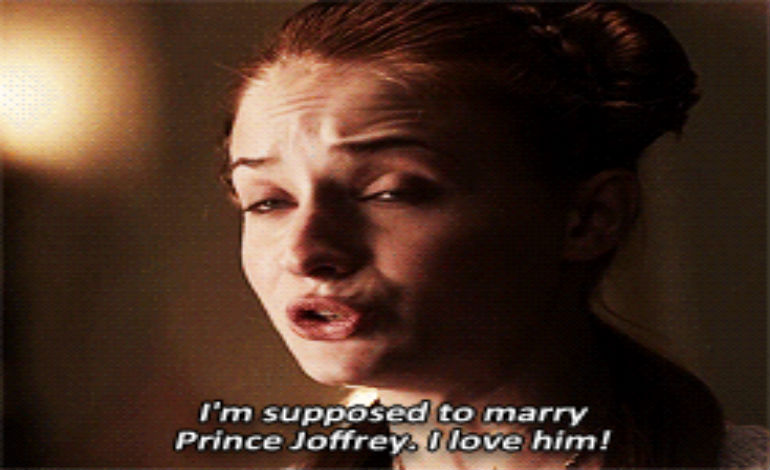
Sansa Loves Joffrey

I will admit that when I first read A Song of Ice and Fire, I didn’t particularly like Sansa. She came off as spoiled, arrogant, and downright ignorant and selfish. But then I looked at where she came from. In fact, I looked at where she and other women came from. If you watch the television show or, more specifically, read the books you begin realize that while Westeros seems to be an awful place for anyone to live, it is particularly bad for women. You have this setting, this social structure from Westeros to Essos where rape seems to be a given act in the many wars that are constantly going on. And these are for the smallfolk women.

In Westeros, the women of the nobility or the various Houses seem to have a better existence. They are taught how to read and write. They are generally protected as they grow up and they have the guidance of various mentors and a good name to back them up. Of course, there is the patriarchy of the entire thing. When it all comes down, highborn women in Westeros marry whomever their fathers say they will marry. They are little more than dowries, breeders, and bargaining chips exchanged between the Houses in an arrangement that is otherwise part of the political bandying known as “the game of thrones.”

Now, some of these highborn women learn how to use the traditional feminine role to their advantage. They hold court and meet with their friends. They organize social settings, or they make themselves popular within these settings. Some begin to understand that power is not merely a sword or an army or even a drop of poison, but information and the right word whispered to the right or wrong ear. The point I’m trying to make here is that those women who understand how to use what is traditionally considered feminine in Westeros and are capable blending into that role, do so in order to survive and thrive in an environment that they can navigate or even subvert. This is, of course, not always the case. Arya Stark’s interests are more in line with the smallfolk, the commoners of Westeros, and martial considerations whereas Brienne of Tarth doesn’t have what many consider to be traditional “feminine traits” and prefers the straightforward and “masculine-gendered” idea of chivalry and battle prowess.

Sansa and Arya

And as Ross in her article states, audiences generally seem to consider these kinds of female characters as stronger and more heroic. However, heroism is a questionable word at best. Throughout our own history, and that of Westeros, heroism has been applied to people who have done morally questionable and even reprehensible acts. And sometimes heroism glorifies a certain kind of suffering or struggle that is, really, in the end all about survival. Someone can be in a terrible place and have to act a certain way in order to keep on living or maintain their sense of sanity because–in the end–they have no choice.

Sansa Stark, at this point in the television series, would not consider herself a hero and right now, she too and despite her adherence to a more conventional archetype of femininity, has no place in courtly intrigue. Right now, Sansa Stark is a child. Sansa is a girl who has been sheltered by her lord father in Winterfell and kept from seeing the worst of humanity. She doesn’t hate her servants and she even has a friend in the form of Jeyne Poole her father’s Steward’s daughter. But she has been raised with stories of courtly love, nobility and true knights. She is the girl that always wanted to meet her Prince Charming and ride off with him. Her instructors and her mother Catelyn in particular train her to be the “perfect young lady.” In fact, Sansa really has no idea about politics or the game of thrones and what is done to maintain power.

Sansa Holding On

She is a girl that takes her world for granted, and the illusions behind it even more so and when she gets to King’s Landing she has that veil slowly ripped off of her. Here is a girl whose childhood wolf pet Lady gets slaughtered because another wolf attacked Joffrey. Here is a girl who looks up to the beautiful Queen Cersei as something of a fairy-tale surrogate mother before she knows how dysfunctional and shallow and cruel she truly is. Here is a girl who finds her beloved prince and learns the hard way that not all princes are noble and kind.

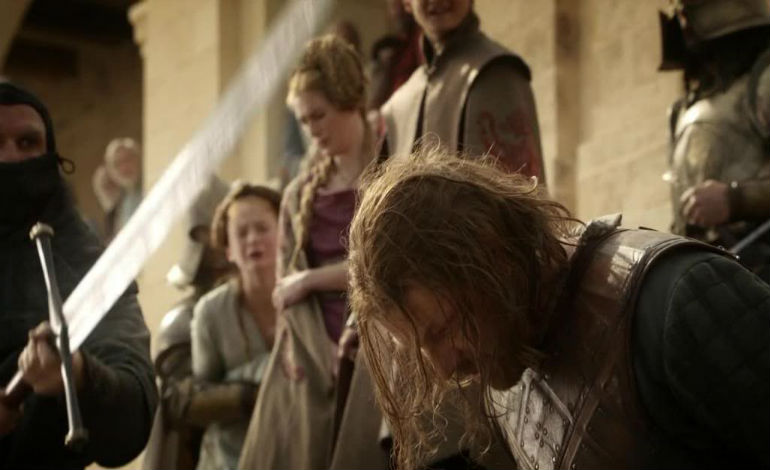
Sansa Watches Ned Die

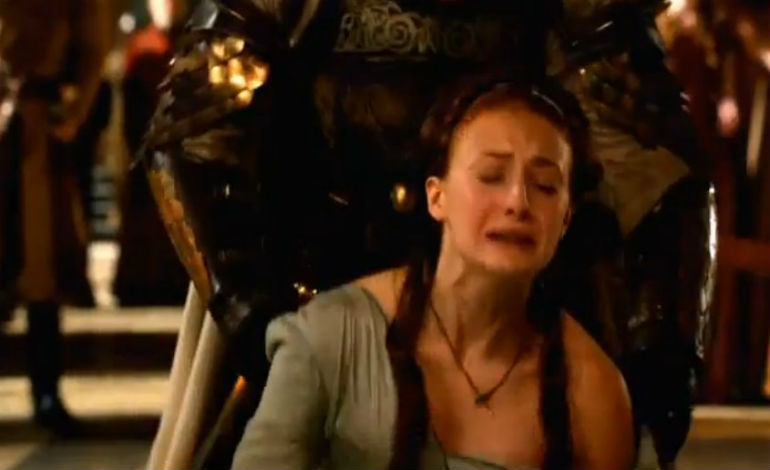
Here is a girl who is coerced into betraying her own father for political games she has no understanding of, who watches her father get executed, who has to look at his decapitated head and gets beaten by knights for the King–her former beloved’s–amusement.

Sansa Beaten

She is married into the House that ends up instigating the slaughter of most of her family and to a man she doesn’t love.

Here is a girl who likes tales of maidens and true knights and lemon cakes.

And Sansa gets used. And used again. And again. She ends up getting her first menstrual cycle, which her mother should have been there to talk her through, and has to share that with Cersei: all the while dreading that natural human function because of what it will mean for her value as a woman, as a breeder, in this situation. That one scene sticks out at me the most and if everything else wasn’t enough to make Sansa grow up in such a traumatic way, that symbolized it the best from my perspective.

Sansa and Cersei

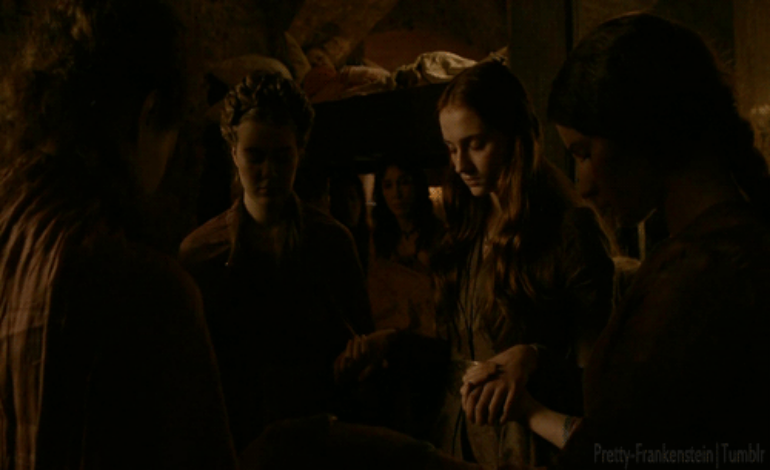
Even so, she still believes in those tales her mother and tutors used to tell her. But more than that, Sansa actually cannot stand to look at cruelty and even pleads for Ser Dontos’ life when he arrives drunk to one of Joffrey’s celebrations and when she tells Margaery Tyrell of Joffrey’s true nature. An even greater example of Sansa’s moral nobility is when, during Stannis Baratheon’s siege of King’s Landing and Cersei’s descent into despair, she actually leads the women hidden away in the castle in prayer:  keeping up morale and hope while their Queen essentially fails them and feels sorry for herself. The fact is, there is still that honour and decency that her father and House Stark instilled in her as well her own sense of compassion.

Sansa Morale

She is a girl who hasn’t been warped by bitterness and shallow displays of power like Cersei or her aunt Lysa Arryn, or blinded by the idea that political power will always benefit family first like her mother Catelyn (which was far more pronounced in the books where she wanted Lord Eddard Stark to go to King’s Landing as Hand), and she is definitely not as shrewd or as clever as Lady Olenna Tyrell but again, she found herself in this entire situation as a child. And now, for better or worse, Sansa is growing up: and she is learning. She is learning the rules of how to survive in her suddenly very cruel world.

I won’t say very much more about Sansa’s journey, but I will tell you this much. She may not be a warrior like Brienne, or a rebel like Arya, or even the fierce woman that Daenerys Targaryen forced herself to be by necessity but Sansa has many strengths that already exist inside her: great intelligence, a growing knowledge of the court and its rules, as well as compassion. I suspect she might become more ruthless in some ways, but never callow or vain or arbitrarily cruel. She won’t be as direct in her lessons of power, but she will do what she has to and, if she can, maintain her integrity and capacity for empathy in doing so. And, more than this Sansa Stark has also demonstrated, through her morality, the ability to take charge and provide a deep sense of moral support, inspiration and hope: as some might think that a good queen should.

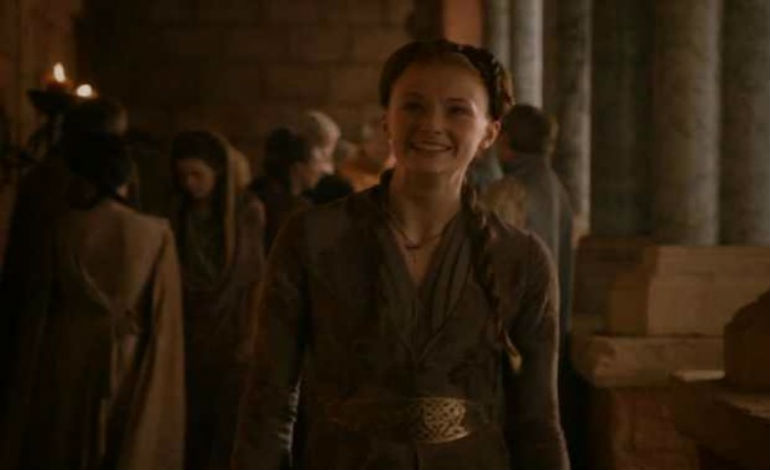
In the end, I don’t think that Sansa Stark is a hero, or a coward, or a weakling. I think that she has her own personality and will eventually find her way through the game of thrones. I think, by necessity, she will continue to be a strong female character: perhaps not the strongest, but definitely one of them.

Sansa Smiles

What If Comics Had Been a Place Without Codes? Would We Live as Air?

I’ve been having some technical issues these past few days and time hasn’t really been my friend but what I’m going to write here past most reasonable people’s sense of sleep is another down and dirty, and therefore ad hoc, article on comics.  So if anyone out there is an expert or has done their homework, by all means, please correct me if need be.

As some of you already know Sequart created and is now in the process of editing, a Kickstarter called She Makes Comics: a documentary on women in the comics industry and the culture surrounding it. One element in particular that it has focused on is the fact that long ago there were more female readers of comics than they were male. Now, I wrote a short article on what will soon be called GeekPron in which I found some of my own assumptions to the question, well, questioned.

I believed that it was the Comics Code Authority, inspired by the fear of McCarthyism “witch-hunting,” blacklisting, the detrimental testimonials by psychological experts such as Frederic Wertham, and a loss of business that had comics publishers eliminate most of their different genres of comics and focus mainly on watered-down stories about superheroes. All the horror, revenge, gore, westerns, romances, and sexuality all went the way of the dodo at the time because of fear. Anything that challenged the rules of the Comics Code, of authority always being right and just for starters, could not exist in mainstream corporations that published for money.

But the comic book editor Janelle Asselin also mentioned that this female readership of 55% over 45% of male readers changed as the superhero genre became more mainstream. Think about that: the idea that after a time the superhero not only reduced a female readership, but also eliminated or greatly marginalized a whole body of stories and genres that made the medium different. I realize now, looking back on what I wrote earlier, that these two statements are not necessarily mutually exclusive.

I mean, if you are afraid of losing your business and your liberty in telling stories for which you want a certain pay cheque and livelihood then eliminating anything that could be construed as an overt challenge to your culture’s status quo or even subversive to it, it unfortunately makes a horrible kind of sense.

The godfather of manga Tezuka Osamu once said that “Now we are living in the age of comics as air.” And while he was most likely referring to the influence of manga in Japan as becoming more widespread, its connotations can be applied to the comics medium in general. According to Paul Gravett, in Sixty Years of Japanese Comics, Tezuka believed that comics without passion or originality can become damaging and even create pollution. It took me a long time to figure out what this meant. When I first encountered the quote and the explanation, I thought that it referred to the potential damage to the morality of the reader but now I realize that the quote can definitely apply to comics as a medium and what occurred during the heyday of the Comics Code Authority.

The age-old notion of the superhero ghetto that we are so used to hearing about with regards to the comics medium: the notion of an immature all-boys club with shallow depictions of sexuality and simplistic violence with no consequences is damaging not only society’s concept of the medium but also that of its readers and future creators.

I’m not, by any means, saying that the comics that existed before the Code and its predecessors were the fonts of enlightenment for gender or, really, humankind. But there was a lot more experimentation before the Code and it just makes you wonder: what would have happened if these vigilantes and superhuman beings in tights had just remained one of many genres and there had been no Code?

I mean, there is always the scenario that Alan Moore presented in Watchmen: that if masked heroes and one a superhero had been in existence then no one would have paid attention to Wertham and the horror comics of Bill Gaines and friends would have dominated the medium from the fifties all the way into the eighties: becoming darker and more grotesque with time while also innovating itself much like our comics have done.

But that is just one creative interpretation. Who knows? Maybe a flat period of unoriginal and recycled stories would have followed regardless. Perhaps female readership demographics would have changed or something else would have challenged the “morals of comics:” for or against the status quo. Or we could have had another Golden Age: where comics became, earlier on, a widely accepted form of beautiful art and every great artist might have tried their hand at one. Maybe comics could have become widely accepted and mainstream coffee table or instructional as manga has in Japanese society to an almost ubiquitous degree. Instructional comics even had their place in North American society and to some extent they still do.

Of course, those latter thoughts are just me playing at utopia and I’ve never been really good at that. Maybe if there had been no Code comics would have, earlier, been just another form that challenged conventional morality much like any work of great art or literature should. Of course, again, this also happened in the Western world through the advent of what we understand as Underground Comix defying the establishment during about the late 60s: about that same time frame that Asselin gave when she talked about the female comics readership majority existed from the 1950s to the 1960s. Or perhaps the comics medium would have burned itself out as a fad and amateurs such as myself would be wondering, even then, what if: what if it had been different.

As for me, if you really want my honest opinion I will say this. I think that if there had been no Comics Code or anything like it children would have still been influenced by Tales from the Crypt, and Archie, and The Lone Ranger, The Green Hornet and all of those others. And some girls and women would have had Wonder Woman and Black Fury. Many things would have continued on, but sometimes I think about that idea of all people–young, old, straight, LGBTQ, male, and female, different ethnicities, different classes–making their own comics and showing them to their friends and the world. They would realize how different they and everyone else are but also how many things they have in common.

And when you wipe away my pseudo-utopia of a whole loss of potential for a readership of intensely intelligent men, women, and sentient beings, when it comes down to it I do like the idea that without the Code and the forces behind its development, the medium of comics would have been considered more than just silly laughter and transparently hidden BDSM parodies. Those things would have been a part of the kaleidoscope. I think that many more people might have seen comics as a medium that tells all kinds of stories: a space inside and outside of us that is pictures and words. I think many more people may have been more accepting that the medium of comics as that place of sheer variety, like film, between both art and literature.

There is another way to look at Tezuka’s quote about “comics as air.” If you take the pollution of censorship and unoriginality away, what you might ideally have is a fluid art-form that anyone can learn and use. And if you consider that we all live in the continuing Age of Information and in societies that utilize wireless Internet and you include webcomics into the medium … perhaps we can all fly where only superheroes used to tread: up, up, out of the ghetto and away.

Miracleman Balloons

Zing! Pow! The Batman and Green Hornet ’60s Crossover

Sometimes classic superhero comics are all about dynamic duos and, in this case, we have three pairs of them. Film-maker and writer Kevin Smith and comedian Ralph Garman along with the artists Ty Templeton and Alex Ross will be creating a Batman and Green Hornet ’60s crossover comic. Moreover, this Batman and Hornet ’60s crossover, entitled Batman ’66 Meets the Green Hornet, is going to be treated “like a missing ‘lost’ sequel to the 1967 Batman two-parter” that brought the two heroic duos together in the first place.

Even though both the 1960s Batman starring Adam West and The Green Hornet were shows that started well before I was born, I spent a lot of time at my grandparents’ place watching both of them: and particularly Batman. In fact, when I look back I can say I’m fairly certain that Adam West’s Batman was the first serialized exposure I had to the character before Tim Burton’s 1989 film and I was always fascinated by the strange campy assortment of villains and how I wanted to know who they all were in the comics: even though some of them were made for the show itself. I took it seriously when I was younger, but as I got older I became “serious” about it and thought the show had become irrelevant to more contemporary times. Really, Adam West’s Batman in particular is a lighthearted comedic parody of itself that isn’t afraid to make fun of itself while paying homage to its sources. And it has a powerful zany effect: so much so that sometimes I find myself saying something along the lines of a Boy Wonder-worthy “Gee Willikers Batman!”

I also only saw a few Green Hornet episodes but from what I have seen, particularly with regards to the Green Hornet and Kato climbing scenes, it made sense that they and Batman existed in the same universe. And though it has been a while, I might have even seen the crossover happen as well.

And let’s look at dynamic duos again. The thing about heroic duos is, in fact, the dynamics that play between them. Kevin Smith and Ralph Garman are the collaborating writers of this twelve issue comics series. Smith himself has written many Batman stories and inundated his films with thoughtful and zany geekery, and Ralph Garman is the host of The Joe Schmo Show, a voice actor on Family Guy and Smith’s co-host on the Hollywood Babble-On podcast.  And then there are the artists to consider as well. Alex Ross is well known for his high mythic art in Kingdom Come and he will be designing the covers for the Crossover series while the Canadian artist Ty Templeton, the creator of Stig’s Inferno and Bigg Time as well as The Batman Adventures, will be the comic’s central illustrator. I actually met Ty Templeton before in a seminar about writing and drawing comics back at the old Paradise Comicon. He and his wife Keiren Smith run the Comic Book Boot Camp in Toronto, while also helping to organize events such as the 12 and 24 Hour Comics Marathons.

So not only do I get the positive feel of visiting imaginary space from my own childhood and know of most of the players involved in its creation, but in writing this article I get to promote someone who is well known and loved in the local geek community of Toronto. There is just so much … fun in this collaboration and if Kevin Smith’s hopes come true, who knows: perhaps it will be adapted into a straight-to-DVD animated feature with Adam West taking a role as a voice actor. In doing so, it would almost be like a spiritual sequel or “second televised episode” of Batman meeting the Green Hornet. Knowing that this comes from a place where the creators finally get to play in the creative sandbox that shaped their youth is just plain full-circle and heartwarming.

You can read further on Batman ’66 Meets the Green Hornet on Brian Truitt’s USA Today article Batman, Green Hornet team for a ’60s crossover. Until then, see ya later. So long! Same Bat-time, same Bat-channel.

The King in Yellow Spreads the Sign

I just want to state, right off the bat, that I am a fan of H.P. Lovecraft. It took a very long time for Lovecraft and his Cthulhu mythos, specifically the idea that something ancient, eternal, and either uncaring or malevolent underlying our conception of space and time, to come to some kind of mainstream appearance in geek culture. It was on my quest to read everything eldritch and gibbous by the man who was Providence and spurred on even further by Alan Moore’s The Courtyard and Neonomicon comics when I came across something called “the yellow sign.”

I followed this up online and found a book called The King in Yellow. The book contains a series of short stories published in 1895 written by Robert W. Chambers: a writer of many genres but especially romance, decadent literature and, in particular, horror. In four of The King in Yellow‘s stories, “The Repairer of Reputations,” “The Mask,” “In the Court of the Dragon,” and “The Yellow Sign” as well as some mention in “The Prophets’ Paradise” we are introduced to the idea of a play in a book that drives people insane, a malevolent entity known as The Yellow King that is a part of the play or summoned by it, and “the yellow sign”: last of which is a symbol associated with the King that can manipulate or distort the minds of those who see it.

They were some fascinating tales, by favourite being “The Repairer of Reputations” but aside from taking some notes on them, I thought that they would remain some fascinating but otherwise obscure stories even though it has a specific following and Lovecraft himself read them and alluded to their content in his story “The Whisperer in Darkness.” But I thought that would be the last I ever saw of them.

So how does this book from 1895 have any bearing on geek culture right now?

The answer is possibly a lot. Very recently I watched a recent video interview with the author and editor Joseph S. Pulver Sr.: who is an expert on the mythos of The King in Yellow. I knew that he would say some very interesting things on the stories, but what I didn’t know then until he and the interviewer, The Arkham Digest’s Justin Steele, mentioned it was that there is a recent television program that draws heavily from The King in Yellow. Please don’t click on the video unless you want spoilers from True Detective.

I’ve had a friend or two suggest that I watch True Detective and I just thought it was another generic police show or a derivative of Criminal Minds until this little nugget was revealed to me. Two detectives undertake a seventeen year old hunt for a serial killer named The Yellow King:  a quest that seemed to have come to its conclusion this past weekend. Steele and Pulver seem really enthusiastic about The King in Yellow becoming more mainstream as a result of this plot development in True Detective. Indeed, for years Pulver himself has been instrumental in gathering The King in Yellow‘s stories for Chaosium anthologies and then even editing and encouraging writers to create stories in Chambers’ particular universe. Pulver takes great pains to point out that despite August Derleth’s attempts to make The King in Yellow a part of the Lovecraftian or Cthulhu mythos that these stories exist in their own continuity and outside of Lovecraft.

In addition, Pulver himself is in the process of gathering further King in Yellow stories from new writers: particularly female horror writers. It is quite fitting in a way. After all, unlike Lovecraft whom the mythos of The Yellow King is often attributed, Chambers was definitely not afraid of writing female characters into his stories that weren’t monsters, one-dimensional throwaway characters, or that just pretty much exist at all.

Justin Steele’s interview with Joseph S. Pulver Sr. is very fascinating and I would definitely recommend watching the above video if you are at all interested in the origins of The King in Yellow as well as reading Pulver’s article on the subject at The Lovecraft eZine. Also, please check out True Detective: Season One is now over and there are only eight episodes in the series, so it shouldn’t take you long to get through them. Finally, I should point out that you can read The King in Yellow for free online.

As an added bonus, it seems that H.P. Lovecraft himself and a Southern doppelganger, reanimated for YoutTube by Leeman Kessler, have their own opinions about both True Detective and The King in Yellow.

In any case, you will find that the mythos of The King in Yellow is a very mysterious thing of poetic fragments and goose bumps not unlike its yellow sign. This is just as well: as that sign, whatever its shape or purpose, makes minds receptive to madness.

See you in Carcosa.


You Never Know: Resurrecting a Phoenix and Moving On

I’ve been writing a lot on here lately again. There is so much else that I am needing to do, but now I just want to spend some time and really get contemplative on something.

I still find it really amazing just which of my articles garner the most attention. When I first wrote my When I Recognized Elfquest article, I had no idea that so many people would find it fascinating or even relate to it: never mind having the Pinis Favourite, Retweet, and Share it throughout the Elfquest community. The fact is, you can never predict these things. I wrote that article back in 2011 and it sat on my Facebook without input of any kind until I realized, after my hiatus, that it was time and I brought it here–with some revisions–to where it rightfully belongs. I actually have another Elfquest personal story in me. I’m not sure when or where I’ll post it but hopefully I will share it one day.

And then there is my Sequart article On the Art and Cycle of Proper Suffering: The Artist Figure in Phoenix: Karma. That article has its own personal story as well and, as I sit here late at night, I consider the place from where it came. It was originally a paper for a class in my Master’s Program. It was conceived and written in the 2008-2009 period when York University was on strike and, as such, many deadlines and time tables were severely messed up. We ended up having to do Fall term papers during the beginning of our Winter term. It was not a pleasant situation.

Nevertheless, I liked my class and I decided that I wanted to write a paper on Tezuka Osamu’s Phoenix: Karma: as I consider myself an artist, who sometimes emotionally suffers and, as such, finds sympathy with that work. I had a lot of challenges to face when writing that paper. Between continuing to live on my own at the time, and juggling my other assignments and relationships in addition to the readjustment of the school year I found that I had to ask for a few extensions on the paper.

It was towards the end of summer, or what I termed at the time the Summer of Hell when everything seemed to be falling apart, that I finally emailed the final draft to my professor. There were a lot of things wrong with my paper back then. I barely grammar-checked it, never mind read through it, and it was barely twenty of the twenty-five pages that it was supposed to be. But I reached a point where, quite honestly, I just didn’t give a damn any more. It had been hovering over my head for so long and I just wanted it done so I could finish the last of the original term’s work and move on.

After going to a much needed vacation at Dragon Con in Atlanta, I came back to find that my professor marked my paper and left it for me. I remember telling myself to prepare for the worst. Despite that, it was both a surprise and a slap in the face. The comments that my professor left on my paper amounted to the following: that I hadn’t done the work I was supposed to have and that this was not Graduate school material. He ended up giving me a B- which, I have to admit, was pretty damn generous of him.

And suddenly, the reality hit me and I felt a great deal of shame. Here was this excellent comic that I read in the remaining years of my Undergrad, while I vowed to write a modest paper on and which I rushed when I just couldn’t take it any more. I didn’t understand my professor’s instructions, despite asking him a few times and it frustrated me. I was also, before all of this, a good student and to see those words in front of me, that what I made wasn’t Grad School material, honestly made me angry. It made me so angry after everything I’d gone through that I wanted to quit my Program.

Of course, this was all ego talking and most of the suffering I went through had nothing to do with academics and more to do with the choices I made in my personal life. In the end, it was too much and I just took the paper, put it in my desk drawer, placed it under a pile of other papers and tried to forget about it and the lingering shame of failure.

Fast forward a few years. I was living with my girlfriend and we talked about the paper. She gave me a bit of a reality check and told me what I already knew: that my professor had been damned generous. So I called up a digital copy of my paper and read it. I actually read it. I looked at all the grammatical errors, the bad sentence continuity, the lack of flow between ideas, and even some outright preventable errors. And when I mean preventable, I mean I made spelling errors. I even misspelled one character’s name.

It did not sit well with me.

So I spell and grammar-checked that son of a bitch. I made more transitional sentences. I made the word flow a whole lot less awkward and painful to look at. I didn’t know why I was doing it. I finished the assignment years ago. There was no point. Maybe I planned on publishing a better version. I do know I was toying with doing more research and going beyond the narrow limits of books that my University had available on this subject at the time. But then life happened and I forgot about it again.

A year or so later, Julian Darius saw my comments and my work on Mythic Bios and asked me to join Sequart. At one point, another year later, we were informed of it being Manga Week: that we had something of a call to papers or articles to do with manga, its creators, and culture.

That was when I realized something. My professor was right. Maybe “Proper Suffering” wasn`t Grad School material.

But it is Sequart material.

There were some difficulties of course. I’d evolved a different style of writing thanks to Mythic Bios: a combination of the formal and the profane as I like to say. Even my article on The Stitching Together of a Mythos: Kris Straub’s Broodhollow, for all of its relatively extensive footnoting, still had the informal aspect of contractions and some personality on my part. In the case of “Proper Suffering,” my idea was first to re-adapt my old paper into an article that specifically focused on the manga of Phoenix: Karma itself and then get rid of the internal citation and the formal arrangement of language in the paper. But first, I eliminated the extra material on Japanese modernity in the paper. I narrowed and focused it solely on the manga. I added more to the title of the thing. And then I remembered something another professor said to me about my work with comics at York. She told me that I needed graphic examples to complement my written work as that was the medium I had chosen to examine.

So I looked for scans of Phoenix: Karma panels on the Internet. I did not find much. I tried to scan my own copy professionally but it didn’t work and it would been too expensive: especially for bad copies. I did work on Neil Gaiman’s The Sandman Overture #1 in the meantime and forgot about it until I was asked to contribute another article. So that was when I decided to bite the bullet, place the graphics in that I could get, create transitional sentences between parts because, at this point, I realized “Proper Suffering” was at least three serialized parts in Sequart format. I even added in an extra part examining the kleptomaniac Buchi, whom I didn’t have the time or the energy to look at before, though she was important in the artist Akanemaru’s future decisions.

Then, finally, I sent it in.

And there it is. It still isn’t perfect. Sometimes I wish I added a bit more about how the artifice in the ancient Japanese city of Nara in Phoenix: Karma was representative of the Hindu and Buddhist concept of maya: that all of reality is an illusion of sensory addiction and suffering and how Nature leads to a truer state of non-being beyond ego: or nirvana if you’d like. I feel as though some of the graphics are not quite positioned in flow with the words of my article and then there is the occasional awkward sentence. I thought very few, if any people, would want to see something so painfully, bluntly, academic. It was a relic from another time in my life and I had reinvented myself in many ways much like Tezuka’s emblematic fire-bird.

But then I noticed something. People were retweeting my article in all its three parts. Not just Sequart and my peers there, but other places and people like Brigid Alverson and Tezuka in English. I mean, I was told by Julian that there were few scholastic English sources that focused on manga in depth, but I didn’t believe him. I thought what I made was mediocre at best or at least serviceable. I still think that to some extent.

Yet having “On the Art and Cycle of Proper Suffering” acknowledged really vindicated something for me. It’s one of the few things that from that point in my life that I could go back and give another chance. It was the only thing I could fix. And I did fix it. I resurrected that work like the namesake of the book that I examined and made it better. I suppose, in the end, in doing so I didn’t just make a good and reasonable article but in so doing I also redeemed a perceived failure and honoured a part of my life: with something to show for it in the end.

Perhaps that is one of the real lessons that Tezuka’s characters should have taken when hunting for the legendary phoenix. Like the ancient Sumerian hero Gilgamesh realizing that a mortal life of accomplishment is far better than one of perceived eternity and perfection, I realize it was the process of searching for the phoenix and that even though the pain was a part of it, it was only part of a totality.

So yes, sometimes you just don’t know which of your articles or writings people will like, or become relatable. Sometimes you just have to keep moving on.

Tezuka's Phoenix v4 p108

When I Recognized Elfquest

It took a long time for me to discover the World of Two Moons.

Back in High School, my Mom started me reading Piers Anthony’s Xanth series. It was a fantasy series with a world of magic and puns and where practically everyone had a magical Talent of some kind. At one point in the series, Piers Anthony got a letter from a mother whose twelve year old daughter Jenny was in the hospital paralysed from being hit by a drunk driver. She was very fond of the world of Two Moons: with the Wolfrider Elves and their wolf mounts: so much so, that Anthony actually created a character from that world named Jenny Elf and transported her to the world of Xanth. This was the first time I’d heard of this place, and for the longest point it was almost the last time.

This was until about a year or so before I started working. I was finishing off my Undergrad at York and I came back to the world of comics with extreme prejudice. I came to Cyber City Comix near Bathurst and Clarke where I found the DC Archives volumes of The Spirit and a strange series called Elfquest. Elfquest looked particularly strange and vintage: from the covers alone they looked like 70s adult versions of my childhood fantasy cartoons mixed with Tolkien on a beautiful manga binge for good measure. They were colourful and compelling and beautiful and also very expensive.

Little did I know that Elfquest and the World of Two Moons were one and the same, or that they would be relevant to me. I did, however, have the nagging suspicion that we’d meet again at some point. But it was not at that time. Not yet.

A lot more things happened with me. I finally moved out and got into Grad School when I discovered the black and white versions of the books at the Seneca Library at York. I was just going to read them there, but I didn’t for some reason. I kept putting it off …

A few months later, I found out that Labyrinth Comics were having a comics sale in Seneca. I planned to stop by the place after I picked up my OSAP grant and loan. Unfortunately for me, that particular day I found out that the Faculty of Graduate Studies had changed my status to part-time without my knowledge and as such withheld my loans from me: just as they had before because my previous government ID expired. I was in at a very low point at this time when I came back from the Student Financial Building to Seneca, not expecting to find anything, not really expecting to be happy for a very long time …

And then I found it. I found the first Elfquest Archives volume for $30. I put down a copy of Mark Millar’s 1985 and decided to buy this. I didn’t quite know what to expect at this point but I was glad to begin with the first volume.

Then I read it.

Somehow, something in me knew that I would relate to some aspects of this series. And that something, somehow in me was right. The DC Archives edition of Elfquest were coloured and vibrant in precisely the way that its creator Wendy Pini planned it along with her husband Richard. Her paneling is not unlike Will Eisner’s comics work in The Spirit and is varied and far beyond the traditional boundaries of squares and rectangles: bringing you closer into the world she made.

I was treated to a world that had been in existence since the late 1970s: that strange, weird and somehow marvelous place that made other things like Star Wars and Wizards.  The premise was that ages ago a floating castle containing a race of Elves crashed onto a world populated by primitive and superstitious humans. These beings drove them out of their fallen castle and their descendants had to adapt to and survive in their new environment.

One of their descendants are the Wolfriders: short, powerful Elves (not unlike a friend of mine’s drawings of other beings in our shared world) that are linked to and ride on wolves as hunters and warriors in their forest. Wendy Pini’s drawing style was this vintage hybrid of manga and North American comics illustration that just really somehow managed to touch that 80s childhood part of my heart. But what was more was in addition to magic and a really varied world, she also touched upon new elements that I was also dealing with in my life these days as well. She touched upon these in a way so poignant that tears almost came to my eyes. Suffice to say, after starting to read this series in colour, I could not in good conscience go back.

I wouldn’t do justice to Elfquest by simply summarizing it or trying to explain what the Wolfriders and their Tribe are like. They have close bonds with their Wolves, who they hunt with, and each other. Especially each other. If there is a positive archetype or ideal for the concept of “Tribe,” they would be it. In many ways, they are like humans, though not necessarily like the barbarian humans we initially see in their world, but in others they really aren’t. They are savage, and merciless but at the same time fiercely loyal, sensitive, and honourable. And they are so incredibly close with each other. I am very glad that the people at DC at that time decided to include the comic strip that others before them would have rejected in the first Volume of the Archives. And Wendy Pini was not afraid to talk about just how different Elf relationships could be: reminding the reader that for all we can relate to them and some of their ways, the Elves of Two Moons are definitely not human.

It’s sad sometimes to realize that Sending doesn’t exist in humankind, just as it is humbling to realize that Recognition as a visceral feeling of affinity with another being is weaker in us though when it’s not, it’s really not. Even so, the Elves get into conflict and this spans a great deal of a world. A world I really wanted to follow.

Unfortunately, a while ago I learned an unfortunate fact about the Elfquest Archives. The first was that they were out of print. And second was that while I could buy Volumes 3 and 4 for $30 as well, Volume 2 somehow has become especially rare. I have seen some of these copies go for over a hundred if not two hundred dollars or more. This is money that not even the creators get, but only the comics store owners. It was very disappointing and infuriating: especially since I remembered being in Cyber Comix and realizing that they were all there and I could have bought them all at that time.

But the good news is that the Pinis have taken all their Elfquest comics and put them on their website for free. That’s right. All the Elfquest run to date is online for free. You just have to look it up online and it’s right there. Granted, I know I would have liked my own complete book copies and it saddens me to know I probably never will, but you know: I’m just glad I found them at all. I have even started reading beyond what the DC Archive books contained. Coincidentally, I find that out of all the Elf characters, I relate the most to Cutter’s fierce heart, Rayek’s brooding ambitions, and Skywise’s sense of curiosity and understanding.

Personally, though, I can see myself as the leader of a group of Gliders that left the Blue Mountain in the early days before Voll fully settled and sought to reclaim magic for ourselves, and continue to evolve as opposed to languishing in stagnation. I always liked the idea of having a bird mount, even though I am not adverse to wolves on a spiritual level.

It’s funny how you find something when it is time and when you Recognize its significance in your own life.